
Wash a car in a Provo driveway on a July afternoon and watch it dry. What is left behind is a constellation of white spots that were not there when you rinsed it, and that is your introduction to the single most consistent complaint about living in Utah Valley.
The water here is hard. Not borderline, not seasonally — reliably, structurally hard, for a geological reason that is not going to change.
Most local guidance treats this as a purchasing decision about softeners. It is worth understanding first, because the decision looks different once you know what hardness actually is, what it does and does not harm, and which of the annoyances are cheaply fixable without buying anything.
The short version
The water is hard because of where it comes from — limestone mountains.
It is not a health problem. It is an equipment and fabric problem.
A softener is usually worth it if you own and is not your call if you rent.
Renters can fix most of the daily irritation with vinegar, a squeegee and rinse aid.
Why the water here is hard
Hardness is dissolved calcium and magnesium, and water acquires it by moving through rock that contains it.
Utah Valley's water starts as snow and rain on the Wasatch, then travels through limestone and dolomite — carbonate rock, exactly the sort that dissolves into water most readily. By the time it reaches a well, a spring or a reservoir, it is carrying a substantial mineral load.
Our explainer on where Provo's water comes from covers the springs, wells and river rights behind that journey. This is why the hardness is not a treatment failure or a utility's oversight. There is nothing wrong with the water. It is doing what water does when it runs over that particular geology, and every community along the Wasatch Front deals with the same thing.
The corollary is that no amount of complaining to a city will change it. Utilities treat water for safety, not for hardness, because hardness is not a safety issue.
What the numbers mean
Hardness is expressed either in grains per gallon or in milligrams per liter, and the two are easy to confuse. One grain per gallon is roughly 17.1 milligrams per liter.
The conventional bands:
- Soft: under about 1 grain per gallon
- Slightly hard: roughly 1 to 3.5
- Moderately hard: roughly 3.5 to 7
- Hard: roughly 7 to 10.5
- Very hard: above about 10.5
Utah Valley systems commonly report figures in the hard to very hard range, which is the practical explanation for why the effects are so visible here compared with, say, the Pacific Northwest.
Get your own number rather than trusting a general figure. Every public water system in the United States is required to publish an annual consumer confidence report — sometimes called a water quality report — and it is where your provider's actual hardness figure lives, along with everything else in the water. Utah Valley is served by several different systems, and a figure from one city does not necessarily describe another.
If your house is on a private well, the report does not exist and a laboratory test is the only way to know.
What hard water is not
It is not a health hazard. Calcium and magnesium are dietary minerals. There is no drinking water standard for hardness in the way there is for lead or nitrate, because hardness is classified as an aesthetic and nuisance characteristic rather than a health-based one. Some research has examined whether harder water is mildly protective for cardiovascular health; nothing suggests it is harmful.
It is not why your water tastes like anything. Taste complaints usually trace to chlorine or to something in the plumbing, not to hardness.
It is not the cause of dry skin, exactly. What dries skin is soap residue, which hard water makes harder to rinse away completely. The distinction matters because the fix is different: a softener helps, but so does using less soap.
It is not a reason to distrust your tap water. Utah Valley tap water is regulated, tested and reported. If you want to know what else is in it, the same annual report answers that.
What it actually costs you
The damage is real, but it is slow and invisible, which is why people underestimate it.
Water heaters. This is the expensive one. Heating hard water precipitates the dissolved minerals out of solution, and they settle as scale on the tank bottom or on the heating element. Scale insulates — the burner or element has to work through a mineral layer to heat the water above it, so efficiency drops and the unit runs longer for the same result. Over years this shortens the life of a heater meaningfully.
Anything else that heats water. Dishwashers, washing machines, humidifiers, coffee makers, kettles, tankless heaters. Tankless units are particularly sensitive, because their heat exchangers have narrow passages and scale accumulates where flow is highest.
Fixtures. Showerheads and faucet aerators clog with mineral deposits, which is the actual cause of most "low water pressure" complaints in this valley.
Soap and detergent. Hardness minerals react with soap instead of lathering it, which is why you use more shampoo, more dish soap and more laundry detergent here than you did somewhere soft. That is a recurring cost most people never attribute to the water.
Laundry. Fabrics wash stiffer and colors dull faster, because mineral residue stays in the fibers.
Glass and tile. The film on shower doors and the spots on drinking glasses. Cosmetic, endless, and the thing people actually complain about.
Our HVAC and home systems guide covers the water heater side in more detail, and the car wash guide covers why every express tunnel in the valley advertises a spot-free rinse.
How a softener works
Understanding the mechanism explains most of the maintenance and all of the tradeoffs.
A conventional softener runs your water through a tank of resin beads carrying sodium ions. Calcium and magnesium have a stronger affinity for the resin than sodium does, so as water passes through, the hardness minerals stick to the beads and sodium ions are released into the water. The minerals are genuinely removed and swapped for a small amount of sodium.
The resin eventually saturates. The unit then runs a regeneration cycle: it draws concentrated brine from the salt tank, flushes the accumulated calcium and magnesium down the drain, recharges the resin with sodium, and rinses.
That cycle explains everything you will deal with as an owner. You add salt periodically. The unit uses some water to regenerate. It needs a drain connection. And it needs to be sized to your household and your hardness, because a unit too small regenerates constantly and one too large sits idle between cycles.
Modern units regenerate on metered demand rather than a timer, which is more efficient and worth specifying.
Salt-free conditioners are a different product
This is the most common confusion in the category, and vendors do not always clarify it.
A salt-free water conditioner — usually template-assisted crystallization — does not remove anything. It converts dissolved hardness into microscopic crystals that are far less inclined to adhere to pipe walls and heating elements.
What that gets you: meaningfully less scale in plumbing, water heaters and tankless units. That is a genuine benefit and it is not nothing.
What it does not get you: slippery-feeling water, better lather, softer laundry, or spot-free glassware. The minerals are still in the water, so anything caused by their presence rather than their adhesion is unchanged.
Conditioners need no salt, no drain and no regeneration water, which makes them attractive where a drain connection is hard or where discharge is restricted. Just buy one knowing what it is.
The sodium question
Softened water contains more sodium than it did, and the amount scales with how hard the incoming water was — harder water means more exchange and therefore more sodium.
For most households this is small relative to dietary sodium. It becomes worth attention when someone is on a medically restricted sodium diet, and there are three standard answers:
Use potassium chloride in the softener instead of sodium chloride. It works the same way and costs more.
Leave the kitchen cold tap unsoftened, so drinking and cooking water bypasses the system. This is a plumbing decision made at installation and is much easier to specify then than to retrofit.
Add reverse osmosis at the kitchen sink for drinking and cooking. Many Utah Valley installations do this by default, and it addresses far more than sodium.
Do not soften everything
Two lines should generally stay hard, and installers do not always ask.
Outdoor spigots and irrigation. Plants do not benefit, and softening landscape water in a valley where summer irrigation is the largest household water use wastes salt, water and money on a large scale.
Sometimes an outside hose bib used for car washing — though note that hard water is precisely what spots a car, so this one cuts both ways depending on whether you dry the car by hand.
Given how much of a Utah Valley water bill is landscape irrigation, keeping that line off the softener is one of the easier good decisions. Our waterwise landscaping guide covers the broader irrigation picture.
Scale in the places you never look
Two spots cause disproportionate trouble and neither is on anyone's maintenance list.
The dishwasher's spray arms. Those holes are small by design, and mineral deposits narrow them steadily until the arms spray weakly and unevenly. The symptom presents as a dishwasher that has stopped cleaning properly — dishes on the top rack coming out dirty, cloudiness that no detergent fixes — and the usual response is to buy a new dishwasher. Pull the arms off, hold them up to a light, and soak them in vinegar. A great many perfectly good machines have been replaced over a clogged spray arm.
The washing machine's inlet screens. Where the hoses connect, there are small mesh filters. They clog with scale and sediment, the machine fills slowly, and eventually a cycle that used to take fifty minutes takes ninety. Shut off the valves, disconnect the hoses, and clean the screens. It takes ten minutes and restores fill rate completely.
Both of these appear as appliance failure and are neither. In a valley with water this hard, check them before calling anyone.
The third place scale accumulates is one nobody thinks of as plumbing at all: window glass. Sprinkler overspray puts culinary water on the same panes several times a week all summer, and left long enough those deposits etch the glass permanently. Our guide to window cleaning in Utah Valley covers why that damage becomes irreversible and what to do about the sprinkler heads causing it.
The ice maker, the humidifier and the fish tank
Three edge cases that come up constantly here.
Ice makers produce cloudy, fast-melting ice from hard water and their small water lines are prone to scaling. A refrigerator filter helps with taste and particulates but does not remove hardness; if clear ice matters to you, the water needs to be softened or run through reverse osmosis upstream.
Whole-house humidifiers, which many Utah Valley homes run through the winter because the air is so dry, scale up quickly on hard water and need their pads replaced more often than the manual assumes. A humidifier that has stopped keeping up is usually scaled rather than broken.
Aquariums are the reverse problem: hard, alkaline water suits some species and is hostile to others. Do not soften water for a tank with a household softener — the sodium is the wrong solution. Reverse osmosis water remineralized to the species' requirement is the standard approach, and any local aquarium shop will have opinions about Utah Valley tap water specifically.
What renters should do instead
If you rent, a whole-house softener is neither your decision nor your investment. Almost all of the daily irritation is still addressable, cheaply, without touching the plumbing.
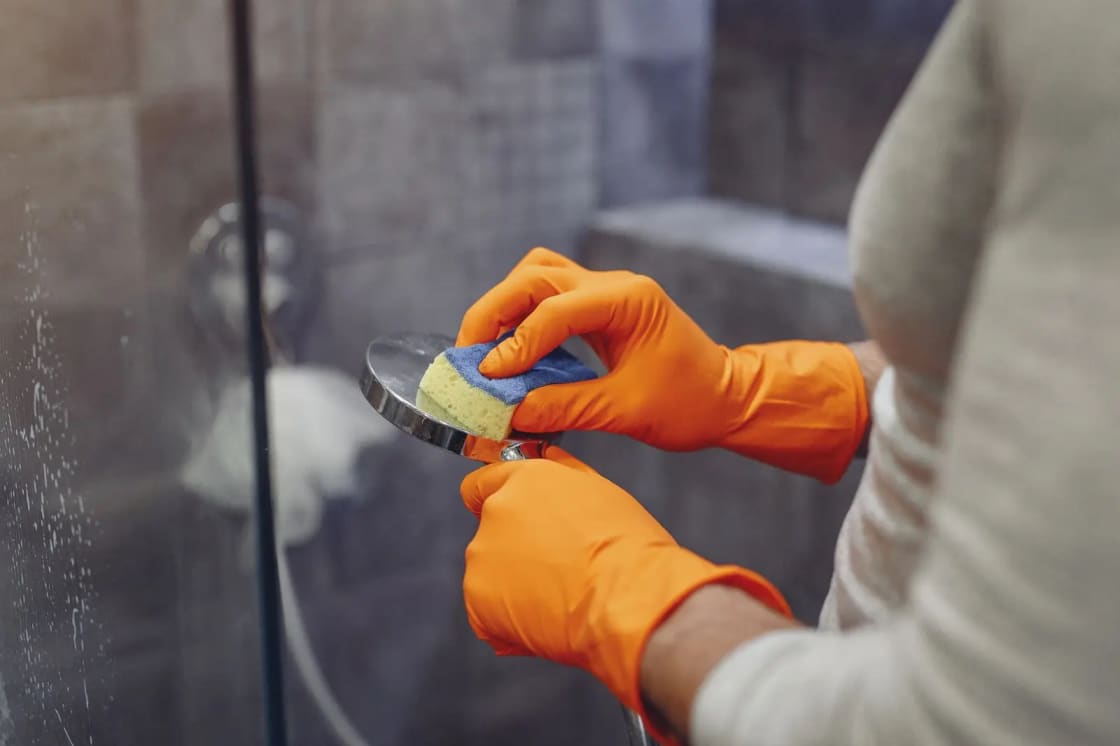
Soak the showerhead. Fill a bag with white vinegar, rubber-band it over the head so the face is submerged, leave it overnight, then run hot water. Do the same with faucet aerators, which unscrew by hand. This restores flow that most people have already written off as bad water pressure.
Buy a squeegee. Twenty seconds on the glass after a shower prevents the film entirely. Nothing else works nearly as well, and no cleaning product beats not letting it form.
Use rinse aid in the dishwasher, always, and run a citric acid dishwasher cleaner through it monthly. Rinse aid works by breaking surface tension so water sheets off rather than beading and drying into spots.
Use slightly more detergent than the label suggests, or buy one formulated for hard water. Label doses assume moderate hardness.
Descale the kettle and coffee maker with vinegar or citric acid periodically. The scale that accumulates inside them is the same scale forming in the water heater.
Skip the shower filter if what you want is soft water. They can improve how water feels and reduce chlorine, but they do not remove hardness and are frequently sold as though they do.
What owners should do first
Before buying anything, do the free things.
Find your hardness number from the consumer confidence report. Any installer's recommendation should be based on that figure and your household size, and one that is not is guessing.
Flush the water heater. Sediment and scale accumulate at the bottom of the tank, and an annual flush is a genuinely useful maintenance task that most homeowners never perform. If yours has never been flushed and is more than a few years old, read up first — a heavily scaled tank can behave unexpectedly.
Then price a softener, and get more than one quote. Installed cost varies widely with capacity, whether a drain and a loop already exist, and whether you want a reverse osmosis unit at the kitchen sink alongside it. Many Utah Valley homes built in recent decades were plumbed with a softener loop already in place, which makes installation dramatically cheaper — check the garage or utility room for a pair of capped stub-outs before assuming otherwise.
The buying-a-house version of this
If you are house-hunting here, hard water is worth two minutes of attention during a showing.
Look for a softener loop in the garage or mechanical room. Its presence lowers the cost of adding a system later by a large margin.
Look at the water heater's age and condition, and ask whether it has ever been flushed. In this valley a heater that has run a decade on unsoftened water without maintenance is closer to the end of its life than its age alone suggests.
Look at the fixtures. Heavy scale on faucets and showerheads throughout a house tells you about the maintenance culture of the previous owner more broadly, which is useful information about everything else you cannot see.
Our guide to buying a home in Provo covers the rest of the inspection picture.
The bottom line
The water in Utah Valley is hard because it comes off limestone, it will always be hard, and it is not hurting you.
It is quietly hurting your water heater, your dishwasher, your showerheads and your laundry, and it is costing you extra soap every week.
If you own, find your hardness figure, flush the heater, check for an existing softener loop, and price a system properly sized to that number. Leave the irrigation line unsoftened.
If you rent, buy a squeegee and a gallon of white vinegar. That is genuinely most of the benefit, for the price of lunch.
Related guides
- Heating, cooling and home systems in Utah Valley
- Car washes and detailing in Utah Valley
- Setting up utilities in Provo
- Waterwise landscaping in Utah Valley
- Buying a home in Provo
- Provo's Last Frost Is May 1. It's Also May 21. Both Numbers Are Right.
- Burning Anything in Utah Valley: Two Windows a Year, and a Number Called the Clearing Index
- Backyard Chickens in Provo: Six Hens, No Roosters, and a Lot Size That Decides Everything
- HOAs in Utah Valley: What You're Actually Signing Up For
- Building Permits in Provo: When You Need One and When You Don't
- Secondary Water and Water Shares in Utah Valley
Frequently Asked Questions
Does Provo have hard water?
Is hard water bad for you?
How hard is the water in Utah Valley?
Do I need a water softener in Provo?
What is the difference between a water softener and a salt-free conditioner?
Does softened water have too much sodium?
How do I get hard water stains off shower glass and faucets?
What can renters do about hard water?