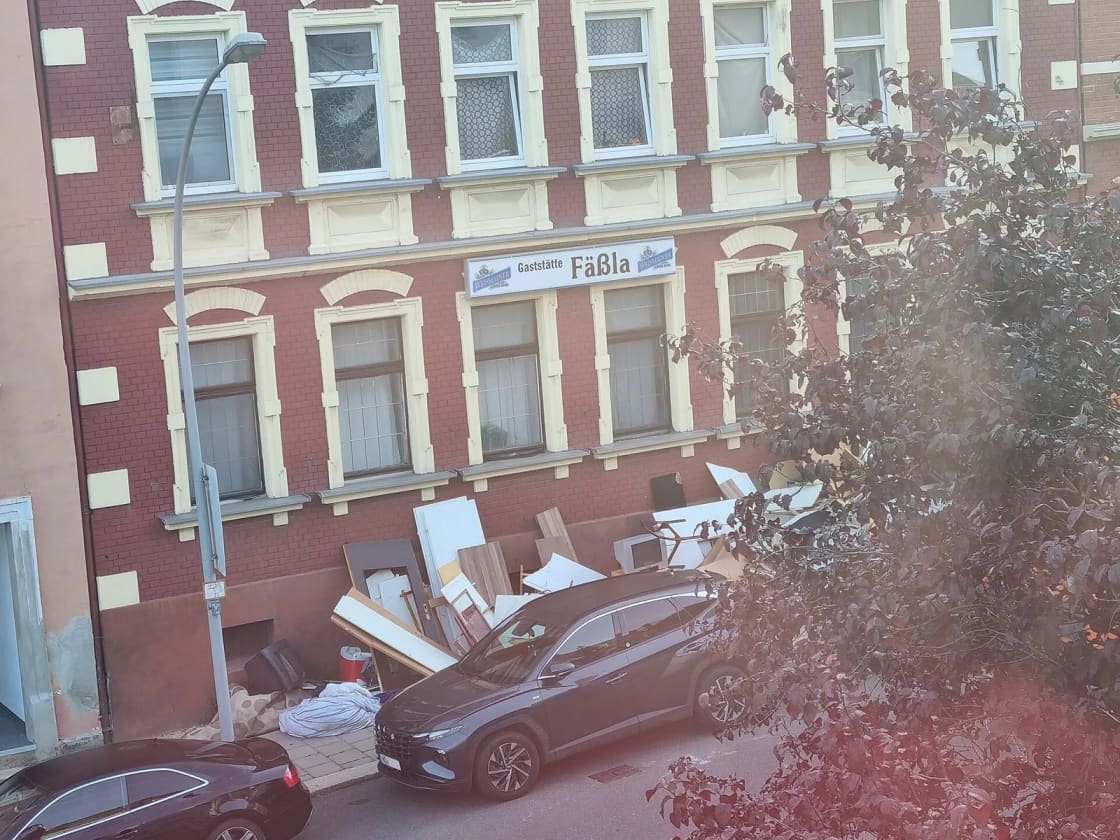

There is a category of object that defeats the ordinary machinery of household life. It is too big for the can, too intact to feel like garbage, too broken to sell, and too awkward to keep. A sleeper sofa. A tube television that weighs ninety pounds. Four partial cans of exterior stain. A refrigerator that has been running in the garage for eleven years and stopped last Tuesday.
Every household in Utah Valley accumulates a small stack of these, and the reason they sit for months is not laziness. It is that the correct answer is different for each one, spread across at least four separate systems, and nobody hands you the map.
Here is the map.
The four systems, and what belongs in each
Your city's curbside service handles what fits in the can. That is it. Provo's ninety-gallon container and its recycling counterpart are sized for weekly household volume, and the rules for what goes in them are their own subject.
The South Utah Valley Solid Waste District is where nearly everything else in the south end of the valley goes. It is a public district owned jointly by local municipalities, and it operates the facilities that take construction debris, bulk items, green waste, electronics and household hazardous waste. Provo City's own solid waste page routes residents there for electronics. In the north end of the valley, from Orem and Lindon up through Lehi, Saratoga Springs and Eagle Mountain, the equivalent is the North Pointe Solid Waste Special Service District and its transfer station in Lindon.
Utah County Health Department administers household hazardous waste collection at the county level and publishes the guidance on what is accepted free and what carries a fee.
Charity resale and reuse absorbs a substantial share of what would otherwise be bulk waste — furniture, appliances, building materials — and is the correct first destination for anything still functional.
The mistake almost everyone makes is treating these as a single "dump run." They are not, and the ordering matters: donate first, hazardous second (because it is often free and always has limits), bulk last.
Electronics: the household exemption is a real number
The reason you cannot put a television in the trash is regulatory rather than aesthetic. Electronic waste has the potential to be classified as hazardous waste, because of the lead, mercury, cadmium and other heavy metals in the components.
The South Utah Valley Solid Waste District handles this by operating under the EPA's household exemption — the provision that treats waste generated by households differently from the identical material generated by a business. Under that exemption the district accepts household quantities of e-waste.
The category is broader than most people assume. The district's own description covers older computer monitors and televisions, flat-screen monitors and televisions, computers, printers, DVD players, VCRs, cell phones, fax machines, stereos, microwaves, and electronic games.
Two consequences follow from the household cap. If you are clearing out a house and have eleven monitors, that is not a household quantity and you need to talk to the district before you arrive. And if you are a business — even a very small one operating out of a house — the household exemption is not yours to use, and you will be referred to a commercial electronics recycler.
One thing the district cannot do for you: wipe your data. Any device capable of storing information should be securely erased before it leaves your possession. Facilities across the region state plainly that they are not responsible for data on devices brought for disposal, and that is the correct assumption to make everywhere.
Household hazardous waste: free, but capped
This is the category people most often handle wrongly, usually by pouring something down a drain or setting it at the curb in a bag.
Utah County Health Department's guidance is that many common items can be dropped off for free: paint, oil, gasoline, pesticides and cleaners. Other items — including electronics, general trash and certain materials — may carry a disposal fee. The South Utah Valley Solid Waste District describes accepting paint, motor oil, antifreeze and other household hazardous waste from residents at no additional cost.
The limits are specific and they are enforced:
- No more than five gallons of any one chemical per day, unmixed.
Those caps come from the same household exemption that governs e-waste. Fifteen gallons of one product is not household waste in any regulatory sense, and arriving with it converts a free drop-off into a conversation about commercial disposal.
Two adjacent routes are worth knowing because they are easier than a trip to the district:
Medications go to police departments and most pharmacies, not to hazardous waste collection. Utah's Know Your Script program maintains a locator for drop-off sites, and several Utah Valley police departments host permanent boxes in their lobbies.
Used motor oil has its own statewide network. The Utah Used Oil Recycling Program maintains lists of collection sites, and a great many auto parts and service businesses accept used oil directly — often more conveniently than any municipal facility. The usual caveat is that oil-only means oil-only: antifreeze and batteries are separate streams even at a site that takes oil.
Bulk items: the fee structure matters more than the fee
Furniture, carpet, appliances, mattresses and general construction debris go to the district's facilities. The pricing has a shape worth understanding even though the specific numbers move.
Loads must be covered. The district charges an additional fee for uncovered loads and asks that everything be secured with straps or a tarp before arrival. This is not merely a facility policy — Utah Code Section 72-7-410 requires loads headed to a landfill or transfer station to be securely covered and sets a minimum fine for those that are not, and an unsecured load is how roadside litter happens.
Some items are "special handling." Mattresses and refrigerators fall in this category. The district's materials describe one mattress being included in the minimum dump fee with a per-unit surcharge for each additional mattress, and a per-unit surcharge for refrigerators. Refrigerant is the reason for the fridge surcharge, and it is also why setting a dead refrigerator at the curb is not an option anywhere in the valley.
We are deliberately not printing dollar figures. Transfer station fees are exactly the sort of number that changes between when a page is written and when it is read, and a stale figure is worse than none. The district publishes current fees on its own site, and checking before you load is a two-minute step that prevents an expensive surprise at the scale.
One address note: older sources describe a district facility in Springville, but the district now lists its new Dry Creek Transfer Station at 518 West 3450 North in Spanish Fork. Check the district's own site for current hours before driving.
Green waste and the seasonal calendar
Provo operates a compost yard, and its schedule is the detail that catches people out: full services March through November, with December through February open for recycling drop-off only.
That gap is not arbitrary — winter green waste volume is minimal and the composting process largely stops — but it means the December pile of Christmas tree, storm-broken branches and the last of the leaves has nowhere obvious to go.
Which is where the city's cleanups come in.
The spring and fall cleanups are the best deal in the valley
Provo City Solid Waste places dumpsters around the city for six weeks each spring and six weeks each fall. Both cleanups include a coupon for a free load to the transfer station. The fall cleanup additionally includes a coupon for leaf bags.
For a household with a genuine backlog — a garage clear-out, an estate, a renovation's leftovers — timing the effort to a cleanup window is the single largest cost reduction available, and it is free. The dumpsters handle the volume, and the free-load coupon handles the one item that will not fit in them.
The corollary is a planning point rather than a rule: if it is February and you are looking at a pile, and none of it is hazardous or urgent, waiting six weeks for the spring cleanup is frequently the rational choice.
Donation: the honest test
Utah Valley has an unusually dense network of charity resale operations, and a strong cultural habit of using them. That is a genuine asset and it is worth not abusing.
The test that works: would you buy this, in this condition, from a store floor?
If yes, donate it. Furniture, working appliances, clothing, housewares, books, tools and building materials all move well here, and the operations that resell them fund real programs with the proceeds.
If no, do not donate it. This is the part worth being direct about. A charity resale operation that receives a broken item pays to dispose of it — a cost that comes out of the same budget the resale was meant to fund. Leaving an unusable couch at a donation door after hours is not a donation. It is a disposal fee transferred to a charity, plus the labor of moving it twice.
The gray zone is furniture that is structurally fine and cosmetically tired. That generally does move, particularly in a valley with two large student populations turning over housing every August and a steady supply of first apartments to furnish. When in doubt, call ahead — most operations will tell you plainly whether they can take a specific item, and several will do a pickup for larger pieces.
For anything with real remaining value, the local secondhand market is active enough that a listing often clears a piece faster than a donation run, particularly in the weeks around the semester turnover.
August, and the valley's strangest waste season
Utah Valley has a waste cycle unlike almost anywhere else its size, and it happens in the last two weeks of August.
Two large student populations turn over their housing simultaneously. Tens of thousands of leases end and begin inside a fortnight. And the physical consequence is a volume of abandoned furniture, mattresses, mini-fridges, shelving and half-used cleaning supplies appearing at curbs and dumpster enclosures across central Provo and the Orem corridor, on a scale the ordinary system is not sized for.
Three practical notes for anyone caught in it.
If you are moving out: the material you leave beside a full dumpster does not disappear. It becomes the property manager's disposal cost, frequently deducted from a deposit, and in some cases a code matter for the property. A mattress left at a curb is a special-handling item somebody pays for. Plan the last load rather than the first — donation sites and the transfer station are both open in August, and both are cheaper than a deposit deduction.
If you are moving in: this is the best free furniture week of the year in Utah Valley, and it is worth being deliberate about. Curb-sourced upholstered furniture carries a real bed bug risk, which is not a theoretical concern in dense student housing; solid wood, metal shelving, desks and kitchen equipment carry essentially none. The distinction is upholstery and seams, not age or appearance.
If you live in one of these neighborhoods and are neither: the useful thing to know is that the surge is temporary and the enforcement posture during it is generally pragmatic. A pile that would draw a notice in February is being handled in a queue in late August.
Construction and renovation debris
One more category that behaves differently from everything above: the output of a remodel.
Construction debris goes to the district, not to your can, and it is priced by weight or volume as an ordinary load rather than treated as household waste. Two things catch homeowners out. Older homes carry material questions — Utah Valley's pre-1980 housing stock can contain asbestos and lead paint, and demolition debris from those homes is not simply debris. That is a testing question before the work starts, not a disposal question after it.
And a contractor's price may or may not include haul-away. It is worth confirming in writing which party is disposing of what, because a dumpster left on a driveway for three weeks after a job ends is a dispute that begins with an unread line in a bid.
When to hire someone instead
Private junk removal services operate throughout Utah Valley, and they are the right answer in a narrow but real set of circumstances: when you cannot lift the item, when you do not have a vehicle that can carry it, when the volume is a full house rather than a load, or when the labor of doing it yourself is worth more than the fee.
Three things to establish before booking. Ask where the material goes — a reputable operator will tell you which items are donated, recycled and landfilled, and one that cannot answer is worth passing on. Ask whether hazardous waste and electronics are included, because many services exclude both and you will be left holding exactly the items that were hardest to place. And confirm the pricing basis, which is typically by volume in the truck rather than by item.
For a standard household backlog with a working vehicle and a free Saturday, though, the sequence is straightforward and mostly free: donate what someone would buy, take the hazardous material and electronics to the district under the household caps, and put the rest in a cleanup dumpster in April.
Clearing an entire house is a different problem from clearing a garage
Everything above assumes you are disposing of things at roughly the rate a household produces them. Sooner or later a lot of people in this valley face the other version: a house that has to be emptied completely, usually on a deadline, usually after a death or a move into care, and usually by adult children who do not live here.
It is worth saying plainly that this is not the same task at a larger scale. It is a different task, and the assumptions that work for a garage clear-out actively mislead here.
The volume defeats the donation instinct. A lifetime of possessions is mostly not donatable, and that is not a judgment about the person. Thrift operations accept what they can resell, and their constraints are shelf space and staff time rather than sentiment. Upholstered furniture, older mattresses, large console furniture, incomplete sets and anything with a hint of damp are commonly declined. Planning around a fifty-fifty split between donation and disposal will produce a much more accurate schedule than planning to donate most of it.
The timeline is usually set by something other than the work. A rental handover, a closing date, or the end of a month of paid-for utilities is what fixes the deadline. Work backwards from that date, and put the bulky-item and hazardous-waste steps first, because those are the ones with fixed schedules and capped quantities that cannot be compressed by working harder on the last weekend.
The valuable things and the emotionally loaded things are rarely the same objects, and both get lost in a fast clear-out. Documents, photographs, military records, jewelry mixed into ordinary drawers, and anything with a serial number deserve a single labeled box that leaves the house on day one, before anybody starts making volume decisions in a hallway at nine in the evening.
Estate sale, auction, buyout, or skip. These are four different services with four different economics. An estate sale company takes a percentage and needs enough saleable inventory to justify staffing a weekend. An auctioneer wants specific categories. A buyout offers one number for everything and removes it, which is often the right answer when the deadline is real and the alternative is four more trips from out of state. A haul-away service is the last of these, not the first, and calling one before you have had someone look at the contents can convert a modest sale into a disposal bill.
Do the hazardous and electronic items first, not last. Garages accumulate paint, solvents, pesticide, old fuel and batteries over decades, and these are exactly the categories with capped quantities and limited drop-off windows described earlier on this page. They are also the items a haul-away crew is most likely to refuse on the day, which is how people end up with a cleared house and a corner of the garage they have to come back for.
Related reading
- Recycling & Garbage in Provo — what belongs in the can, and what does not
- Burning Anything in Utah Valley — why the brush pile is not a burning question most of the year
- What Provo Can Actually Cite You For — the point at which a pile in the yard becomes a code matter
- Chimneys and Fireplaces in Utah Valley: Even an EPA-Certified Stove Is Illegal on a Mandatory Day
- Garage Doors in Utah Valley: Two Federal Dates, One Spring, and the Test You Should Run Tonight
- Wildlife Removal in Utah Valley: You Can Kill the Raccoon. You Can't Drive It Up the Canyon.
- Radon in Utah Valley: One in Three Homes, and the Only Way to Know Is to Test
- Tree Removal in Utah Valley: The Tree Out Front Probably Isn't Yours
- Appliance Repair in Utah Valley: Utah Deliberately Does Not License the Person Fixing Your Dryer
- Asbestos and Lead in Older Utah Valley Homes: The Exemption Turns on Whether You Live There
- Hiring Home Pros in Utah Valley: How to Vet Anyone Who Works on Your House
- Handyman Services in Utah Valley: The Dollar Threshold Everyone Quotes and Nobody Agrees On
- Yard-sale season in Utah Valley — selling it before you haul it away
Frequently Asked Questions
Where do Provo residents take electronics?
Is household hazardous waste disposal free in Utah County?
How much hazardous waste can I bring at once?
What are the Provo spring and fall cleanups?
Where does yard waste and green waste go?
Do I have to cover my load going to the transfer station?
Are mattresses and refrigerators accepted?
Should I donate or dump?
What is the fastest way to clear out an entire house in Utah Valley?
Sources
The facts in this guide were checked against these sources. Hours, fees and rules change, so confirm anything time-sensitive with the source before you go. How we make Provo.com.
- South Utah Valley Solid Waste District. Checked October 12, 2026.
- Household Hazardous Waste Collection, Utah County Health Department. Checked October 12, 2026.
- Utah Code 72-7-410 Public landfill litter abatement fine, Utah State Legislature. Checked October 12, 2026.
- Transfer Station Fees & Charges (Lindon) / FAQs, North Pointe Solid Waste Special Service District. Checked October 12, 2026.
- Seasonal Cleanup, Provo City. Checked October 12, 2026.