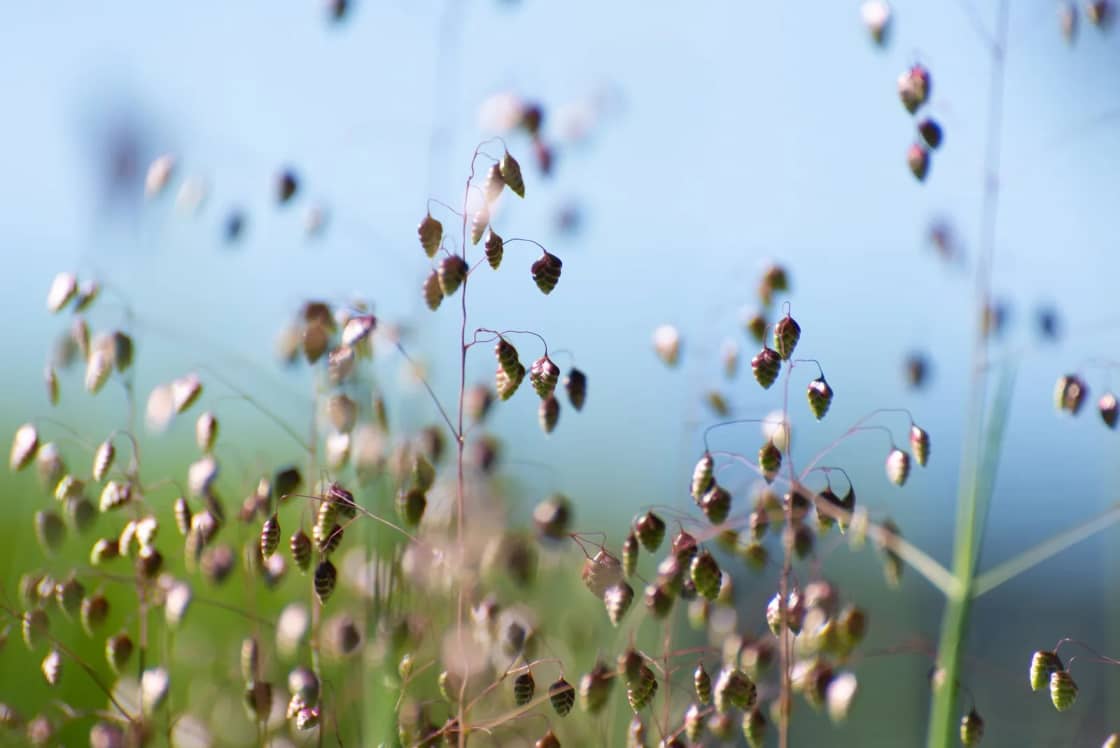

If you moved to Utah Valley and found yourself sneezing in February, you were not imagining it and you did not have an unusually long cold. Allergy season here starts while the mountains are still white, and it does not reliably end until something freezes hard enough to kill the weeds.
That is roughly nine months. It is one of the longer pollen seasons in the country, and almost nobody arriving here is warned about it.
The season nobody tells newcomers about
The mental model most people bring to Utah is spring allergies. Flowers bloom, pollen happens, it passes. That model fails here in two directions.
It fails at the front because the first pollen of the year comes from juniper and cedar, which start releasing in late winter, while snow is still on the benches. These are wind-pollinated conifers. They produce no petals, no color, no scent — nothing that looks like blooming. A person watching for visual cues gets no warning at all.
It fails at the back because weed pollen does not stop on a schedule. It stops when a hard freeze kills the plants, which in most years means late October or November.
Between those two points, the valley runs three overlapping pollen seasons rather than one. Understanding which of the three is yours is the single most useful thing you can do, because the treatment timing is completely different depending on the answer.
Three seasons, stacked
Trees: roughly February through May. Juniper and cedar open, followed by box elder, cottonwood, poplar, ash, maple, birch, elm, mulberry, oak and walnut. Cottonwood deserves a specific note because it is widely blamed and largely innocent — the cottony fluff people see drifting in June is a seed dispersal structure, not pollen. The actual cottonwood pollen was released earlier and invisibly. People curse the fluff and medicate too late.
Grasses: roughly May through July. Bermuda, orchard grass, timothy, rye, brome, meadow fescue and wild oat. Grass pollen is the one most closely tied to lawn culture, which Utah Valley has in quantity, and it is the reason a mowed lawn can trigger symptoms within minutes.
Weeds: July until the frost. Ragweed, sagebrush, pigweed, Russian thistle — the plant that becomes tumbleweed — cocklebur, kochia and lamb's quarters. This is the longest of the three and, in a high desert valley, sagebrush makes it distinctly regional. A person who was fine with ragweed in Ohio can arrive here and discover sagebrush is a different problem entirely.
The stacking is what makes May and September so consistently bad. In May you get the tail of the trees and the front of the grasses. In September you get weeds at full volume with nothing yet to stop them.
The company in Provo that measures the air
Here is something unusual about living here, and no local guide seems to mention it.
For most of the history of pollen reporting, counts were produced by hand. Air was drawn across a sticky slide, a technician looked at the slide through a microscope, and counted grains one at a time. The result was a 24-hour average, published a day after the air it described. If you wanted to know whether to go running this afternoon, the number available to you described yesterday.
Pollen Sense, headquartered on North Canyon Road in Provo, was founded to automate that. Their sensors draw air in, capture particles, image them, and identify them using machine vision — continuously, rather than once a day. The output feeds a consumer app that reports hourly rather than daily, broken out by category: trees, grasses, weeds, mold.
One thing about this is worth knowing as a resident: the company's own position has consistently been that manual counting remains the reference standard and that the sensors are stronger at identifying some pollen types than others. That is an honest caveat and it should shape how you read the number: excellent for tracking the shape of a day, less absolute than it looks.
The practical use is timing. If the count climbs through the morning and drops after a rainstorm, you can see that happening and move your run.
Inversion is not an allergy, and that is the point
Utah Valley's air quality is a serious subject and this site covers it in several places. What gets muddled constantly is the relationship between air quality and allergies, so it is worth stating plainly.
Pollen is an allergen. It provokes an immune response in sensitized people. Your body is reacting to a harmless protein as though it were a threat, which is why antihistamines — drugs that interrupt that immune signaling — help.
Particulate pollution is an irritant. Fine particles inflame airway tissue directly, in anybody, regardless of immune sensitization. Antihistamines do comparatively little for it, because there is no histamine cascade to block.
The reason this matters in Utah Valley is that the mechanism trapping one traps the other. A temperature inversion puts a lid of warm air over the valley and holds cold air underneath it. Everything in that cold layer stays there — vehicle exhaust, wood smoke, and pollen alike. So a person with hay fever gets a double hit during an inversion event: more pollen concentrated in the air they breathe, plus irritated airways that respond more violently to it.
That combination is also why some people conclude the pollution gave them allergies. It did not. It made existing allergies feel considerably worse, which is a different problem with a different fix.
For the mechanism behind the inversion itself, our Provo weather guide covers why this valley traps air the way it does.
Summer smoke is the newer half of the problem
Winter inversion is the version everyone knows. The summer version has grown considerably more relevant.
Wildfire smoke arriving from regional fires produces multi-day episodes of poor air quality that behave much like inversion for anyone with reactive airways, except in the middle of the outdoor season when people most want to be outside. Smoke particulate is fine enough to reach deep into the lungs, and it arrives with no relationship to whether anything is burning nearby.
For an asthmatic household this changes the summer planning calculus. It is worth having a rule agreed in advance — a threshold at which outdoor practice moves indoors, for instance — because making that call in the moment, with a disappointed teenager, is a much harder conversation than making it in May.
What helps, in rough order of effort
Start medication before the season, not during it. This is the most consistently underused piece of advice in allergy care. Antihistamines and steroid nasal sprays work considerably better as prevention than as rescue, and nasal steroids in particular take days to reach full effect. Start ahead of your known trigger season, and ask your doctor how far ahead; that requires knowing when your season is — which is the whole reason to figure out whether you are a tree, grass or weed person.
Manage the indoor air you control. You cannot fix the valley. You can change a furnace filter, keep windows closed during peak count hours, run air conditioning on recirculate during high-pollen days, and shower before bed during heavy weeks so you are not sleeping in a night's worth of pollen. Our HVAC guide covers filter ratings, which matter more here than in wetter climates.
Treat the yard as a variable. Lawn care is a direct exposure event for grass-sensitive people. If mowing reliably wrecks you, that is a good reason to hire it out or to wear a mask while doing it. Waterwise landscaping has an underappreciated side benefit here: less lawn is less grass pollen at close range, though it does nothing about the neighborhood's.
Get tested if you are guessing. Allergy testing — skin prick or blood — replaces a decade of guesswork with a list. Knowing you react to sagebrush and not to cottonwood changes what you do in September and lets you stop worrying in June.
Consider immunotherapy if the season is ruining your year. Allergy shots and sublingual drops work by gradually retraining the immune response, and they are the only common treatment that addresses the sensitization itself rather than the symptoms. The trade-off is honest: it is a multi-year commitment with regular appointments, and it is not a quick fix.
Finding care in Utah Valley
For most seasonal symptoms, a primary care physician is the right first stop and a much shorter wait. Our guides to finding a pediatrician and healthcare in Provo cover how the local systems fit together.
Escalate to an allergist when symptoms are not controlled on standard medication, when you want testing rather than guessing, when asthma is involved, or when you want to discuss immunotherapy. Allergy and immunology is a subspecialty, and practices serving Utah Valley include both local offices and Salt Lake–based groups running satellite clinics down here — worth asking about, because it can mean a shorter drive than the main address suggests.
Verify any provider's license through Utah's Division of Professional Licensing before your first appointment. It takes about a minute and it is the same check regardless of specialty.
Asthma specifically, in this valley
Asthma and allergies overlap heavily but are not the same condition, and Utah Valley treats them differently.
The dry climate is helpful for one class of asthma. Dust mites and indoor mold both need humidity, and this is a semi-arid valley — so households arriving from the Southeast or the Midwest frequently find that particular trigger diminishes.
The trade is the particulate load. Winter inversion and summer smoke are both multi-day, valley-wide, and unavoidable by staying indoors alone, because indoor air follows outdoor air unless it is being filtered.
Practical consequences worth building into a household routine:
- Keep a current written asthma action plan, especially for school-age children, and give a copy to the school.
- Check the rescue inhaler's expiry date at the start of each school year. Inhalers expire quietly and a child discovers it during an attack.
- Check air quality before outdoor exercise, and treat that as normal rather than fussy. The state publishes current conditions; so does the pollen app.
- Know where urgent care ends and the emergency room begins. Our guide on urgent care versus the ER is worth reading before you need it rather than during.
The swamp cooler problem
Here is a local trap that gets almost no attention, and it undercuts half the advice above.
Evaporative coolers — swamp coolers — are common in Utah Valley because they work extremely well in dry heat and cost a fraction of what refrigerated air conditioning costs to run. They cool by pulling outside air through wet pads and blowing it into the house.
Both halves of that sentence are allergy problems.
They pull outside air in, continuously, and they do not filter it the way a closed AC system does. A house running a swamp cooler during July is not a sealed environment. Grass and weed pollen comes in with the air, all day. The standard advice to keep windows closed during peak count hours is close to meaningless in a swamp-cooled house, because the cooler is a very large open window with a fan in it.
They add humidity to the one climate where dryness was helping you. BYU studies of Utah County homes found evaporative coolers consistently raise indoor humidity. In smaller, lower-income homes with coolers, 68% tested positive for dust-mite allergen, though a study of larger single-family homes found mite levels no different from homes with central air. A desert-population study found people from cooler homes about twice as likely to test positive to molds and mites. Damp pads that sit unused between cycles are themselves a mold surface, which is why the pads need replacing on a schedule rather than when they fail.
None of this means swamp coolers are the wrong choice — they are cheap, they are effective, and for most households the trade is fine. But if you are allergic and cannot work out why your indoor measures are not helping, the cooler is the first thing to look at. Options are real: replace the pads at the start of every season, run the fan without the pump on high-pollen days if the temperature allows, or, for a badly affected household, price out the switch to refrigerated air. Our HVAC guide covers what that conversion involves here.
The school year, which is also weed season
Utah Valley's academic calendar and its worst weed pollen arrive within a few weeks of each other, and for families that collision is the practical heart of the problem.
School starts in mid-to-late August. Ragweed and sagebrush peak in September. Outdoor sports practice runs through both. So the child most exposed is frequently the one running laps in the afternoon during the highest counts of the year, and the first month of school is when they are least likely to mention that they cannot breathe properly.
A few things worth doing before the first week rather than during the third:
- Get the medication conversation done in August, including who holds an inhaler and where it lives during the school day. Utah allows students to carry and self-administer asthma inhalers under specified conditions, and the school will have paperwork for it. Fill that out before you need it.
- Ask the coach directly about air quality thresholds. Utah districts and athletic programs generally have guidance for poor air quality days; knowing your specific team's practice is more useful than knowing the policy exists.
- Watch for the symptoms that do not look like allergies. A child who is tired, irritable and doing badly in the first month is sometimes a child sleeping poorly because their nose is blocked every night. That presents as a behavior problem and gets treated as one.
Our guides to the Provo City School District and youth sports in Utah Valley cover the surrounding logistics.
Altitude, dryness and the two things people blame wrongly
Two local features get blamed for allergy symptoms and deserve a more careful answer.
Altitude. Provo sits around 4,550 feet, and higher elevation does reduce some allergen loads — dust mites thin out with altitude, for one. But the valley floor is not high enough to escape pollen, and the surrounding plant community is well adapted to producing plenty of it. Altitude is not the reason your allergies are bad here, though it may be part of why they feel different. Our elevation guide covers what the altitude does and does not change.
Dryness. Low humidity cuts mold and dust mites, which helps. It also dries out nasal passages, which reduces the mucous barrier that would otherwise trap pollen before it reaches sensitive tissue, and it keeps airborne particles suspended longer than humid air does. So dryness is a mixed blessing rather than the straightforward benefit it is often described as.
A calendar you can use
If you take one thing from this page, make it a personal calendar rather than a general one:
- January: Note when symptoms begin. That date is your trigger season's leading edge, and it repeats.
- Two weeks before that date, every year: Start your preventive medication.
- February–May: Tree season. Windows closed on windy dry days; these are the worst.
- May–July: Grass season. Reconsider who mows.
- July–first frost: Weed season, the long one. Sagebrush and ragweed dominate September.
- After the first hard frost: Outdoor season over. Shift attention to indoor triggers, humidifier hygiene and filters.
- Any inversion or smoke event, any month: Different problem, different response. Filtration and staying inside, not antihistamines.
Nine months is a long season. It is considerably more manageable when you know which three of them are yours.
Frequently Asked Questions
When does allergy season start in Utah Valley?
What is the worst month for allergies in Utah Valley?
Does the inversion cause allergies?
Where can I get real-time pollen counts for Utah County?
Do I need an allergist, or is a regular doctor enough?
Why do my allergies get worse when I move to Utah?
Is Utah Valley a bad place to live with asthma?
When does allergy season end here?
Sources
The facts in this guide were checked against these sources. Hours, fees and rules change, so confirm anything time-sensitive with the source before you go. How we make Provo.com.
- Prevalence of house dust mite allergens in low-income homes with evaporative coolers in a semiarid climate (Arch Environ Occup Health 2018;73(1):38-41), Archives of Environmental & Occupational Health (BYU researchers; via PubMed). Checked October 12, 2026.
- Evaporative Cooler Use Influences Temporal Indoor Relative Humidity but Not Dust Mite Allergen Levels in Homes in a Semi-Arid Climate (PLoS One 2016;11:e0147105), PLoS One (BYU researchers; via PubMed). Checked October 12, 2026.
- Effect of evaporative coolers on skin test reactivity to dust mites and molds in a desert environment (Allergy Asthma Proc 2009;30(6):624-7), Allergy and Asthma Proceedings (via PubMed). Checked October 12, 2026.
- Pharmacologic Treatment of Seasonal Allergic Rhinitis: Synopsis of Guidance From the 2017 Joint Task Force on Practice Parameters (Ann Intern Med 2017), Annals of Internal Medicine (AAAAI/ACAAI Joint Task Force; via Consensus). Checked October 12, 2026.