
Ask anyone who grew up in Utah Valley in the 1990s where they spent July and a decent share of them will say the same three words. Then they will ask whether it is still open, and get an answer that depends entirely on who they ask.
It is open. It is not called Seven Peaks. It has not been called Seven Peaks since 2020, and the years in between contain a bankruptcy, two entirely lost summers, a set of injuries that shut the gates mid-season, and a rebrand that a large portion of the internet has never registered.
This is the story of a Provo institution that came closer to disappearing than most people here realize.
The park, and why it mattered
The water park at 1330 East 300 North opened at the end of the 1980s — local reporting puts the first season at 1989 — on a seventeen-acre site on Provo's east side, up against the foothills.
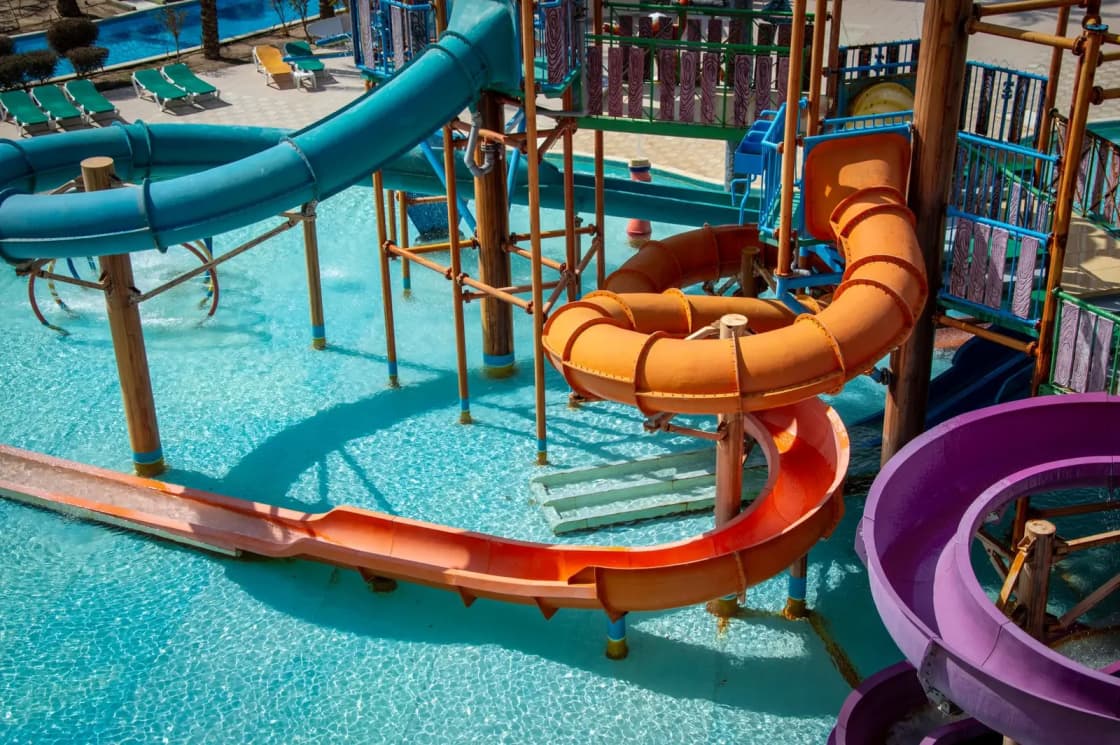
It arrived at a useful moment. Utah Valley in the late 1980s had a steel mill, a university and not a great deal of built recreation. A large commercial water park was, at that point, a genuinely significant amenity, and it became the default answer to the question of what a family does with a hot Saturday. Fifteen-plus slides. A wave pool holding half a million gallons. A lazy river.
There is a detail here that people from outside the valley never quite believe. Alan Osmond wrote a theme song for the park. The Osmond family's connection to the place persisted for decades — his son David Osmond has served as chief entertainment officer under the park's current name. In most towns the water park does not have a jingle written by a nationally famous musician who lives twenty minutes away. In this one it does.
By the 2010s the park had done the thing that turns a business into an institution: it had been there long enough that the parents buying the season passes were the children who had used them.
2017: the summer it stopped
In June 2017, mid-season, the park closed.
The trigger was a set of safety failures. Consumers complained about injuries. Children suffered chemical burns, and at least one lawsuit followed. State attention followed the complaints, and the gates shut.
At the time this was characterized as temporary — a closure to fix deficiencies and reopen. That framing turned out to be optimistic in a way that is only visible in hindsight. The park did not reopen that summer. Officials said they hoped to have the issues resolved in time for the 2018 season.
2018: the year the owner went bankrupt
They did not.
In April 2018, Parkprovo, LLC — which had owned the park since 2016 — filed for Chapter 11 bankruptcy in the U.S. Bankruptcy Court for the District of Utah.
That filing cost the park its second consecutive summer. A seventeen-acre facility built entirely around a three-month season had now missed two of them. For a business of that shape, two lost seasons is close to the maximum survivable damage: the fixed costs continue, the equipment degrades from disuse rather than use, the trained seasonal staff scatter, and the habit that makes a family buy a pass in April simply breaks.
Anyone who drove past the site in the summer of 2018 saw the thing that usually precedes demolition — a large recreational facility with nobody in it, in July.
2019: the reopening
The bankruptcy was settled at the end of 2018 and ownership changed hands. New management came in, roughly a million dollars went into repairs and upgrades — boiler systems, water pumps, slides refinished — and the park reopened for the 2019 season.
One point of honesty about the record here: contemporaneous reporting from that winter names different companies as the incoming operator, and the arrangements shifted more than once in a short period. What is not in dispute is the shape of it — the park changed hands out of bankruptcy, took significant capital work, and opened again after nearly two years dark.
2020: the name goes
In February 2020 the park was rebranded. Seven Peaks became Splash Summit Water Park — new signage, new logo, new web address, same seventeen acres, same wave pool, same slides.
Renaming an institution is a decision with a long tail, and this one has a longer tail than most. The name Seven Peaks is still all over the internet. Old blog posts, unmaintained directory entries, aggregator listings, map pins, and the memories of everyone who went before 2020 all point at a brand that no longer exists on the building. Six years on, "is Seven Peaks still open" remains a question people genuinely need answered — which is a fair measure of how thoroughly a name can outlive its signage.
The name change also collided with something else. There were two Utah parks under the Seven Peaks name, and the other one did not make it.
Why two lost summers is different from two bad ones
It is worth being precise about the mechanism, because "the water park closed for two years" sounds like a slow decline and it was not one.
A water park earns in a window and spends all year. Insurance, debt service, property costs, maintenance and off-season repair run twelve months. Revenue runs roughly three. A season is not a third of the year's income; in practice it is close to all of it. Remove one and the year's fixed costs come out of reserves. Remove two and they come out of somewhere else.
Capital equipment degrades faster idle than in use. Pumps, filtration, boilers and slide surfaces are maintained by being run and inspected. A facility that sits still for eighteen months does not pause — it deteriorates in ways that only show up when someone tries to start it again. That is a large part of why reopening took roughly a million dollars of work rather than a coat of paint.
Seasonal staff do not wait. A water park runs on lifeguards, ride attendants and food staff recruited and trained every spring, most of them students. Skip a season and that pipeline empties; skip two and the supervisors who trained it have taken permanent jobs elsewhere. Rebuilding an operating culture is slower than rebuilding a pump.
And the habit breaks. Season passes are bought in spring out of momentum. Two consecutive springs where there was nothing to buy is enough to reset a family's default summer, which is exactly what happened — see below.
Set against all four, the striking thing is not that the park nearly died. It is that it did not.
The other Seven Peaks, and why the photos are misleading
The park in Salt Lake City's Glendale neighborhood had been Raging Waters before it carried the Seven Peaks name. It closed at the end of 2018 and did not come back.
It then spent years derelict — leaking pools, stripped wiring, equipment theft, fires, and a persistent trespassing problem serious enough that the city hired security to keep people out. Photo essays about the abandoned Utah water park circulate regularly, and the city has been working through what the site should become.
Those photographs are not Provo. Two parks, one brand, opposite outcomes, and a decade of confusion for anyone searching the name. If you have seen images of a ruined Seven Peaks and wondered what happened to the one you went to as a kid, that is the answer: different park, different city, and yours survived.
2025: the proposal that was not submitted
The most recent chapter is about land rather than water.
In May 2025, at a neighborhood meeting, the park's owners floated the idea of buying city-owned land at the base of Slate Canyon and building a resort there. Residents near the canyon reacted strongly against it, and no plan was ever formally submitted to the city.
What followed went the other way. The mayor stated publicly that Slate Canyon was not for sale, and in 2026 the City Council moved to pursue a conservation easement over roughly 115 acres of city-owned parcels at the canyon mouth and foothills, with Utah Open Lands holding it.
That sequence is regularly reported as settled in one direction or the other when it is not, so we keep the detailed and sourced version on one page rather than five: our Slate Canyon guide carries the dates, the acreage, the easement mechanics and what was still outstanding.
What is actually there now, if you go
This page is a story rather than a visitor guide — things to do in Provo and summer activities cover the practical side properly. But three things are worth knowing before you set a satnav.
The address has not moved. 1330 East 300 North, on Provo's east side against the foothills. Whatever your phone calls it, that is the site.
The season is short and it is the whole business. A water park in a valley with real winters operates for roughly three months. Opening and closing dates move year to year with staffing and weather, and the shoulder weeks are the ones most likely to catch you out — a June or late-August visit is worth confirming rather than assuming.
Prices and passes are set annually. Season passes are the standard local purchase and single-day admission is the expensive way in, which is the same arithmetic at every water park in the country. We do not print figures here because they expire; the park's own site carries the current year.
The thing the closure years changed locally
There is a second-order effect worth recording, because it explains something about the valley's current recreation mix.
Two summers without the park pushed families toward the alternatives, and Utah Valley's alternatives improved considerably in exactly that window. City aquatic centers, splash pads, the reservoirs, and the canyons all absorbed demand that had previously defaulted to one commercial site. A household that discovered in 2018 that a free splash pad and a morning at a reservoir made a perfectly good July did not necessarily go back to buying passes in 2019.
That is not a decline story — the park is busy — but it does mean the site no longer occupies the near-monopoly position on a hot Saturday that it held in 1995. Our best parks in Provo guide covers what filled the gap, and a fair amount of it is free.
The other durable change is institutional memory. A generation of Utah Valley children now has no personal association with the name Seven Peaks at all. For anyone under about twelve, the park has always been Splash Summit, and the older name is something their parents say by accident. Brands normally get to fade slowly. This one was cut over in a single winter, and the two populations — people who say Seven Peaks and people who say Splash Summit — map almost exactly onto an age line.
What the story actually shows
Three things, none of them the obvious lesson.
A seasonal business has almost no margin for a lost year. The park did not fail because demand disappeared. Demand was fine — the crowds returned as soon as the gates opened. It nearly died because a safety failure in June removed one summer, and a bankruptcy filing in April removed the next, and there is no such thing as a make-up season for a water park.
A brand can outlive the business that dropped it by years. Six years after the rebrand, the old name still generates more recognition than the current one. That is a genuine problem for the operator and a genuine annoyance for visitors, and it is the reason a page like this one needs to exist at all.
And an institution is not the buildings. What made the closure land locally was not the loss of a recreation option; the valley has plenty. It was that a specific set of summers, belonging to a specific generation, had happened on that site — and for two years it looked as though the next generation would not get theirs.
They did. It is still there. It just answers to a different name.
A note on sourcing this one
Local business history is unusually hard to get right, and this page is a good example of why.
The 2017–2019 period generated a lot of coverage, and the coverage does not fully agree with itself. Different outlets name different companies as the incoming operator across the same few months, because the arrangements genuinely changed more than once while reporters were writing about them. Trade publications, local television and the local newspaper each captured a different moment in a moving situation and all three were accurate when filed.
Our approach where sources conflict is to describe the shape of what happened — ownership changed out of bankruptcy, capital work followed, the park reopened — rather than to pick a company name and present it as settled. A page that asserts one version of a contested detail reads as more authoritative and is more likely to be wrong.
The same principle applies to the opening year. Local reporting puts the first season at 1989; at least one other source says 1990. We say the end of the 1980s, because that is the claim the evidence actually supports, and the precise year does not change anything a reader needs.
If you have primary material on the park's early years — photographs, passes, programs, or the original theme song recording — we would genuinely like to see it.
The plumbing bill every water park in America inherited
One thread runs underneath the ownership churn above and rarely gets mentioned in accounts of it: a water park is not a collection of slides. It is a pumping station, and since 2008 the pumping station has been federally regulated.
The Virginia Graeme Baker Pool and Spa Safety Act, codified at 15 U.S.C. Sec. 8001 and following, is enforced by the Consumer Product Safety Commission and took effect on December 19, 2008. It is named for a seven-year-old who drowned after the suction from a hot tub drain trapped her underwater. The act's target is suction entrapment, and its core requirement is mechanical: every drain cover in a public pool or spa must conform to a specified entrapment protection standard, and any public pool or spa with a single main drain that is not an unblockable drain must carry an additional anti-entrapment device or system on top of that. In practice the second system is often a safety vacuum release system built to ASME A112.19.17 or ASTM F2387, which kills the pump when it senses a blockage.
The standard has moved since. Congress wrote the original requirement against ASME/ANSI A112.19.8, and provided for successor standards. The CPSC incorporated sections of ANSI/APSP-16 2017 as the successor by direct final rule published at 84 Fed. Reg. 24021 on May 24, 2019, with the effective date subsequently pushed from November 2020 to May 24, 2021 because of the pandemic. Compliant covers also carry a service life and have to be replaced when it runs out, which turns a one-time retrofit into a recurring line item.
None of that is a story about Seven Peaks specifically, and we are not asserting anything about this park's compliance history, which we have not examined. The point is structural. A facility of this kind carries a category of fixed cost that is invisible from the parking lot, does not scale down when attendance falls, is not deferrable in the way that repainting is, and is enforced by a federal agency rather than by a landlord. When a seasonal business with two lost summers changes hands, that cost is sitting on the other side of the transaction whatever the slides look like.
One sourcing caution, because this act attracts it. Published references disagree on the public law number — some cite Public Law 110-140, others 110-440 — and several conflate the December 2007 signing date with the December 2008 effective date. The codified citation, 15 U.S.C. Sec. 8001 et seq., is stable and agreed across the CPSC's own materials and the Federal Register, which is why it is the one used above. We have not resolved the public law discrepancy and are recording it as unresolved rather than picking the more common answer, which is how this site handles a conflict between reputable sources.
Related Guides
- Slate Canyon: trails, access and the land at the mouth
- Best Parks in Provo
- Family Activities in Utah Valley
- Things to Do in Provo
- Summer Activities in Provo
- Provo for Families
- The History of Provo
- Famous People From Provo and Utah Valley
- Geneva Steel: The Mill That Built Utah Valley, and the Ground It Left Behind
- iProvo: The City That Built Its Own Internet, Sold It Twice, and Kept the Debt
- Utah City, Explained: How a Vanished Steel Mill Became Utah County's New Downtown
- Provo City Cemetery: Finding a Grave, Reading the Records, and the 1853 Ground Underneath It
Published August 2026. The closure, bankruptcy, reopening and rebrand sequence was verified against contemporaneous reporting this month. Ownership and operating arrangements in this category change, and reporting from the 2018–2019 period names more than one incoming operator — where the record disagrees, this page describes the shape of the transaction rather than asserting a single company. Confirm current hours, prices and operator with the park directly.
Frequently Asked Questions
Is Seven Peaks still open in Provo?
Why did Seven Peaks close?
Who owns the Provo water park now?
Is the Provo Seven Peaks the same as the abandoned one in Salt Lake City?
Did an Osmond really write the Seven Peaks theme song?
How old is the Provo water park?
What is Peaks Ice Arena, and is it related?
Is the water park moving?