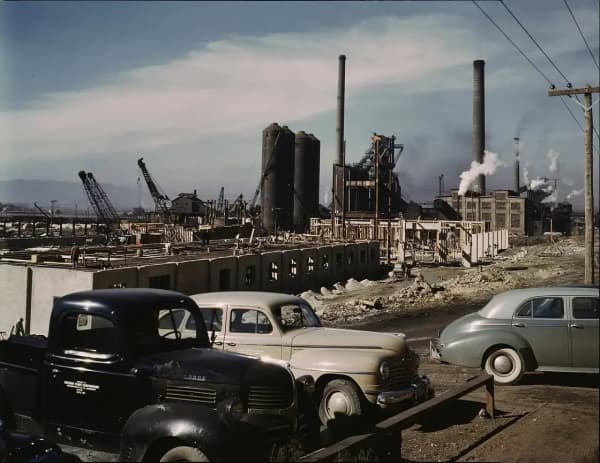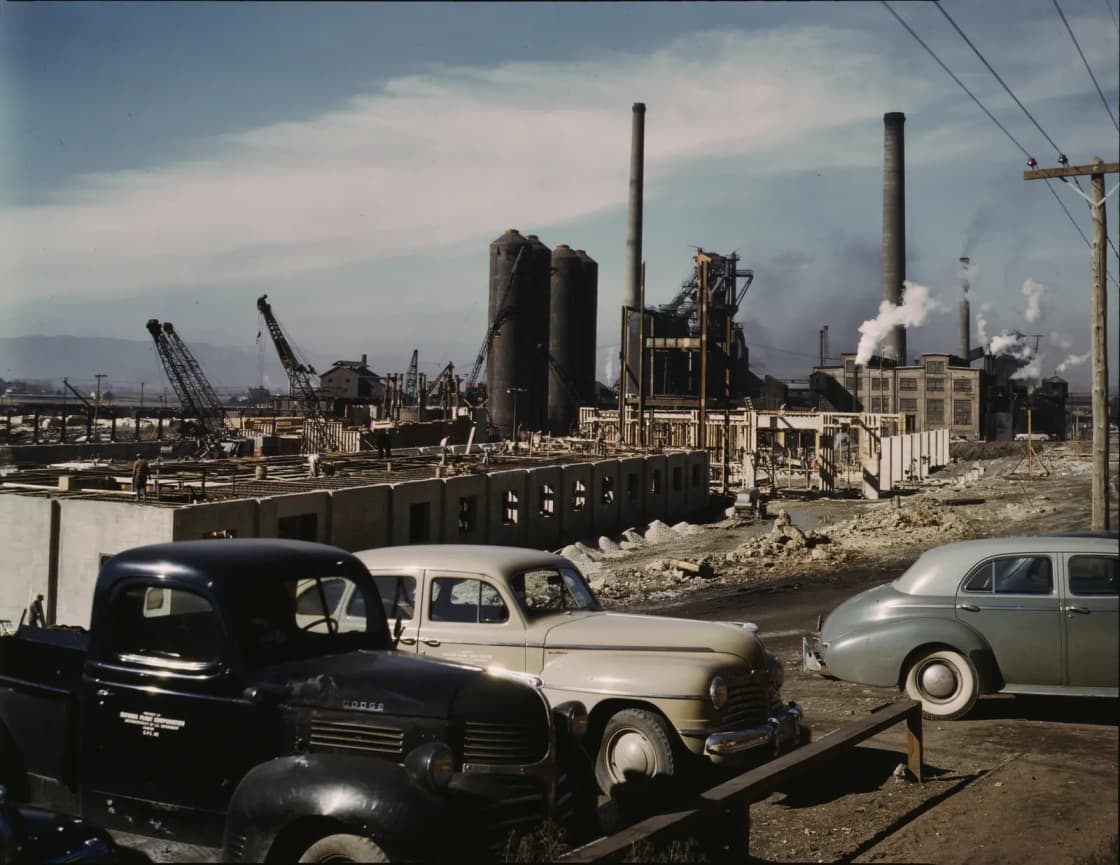

There is a stretch of ground between Orem and Utah Lake where, for about sixty years, the sky was orange at night.
People who grew up in Utah Valley before 2002 do not need that explained. Everyone else moves here, drives past the Vineyard exit, sees a new grocery store and a linear park and a row of townhouses, and has no idea that they are looking at the site of what was once described as the largest steel plant west of the Mississippi River.
This page is the mill's own story: why the federal government put a steelworks in a farm valley, what it actually made, the phone call that kept it alive in 1987, why it finally stopped, and the one building in Utah County you can still walk into that is substantially made out of it.
For what is being built on the ground now, Utah City, explained picks up where this page ends.
Why a steel mill in a valley full of orchards
In 1941 the United States had a strategic problem it did not like the shape of. Nearly all of the country's steelmaking capacity sat in the Midwest and along the coasts. If the Panama Canal were closed or a coastal plant were hit, the war effort had a single point of failure.
The answer was to build inland. Utah Valley fit the requirement almost embarrassingly well:
- Iron ore from Iron County in southern Utah
- Coal from the Carbon County fields to the east
- Limestone from quarries within about 25 miles
- Rail already running through the valley
- Water from Utah Lake
- And roughly 700 miles of mountain and desert between it and the Pacific
Construction ran from November 1941 to December 1944, financed by the federal government through the Defense Plant Corporation and carried out by Columbia Steel and U.S. Steel. The Utah History Encyclopedia puts the price at $200 million — in 1940s dollars — and about 10,000 workers were involved in building it. Small farm buildings were cleared off roughly 1,600 acres in the spring of 1942.
The first open-hearth furnace was charged in early February 1944, with steel tapped some fifteen hours later. Full production came that December. Its wartime output was plate steel for the West Coast shipyards, and several of the Liberty ships built with it carried Utah names.
It took its name from Geneva Resort, a vanished recreation spot on the lakeshore. Geneva Road took its name from the same place. You will find sources claiming the plant was named for the road; that gets the order backwards.
The thing about the 1946 sale
When the war ended the government sold the plant. In June 1946, U.S. Steel bought it for $47.5 million — against a construction cost the government had put in the region of $200 million.
That gap is the single most-cited number in Geneva's history, and it deserves a note of caution rather than outrage. Wartime plants across the country sold at steep discounts because the alternative was mothballing them, and a mill's book value and its market value in 1946 were genuinely different things. But the figure is real, and it set the terms of everything that followed: Geneva entered the peacetime economy as a facility nobody had to pay full price for, running technology chosen for a war rather than for a market.
For the next forty years it worked. It supported an entire economy of fabricators and suppliers. It pulled thousands of families into a valley that in 1940 was mostly orchards and dairy farms — Orem had fewer than 3,000 residents that year — and rewrote what Utah County did for a living.
What it was actually like as a place
Geneva was an integrated mill, which is a technical term with a physical meaning: raw rock and coal went in one end and finished steel came out the other, all on one site.
That required, at various points, 252 by-product coke ovens in four batteries, three blast furnaces rated at 1,100 tons, nine open-hearth furnaces at 225 tons per heat, plate and structural rolling mills, a power plant, and a by-products plant. The complex eventually sprawled across something on the order of 1,600 to 1,700 acres depending on which boundary you count, with well over a hundred industrial buildings, some of them close to a mile long.
It had its own railroad. Not a siding — an internal rail network with its own locomotives, moving molten iron, slag, raw material and finished steel between furnaces and mills like a small industrial short line, interchanging with the Denver and Rio Grande Western and later Union Pacific.
One Geneva worker's description of the floor, quoted in the Intermountain Histories archive, has stuck around because nothing else quite covers it: standing in the dust and noise and machinery was, he said, like standing at the gates of hell.
1986: the year the mill stopped and did not start again
This is the part that almost every short account gets slightly wrong, and it is worth getting right because it explains why sources disagree about when Geneva closed.
On 1 August 1986, the United Steelworkers began a national work stoppage against USX, U.S. Steel's parent. The company called it a strike; the union called it a lockout. It ran until 31 January 1987 and remains the longest work stoppage in the history of the American steel industry. Geneva went to caretaker operations along with the rest of the company.
The dispute settled at the end of January 1987. Geneva did not reopen. USX kept it on "hot idle" — warm enough not to destroy itself, cold enough not to make anything — while it looked for a buyer.
So when a source says the plant "closed in 1986," it is describing the day the fires went down. When another says "1987," it is describing the end of U.S. Steel's ownership. Both are defensible. Neither is the whole sequence.
The phone call
In August 1987 a group of local investors bought the mill for $44 million — less than a third of its estimated liquidation value, and below USX's own $58 million asking price.
The group was headed by Joseph Cannon, a Utahn then working at a Washington law firm who had served as an associate administrator at the Environmental Protection Agency during the Reagan administration, and Robert Grow, a Salt Lake real-estate lawyer. The rest were relatives and attorneys. By the accounts of the deal, not one of them had meaningful experience operating a steel mill.
The deal nearly died twice. A Texas savings-and-loan that had committed to the financing balked. And then USX moved to shut off the gas feeding the coke ovens — which, if you know what coke ovens are, is close to a death sentence. A coke oven battery that cools down cracks. Once the brickwork goes, the ovens are scrap, and without coke there is no ironmaking.
What stopped it was a phone call. Cannon called Senator Orrin Hatch, who called USX chairman David Roderick, who agreed to hold off on the gas. The financing came together, and the new Geneva Steel went into business on 31 August 1987.
The coke ovens were relit. The mill was shipping product 33 days later.
It is a genuinely remarkable industrial story and it is almost entirely absent from the popular account of Utah Valley, which tends to compress the whole thing into "the mill closed."
The air
You cannot write honestly about Geneva without the air, and this is where local memory is sharpest and most divided.
The mill's emissions were a serious, sustained public issue through the 1980s and 1990s. BYU students protested at the entrance to football games. Researchers studied respiratory health in the valley during periods when the plant was running and when it was idle, and that work became part of the wider scientific literature on particulate pollution — one of the reasons Geneva shows up in air-quality research well beyond Utah.
Two things are true at once, and local arguments usually pick one:
The mill made the valley's air materially worse. That is not seriously contested, and the improvement after it closed was real and measurable.
The mill did not create the underlying problem. Utah Valley sits in a bowl. In winter, cold air sinks into it, a warm lid forms above, and everything emitted underneath stays put. That is geography, and it is still here. The valley records bad inversion days now, with the mill twenty-five years gone and several hundred thousand more people and cars than it had in 1990.
Anyone who tells you the air problem left with Geneva has not looked at a January sky recently. Anyone who tells you Geneva was irrelevant to it is not reading the record.
How it ended
The 1990s were unkind to American integrated steel, and Geneva's particular position — old technology, inland freight costs, a product mix under pressure from imports — was a hard one.
The company filed for bankruptcy in March 1999 and reorganized with a $110 million loan backed under the Emergency Steel Loan Guarantee Act. The reorganization did not hold.
Steelmaking stopped in November 2001. Chapter 11 followed in January 2002. The plan at that point was genuinely ambitious: repay existing debt and buy an $80 million electric arc furnace, converting Geneva from an ore-based integrated mill into a scrap-melting mini-mill of the kind that was actually making money in the industry. That plan needed roughly $250 million in financing from Deutsche Bank.
In October 2002 the financing evaporated. Around 1,200 laid-off workers had been waiting on it. That was the end.
The coda is the part people remember. The bankruptcy trustee sold the steelmaking equipment to Qingdao Iron and Steel Group of China, which sent crews to disassemble the works and ship them across the Pacific, finishing in early 2006. Separately, CST Environmental bought the salvage rights in December 2004 on the condition that it demolish every building and structure to grade level.
Furnaces built to win a world war were taken apart and shipped to Shandong Province. Everything else was flattened.
The number nobody puts next to the other number
In 1946 the federal government sold the Geneva plant to U.S. Steel for $47.5 million.
In 2005, Anderson Geneva and affiliates bought the land out of the bankruptcy estate for a reported $46.8 million.
Fifty-nine years apart, for two completely different things — a working mill versus a contaminated empty flat — the nominal figures land within about a million dollars of each other. In real terms they are not remotely comparable; inflation alone makes the 1946 figure many times larger. It is a coincidence of round numbers rather than a lesson. But it is the kind of coincidence that is hard to un-notice once you have seen it, and no account of the site puts the two figures on the same page.
Where you can actually see Geneva today
On the site itself: essentially nothing. The demolition contract was explicit about grade level, and it was carried out. Old slag remains on parts of the ground, and remediation has continued for years under Utah Department of Environmental Quality oversight, including consolidating impacted soil into an engineered containment structure on site.
But there is one place you can walk into.
The Harley-Davidson dealership at 555 S Geneva Road in Lindon was deliberately built out of reclaimed industrial material, a large share of it salvaged from Geneva's rubble across the street. The owner spent the demolition years collecting timbers, beams and steel lattice specifically because they had, in his words, a legacy of Geneva. The building runs around 58,000–60,000 square feet and has been claimed as one of the largest reclaimed structures in the country.
Two corrections worth carrying, because both are wrong on most listings:
The name changed. It operated for years as Timpanogos Harley-Davidson and is now Summit Harley-Davidson. Its own social accounts say "formerly Timpanogos H-D." Nearly every tourism and directory listing still prints the old name, so searching for it under the name in the guidebooks will get you a business that no longer exists under that name at an address that is still correct.
It is not all Geneva. The marketing line — that more than 75 percent of the materials came from Geneva Steel — does not match the building's own published history, which describes the main trusses as coming from the 1903 Salt Lake City Coca-Cola plant and from an 1870s Ogden railroad building, with over 70 percent of materials reclaimed in total from Geneva and those other sources. The Geneva content is real and substantial. It is not three-quarters of the building.
Beyond that: the Vineyard FrontRunner station sits on ground the mill used, and if you want to understand the scale of what was here, stand on the platform and look west. Everything between you and the lake was plant.
Why this still matters to anyone living here now
Three reasons, and none of them are nostalgia.
It explains the shape of the valley. Orem and Vineyard's population curves, the location of the rail lines, the industrial zoning on the west side, the road named Geneva — all of it is downstream of a wartime siting decision made in 1941.
It explains why there was land. Utah County built out east and south against the mountains for decades because the flat lakeside ground in the middle was a working steel mill and then a contaminated site. When it finally cleared, it released hundreds of acres of buildable, freeway-adjacent, transit-adjacent land into a valley that had almost none left. That is the entire reason Vineyard went from a few hundred residents to a city, and the reason a 700-acre downtown is being built from scratch there instead of somewhere else.
It is the honest version of the air argument. Every winter the inversion conversation restarts, and every winter someone says the valley used to be worse and someone else says it has not improved. Both are describing something real. Knowing what Geneva actually emitted, and when it stopped, is what makes that conversation useful rather than circular.
The short version
The federal government built a steel mill on the shore of Utah Lake in 1941 because it was afraid of losing the coasts, sold it for a quarter of what it cost in 1946, and watched it become the economic center of Utah County for forty years.
It stopped in August 1986 and never really restarted under its original owner. A group of lawyers with no steel experience bought it in 1987 and kept it running for fourteen more years on the strength of a phone call to a senator. It made its last steel in November 2001, and by 2006 it had been shipped to China or knocked to the ground.
What is left is the valley's shape, an argument about the air, and a motorcycle dealership on Geneva Road built out of the wreckage — under a different name than the one on the listings.
Related Guides
-
New FEMA flood maps take effect in Provo on June 23 — what homeowners and renters should know
Advertisement -
iProvo: The City That Built Its Own Internet, Sold It Twice, and Kept the Debt
-
Provo Airport is growing up: mainline jets, more routes, and a push to 10 gates
-
The Osmonds and Utah Valley: How a Family From Ogden Built a Hollywood in Orem
-
A Short History of Orem: From the Provo Bench to Family City USA
Frequently Asked Questions
What was Geneva Steel?
Where exactly was the Geneva Steel plant?
Why is it called Geneva?
When did Geneva Steel close, and why do sources say different years?
Is there anything left of Geneva Steel to see?
Did Geneva Steel cause Utah Valley's air pollution problem?
How many people worked at Geneva Steel?
What is on the Geneva Steel site now?