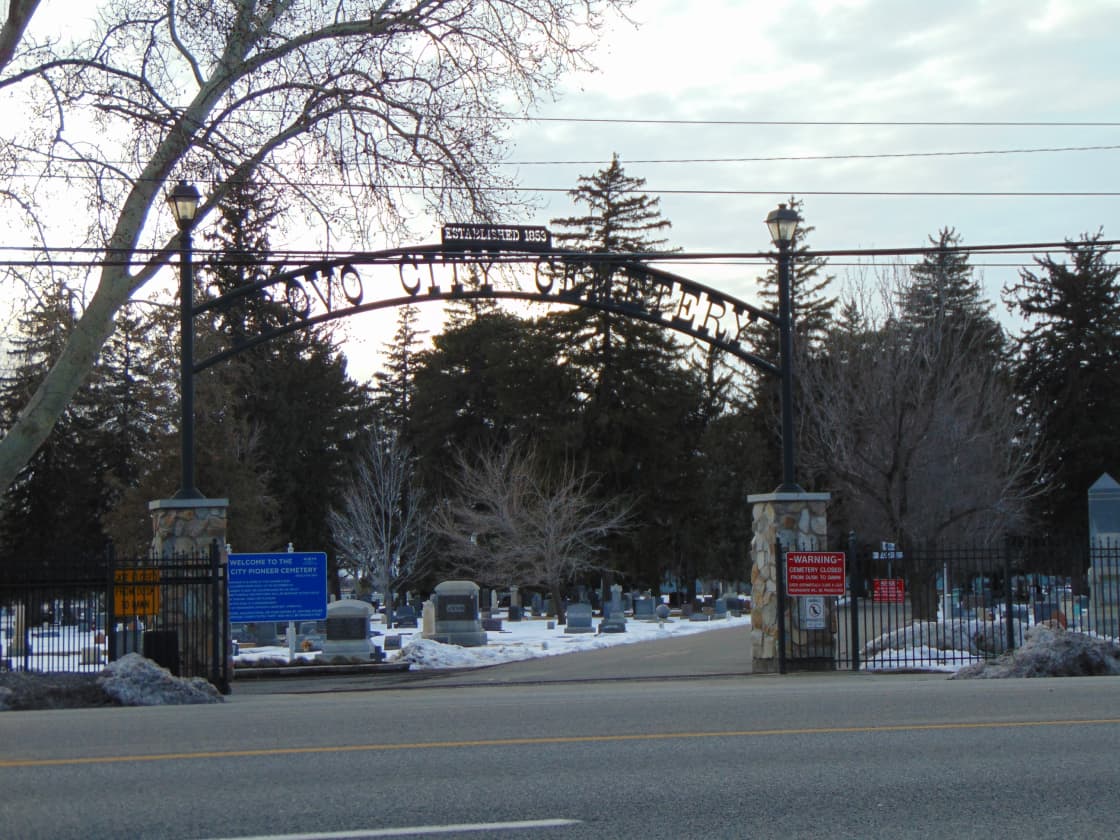

Most people encounter the Provo City Cemetery for one of three reasons: somebody has died, somebody is looking for an ancestor, or they were driving down State Street and wondered about the forty-five acres of headstones.
All three are well served by the same set of facts, and the facts are unusually good here. This is a municipal cemetery with a city department behind it, a public records trail going back to the settlement itself, and — recently — a searchable map built with a state preservation grant. If you are trying to find somebody buried in Provo, you have better tools than the people looking for them a decade ago did.
What follows covers the practical questions first, then the history, which is more interesting than the phrase "city cemetery" suggests.
The basics
The cemetery occupies roughly 45 acres on South State Street, holds approximately 38,000 burial spaces, and was dedicated in 1853. It is operated by Provo City through its parks department, not by a private company.
That last point is worth dwelling on, because it changes how you deal with the place. There is a published fee schedule. There are published rules. Records are city records. When you call the office you are calling a municipal department during business hours, and when a question is ambiguous the answer exists somewhere in a public file rather than in a sales process.
The city has also invested in access. There is a searchable web map of the grounds, made possible by the Utah Department of State History's Cemetery Preservation Grant, and a 360-degree video tour for anyone who wants to see the layout before visiting — useful for out-of-state relatives who cannot come.
Finding a specific grave
Work through these in order. They are ranked by how close each is to the original record.
1. The city's searchable web map. This draws on the cemetery office's own records, which makes it authoritative rather than derivative. Start here. It will give you a location on the grounds, not just a confirmation that somebody is here, which is the difference between a useful answer and a forty-minute walk.
2. Find a Grave. Tens of thousands of memorial records are logged for this cemetery, many with headstone photographs contributed by volunteers. It is excellent for photographs and for the connective tissue between family members, and it is worth searching even when you already have the plot, because somebody may have photographed the stone.
3. FamilySearch. Maintains a cemetery page for the site. Free, and the natural next step if you are working a family line rather than looking for one person.
4. Names In Stone. Carries an interactive grave map for the cemetery with information drawn from the cemetery office.
5. The cemetery office itself. If the person is not in any database, call. The office record is the original; every online database is a transcription of something, and transcriptions have gaps. This is particularly true for older burials, for infants, and for anyone whose stone has weathered past legibility.
One practical note about volunteer databases generally: they tell you what has been recorded, not what exists. A cemetery's true burial count is almost never known precisely, which is why Find a Grave declines to express its coverage as a percentage of total burials. An absence from an online index is not evidence of an absence from the ground.
Going back further: the archives
For genealogical work that outruns the online indexes, the Utah State Archives holds the deeper material.
The archives hold a series of Provo cemetery records, classified as public and available on microfilm, comprised primarily of burial records. The earliest volume — a registration of deaths and burials — appears to have been begun in 1876, but it carries information about deaths and burials from as early as 1849.
That gap between the two dates is the useful part. It means the book was compiled retrospectively, reaching back into the settlement's first quarter-century from records and memory that existed at the time. For anyone working on a Provo family from the pioneer period, this volume is likely the closest surviving thing to a primary source.
A separate archival series holds lot ownership and perpetual maintenance records, which is where to look for questions about who owns a family plot, how many spaces it contains, and whether any remain unused — a question that comes up more often than people expect, usually at an inconvenient moment.
The Provo City Library also maintains research material on the city's historic cemeteries, and is a better starting point than a general web search if what you want is context rather than a specific name.
The 1849 problem, and why the cemetery is older than itself
Here is the thing that makes this ground more interesting than its dedication date.
In 1849, Brigham Young sent John S. Higbee south to find a place to settle a colony on the Provo River. Two weeks after his report, thirty-one families — around fifty people — made the three-day journey and began building a stockade on the south side of the river. They called it Fort Utah, a name soon changed to Fort Field.
Eight people died that first year. Cemetery records identify four of them: George and Matilda Haws, Harriet Turner, and William Dayton.
They were buried where people are buried when a settlement is one year old — near the fort, in ground chosen for convenience rather than permanence. A second early burial ground existed at Temple Hill.
When the Provo City Cemetery was dedicated in 1853, the community began moving those earlier burials into it. The process took many years. George and Matilda Haws, Harriet Turner and William Dayton were moved from Fort Field. Mary Blake Peay, Abisha Ware and others came from Temple Hill. A large area within the cemetery was set aside specifically for the relocated remains.
Inside the grounds, a Daughters of Utah Pioneers memorial drinking fountain lists the names of the known pioneers who were moved from other burial sites — which is both a memorial and, functionally, an index to a relocation that predates modern record-keeping.
The first burial in the cemetery's records that was not a relocation is Joseph Whipple, in December 1856.
So the cemetery contains people who died four years before it was dedicated, and its first three years of records are largely an account of exhumation and reburial rather than of death. For a genealogist, that has a concrete implication: a death date before 1853 does not rule out a Provo City Cemetery burial, and the burial date in the record may bear no relationship to the date of death.
The expansion, and a number worth being careful with
The cemetery has grown. An eight-acre expansion added approximately 10,295 new burial spaces in a traditional lawn interment area offering both upright and flush headstone options, along with a cremation garden built around a stream and a committal pavilion.
The figures for the cremation garden are where a small caution belongs. The city's current material describes the garden as holding 2,695 cremation sites with 17 interment options. Older local material, written while the expansion was still scheduled rather than built, described a cremation garden of 2,757 spaces along with 290 crypt spaces and 340 niche spaces.
Those numbers do not match, and they do not need to — the earlier figures describe a plan and the later ones describe what exists. It is a normal kind of drift, and it is only a problem if you carry the planning number forward as though it were the built one. Where a projection and an operator's current statement disagree, the operator's current statement is the one to use. This page uses the city's.
Terminology, since the paperwork uses it: a crypt holds a full body; a niche holds cremated remains.
Arranging a burial
The practical shape of it, without figures that will age badly.
Provo City publishes a fee schedule, and it is itemized rather than a single price. The space is one line. Opening and closing — the physical work of preparing and closing the grave — is another. A required liner or vault, and a foundation for a monument, are further items again. Crypts and niches price differently from lawn spaces.
Two specific things the city states: a merchant fee applies to credit and debit card payments, and all fees must be paid before a burial site is prepared. Neither is unusual, and both are the kind of detail that causes friction if discovered on the day.
The advice that saves the most difficulty: ask for a full itemized quote, not a plot price. National averages published on cemetery aggregator sites are not Provo figures and should not be used for planning — they are broad ranges assembled across the whole country, and this page deliberately does not reproduce them.
Pre-need purchasing — buying before there is an immediate need — is available and generally locks in current rates. Whether that is financially sensible depends on circumstances this page cannot assess, but it is worth asking the office about the mechanics.
Visiting
The grounds keep daylight hours that change with the season, and the office keeps separate hours from the grounds. Confirm both on the city's page before a trip that depends on reaching a person rather than a headstone.
Memorial Day is the cemetery's defining day. Utah observes it seriously, and Provo's cemetery fills — flowers on nearly every grave, families walking the rows, traffic on State Street backed up around the entrances. If you are visiting for quiet reflection, that weekend is the wrong choice. If you want to see what a community's relationship with its own dead looks like when it is still intact, it is the only choice.
For an ordinary visit, early morning is best. The grounds are well maintained, mature trees run through the older sections, and the mountains stand behind it — which makes it, without wanting to be strange about it, one of the more peaceful open spaces on the south end of the city.
A memorial within the grounds commemorates people connected to the Utah State Hospital, a reminder that institutional burials are part of the record here as they are in most cities of this age.
Cemetery etiquette, briefly
Standard practice, which nobody explains and everybody is expected to know:
- Drive slowly and stay on the roadways.
- Walk between rows rather than across graves where you reasonably can.
- Leave other people's flowers and objects alone, including things that look like litter. They usually are not.
- Keep children close and voices low, particularly if a service is under way anywhere in sight.
- Check the rules before leaving anything. Municipal cemeteries have decoration policies covering what may be left, where, and for how long, largely so that grounds crews can mow. Provo publishes its rules; read them before investing in something elaborate.
- Do not do headstone rubbings without checking. On old and weathered stones the practice can cause damage, and preservation-minded cemeteries increasingly discourage it. Photograph instead, in raking light early or late in the day, which reads a worn inscription better than a rubbing does anyway.
Reading a headstone, when the stone is the only record
Sometimes the database has nothing and the stone is all there is. A few things worth knowing before you stand in front of one.
Nineteenth-century stones abbreviate relentlessly. "Dau. of" and "Son of" carry the family link; "Consort of" and "Relict of" indicate a wife and a widow respectively; "Aged 2 y'rs 4 m'os 11 d's" is a precise age at death, and running it backward from the death date gives you a birth date the record may not hold.
Symbols carry meaning. A lamb marks a child's grave. Clasped hands frequently mark a married couple. A broken column indicates a life cut short. A willow, an urn, an open book, a hand pointing upward — all were part of a common vocabulary that everyone burying a family member understood and almost nobody reads now.
Weathering is uneven and directional. Sandstone and marble erode badly, granite survives. A stone facing the prevailing weather can be unreadable while its neighbor is crisp. Low, raking light early or late in the day will lift an inscription that is invisible at noon, and a photograph taken then can often be read on screen when the stone cannot be read in person.
Small blank spaces between family stones are usually not empty. They are frequently infant burials whose markers were wood, or were never placed. The office record may know; the ground shows nothing.
When the person is not here
Two possibilities worth checking before concluding a search has failed.
They may be in one of the other Utah County cemeteries. Provo City Cemetery is the largest in the immediate area but it is not the only one — the surrounding cities each maintain their own, several of them also dating to the settlement period, and a family that lived in Provo may well have buried in Springville, Pleasant Grove or American Fork depending on where the relatives were. Utah County families moved between these towns constantly.
They may be in a private or institutional plot. Church-associated and family burial grounds existed in the early period, and not all of them were consolidated.
The relocation history at the front of this article also cuts the other way. Remains were moved into the city cemetery from Fort Field and Temple Hill, but the records of that process are incomplete by their nature — a relocation in the 1850s or 1860s did not generate the paperwork a modern one would. Some people known to have been buried at the early sites cannot be individually located in the cemetery today, which is precisely why the Daughters of Utah Pioneers fountain lists names rather than plots.
Why this matters more in Utah than elsewhere
Utah is the center of gravity for genealogy worldwide. The infrastructure, the archives, the volunteer culture and the sheer density of people actively researching family lines are unlike anywhere else, and Provo sits inside that with a university and a large research community attached.
The practical consequence for anyone using this cemetery is that more has been recorded, transcribed, photographed and indexed here than would be true of a comparable cemetery in most other states. The searchable map exists because a state history office funded cemetery preservation. Volunteers have photographed tens of thousands of stones. County genealogical societies maintain their own records that sometimes reach further back than official databases.
If you cannot find somebody, the answer is usually another source rather than an absence — and in Utah there is nearly always another source.
Where to start
Looking for a grave: the city's searchable web map first, then Find a Grave for photographs, then the office if both come up empty.
Researching a pioneer-era ancestor: the Utah State Archives burial registration series, and remember that a pre-1853 death does not rule out a burial here.
Arranging a burial: call the cemetery office and ask for an itemized quote and current availability by section.
Just curious: go on a weekday morning, walk the older sections near the relocated-pioneer area, and find the Daughters of Utah Pioneers fountain. It lists people who were buried twice.
For more on the city's early years, see our guides to the history of Provo and the history of Utah Lake, the river and lake that decided where Fort Utah went in the first place.
Visiting for Día de los Muertos
On 1 and 2 November some families visit graves as part of Día de los Muertos. Two of this cemetery's ordinary rules matter more than usual on those days: what may be left on a grave and when groundskeeping removes it, and whether open flame is permitted, which is governed by fire code and seasonal restriction rather than preference. Both are questions for the cemetery office rather than assumptions to make at the graveside.
Related Guides
-
Funeral Homes, Obituaries and Death Records in Utah County: The Practical Guide
-
Doing Laundry in Provo When Your Building Has Four Machines for Sixty People
-
Calling Provo Police Without Calling 911: The Non-Emergency Line, Online Reports & Records
Frequently Asked Questions
Where is the Provo City Cemetery?
How do I find a specific grave in the Provo City Cemetery?
How old is the Provo City Cemetery?
Are Provo cemetery burial records public?
What are the Provo City Cemetery hours?
How much does a burial plot cost in Provo?
Is the Provo City Cemetery still selling plots?
Are there other historic cemeteries in Provo?
Sources
The facts in this guide were checked against these sources. Hours, fees and rules change, so confirm anything time-sensitive with the source before you go. How we make Provo.com.
- Historic Provo Cemeteries, Provo City Library. Checked October 12, 2026.
- Provo City: Cemetery, Provo City. Checked October 12, 2026.
- Series 26410: Provo Cemetery burial registers, Utah Division of Archives and Records Service. Checked October 12, 2026.