
One sentence governs more of Provo than any other line in the city code.
Most properties in Provo City only allow One Family or Three Singles.
That is the city's own phrasing, published in its zoning guidance. It is short, it sounds administrative, and it quietly determines the economics of a substantial share of the housing stock in a city built around two universities and tens of thousands of students.
It also catches people every year — buyers who ran the numbers on five bedrooms, landlords who inherited a tenancy arrangement that predates enforcement, and students who signed a lease in a house where the fifth roommate is not lawful.
Why a university city zones this way
The reasoning is not hidden. Occupancy limits in single-family zones exist to keep parking, traffic and neighborhood character within what the built environment was designed for.
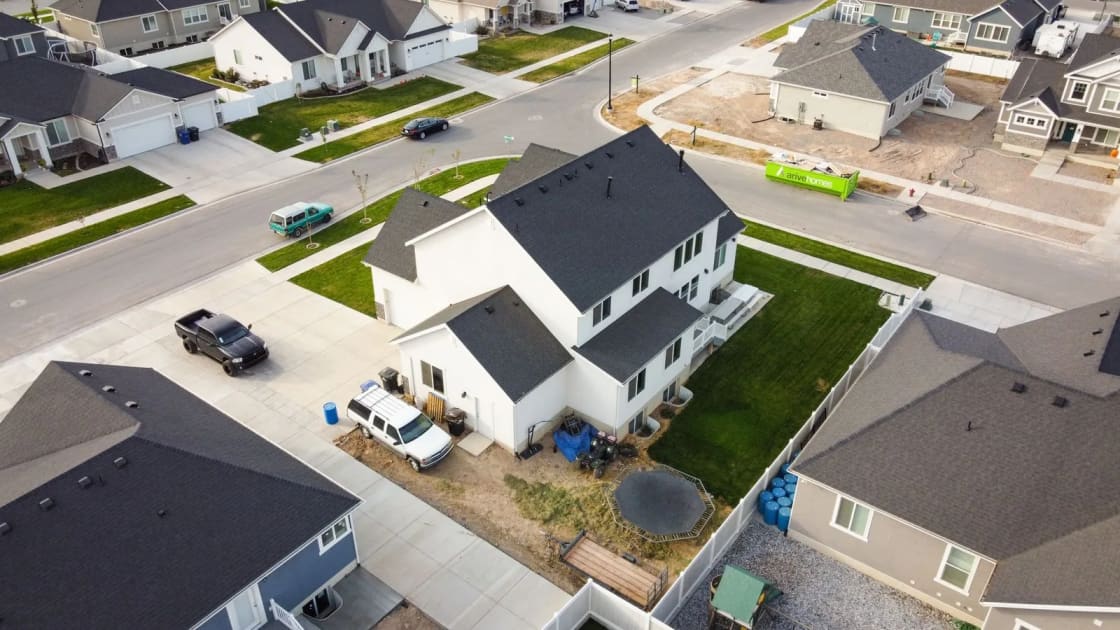
The parking argument is the one that comes up at every public meeting. A house designed for one household with two vehicles becomes a very different thing at six adults with six vehicles, on a street with no off-street capacity to absorb them. Provo council members have made this point in public discussion for years: the street is meant for service vehicles and visitors, not as overflow parking.
Whether the rule is the right instrument is a live political question, and it has been debated in this city repeatedly. What is not in question is that the rule exists and is enforced.
The zones, in outline
Provo's zoning lives in Title 14 of the Provo City Code, administered by the city's development function.
The residential zones carry designations like RA, R1 in several lot-size variants, R2, and the density-based labels LDR, MDR, HDR and VLDR — low, medium, high and very low density residential. There are multi-family designations including RM and the numbered R1 variants, a residential conservation zone, commercial and mixed-use zones, industrial zones, and a set of overlays that modify the base rules on particular parcels.
Overlays are the part that surprises people. A property can sit in a familiar base zone and still behave differently because a Performance Development Overlay, a Specific Development Plan Overlay or a Project Redevelopment Option applies to it. The base zone alone does not always tell you the answer.
This is precisely why the city's advice is to verify rather than infer.
Finding your zone: two minutes, then the real answer
Provo publishes a static zone map and an interactive map, both on the city website. Either will identify a parcel's zone quickly, and for general curiosity that is sufficient.
For anything with money attached, it is a starting point rather than proof. Maps are generalized, overlays are easy to miss, and a map is not a document you can rely on in a dispute.
The Zoning Division answers at (801) 852-6427 and will discuss a specific property. That call is free and frequently resolves the question.
The $25 letter, and why you should buy it early
The document that carries weight is a Zone Verification letter. Provo charges $25 and states it may take at least ten business days.
Both numbers matter. Twenty-five dollars is trivial against any property transaction. Ten business days is two calendar weeks, which is why the letter needs requesting at the start of a purchase rather than during the final week when everyone is trying to close.
The city's own encouragement is explicit: it advises all buyers of property, and anyone who intends to occupy a rental unit, to obtain correct zoning information before occupying or taking ownership. That advice extends to tenants, which is unusual and worth noticing. If the number of people on a lease is material to whether you can afford the rent, the permitted occupancy is a term of the deal, and it is verifiable for $25.
A listing that says "great for six students" is marketing. It is not a defense. (Occupancy is a city rule, not a market statistic; for the market side, see our housing data source guide.)
Accessory dwelling units: permitted, and conditioned
An ADU is a second, self-contained dwelling on the same lot as a primary home — internal to the house, attached to it, or in a detached building.
State law drives part of this. Utah Code Section 10-9a-530 requires that internal accessory dwelling units be treated as a permitted use in areas zoned primarily for residential use, and Provo's code reflects that. The code enumerates the zones in which "areas zoned primarily for residential use" applies, listing RA, R1, R2, LDR, MDR, HDR, CMU, VLDR, RM and RC, any Project Redevelopment Option zone, and Specific Development Plan Overlay zones 2 through 5. That does not make ADUs a blanket right. Provo's code still bars them in Project Redevelopment Option zones, in R2 zones with a Performance Development overlay, and in RM and the small-lot R1.6 through R1.10 areas except where its map allows, and a separate rule governs properties west of I-15.
There is additional geography in the ordinance. West of Interstate 15, ADU use is permitted in all areas zoned primarily for residential use with specific exceptions — Specific Development Plan Overlay zone 5, and R2 zones carrying a Performance Development Overlay.
"Permitted use" does not mean unconditioned. It means you are not seeking a discretionary approval for the use itself.
The ADU conditions that bite
Provo attaches a set of requirements, and several of them have killed projects that were already underway.
Owner occupancy. Either the main dwelling unit or the ADU must be occupied by an owner occupant as the code defines that term. If that requirement is not met, no ADU is permitted. The one exception is a temporary absence of three years or less, for a job, sabbatical, military or voluntary service, or a stay in a care facility, if the owner lived there at least a year first and applied before leaving. This is the condition most likely to defeat an investment thesis, because it forecloses buying a house purely to rent both halves.
One per dwelling. No more than one ADU is permitted with each one-family detached dwelling.
Occupancy of the ADU. Limited to one family or three related or unrelated adults, together with the minor children of those adults. The three-single logic follows the ADU inside.
Appearance. The property must continue to look like a one-family dwelling. Only one front door may be visible from the front yard; new entrances go on the side or rear.
Interior access. An interior connection between the main living area and the accessory apartment must be maintained.
Utilities. An internal ADU may have one or two meters each for water, gas and electricity. A detached ADU needs its own separate meters. All meters must be in the owner's name.
Addressing. Each dwelling unit and the accessory apartment receives its own address from Provo City.
Parking. At least four parking spaces conforming to the city's parking standards in Title 14.37, of which two may be tandem on a driveway under specified conditions.
Permit. Anyone establishing an accessory apartment must obtain a building permit. Our guide to building permits in Provo covers how that process runs.
Note also that the city does not authorize an ADU on a property carrying outstanding ordinance violations. Existing problems must be cleared first.
What "family" means here, and why the definition is the whole game
The occupancy rule turns on a defined term, and the definition is where the actual work happens.
Provo's code defines "family" in Chapter 14.06, and it is not the everyday meaning. The definition contemplates related persons living as a single housekeeping unit, and separately contemplates groups of unrelated individuals — including specific treatment for unrelated adults over eighteen without minor dependent children, and for college students over sixteen.
Two consequences follow that people rarely anticipate.
First, a household of related people is treated differently from a household of unrelated people of the same size. A family of seven and seven unrelated adults are not equivalent under this code, however similar the parking impact.
Second, the count is of adults, not bedrooms or occupants generally. Minor children of the qualifying adults do not consume the allowance in the way another adult roommate does.
If your situation is anywhere near a boundary — a blended household, an adult child returning home, a live-in caregiver, a lodger — the definition rather than the headline number is what determines the answer, and that is a question for the Zoning Division rather than for inference.
Nonconforming uses: the "but it's always been like that" argument
Sometimes the arrangement predates the rule, and zoning law has a concept for it.
A legal nonconforming use is a use that was lawful when it began but no longer conforms because the ordinance changed afterward. Provo's code addresses this directly, describing property that does not conform with the regulations that now govern it because of subsequent land use ordinance changes.
The protection is real but narrower than people hope, and it fails in predictable ways. It generally does not survive a substantial interruption in the use. It does not expand — a nonconforming four-unit arrangement does not become a lawful five. And critically, it has to be proven, which means documentary evidence of continuous use from before the ordinance changed, not a recollection that it has always been this way.
If you are buying on the strength of a nonconforming use, the existence of that status is a diligence item with a documentary answer, and the Zone Verification letter is where you start.
What a zoning problem costs when it surfaces late
The reason to spend $25 and two weeks is that the alternative is priced differently.
A financed purchase premised on rental income that the zone does not permit does not become lawful because a lender approved it. The income disappears; the mortgage does not. A conversion built without a permit may need to be undone, and unpermitted work is a disclosure problem at resale and an insurance problem if something goes wrong. An owner facing an over-occupancy finding loses the extra rent immediately and may face enforcement on top.
Tenants absorb their own version. A household required to shed occupants mid-lease has to renegotiate rent shares in a market with limited slack, usually in the middle of a semester.
None of this requires bad faith by anyone. The common pattern is simply that nobody checked, because checking felt like an unnecessary step in a transaction where everything else was moving quickly.
Where a well-known summary site gets it wrong
A commercial zoning-information site publishing a Provo page states that there is no owner-occupancy requirement for ADU approval.
Provo City Code says the opposite, in terms: either the main dwelling or the ADU must be occupied by an owner occupant, and if that requirement is not met, no ADU is permitted. The same requirement appears in the city's own published ADU requirements and in Planning Commission documentation.
The code is the authority. A summary site is not, however confident its formatting looks, and this particular error is the kind that turns a financed conversion into a stranded asset. The general rule holds across every topic on this site: read the operator's own document, not the aggregator's summary of it.
The rule in the neighborhoods, and the exception near campus
The three-single limit is felt most acutely in the single-family neighborhoods surrounding BYU, where the pressure of student demand meets housing zoned for households.
Our profile of the Tree Streets covers the clearest case: an area within walking distance of a large university that never converted wholesale to student rentals, and the zoning rules are the reason rather than charm.
The exception that confuses people is approved student housing. Large complexes near campus lawfully accommodate far more than three unrelated adults per unit because they operate under different provisions from an ordinary single-family home. The apartment block at the end of the street tells you nothing about the house you are looking at.
For students working out where they can lawfully live, our guides to finding student housing in Provo and UVU student housing address the housing categories directly.
Enforcement, disclosure and what happens
Occupancy enforcement runs through Code Compliance, not the police. Staff work with property owners on violations including property use and maintenance, junk storage, over-occupancy, and basic health and safety concerns. Concerns can be reported by phone on (801) 852-6427 or through an online form.
Provo has also used disclosure as a tool: landlords have been required to have tenants sign an acknowledgment that only three unrelated singles may occupy the property. The purpose is to remove the "nobody told me" defense from both sides of a tenancy, and it means the limit is frequently in the paperwork a tenant signs.
The consequences differ by party. For a tenant the immediate risk is disruption — being required to reduce the household in a market with limited slack. For an owner it is enforcement action against the property, and the loss of income the extra occupants represented.
The city has historically assigned specific legal resource to zoning matters, which is a reasonable signal of how seriously it treats them.
If you disagree with the rule
Zoning is set politically and can be changed politically. Planning and zoning hearings are noticed by neighborhood, and public comment happens at the Planning Commission or by email to it. Ordinance changes go to the City Council.
That is the venue. A dispute with an inspector is not the venue, and neither is a lease clause.
Our guide to following the Provo City Council covers how noticing works, when comment influences an outcome, and how to find out that something affecting your street is on an agenda before it is decided.
Short answers to the four questions people arrive with
Can I rent to five students? Almost certainly not, unless the property is in a zone or category that permits it. Verify before you buy on that assumption.
Can I convert my basement? Possibly, as an internal ADU, subject to owner occupancy, parking, permits and the appearance rules. Confirm your zone first.
Can I run a business from home? A separate question with its own provisions, and it depends on the nature of the business and the traffic it generates. Ask the Zoning Division.
My neighbor has eight cars and I think twelve people live there. That is a Code Compliance report, not a police call.
Codes are amended and fees change. Everything here reflects Provo City Code and the city's published guidance at the time of writing — for a decision with money attached, buy the Zone Verification letter.
Related Guides
- Building Permits in Provo
- The Tree Streets
- Property Tax in Utah County
- Following the Provo City Council
- Utah Renters' Rights
- The Osmonds and Utah Valley: How a Family From Ogden Built a Hollywood in Orem
- What Rent Actually Costs in Provo: Reading the Number Correctly
- Buying a BYU-Area Rental in 2026: The Honest Investor's Guide
- Buying a Home in Provo: What You Need to Know (2026)
- Rent or Buy in Provo? The Honest 2026 Math
- Provo Development Tracker — which rezones the city has approved, denied or left pending, with decision dates
- Who Decides What in Utah Valley — which body hears a rezone in your city, and which 24 register a planning commission at all
- Finishing a basement — where a finish becomes a separate dwelling unit
- Detached ADUs and S.B. 284
- Student rental economics in Provo
- Who builds houses in Utah Valley
- Detached ADUs on October 1: Where Provo, Orem and Lehi Stand — the S.B. 284 status report
Frequently Asked Questions
How many unrelated people can live in a house in Provo?
How do I find out what zone my property is in?
What is a Zone Verification letter and what does it cost?
Can I build an accessory dwelling unit in Provo?
Is there an owner-occupancy requirement for a Provo ADU?
What happens if a property is over-occupied?
Does the three-single rule apply to student housing near BYU?
Who do I call about a zoning question in Provo?
Sources
The facts in this guide were checked against these sources. Hours, fees and rules change, so confirm anything time-sensitive with the source before you go. How we make Provo.com.
- Code Compliance / Zoning FAQs, Provo City. Checked October 12, 2026.
- 14.30.010 Purpose and Definitions (Accessory Dwelling Units), Provo City Code (Provo City Recorder). Checked October 12, 2026.
- 14.30.020 Permitted Use of Accessory Dwelling Units, Provo City Code (Provo City Recorder). Checked October 12, 2026.
- 14.30.030 ADU Development Standards, Provo City Code (Provo City Recorder). Checked October 12, 2026.