
More on Provo: every guide we have published there, in one place.
Provo is a city of coordinates. Almost every street here is a number counting outward from a fixed point — 900 East, 100 West, 1230 North — and after a week you stop noticing, because the system works.
Then you turn off one of those numbered streets and find yourself on Cedar Avenue. Then Birch Lane. Then Locust, Cherry, Oak, Choke Cherry, and a road actually called Old Willow Lane.
That is the Tree Streets, and the first thing worth understanding about it is that the name is not decoration. In a city built entirely on arithmetic, this is the pocket that opted out.
What and where it actually is
The Tree Streets sit north and northeast of the BYU campus, on the slope that climbs toward the mouth of Rock Canyon. Head uphill from campus, and somewhere around the point where the grid stops being flat, the numbers start giving way to names.
Nobody agrees on the boundaries, and you should be suspicious of any page that states them confidently. Real estate sites draw the lines differently from each other, and differently again from how residents describe it. The reason is simple: the Tree Streets is not an administrative unit. It is a name people use. Its edges are wherever the person you are talking to thinks they are.
That is worth knowing before you start a property search, because two listings both described as "Tree Streets" can be a fifteen-minute walk apart and feel like different neighborhoods.
The official name is Wasatch
Here is the practical piece almost no guide mentions.
Provo runs a formal neighborhood program, and this area is filed under a different name entirely: the Wasatch Neighborhood, within what the city calls the East District. When Provo posts a proposed zone change on a Tree Streets address — a concept plan on Cedar Avenue, say — it publishes it under Wasatch.
This matters the moment you need the city rather than a realtor:
- Searching city notices for "Tree Streets" will find you nothing. Search Wasatch.
- Planning and zoning hearings are noticed by neighborhood, and public comment happens at the Planning Commission or by email to it.
- Provo's neighborhoods have chairs and meetings. If you want a say in what gets built on your street, that structure is the mechanism, and it is considerably more effective than complaining about it afterwards.
The Tree Streets is what you call the place. Wasatch is what you call it when you want something to happen.
The housing stock, described honestly
Listings for this neighborhood lean hard on the word historic. It is worth being straight about what that means here.
The Tree Streets housing stock is predominantly mid-century — heavily 1950s and 1960s, with a scattering of older properties. On a street like Locust Lane, the typical build year sits right around the end of the 1950s. These are solid post-war houses on generous lots, many of them updated, sitting under sixty or seventy years of tree growth. That combination is genuinely lovely.
It is not, however, pioneer-era Provo. The genuinely old building stock in this city is downtown, along University Avenue and in the Provo Downtown Historic District, where the buildings start in the 1880s. If you are coming here specifically for nineteenth-century architecture, you want a different part of the city.
What the Tree Streets actually offers is the canopy and the street pattern. Mature trees, curving named lanes instead of a numbered grid, and a slope that gives a lot of houses a view. That is a real and rare thing in Utah Valley, and it does not need to borrow the word historic to be worth wanting.
The base zoning across much of the area is one-family residential — which brings us to the part that explains everything else.
The rule that made this neighborhood
Here is the question nobody answers: how does a leafy family neighborhood survive directly uphill from a university of 35,000 students, when the neighborhood on the other side of campus converted to student housing decades ago?
The answer is not charm. It is zoning, and specifically two rules.
Rule one: how many unrelated adults can live in a house
Provo City's own guidance is blunt about it: most properties in Provo allow only one family, or three unrelated single adults. That is the occupancy limit, and it is the single most consequential housing rule in the city.
Three is not many. It is the difference between a house being worth converting into a rental and not. Across most of Provo's single-family zones, that ceiling is what stops the economics of student housing from steamrolling the residential fabric — and next to a campus this large, that pressure is constant.
Rule two: the owner has to actually live there
The second rule is the one that has been fought over.
Provo permits an accessory apartment — a basement flat, a converted space rented to unrelated people — only in a one-family dwelling that is owner-occupied, and only in appropriately zoned areas. The owner must genuinely live on the property.
The conditions attached are unusually specific, and they are all pointed at the same goal — keeping the house reading as a single home:
- One accessory apartment per house. Not two.
- Occupancy limited to one family, or three unrelated adults.
- The house must still look like one house. Only one front door visible from the front yard; any new entrance goes on the side or the rear.
- Interior access must be maintained between the main living area and the accessory apartment. You cannot fully seal the two halves off from each other.
- Utility meters are capped — at least one and no more than two for water, gas and electricity.
- Each unit gets its own address assigned by the city.
- A parking minimum applies, with a set number of conforming spaces required.
Read that list again and the intent is obvious. Every clause is designed to make the accessory apartment a genuine accessory rather than a second house wearing a disguise.
This has been litigated, more than once. In the early 2000s an out-of-town investor sued the city over the owner-occupancy requirement after spending heavily to renovate a large brick home on the edge of this neighborhood for student rental. Residents at the time argued the ordinance had revitalized the Tree Streets — and pointed to a rising count of elementary-school-age children as their evidence.
Whatever you think of the policy, the causal story is clear enough. The Tree Streets is quiet because of a rule, not because of an accident of taste.
What changes on October 1, 2026
There is a live change worth tracking, and its date is close.
Utah's S.B. 284, passed in the 2026 general session, enacted Utah Code § 10-21-304 — effective October 1, 2026 — requiring covered municipalities to permit a detached accessory dwelling unit on lots of 11,000 square feet or larger where single-family homes are already a permitted use. Backyard cottages, garage conversions, standalone units. Cities that lack a qualifying ordinance have to adopt one by that date — and as of September 1, 2026, Provo had published an eligibility map but had not, so far as we could verify, adopted its implementing ordinance; our October 1 status report tracks it.
Cities keep meaningful authority over height, setbacks, lot coverage, design compatibility, utility capacity, front-yard placement, short-term-rental use and owner-occupancy. Building, fire and health code review all still apply, and a local permit is still a local permit. Two limits are worth stating plainly: the statute is a floor, not a ceiling — nothing stops a city permitting detached units on smaller lots, and several already do — and one accessory unit per lot, internal or detached, not both, which cannot be sold off separately from the main house.
⚠ One point is contested in the reporting. Coverage of the bill splits on whether a covered city may impose a maximum size on a detached unit. The enrolled text lets a city require conformance with its general rules on structure size and bar a unit larger than the main house, and contains no size-cap prohibition — but it does not plainly authorize an ADU-only ceiling either. Ask Provo's planning division about the size cap specifically, because it is the single variable most likely to decide whether the unit you have in mind is buildable.
What this means for any particular Tree Streets lot depends on two things: whether the lot clears 11,000 square feet, and what Provo's implementing ordinance ends up saying. Many lots here are generous; not all will clear that bar. And the city has been actively amending its accessory-dwelling rules in recent years, including adopting citywide provisions on where such units are prohibited.
Treat this as a live question, not a settled one. If you are buying here with an ADU in mind, that is a conversation to have with Provo's planning division before you sign anything — not after.
Renting or buying here: the checks worth doing
Two pieces of process that save real money:
A zone verification letter. Provo will tell you, in writing, what a specific address is zoned for and what occupancy it allows. It costs a modest fee and takes on the order of ten business days. If you are buying a property whose value depends on being able to rent part of it, this is not optional diligence — it is the diligence.
A rental dwelling license. Provo City code makes it unlawful to operate a rental dwelling without a business license for it. If you are a tenant and something about an arrangement feels informal, that is a reasonable thing to ask about. If you are a landlord, it is not a formality you can skip.
The BYU-area rental investment guide goes deeper on the economics; first-time renters covers the tenant side of the same questions.
One thing we will not print: a median price. Utah is a non-disclosure state, which means sale prices are not part of the public record, and any median you see quoted for a neighborhood this small is an estimate built on partial data. Ask a local agent for current comparables instead of trusting a number on a website.
The streets themselves
Since the name is the whole identity, it is worth listing what is actually there. Provo's 84604 street index carries, among others: Cedar Avenue and Cedar Circle, Birch Lane, Cherry Lane and Cherry Circle, Choke Cherry Lane, Locust Lane, Oak Lane, Briar Avenue and Brook Lane — plus Old Willow Lane, which is the one that turns up most often when people describe the area from memory.
Two honest caveats. First, not every tree-named street in Provo is in the Tree Streets — 84604 is a large zip code and it covers a lot of the city's north and east. Second, the naming has no published origin story that we have been able to verify. There is no commemorative ordinance, no founding developer with a documented arboreal theme, no plaque. It appears to be what it looks like: a mid-century subdivision that chose names over numbers, and a name that stuck because it described itself.
That absence is worth stating rather than filling. A great deal of neighborhood writing invents an origin because a paragraph felt empty; we would rather say we do not know.
How it compares to what is next to it
The Tree Streets only makes sense next to its neighbors, because the contrast is the point.
Versus the BYU-area / Joaquin side: south and west of campus is where the student housing actually went. Higher density, higher turnover, cheaper, louder, and vastly more convenient if you are twenty and enrolled. The Tree Streets is what that area might have become without the occupancy rules, and did not.
Versus the east bench further north: keep climbing and you reach newer, larger, more suburban housing with bigger lots and better views — and a longer drive to everything. The Tree Streets trades some of that space for being genuinely close in.
Versus downtown: downtown is walkable to restaurants; the Tree Streets is walkable to trails. Both are walkable neighborhoods, to completely different things. This is the actual decision most buyers in central Provo are making, and it is worth framing it that way rather than as a quality ranking.
Who this neighborhood is wrong for
The honest inverse, because every guide lists the upsides and stops:
- Investors counting on rental income. The rules above are the whole point of the neighborhood. Buying here on the assumption that you can convert a house into student rental is buying against the grain of the zoning, and people have gone to court over exactly that assumption and not obviously won.
- Anyone who needs to be near a freeway. You are on the far side of the city from Interstate 15. That is several minutes in normal traffic and considerably more on a game day.
- Buyers on a tight timeline. Thin inventory in a desirable pocket means waiting, and waiting is the actual cost here.
- People who want quiet in August. Late summer is move-in season on both campuses, and this neighborhood sits inside the effect.
- Anyone expecting flat. It climbs. For most people that is a feature; for anyone with mobility considerations or a real dislike of winter driving, it is worth walking a street before committing to one.
What it is actually like
Stripped of the zoning seminar, the daily experience:
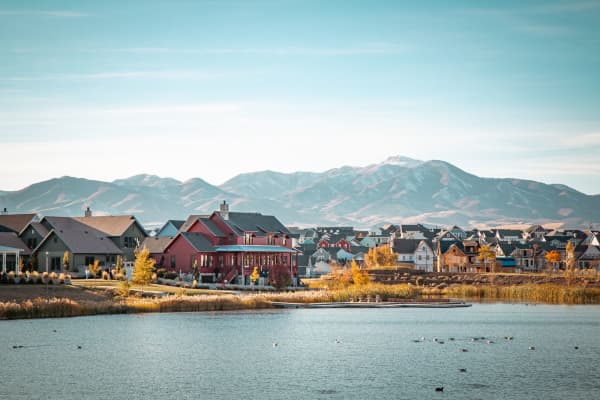
The mountains are close enough to be routine. The Rock Canyon trailhead is a short trip, not an expedition — close enough that people here walk it after work rather than planning it as an outing. The Bonneville Shoreline Trail runs the bench above, and the Y Mountain trail is a few minutes south.
Campus is walkable, with a caveat. Being able to walk to a university is a genuine amenity. Being able to walk to a university also means being near a university on game days, at graduation, and during Education Week. Most residents consider this a fair trade; a few do not.
The slope is real. These streets climb. That is where the views come from, and it is also what winter feels like. Winter tires and canyon driving is written for the canyons but the logic applies to a steep residential bench in February.
Inventory is thin. The thing that makes this neighborhood desirable — a limited number of mid-century houses under mature trees, in a zoning regime that keeps them houses — is also the thing that keeps supply short. Homes here tend to move quickly.
For the wider comparison against every other part of the city, the Provo neighborhoods guide puts the Tree Streets next to its alternatives; if you are still deciding between cities entirely, Provo vs Orem is the honest version of that argument.
The short version
The Tree Streets is the one corner of Provo that traded coordinates for names, and it has spent seventy years quietly proving that a family neighborhood can hold its ground next to a very large university — provided somebody writes the rules that let it.
Learn the word Wasatch before you need the city. Read the accessory-apartment conditions before you count on rental income. And check what October 2026 actually means for your specific lot rather than for the neighborhood in general.
Related Guides
- Freedom Boulevard: The Street Where Provo Keeps the Things It Actually Needs
- West Provo: The Half of the City Everyone Else Drives Past
- House Painters in Utah Valley: Why Exterior Paint Fails Faster Here
- Detached ADUs and S.B. 284
- Detached ADUs on October 1: Where Provo, Orem and Lehi Stand — whether Provo has adopted its ordinance yet
Frequently Asked Questions
Where are the Tree Streets in Provo?
Is 'Tree Streets' an official Provo neighborhood?
Are the Tree Streets homes historic?
Why is the Tree Streets area quieter than the student neighborhoods next to it?
Can I rent out a basement apartment in the Tree Streets?
Is Utah's new ADU law going to change the Tree Streets?
What is it like to live in the Tree Streets?
Are the Tree Streets good for families?