
More on Orem: every guide we have published there, in one place.
Orem is the largest city in Utah County that most people drive through rather than to. It has no historic downtown in the Provo sense, no founding square, no pioneer fort. Its main street is a six-lane state highway. That is not an accident of planning; it is the entire history of the place, and once you know the history the city stops looking like sprawl and starts looking like the map of a hundred and fifty years of decisions.
This is a short version of that history, from the bench nobody wanted to the city of nearly a hundred thousand.
The bench nobody wanted
When Latter-day Saint settlers founded Provo in 1849 they built beside the Provo River, where the water was. North of the river the land rose in a broad, flat, rocky terrace, an ancient shoreline of Lake Bonneville, that ran along the base of Mount Timpanogos for miles. The river had cut below it and bypassed it entirely. Without water it was sagebrush and cobbles, and the first settlers judged it uninhabitable, especially in winter. They called it the Provo Bench.
Small groups tried to farm it in the late 1850s and mostly failed. The bench had good soil and a long growing season, sitting above the valley's cold-air pool, but nothing grew without a ditch, and the ditch would have to come from the Provo River miles to the south and east.
1864: the canal that made a city
The Provo Bench Canal, completed in 1864, brought river water out of the canyon mouth and along the bench, and with it came the first permanent farms and orchards. There were still no full-time residents at first; farmers lived in Provo and rode up to their fields. As canal construction expanded through the 1870s and 1880s, and as a web of secondary ditches spread the water across the terrace, homesteaders built houses beside their fields. The conventional settlement date is 1877.
What they built was unusual for Utah. Nearly every Latter-day Saint town was laid out on the Plat of Zion grid: a compact village of square blocks with farms outside. The bench farmers did the opposite. They strung their houses along the territorial highway, which is now State Street, and along the other roads, so they could be close to both the road and the orchard. There was no town center because there was no town, only a road with farms on it. That decision, made by a few hundred people in the 1880s, is why Orem looks the way it does today.
Peaches, and the Garden City
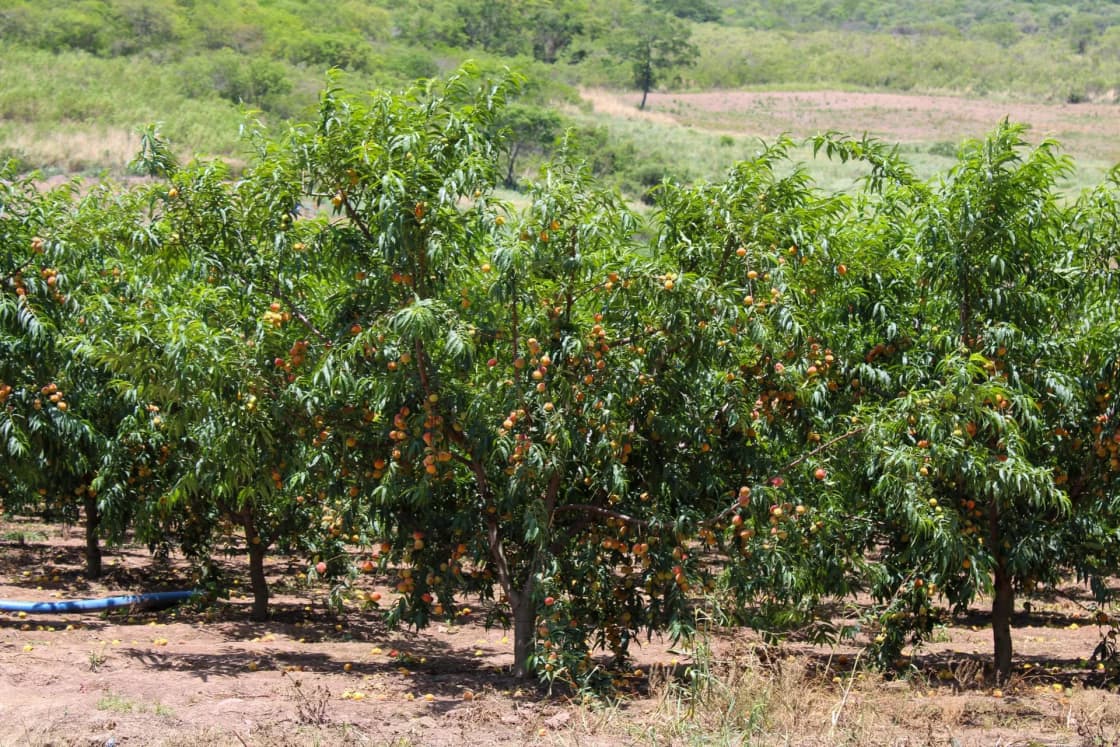
The bench farmers tried wheat, sugar beets and everything else, and found that fruit paid best. The first major peach harvest came in 1892, and the Provo Bench became an orchard district: peaches, apples, cherries, pears and berries, shipped to Salt Lake and, once the railroad arrived, beyond. The bench called itself the Garden City of Utah, and for two generations that was true. By 1900 the bench had a molasses mill, two schoolhouses, a meetinghouse, a blacksmith and a general store.
The Geneva resort on the lakeshore at the bench's west end drew Provo families for swimming and dancing, and the name Geneva, borrowed from the resort, would later attach itself to something very different.
1914: a railroad man's name
The Salt Lake and Utah Railroad, an electric interurban line, built south from Salt Lake City through the bench to Provo and eventually Payson in the 1910s. Its president was Walter C. Orem, a mining and railroad man. The bench's farmers wanted the line badly, because a rail siding meant fruit could go to market without a wagon trip to Provo, and in 1914 the Provo Bench Commercial Club, organized that year to promote the community, renamed the place in his honor. Whether it was gratitude or flattery aimed at getting the siding, the histories disagree; probably both. Orem himself does not appear to have lived there.
For a few years the community was also called Sharon, a Biblical name for a fertile plain between mountains and sea, and the name of Joseph Smith's birthplace in Vermont. It survives on a few street signs and a school. Orem won.
1919: a town
In May 1919, Orem incorporated as a town. Electricity and telephones had arrived on the bench in the 1910s. A town government meant a water system, which the bench needed badly because its wells were poor and its canal water was for irrigation, and Orem spent its first decades building one. The orchards stayed the economy. The Depression hurt fruit prices and the town stayed small: 2,914 people in 1940.
The SCERA and the town's living room
Orem's oldest cultural institution was built by the town's own hands. In 1933 a group of residents organized the Sharon's Community Educational and Recreational Association, the SCERA, to give a farming community with no downtown a place to gather, and in 1941 it opened a theater on State Street built partly with volunteer labor and community bonds. The SCERA showed films, hosted dances and became the de facto civic center of a town that had never built one. It is still there: the SCERA Center for the Arts, with the outdoor SCERA Shell amphitheater added in the 1980s and the Orem Heritage Museum inside, holding the city's collection of photographs, tools and orchard-era objects. The original name, with Sharon in it, is one of the few places the discarded town name survives in daily use.
1944: Geneva Steel
Then the war came, and with it the single largest event in Orem's history.
In 1941 the federal government, planning for a Pacific war and wanting steel production far from either coast, chose a site on the bench's west edge beside Utah Lake for an integrated steel mill. It was named Geneva, after the old lakeshore resort. Built at a cost of roughly $200 million by the Defense Plant Corporation, Geneva Steel opened in 1944 with blast furnaces, coke ovens and rolling mills, fed by coal from Carbon County, iron ore from Iron County and limestone quarried above Payson. It employed thousands almost overnight. Liberty ships were named for Utah to honor its contribution.
After the war the government sold the mill to U.S. Steel, which restarted it in 1946 and ran it for four decades. Geneva was the largest employer in Utah County, the reason a generation of families moved to Orem, and the reason the west side of the city filled with modest postwar houses. It was also the reason the valley's air was brown; the mill was the dominant source of particulate pollution in Utah Valley for fifty years, and the epidemiological studies of what happened to residents' lungs during a mill strike became famous in air-quality science.
Orem's population, under 3,000 in 1940, multiplied several times over in the next two decades. The orchards began to come down for houses.
The vocational school that became a university
In 1941, the same year the mill was planned, the state opened the Central Utah Vocational School in Provo to train workers for the war effort. It grew, moved, changed its name to Utah Technical College at Provo, and in 1977 moved to a new campus on Orem's west side beside the freeway. It became Utah Valley Community College in 1987, Utah Valley State College in 1993 and Utah Valley University in 2008, and it is now the largest university in Utah by enrollment, with nearly fifty thousand students. It is Orem's second-largest employer after the school district and the reason a city with no historic downtown has a campus that functions as one.
The mall, the freeway and the suburb
Interstate 15 arrived on Orem's west side in the 1960s and turned the bench into a suburb. University Mall opened in 1973 at University Parkway and State Street and, for thirty years, was the retail center of the county. State Street became the commercial strip it remains. Subdivisions replaced orchards through the 1970s and 1980s at a pace that shows in the census column: 25,729 in 1970, 52,399 in 1980, 67,561 in 1990. Somewhere in those decades the city adopted the slogan Family City USA, and it has never let go of it.
The city built what suburbs build: the Orem Fitness Center, parks, a library, the SCERA Shell outdoor theater, schools every few blocks. What it did not build was a downtown, and periodic efforts to create one, at the City Center block on State Street and later around the mall, have produced civic buildings and a redeveloped shopping center rather than a main street.
Two hospitals and a city that could take care of itself
A farming town on a bench sent its sick to Provo. A suburb of fifty thousand could not keep doing that, and in the 1980s Orem got a hospital of its own when Intermountain opened Orem Community Hospital on 400 West, a small community facility that has since specialized in women's and newborn care. In the late 1990s a second, larger hospital, Timpanogos Regional, opened on 800 North near the freeway under the for-profit chain that became MountainStar, giving the county its first serious competitor to Intermountain's Utah Valley Hospital in Provo. The two buildings mark the moment Orem stopped being Provo's bench in any practical sense: a city with its own university, its own hospitals, its own mall and its own tax base, sharing a name for the mountain and not much else.
Software on the bench
In the early 1980s two Brigham Young University computer scientists, Bruce Bastian and Alan Ashton, founded a company in Orem to sell a word-processing program. WordPerfect became, for a few years, the dominant word processor in the world, and its campus on Orem's north side was the beginning of the valley's technology industry. Novell, the networking company, grew up in Provo and Orem in the same decade. The two companies made Utah Valley a software center before anyone called it Silicon Slopes, and their alumni founded much of what came after: Omniture, Blendtec and a long list of Orem-rooted firms. WordPerfect was sold to Novell in 1994 and later to Corel; its name survives, and its Orem campus passed to Novell and then to other tenants.
2001: the mill closes
Geneva Steel struggled through the 1980s, closed briefly in 1986, was bought by local investors and reopened in 1987, and ran for another fourteen years through bankruptcies and a changing steel market. It shut down for good in 2001 and was dismantled, with much of the equipment shipped to China. What remained was seventeen hundred acres of contaminated industrial land on the lakeshore, most of it inside the newly incorporated town of Vineyard rather than Orem, and a state-supervised cleanup that took more than a decade. The site is now Utah City, a master-planned development with a FrontRunner station, apartments, a lakeshore park and a beach where the coke ovens stood. Orem's air cleared noticeably.
For Orem, the closure ended the blue-collar city that the mill had built and confirmed the white-collar one that UVU and the software companies were building. The census told the story: 84,324 in 2000, 88,328 in 2010, a decade of nearly flat growth as the city filled its last open land, and 98,129 in 2020.
Schools and the district question
Orem's schools belonged to Alpine School District from the district's creation in 1915, when the north county's small districts consolidated, and for a century the arrangement was unremarkable. As Alpine grew into one of the largest districts in the nation by absorbing Lehi, Saratoga Springs and Eagle Mountain, Orem residents began asking whether their taxes were building schools thirty miles away. In 2022 Orem voters rejected a proposal to leave Alpine and form an Orem-only district; in 2024 voters across the district approved splitting Alpine into three new districts, one of which will include Orem, on a transition running through the second half of the decade. The city has three public high schools, Orem, Mountain View and Timpanogos, and a dense grid of elementary schools built in the subdivision decades, many of them on land that was orchard within living memory.
Names on the map
Orem's geography is written in borrowed names. Sharon, the Biblical plain, survives on a school and in the SCERA's acronym. Geneva, the lakeshore resort, gave its name to the mill, to Geneva Road along the west side and to the neighborhood around it. Lakeview, the farming district on the lake side, kept its name as a neighborhood and a school. Vineyard, the bench's westernmost farm district, incorporated as its own town in 1989 with fewer than two hundred people and now holds most of the former mill site and a population well past twelve thousand and climbing. Lindon, the orchard district on the bench's north end, split off and incorporated in 1924. The Provo Bench Canal itself is now the Murdock Canal's older sibling, and the Murdock, buried in a pipeline in 2010, carries the paved trail along the foothills that thousands of Orem residents walk every week without knowing they are walking on the water that made the city.
The built-out city
Orem today covers about 18.6 square miles, has essentially no undeveloped land left, and grows by replacing old things with denser new ones: apartments where orchards were, townhomes where a single house stood, mixed-use blocks around the mall and the UVU station. It is the fifth-largest city in Utah and, because it never had a center, it is a city that has to decide where its center is every time it plans anything.
Its neighborhoods still carry the bench's layout. The long east-west streets follow the old canal laterals; the north-south ones follow the property lines of farms sold off one at a time. Orchard rows survive in a few yards on the north bench. The Provo Bench Canal, or what remains of it, still runs along the foothills. And State Street, the territorial highway the first farmers built their houses beside, is still the spine of the city, exactly where they left it.
Reading the history in the city
Stand at the corner of State Street and Center Street and look around. There is no town square, because the farmers who named the place never built one. There is a six-lane highway, because the road came first. West of you, the land drops toward the lake and the former mill, and the freeway and the university sit on the ground the mill's workers lived on. East of you, the bench rises to the mountain, and the older houses on the upper streets stand on orchard land. The name on the sign belongs to a railroad executive. The slogan on the welcome sign belongs to the suburb that grew when the mill did. That is the whole story, and it is visible from one intersection.
Related Guides
- Living in Orem, Utah (2026): The Complete Guide
- Geneva Steel: The Mill That Built Utah Valley, and the Ground It Left Behind
- The Orem Line: The Electric Railroad That Named a City
- A Short History of Provo: From Fishing Camp to College Town
- Vineyard and the Geneva Site: The Development Story
- The SCERA Shell Outdoor Theatre: The Complete Guide to Orem's Amphitheater Under the Wasatch
- Omniture: How Two BYU Dropouts Built the Company That Became Adobe's Utah Campus
Frequently Asked Questions
Why is Orem called Orem?
What was Orem called before?
When was Orem founded?
What was Geneva Steel?
How did UVU start?
Why is Orem called Family City USA?
How big is Orem now?
Where can I see Orem's history in person?
Sources
The facts in this guide were checked against these sources. Hours, fees and rules change, so confirm anything time-sensitive with the source before you go. How we make Provo.com.
- Historic and Architectural Resources of Orem, Utah (National Register Multiple Property Documentation Form), National Park Service. Checked October 12, 2026.
- Community Profile, City of Orem. Checked October 12, 2026.
- City of Orem: Demographics, City of Orem. Checked October 12, 2026.
- 2020, 2010 and 2000 Decennial Census Redistricting Data (P1), U.S. Census Bureau. Checked October 12, 2026.
- Geneva Steel (Utah History Encyclopedia), Utah Education Network / Utah State Historical Society. Checked October 12, 2026.
- Utah Valley University (Historical Places), Provo City Library. Checked October 12, 2026.


