
More on Vineyard: every guide we have published there, in one place.
There is no larger story in Utah County than what happened to the Geneva site. A wartime steel mill occupied a vast stretch of lakeshore for the better part of six decades, employed generations, shaped the air and the economy of the whole north valley, and then stopped. The land it left behind is now one of the biggest redevelopment projects in the state.
The history of the mill and the specifics of the new city being built on it are covered in depth elsewhere on this site. This guide is about the thing between them: the development story — how a decommissioned industrial site becomes a city, what infrastructure had to arrive first, what has been built, and what it means for the rest of the county. Our short history of Vineyard covers how the town got here.
The starting condition
Geneva Steel was built in 1941 as a strategic wartime asset, financed federally and sited inland deliberately, so that steelmaking capacity for the West Coast would not sit on a coast that could be attacked. It was in full production by 1944. It closed permanently in 2001, and the equipment and buildings were removed in the years that followed. Our history of Geneva Steel covers that arc properly, including why the commonly repeated closing dates disagree.
What that left was unusual, and the unusualness is the reason this became a development story rather than a slow patchwork of subdivisions.
A very large, single-owner parcel. Industrial sites do not fragment the way farmland does. Instead of assembling hundreds of small holdings from hundreds of owners, a developer here faced a contiguous site under unified control. That is the rarest ingredient in large-scale development and it is why master planning was possible at all.
On the lakeshore, next to an existing transport corridor. Rail served the mill; the freeway is close; Utah Lake is immediately west.
With environmental history to resolve. Six decades of steelmaking leaves a site that must be characterized and remediated before anything is built on it. That work is a precondition, it is slow, and it is expensive. It is also the reason this land sat quiet for years while the rest of the valley built out — and the reason the eventual development arrived as a plan rather than as an accretion.
Inside a city that barely existed. Vineyard was a small agricultural town on the mill's edge, with a population in the hundreds. It was, in effect, a municipal shell wrapped around an enormous redevelopment opportunity, with almost no established residential politics to negotiate with.
That combination — one owner, one site, one very small city, and a blank slate that had to be cleaned first — is why the outcome looks planned in a way that almost nothing else in Utah Valley does.
Growth from almost nothing
Vineyard went from a town of 139 people in the 2010 Census to more than 12,000 in 2020. That statistic is striking and also slightly misleading, because percentage growth from a very small base produces enormous numbers. The absolute growth is what matters, and it is substantial in its own right.
The mechanics are worth understanding because they explain the character of the place.
The housing arrived first and it arrived dense. Because the land came in one piece and was master planned, Vineyard did not develop as detached subdivisions creeping outward. Townhomes, apartments and small-lot housing went up in coordinated phases. The result is a housing stock materially different in mix from its neighbors.
The population skews young. New dense housing near two universities and a commuter rail station attracts young households, and the demographics reflect that. This is a city with an unusually low median age even by Utah standards.
Amenities lagged rooftops, then caught up. Early residents moved into a place that did not yet have the retail, services or civic institutions to match its population. That gap is the standard experience of living in a fast-growing planned community, and it closes unevenly.
Our city guide to Vineyard covers what living there is like, and our neighborhood guide explains why the areas within it are designations rather than the chartered neighborhoods you find in Provo.
Infrastructure was the unlock
Development on this scale does not happen because someone wants it to. It happens when the movement problem is solved, and three things solved it here.
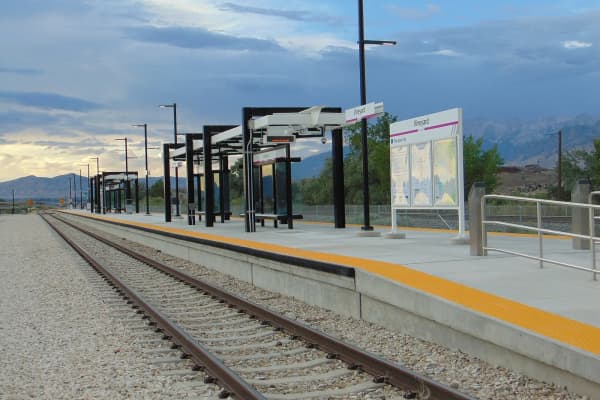
The FrontRunner station, which opened in 2022 in the city's core. This is the single most consequential piece of infrastructure on the site. Commuter rail turns a lakeshore location into a viable base for people working in Salt Lake County, and it is why the density made sense to build. Development is organized around it deliberately rather than incidentally.
North-south road capacity. The Vineyard Connector and associated arterial work opened up movement along the lakeshore corridor, which had historically been constrained. Before it, the site's road access was the practical limit on what could be built.
A UVU presence. Utah Valley University's campus footprint in Vineyard anchors the north end with an institution rather than only with housing, which changes the daytime population and the long-term stability of demand.
The general lesson, which applies beyond Vineyard: in this valley the sequence is almost always transport capacity first, then density, then amenities. Where you see rooftops without the first, you see traffic complaints.
What is being built on the mill land
The centerpiece is Utah City, a large mixed-use development on the former mill land, planned around a walkable core running from the FrontRunner station toward the Utah Lake shoreline. Our dedicated guide to Utah City covers the plan, the people behind it, the numbers it is aiming at, the sustainability commitments including a geothermal component, what has opened, and the honest concerns.
For the purposes of this guide, three things about it matter at county scale:
It is an attempt at a downtown for a county that never really had one. Utah County's population is enormous and its urban form is polycentric — a series of cities each with a modest historic main street and a great deal of low-density development between them. A dense, walkable, mixed-use core of genuine size would be a new kind of place here, not merely more of the existing kind.
It is a very long-horizon project. Developments of this scale are measured in decades and are exposed to interest rates, capital availability and demand across that whole span. Phases open, phases slip, and plans get revised. Any description of what it "will be" is a statement of intent rather than a fact, and should be read that way — including the developer's own.
The rest of the footprint matters too. The former industrial land is not solely one project. Commercial, light industrial and residential development is proceeding across the broader area, and the lakeshore itself — trail access, shoreline restoration and public open space — is a significant part of what changes.
Why the site sat quiet for so long
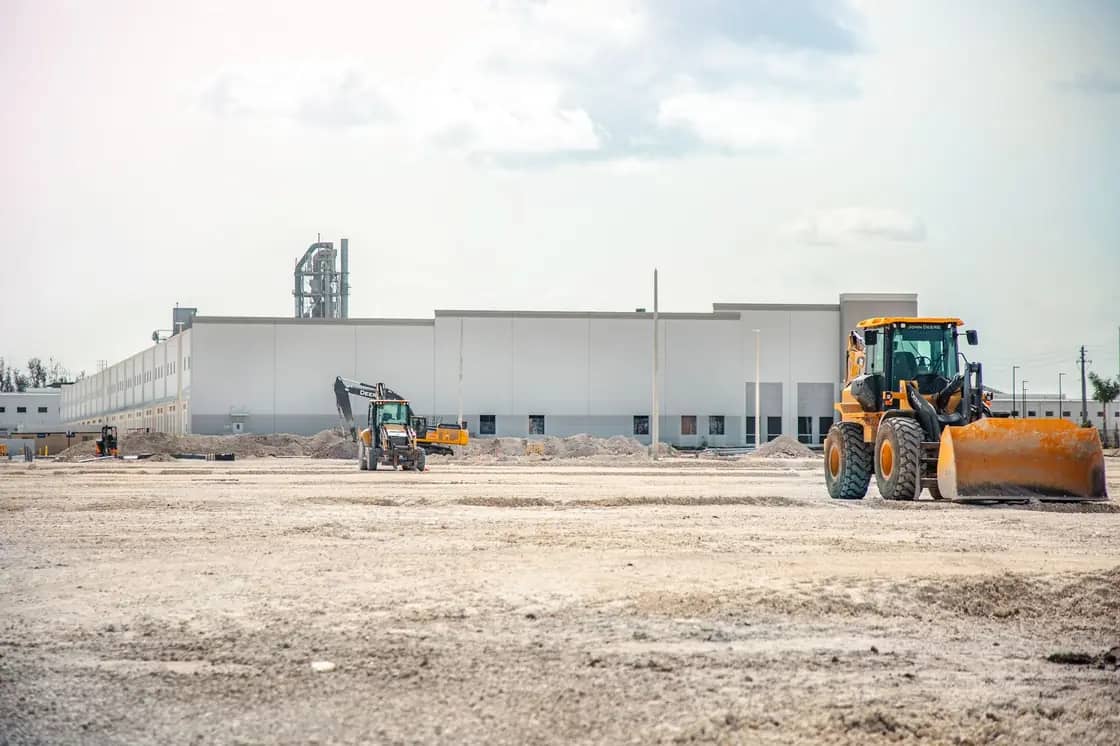
Between demolition finishing and construction starting in earnest, years passed, and the gap confused a lot of people who drove past a very large empty parcel in a county desperate for buildable land.
Several things were happening in that period, none of them visible from the road.
Environmental characterization and remediation. Establishing what is in the ground across a site of that size is a slow technical process, and the remediation that follows is slower. Nothing gets financed or entitled until this is resolved to the satisfaction of regulators, and lenders will not lend against uncertainty of that kind.
Entitlement. Converting heavy industrial land into a master-planned mixed-use community requires zoning changes, development agreements, and a municipal framework capable of administering them. Vineyard was a very small city being asked to govern a very large project, and building that capacity took time.
Infrastructure sequencing. Water, sewer, power and roads had to be sized for a population that did not yet exist. Utilities for a steel mill are not utilities for a city.
Capital timing. A project of this scale needs financing conditions that permit long-horizon commitments, and those conditions come and go.
The lesson generalizes to every large redevelopment site: the visible construction phase is the short part. The invisible phase — testing, cleaning, entitling, financing and servicing — is where most of the calendar goes, and it is why "nothing is happening" is usually wrong.
The air, and why it still comes up
Any discussion of Geneva that omits air quality is incomplete, and long-time residents will not omit it.
The mill was a major emissions source in a valley whose geography traps air. Utah Valley sits in a bowl, and winter inversions hold a lid on it for days or weeks at a time. What was emitted did not disperse; it settled and stayed, and the relationship between the mill's operation and the valley's air was studied and argued over for years.
That history matters to the development story in two ways. It is a substantial part of why the closure was experienced by the valley as ambivalent rather than purely as loss — the economic blow was real and so was the change in the air. And it shapes how residents receive new development on the same ground: a population that has seen what industrial activity did to a bowl-shaped valley reads promises about a new development's environmental performance with a longer memory than a newcomer does.
Air quality remains a live regional issue driven now by traffic and other sources rather than by steelmaking, which is one reason the transit-oriented framing of what is being built there carries more local weight than it might elsewhere.
What it does to the rest of the county
It shifts the valley's center of gravity north, again. Utah Valley's growth has been moving north for years, following the technology corridor. A dense new node on the lakeshore reinforces that, and it does so with a rail connection the corridor's other centers largely lack.
It changes the housing mix, not just the housing count. Most new supply in this valley has historically been detached and semi-detached housing. A large share of what is being added here is denser product near transit, which serves a different household type and, over time, alters what the county's stock looks like.
It raises the water and lakeshore question. Development along the Utah Lake shoreline sits inside a live and contested set of issues concerning the lake's ecology, water levels and long-term management. This is a real subject with genuine disagreement, and anyone reading a purely promotional account of lakeshore development is getting half the picture.
It is a template other sites will be measured against. There are other legacy industrial and institutional sites in this state. How Geneva turns out will shape how those are approached.
It concentrates traffic in a corridor that was already constrained. Rail helps and does not solve it. The lakeshore road network is the pressure point, and it will remain so through build-out.
Reading the project honestly
A few habits, if you want to follow this rather than be marketed to.
Distinguish announced from permitted from built. Renderings are marketing. Permits are commitments backed by fees. Completions are facts. Our guide to reading the Utah Valley housing market explains how to watch permit data, which is the most reliable early indicator of what is happening on a site like this.
Watch the phasing, not the master plan. Master plans describe a destination. Phasing describes what is being funded now.
Treat timelines as estimates. Large mixed-use projects routinely take longer than announced. That is normal, not scandalous, and it is not evidence of failure.
Read the opposition as well as the promotion. There are substantive critiques concerning density, traffic, lake ecology and whether the commercial component will fill at the scale planned. Those critiques are not automatically right, and a reader who has not encountered them has not understood the project.
If you are thinking of moving there
Consider what stage you are buying into. A planned community mid-build is a different proposition from a finished one: construction is ongoing around you, amenities arrive on a schedule you do not control, and the streetscape you buy into is not the one you will live in. Some people find that exciting and some find it exhausting.
The advantages are real and specific — rail access unmatched in Utah Valley, a lakeshore position, new housing stock, a young community, and a plan rather than accretion. The trade-offs are equally real: density unlike its neighbors, HOA structures that are near-universal in this kind of development, a construction environment for years yet, and amenity provision that is still catching up in places.
Our guide to living in Vineyard covers the day-to-day. This page is about why the place exists at all.
What a "master-planned community" commits to
The phrase gets used loosely enough to mean almost nothing, so it is worth being precise about what it does and does not guarantee.
What it does mean is that street layout, land use, density, open space and phasing were designed together before construction rather than emerging parcel by parcel. That is different from how most of this valley was built, and it produces visible results — continuous trail networks, coordinated street grids, mixed uses placed deliberately rather than wherever zoning permitted.
What it does not mean is that the plan is a promise. Master plans are amended, sometimes substantially, as market conditions and ownership change over a build-out measured in decades. A commercial parcel can become residential. A planned amenity can be deferred, resized or dropped. The governing document is the development agreement between the city and the developer, not the brochure, and it is a public document that can be read.
For a buyer the practical translation is to weight what is built and permitted far above what is planned, and to understand that the community you are buying into will be revised. That is not a criticism of any particular project — it is how developments of this length work everywhere.
The name confusion, cleared up
Three names get used interchangeably in conversation and they are not the same thing, which makes a lot of local discussion harder to follow than it needs to be.
Vineyard is a city — an incorporated municipality with a mayor, a council and boundaries. It existed before the redevelopment and it contains far more than the former mill land.
The Geneva site is the land the steel mill occupied. It is a geography, not a project, and parts of it are being developed by different parties for different uses.
Utah City is one development on part of that land — the large master-planned mixed-use project running from the rail station toward the lake. It is the most visible thing happening on the site and it is not the whole of it.
So a statement like "Vineyard is building a downtown" compresses three distinct things: a city, a parcel with an industrial history, and a specific private development inside both. Keeping them separate makes it much easier to read planning coverage, to understand who is deciding what, and to work out which body to contact when you have a question — the city governs land use, while the developer builds within what the city has approved.
The short version
A federally financed wartime steel mill occupied an enormous lakeshore parcel for sixty years, closed in 2001, and was dismantled in the years that followed. What made it redevelopable was not just the land but the shape of the land: one owner, one contiguous site, one very small city, and remediation that had to happen before anything else could. Rail arrived in 2022, road capacity followed, and a university anchored the north end.
What is being built there now is an ambitious attempt at a genuine urban center for this county. Whether it becomes one is a question that will take decades to answer, and the honest way to follow it is through permits and completions rather than renderings.
Related Guides
- Geneva Steel history
- Utah City in Vineyard, explained
- Living in Vineyard
- Vineyard neighborhoods
- The Utah Valley housing market, read honestly
- Impact fees in Utah Valley
Frequently Asked Questions
What was the Geneva Steel site and what is there now?
Why did the site stay empty for years after demolition?
Why is Vineyard growing so fast?
What infrastructure made the development possible?
How does this change the rest of Utah County?
Is the development controversial?
How do I follow what is being built rather than announced?
Why does air quality keep coming up in discussions about Geneva?
Sources
The facts in this guide were checked against these sources. Hours, fees and rules change, so confirm anything time-sensitive with the source before you go. How we make Provo.com.
- Anderson Geneva Development Inc. (formerly Geneva Steel, LLC), Utah Department of Environmental Quality. Checked October 12, 2026.
- Columbia Steel Co., near Provo, Utah. Nov., 1942, Library of Congress. Checked October 12, 2026.
- H.C.R. 16 (2018) Concurrent Resolution Honoring President Holland, Utah Legislature. Checked October 12, 2026.
- Station Area Planning, Mountainland Association of Governments. Checked October 12, 2026.
- Decennial Census PL 94-171, Vineyard (place 80420), 2010, U.S. Census Bureau. Checked October 12, 2026.
- City and Town Population Totals (SUB-EST2025), U.S. Census Bureau. Checked October 12, 2026.