Brenda Gonzalez didn't feel well the morning it happened, but she told KSL that wasn't unusual for her. Later that school day at Mountain View High School in Orem, she collapsed with a heart attack, and her heart stopped. Physical education teacher Jordan Blanchard heard what was happening and ran to give her CPR before paramedics arrived, KSL reported Wednesday, Nov. 26.
Gonzalez, a student mentor at the school, had emergency surgery and two stents placed in her heart. She was told she had a 10% chance of survival. She is back at work now, KSL reported, working through a slow rehabilitation. "If they weren't ready, I wouldn't be here," she said.
Her story lands a few weeks after a new Utah State Board of Education rule took effect that requires every school to have, and practice, a plan for this exact situation.
| Where | Mountain View High School, Orem |
| When | During school hours in April, KSL reported |
| Who helped | PE teacher Jordan Blanchard gave CPR before paramedics arrived |
| Treatment | Emergency surgery, two stents |
| Today | Back at work, in rehabilitation |
| State rule | School cardiac emergency plans required (R277-465, effective Oct. 8, 2026) |
What happened
KSL's Mckenna Rodriguez reported that the heart attack came with no warning that Gonzalez or her family could see. Her daughter, Alethia Rodriguez, told KSL that her mother ate a healthy diet, exercised regularly and had recently had a physical.
That is part of what makes sudden cardiac arrest so dangerous: it can happen to anyone, anywhere, including at work and in front of people who have never had to act in an emergency. What Gonzalez had going for her was a coworker who knew what to do and did it immediately.
The medical bills have been hard on the family, KSL reported. Her daughter started a GoFundMe to help with medical costs and recovery. "I am very grateful for them and for everyone that has been donating. It's overwhelming," Gonzalez said.
KSL's story does not say whether an automated external defibrillator, or AED, was used, how long CPR went on, or which hospital treated her, so we don't either.
"Every school should have a plan"
Gonzalez's message for other schools was simple. She credited her coworkers' readiness and said every school should have a plan for medical emergencies, KSL reported.
As of this fall, Utah law and state board rules require one. Rule R277-465, "CPR and Cardiac Emergency Response Plans in Schools," took effect Oct. 8, 2026, according to the Utah State Board of Education. It says:
- Schools are required to develop a cardiac emergency response plan, or CERP, that meets the requirements of Utah Code 53G-9-216.
- Schools must review and update the plan by June 30 every year.
- Schools must run CERP training and drills at least once a year, and the drills must cover cardiac emergencies before, during and after school hours.
- Schools must check all emergency response equipment as part of the annual review, and replace supplies as needed.
- Schools must designate a CERP team, which may include school nurses, athletic trainers, teachers and other staff the administration assigns.
- CPR certification for that team must come from an approved provider and cover adult and pediatric CPR, first aid and AED use. Schools must keep copies of the certifications.
- Schools report compliance every year through the state's School Health Workload Report.
The rule does not spell out where AEDs go or how many a school needs. Parents who want to know their school's plan can ask the front office or the school nurse who is on the CERP team and when the last drill was.
Students learn CPR too
The same rule covers students. A school district or charter "shall provide high-quality, hands-on CPR instruction at least once to each student between grades 9 through 12," the state board's rule says, with limited exceptions in state law. Students in online-only programs don't have to do the hands-on portion. Under the state's CPR training grant program, instruction must be taught by a certified instructor, with no more than 15 students per instructor when possible.
That requirement started with SB192, which was signed in March 2022 and took effect in the 2022-23 school year, KSL reported at the time. The bill funded CPR training and made it a required part of high school health classes statewide.
The point is numbers. Nearly 1,500 Utahns have a sudden cardiac arrest outside a hospital each year, and about 10% survive, Jennifer Merback, a spokeswoman for the American Heart Association's Utah division, told KSL in 2022. "Bystander CPR can mean the difference between life and death," she said. Every Utah graduate who has practiced CPR is one more person who might know what to do in a grocery store, a church gym or a school hallway.
Mountain View High and its district
Mountain View serves west Orem and most of Vineyard. It is in Alpine School District for now and moves to the new Timpanogos School District on July 1, 2027, when that district takes over schools in Orem, Lindon, Pleasant Grove and Vineyard. Our Mountain View High School guide has the bell schedule, boundaries and contacts, and our Timpanogos School District guide explains the split.
What to do if someone collapses
You don't need to be a teacher or a nurse to do what Blanchard did. These steps come from MedlinePlus, the National Library of Medicine's consumer health site:
- Check if they respond. Tap or gently shake the person and shout, "Are you OK?"
- Call 911 if there is no response. If someone else is nearby, have them call while you start.
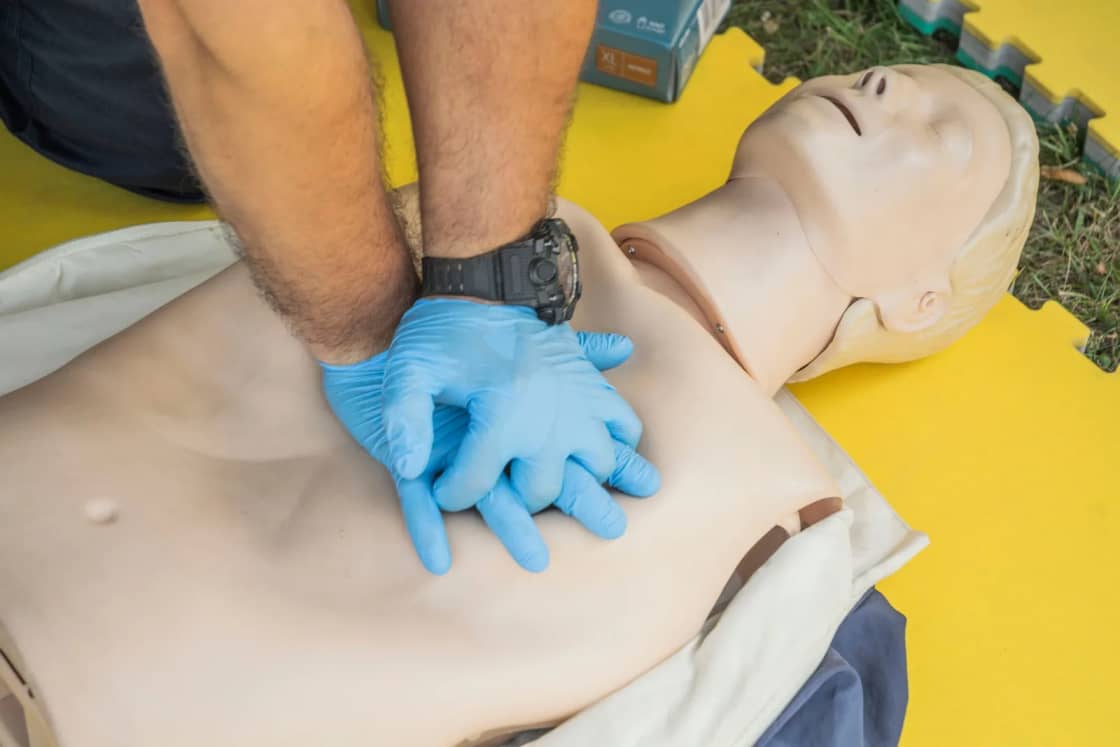
- Push hard and fast. Put the heel of one hand in the center of the chest, between the nipples, with your other hand on top and fingers laced. Press down about 2 inches, at 100 to 120 compressions per minute.
- Use an AED as soon as one is available, and follow its spoken instructions exactly. Many schools, gyms, churches and offices have one on the wall.
- Keep going until paramedics take over or the person starts breathing.
If you're unsure, stay on the phone. Utah adopted a rule in 2022 requiring high-quality CPR training for dispatchers and emergency call takers, so they can recognize cardiac arrest and coach callers through CPR while help is on the way, KSL reported. An American Heart Association Utah board leader told KSL that a dispatcher who coaches CPR well "could double or triple the chances of survival."
Where to learn CPR in Utah County
A class takes a few hours and gives you practice on a manikin, which is the part that makes it stick. Our CPR and first aid classes guide lists American Heart Association and Red Cross courses in Provo, Orem and across Utah County, plus what they cost and which ones count for work certifications.
If you work at a school, ask whether you're on your building's CERP team. If you coach youth sports, teach a class at church or run a gym, find out where the nearest AED is before you need it.
How to help
KSL reported that Gonzalez's daughter set up a GoFundMe to cover medical and recovery costs. KSL's story links to it. As with any online fundraiser, give through the link in the original news story rather than one shared on social media, and use your own judgment.
Related on Provo.com
- CPR and first aid classes in Utah County
- Mountain View High School guide
- Timpanogos School District guide
- Utah Valley Hospital guide
Frequently Asked Questions
What happened at Mountain View High School?
How is Brenda Gonzalez doing now?
What did she say about the people who helped her?
Do Utah schools have to have a cardiac emergency plan?
Do Utah high school students have to learn CPR?
What should I do if someone collapses and isn't responding?
How common is cardiac arrest in Utah?
Where can I take a CPR class in Utah County?
Sources
The facts in this guide were checked against these sources. Hours, fees and rules change, so confirm anything time-sensitive with the source before you go. How we make Provo.com.
- R277-465. CPR and Cardiac Emergency Response Plans in Schools, Utah State Board of Education. Checked November 27, 2026.
- CPR - adults and children after onset of puberty, MedlinePlus, National Library of Medicine. Checked November 27, 2026.
- Orem PE teacher saves colleague's life with CPR, KSL.com. Checked November 27, 2026.
- If your heart stops, a Utah high schooler may be able to save you, KSL.com. Checked November 27, 2026.