Pipe Spring is a small national monument just south of the Utah line on the Arizona Strip, the country between the Grand Canyon and the Utah line. It preserves a spring, a fortified 1870s ranch house called Winsor Castle, and the story of the Kaibab Paiute people, whose reservation surrounds it. From Provo, it fits on a southern Utah trip alongside Zion or Kanab. This guide covers its history and how to visit, from the National Park Service. For the region around it, see our Kanab guide.
Quick facts
| Question | Answer | Source |
|---|---|---|
| Where | 15 miles west of Fredonia, Ariz.; 45 miles east of Hurricane, Utah | NPS |
| Hours | Daily, 8:30 a.m. to 4:30 p.m. Arizona time | NPS |
| Closed | Thanksgiving, Christmas, New Year's Day | NPS |
| Fee | $10 per person 16 and older; cards only | NPS |
| Time zone | Mountain Standard Time all year | NPS |
| Monument since | May 31, 1923 | NPS |
| Phone | 928-643-7105 | NPS |
| From Provo | About 289 miles, 5 hours | OpenStreetMap (OSRM) routing |
The spring and the Kaibab Paiute
"Pipe Spring is a water source in the desert that has been used by humans for thousands of years," the Park Service says. A presidential proclamation described it as "the only water along the road between Hurricane, Utah, and Fredonia, Arizona," a distance of 62 miles.
The Kaibab Paiute lived around the spring long before ranchers came. As settlements spread, the band lost much of its land, and livestock grazing cut into the native foods it relied on, the Park Service's brochure says. A reservation created in 1907 returned a small part of its territory. Today "the reservation of the Kaibab Band of Paiute Indians surrounds the national monument," and the Kaibab Band of Paiute Indians Visitor Center and Museum tells the band's story, from its history and relations with other tribes to Paiute culture today.
The ranch and Winsor Castle
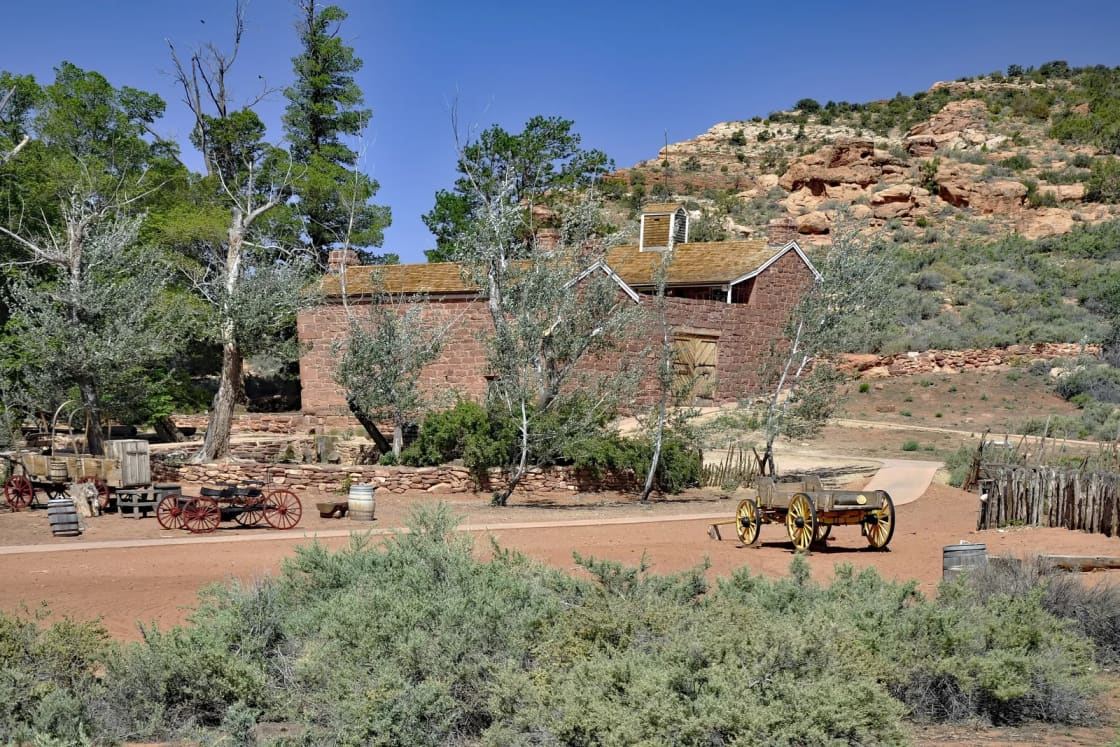
Latter-day Saint ranchers moved onto the Arizona Strip's water sources in the 1860s, and James Whitmore took up land at Pipe Spring in 1863, the brochure says. Brigham Young later bought the claim for the church. "In September 1870 Young and Winsor stepped off the rough outlines of a fortified ranch house." The house, Winsor Castle, was named for Anson P. Winsor, the first ranch superintendent, and was built "to be a tithing cattle ranch," the Park Service says.
The church also put a station on the Deseret Telegraph line at Pipe Spring, which the brochure calls the first telegraph office in Arizona Territory. The historic buildings date from 1863 to about 1885.
Stephen Mather, the first director of the National Park Service, helped promote Pipe Spring as a stop for park visitors, the brochure says, and "on May 31, 1923 President Warren G. Harding proclaimed Pipe Spring a national monument."
Visiting
- Winsor Castle. About 150 yards, a five-minute walk, from the visitor center. The Park Service lists ranger-guided morning tours and open-house afternoons in summer; ask at the front desk for the day's times, since programs change with staffing and weather.
- The museum. The Kaibab Band of Paiute Indians Visitor Center and Museum is open daily, with a 25-minute introductory video and exhibits on Paiute history, Mormon settlement and modern Paiute culture.
- The garden and orchard. In summer, the garden grows pioneer and American Indian crops, and the orchard has historic varieties of peach, apple, apricot, plum and crab apple, plus grapes.
- The Ridge Trail. A half-mile trail with views across the Arizona Strip.
Plan on about two hours: the Park Service suggests half an hour for Winsor Castle, half an hour to an hour for the museum and about 30 minutes for the trail.
Time. Arizona does not observe daylight saving time, so from March to November the monument's clock runs an hour behind Utah's. Its posted hours are Arizona time.
Paying. The fee is $10 per person 16 and older, including a $3 tribal use fee, and the park does not accept cash. America the Beautiful annual, senior and access pass holders get in free with up to three companions.
Getting there from Provo
Pipe Spring is about 289 miles and 5 hours from downtown Provo by an OpenStreetMap (OSRM) routing estimate without traffic. The Park Service gives the last stretch as 45 miles east of Hurricane on UT 59, which becomes AZ 389, or 15 miles west of Fredonia on AZ 389. It pairs with Zion and St. George on one side and Kanab on the other. For lodging along the way, see our guide to where to stay for Zion.
Related reading
- Kanab and Best Friends Animal Sanctuary
- Zion and St. George from Provo
- Where to stay for Zion
- July 1847, day by day
Frequently Asked Questions
What is Pipe Spring National Monument?
How much does Pipe Spring cost?
What are Pipe Spring's hours?
Who was Winsor Castle named for?
Where is Pipe Spring?
How long does a visit to Pipe Spring take?
Sources
The facts in this guide were checked against these sources. Hours, fees and rules change, so confirm anything time-sensitive with the source before you go. How we make Provo.com.
- Basic Information, National Park Service, Pipe Spring. Checked November 27, 2026.
- Operating Hours and Seasons, National Park Service, Pipe Spring. Checked November 27, 2026.
- Fees and Passes, National Park Service, Pipe Spring. Checked November 27, 2026.
- National Park Service, Pipe Spring: Things to Do, National Park Service, Pipe Spring. Checked November 27, 2026.
- Frequently Asked Questions, National Park Service, Pipe Spring. Checked November 27, 2026.
- Pipe Spring park brochure, National Park Service (via NPS History). Checked November 27, 2026.
- History and Culture, National Park Service, Pipe Spring. Checked November 27, 2026.