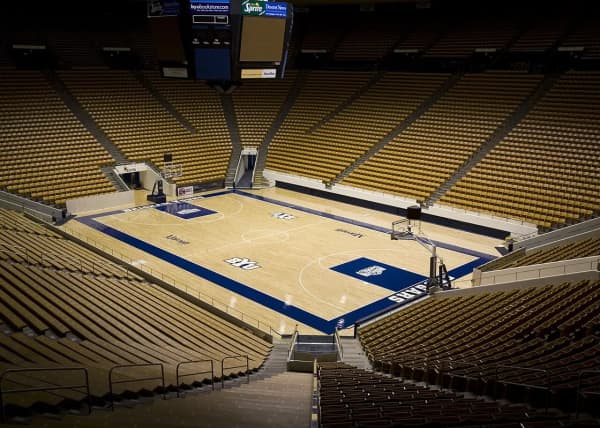

Applications to teach at BYU Education Week 2027 are accepted from September 15 to September 30, 2026. Sixteen days. BYU states that materials arriving after September 30 will not be considered, and that successful and unsuccessful applicants alike hear back by February 2027.
That window is the reason this page exists now rather than in September. Almost everything written about Education Week is written for the roughly twenty thousand people who attend. Very little is written for the several hundred who apply to stand at the front of a room, and the application is more demanding, more specific and more easily failed on a technicality than most people expect.
The dates BYU has already published, and where they are hiding
The 2027 program runs Monday, August 16 through Friday, August 20, 2027.
That is worth stating plainly because it is not where anyone would look for it, and we covered the find itself separately. BYU published the 2027 dates on the Apply to Teach page, in a parenthesis under the application period — "for the program held August 16–20, 2027." The page sits under the site's More menu, behind the FAQ. At the time of writing, the Education Week homepage, the registration page and the schedule page were all still presenting 2026.
If you are planning a proposal, those dates are the fixed point everything else hangs from. Our BYU Education Week 2027 entry collects what is confirmed for next year and, more usefully, what is not.
What you have to submit
BYU asks for four items, and they do not all travel through the same channel. That is the first place applications go wrong: the online form is only one of the four, and the other three arrive by email.
1. The online application. Two links, one for current BYU employees and one for everyone else. Both go live on September 15. Before you start it, have a résumé ready to attach and your Church Membership Record Number to hand.
2. Titles and outlines of your proposed classes. Emailed to educationweek@byu.edu, in Microsoft Word format. BYU is unusually direct about why: the material is cut and pasted into a database, and PDFs do not copy and paste well. Sending a beautifully typeset PDF is a way of making your proposal harder to process.
3. A résumé. Attached during the online application, or emailed.
4. A video of at least twenty minutes showing one of your presentations. Post it on YouTube or anywhere else that does not require a login, then email the link. This is waived only for current full-time BYU or Seminary and Institute faculty — the emphasis on full-time is BYU's.
On the video, BYU is reassuring in a way that is easy to miss: it does not need to be a professional taping. They simply want to observe how you approach a topic. Spending three weeks producing a polished film is effort spent in the wrong place; twenty honest minutes of you teaching is the ask.
The eligibility standard, stated exactly
This is the part that determines whether the rest is worth your time, so it belongs early rather than late.
BYU applies the Church Educational System employment standard announced on January 27, 2022, in the news release "Church Educational System Announces Refinements to Employment Standards." Under it, new employees who are members of the Church are required to hold and be worthy to hold a current temple recommend. BYU's instruction to applicants follows from that: have a current temple recommend before completing the application, because the application cannot be processed otherwise.
Two further mechanisms sit inside the form. The application contains an ecclesiastical authorization and release, and the Church's Ecclesiastical Endorsement Office contacts each prospective presenter's ecclesiastical leader directly about employment eligibility. The application also contains an authorization for a background check, which BYU notes is required for instructors who plan to teach youth classes.
None of that is unusual for a Church Educational System appointment. It is worth knowing in advance that your ecclesiastical leader will be contacted as part of the process rather than discovering it mid-application.
The format BYU wants, which is more specific than "a class"
The preferred shape of an Education Week offering is a series of four related 55-minute lectures, one each day, Tuesday through Friday.
The constraint inside that is the interesting one. The four lectures share a series title and are related — but each one has to stand on its own. BYU states that students should not need to have heard the other lectures to follow any single one, and that it is inappropriate to open with a lengthy recap of preceding lectures. In practice that rules out the most natural way to build a four-part course, which is cumulatively. You are writing four self-contained talks that rhyme, not four chapters.
The reason is structural rather than pedagogical: classes are first-come, first-seated, held in large rooms, and attendance turns over between days. A Thursday audience is not Tuesday's audience.
You may submit a maximum of two series proposals — eight lectures in total. A single standalone 55-minute class is also acceptable, and then no series title is required.
Lecture style is recommended. BYU says so directly, and the reason given is the room: hundreds of attendees in a large space. Formats that depend on small-group work or close discussion do not survive that geometry. Anyone who has sat in a BYU devotional or forum has seen the format that Education Week rooms are closest to.
The outline format, and the two-page cap
Each 55-minute class needs its own outline. BYU's specification:
- A descriptive paragraph for the class.
- A bullet list of the main teaching points to be presented.
- One or two references per teaching point, with complete citations for any quotations.
- No more than two pages per 55-minute class.
BYU publishes a worked example — a four-lecture series with a series title, four class titles and a fully expanded first class showing six teaching points, each with its supporting scripture or quotation. It also publishes a separate "Guidelines for Preparing Your Presentations" PDF, linked from the application page, which it asks applicants to read before preparing outlines.
The two-page cap is the part to design around. Six teaching points with citations fills two pages quickly, and a proposal that runs long signals that the class will run long.
The title rules, which are the most exacting part of the application
Titles are capped at fifteen words and screened against a list of stated preferences. Read as a set, they describe a house style rather than a set of prohibitions:
- Be concise but descriptive of the content — the title should reflect what you will teach, not function as an enticement.
- If your titles are religious in nature, model them on General Conference talk titles.
- Do not use the titles of your own published or marketed materials as class titles.
- Avoid absolutes. BYU's phrasing is worth keeping: "There is rarely a best, most important, or easy anything."
- Avoid implying secret or never-before-known information, or knowledge unavailable to the general populace.
- No titles that are speculative or open to misunderstanding or misinterpretation.
- No title suggesting a specific relationship with a single member of the Godhead.
- Nothing dwelling on the negative, playing devil's advocate, or likely to provoke disagreement among students.
- On sacred subjects, no frivolous, joking or sarcastic slant.
- Be sensitive to men's and women's feelings, and avoid wording that downplays the importance of either a man's or a woman's role.
- BYU Continuing Education programs are not a forum for controversial issues.
A useful way to use that list is as a pre-submission checklist rather than as reading. Most rejected titles fail on two of them: an absolute, or a promise of hidden knowledge.
The commercial rule, which is screened at application and enforced in the room
Education Week classes are not a venue to reference your own commercially available materials or to promote a company or professional services. BYU states this in the general instructions, repeats it in the faculty qualifications as a willingness applicants must demonstrate, and enforces it again in the title rules by barring the titles of published or marketed materials.
For anyone whose teaching and whose business are the same subject, that is a real constraint and it is better understood before writing a proposal than after being accepted.
What the review committee is weighing
BYU lists its faculty qualifications explicitly, and they split into two halves.
About you: educational and professional background, with sound preparation in the proposed field; teaching ability and communication skills; appearance, sincerity, attitude of sharing, and personal testimony; willingness to adhere to the no-promotion policy; ecclesiastical endorsement.
About the subject: timeliness, practicality, pertinence and appropriateness of topic; necessity of the topic to balance the program; and clearance of titles and lecture outlines from a review committee.
That middle criterion is the one applicants underestimate. "Necessity of topic to balance the program" means a strong proposal on a subject already well covered by returning presenters can lose to a weaker proposal in a thin part of the catalog. It is a portfolio decision, not only a merit decision, and it is not something an applicant can fully see from outside.
The AI warning, stated twice
BYU includes the same caution in two separate places on the application page: the use of AI often generates inaccurate quotes, and applicants should verify every quote against original sources.
That is a striking thing to find on a presenter application, and it is not decorative. Outlines require complete citations for each teaching point, and those outlines go to a review committee that clears them. A fabricated quotation, or a real quotation attributed to the wrong speaker or the wrong conference, is exactly the kind of error a committee reviewing hundreds of scripture-and-talk citations is well positioned to catch.
The guidelines document, which is where the real editorial standard lives
BYU links a separate PDF from the application page — "Guidelines for Preparing Your Presentations" — and asks applicants to read it before writing outlines. It is one page, it is easy to skip, and it does more to explain why proposals get turned down than the application page does.
Its opening premise is broader than most applicants assume: all presentations should be consistent with the principles of the restored gospel of Jesus Christ, regardless of subject matter. For readers unfamiliar with the structure that assumption sits inside, our explainer on how Latter-day Saint wards work covers the local units whose leaders provide the endorsement. That applies to the finance class and the family-history class as much as the scripture class. A proposal on retirement planning is still being read as an Education Week proposal.
On sources, there is an explicit hierarchy. Give priority to the scriptures and to the current emphases and teachings of living prophets, apostles and general Church leaders — and, specifically, to teachings that are recent, repeated and established. That last triplet is a usable filter. A single striking line from one talk forty years ago is weaker support, in this context, than a theme leaders have returned to repeatedly. The document also asks applicants to consider the context of scriptures and quotations and to stay faithful to their intended meaning as shown in repeated teaching — which is the same concern that produces the warning about AI-generated quotations, arriving from the other direction.
On tone, the instruction is to build. Messages may acknowledge that people have differences and challenges, but should not foster doubt, contention or misunderstanding; they should address the positive, provide encouragement, and stress personal growth and application. On sacred or sensitive topics, the guidance is to align with the patterns modeled in Church leadership messages rather than to strike out independently.
And then there is a list of five things to avoid, which is the most concretely useful part of the document and has no equivalent on the application page:
- Anything that distorts Church doctrine or distracts from gospel truths.
- Doctrinal speculation or personal interpretation.
- Leadership training that falls under priesthood keys — training for callings.
- Prescriptive statements — the example given is the "if you do A, then B will happen" construction.
- Giving individual counseling — financial, marital, parental.
Those last two catch a great deal of otherwise strong material. The prescriptive-statement caution rules out the promise structure that most self-improvement teaching is built on, and the individual-counseling caution draws a line between teaching a principle and advising a person. A class on family finances can explain how a budget works; it cannot tell the room what to do about their debt. A class on marriage can teach a principle; it cannot conduct counseling from the front of a lecture hall.
Read alongside the title rules, a consistent editorial position emerges. Education Week is a teaching program, not an advice program, and not a platform for a presenter's own reading of doctrine.
What the odds look like
The review is lengthy.
The useful inference is not a success rate — BYU does not publish one — but the shape of the competition. A large share of each year's presenters are returning presenters with an established audience, which is what makes the "necessity of topic to balance the program" criterion decisive for a newcomer. The realistic opening is not a better version of a subject the catalog already covers well. It is a subject the catalog is thin on, taught by someone whose résumé and video make the qualification obvious.
Both of these come straight from BYU's own instructions, and both are the kind of thing that costs an evening.
After attaching your résumé, do not click the "Add" buttons associated with Experience, Education, Certifications, Languages or Skills. Doing so opens a long series of fields the application does not otherwise require.
Do not click "Save and Continue" until you have scrolled to the bottom of the page and answered every question.
A working timeline
- Now through mid-September 2026 — decide your series, draft outlines, record or locate a twenty-minute teaching video, confirm your temple recommend is current.
- September 15, 2026 — the application links go live.
- September 15–30, 2026 — submit the online application; email titles and outlines in Word, your résumé, and the video link.
- September 30, 2026 — hard deadline. Late materials are not considered.
- By February 2027 — BYU responds.
- August 16–20, 2027 — the program.
The gap between the deadline and the reply is about four months, which is worth planning around if the answer affects your other commitments.
If you are not applying, but the week affects you anyway
Education Week is the largest thing that happens in Provo in August that has nothing to do with football or move-in, and its effects reach well past campus. If you live here, the practical consequences — traffic on University Parkway, hotel availability across the valley, restaurant waits — are covered in our Education Week guide, which also carries the attendee-side detail on tuition, parking, campus housing and the under-14 rule. Visitors deciding where to stay that week will find the valley's options in our hotels near BYU guide, and anyone navigating campus for the first time can start with the BYU campus visitor guide.
The short version
Sixteen days, four items, three of them by email and one in Word. A twenty-minute video that does not need to be polished. A current temple recommend before you start. Four related but self-contained 55-minute lectures, two series maximum, fifteen words per title, two pages per outline, complete citations, no absolutes, no promotion. Deadline September 30, 2026; answer by February 2027; program August 16–20, 2027.
Frequently Asked Questions
When can I apply to teach at BYU Education Week 2027?
What do I have to submit to apply?
Do I need to be a member of the Church to teach at Education Week?
How long are Education Week classes, and how many would I teach?
Is there a limit on how long class titles can be?
Can I promote my book or business in my Education Week class?
When will I hear back about my application?
Does BYU say anything about using AI to prepare a proposal?
Sources
The facts in this guide were checked against these sources. Hours, fees and rules change, so confirm anything time-sensitive with the source before you go. How we make Provo.com.
- Apply to Teach, BYU Education Week (BYU Continuing Education). Checked October 12, 2026.
- Church Educational System announces refinements to employment standards, BYU News. Checked October 12, 2026.
- Education Week 2026: something for everyone, The Daily Universe (BYU). Checked October 12, 2026.