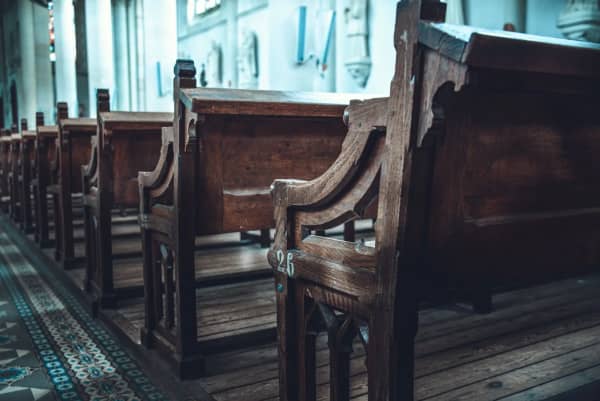

If you move to Utah Valley without a background in The Church of Jesus Christ of Latter-day Saints, one word will do more work in local conversation than any other, and nobody will stop to explain it: ward.
People will ask which ward you are in. A rental listing will mention that the complex is "in a family ward." Someone will say the ward is doing a service project on Saturday. It sounds like a neighborhood, and it nearly is one — but not quite, and the difference explains a surprising amount about how this valley works: why strangers knock on your door in your first week, why an apartment complex has a social life, why the streets empty at a particular hour on Sunday morning.
This guide is written for people who are not members and want to understand what is going on around them. It is descriptive, not persuasive. Nothing here is an argument that you should join anything.
The short version
- A ward is a local congregation, usually a few hundred people.
- You do not pick it. It is assigned by your home address.
- Everyone in the boundary attends the same building at the same time.
- The bishop who leads it is an unpaid volunteer with a day job.
- Anyone may attend a Sunday meeting. Temples are different and are not open to the public.
- Several wards make a stake. A smaller congregation is a branch.
Geography, not choice — and this is the key idea
Most congregations in most faiths are chosen. You visit a few, you like one, you go there.
Latter-day Saint congregations are assigned by where you live. Draw a set of boundaries on a map, and everyone inside them belongs to that ward. Members are asked to attend the ward they live in rather than shopping for the one they like best, and boundaries are redrawn when a ward grows too large.
This one structural fact produces most of what a newcomer notices:
Your congregation is your neighborhood. The people at church are the people on your street, whether or not you would otherwise have chosen each other. That is a genuine social strength and it is also, by design, not optional.
Moving house can mean changing congregations. Crossing a boundary — even a short move within the same city — can move a family into a different ward, with different leaders and a different Sunday schedule.
A boundary line is a real local fact. Ward boundaries are one of the invisible maps laid over Utah Valley, alongside school boundaries and city lines, and long-time residents know roughly where they run.
Who runs it, and the fact that surprises people most
The bishop is not paid. He is not a trained, salaried minister. He is a member of the congregation — an engineer, a teacher, a contractor — who was asked to serve and who does the job around a full-time career. He serves for a period of years and is then released, and someone else is asked.
Two counselors serve alongside him; together the three are the bishopric. According to the Church's General Handbook, the bishop presides over the ward, oversees its records, finances and use of the meetinghouse, and has particular responsibility for those in need.
The same principle runs through everything. Nearly every job in a ward — teaching a class, leading the music, running the youth program, organizing meals for a family with a new baby — is an unpaid assignment, called a calling, given to an ordinary member. The women's organization is the Relief Society; the children's is Primary.
Practical consequence for a newcomer: when a neighbor mentions they have "a calling," they are describing volunteer work, not a job. And when your street organizes a funeral lunch or a moving crew with startling speed, that is this system doing what it is built to do.
What actually happens on Sunday
Meetings run two hours. The Church's General Handbook sets a two-hour Sunday schedule; it was three hours until 2019, and older guides still say so.
- Sacrament meeting, the first hour, is the main worship service. It is held in the chapel, presided over by the bishop, and the distinguishing feature is that the talks are given by ordinary members rather than by clergy. Once a month it becomes a fast and testimony meeting, at which members speak without prepared assignment.
- The second hour rotates: Sunday School some weeks, and on others separate meetings for the Relief Society and for the men.
Buildings are shared. A single meetinghouse commonly hosts two or three wards at staggered start times, which is why a chapel car park fills and empties three times on a Sunday morning, and why start times differ between neighbors.
Twice a year, wards across a region gather for stake conference, and twice a year the whole Church holds general conference, broadcast from Salt Lake City — a weekend when a great many Utah Valley households are watching the same thing at the same time.
Visiting: what is open and what is not
Sunday meetings are open to anyone, member or not, believer or not. There is no ticket, no check-in and no obligation. Dress tends to be formal — a shirt and tie, a dress or smart trousers — but nobody will stop you at the door over it.
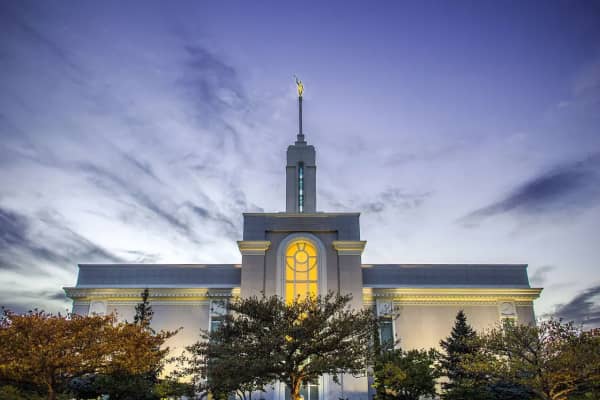
Temples are a different building and a different thing. They are not used for Sunday worship, they are not open to the general public, and entry requires a document called a temple recommend. The grounds are usually open and are often the nicest gardens in town. A newly built or renovated temple holds a public open house before dedication, which is the one window when anyone can go inside. Our guides to visiting a church in Provo and to Utah Valley's temples cover both in detail.
The distinction in one line: the chapel is the neighborhood building and everyone is welcome; the temple is the sacred one and it is not a tourist site.
Why the neighbors knock
Two things are happening, and they are usually mistaken for one.
The first is simply that a ward notices arrivals. Boundaries mean somebody keeps track of who lives where, so a new household is visible within days rather than months.
The second is a formal program called ministering, in which members are assigned specific households to check in on. It replaced the older programs known as home teaching and visiting teaching in 2018, and the name change was the point: fewer required monthly visits, more open-ended looking-after.
What this looks like on the ground: someone brings food when you move in. Someone asks whether you need help unloading a truck. Someone notices you have been ill.
If you are not a member, or simply would rather be left alone, saying so directly and pleasantly is normally sufficient and is not taken badly. What newcomers often misread as a sales approach is, in most cases, the local dialect for hello. It is also worth saying plainly that not everyone enjoys the visibility, and that is a normal thing to feel about a system built on knowing your neighbors.
YSA wards, student wards, and why your apartment decides your social life
This is where Utah Valley stops being typical.
Alongside family wards, the Church organizes young single adult (YSA) wards — congregations for single members ages 18 to 35. With BYU and UVU here, Utah Valley has one of the densest concentrations of them anywhere, plus married student wards for student couples.
That age range changed recently and most published material has not caught up. In a letter dated 18 July 2024, the Church's Priesthood and Family Department adjusted the classifications: "young single adult" now means unmarried members ages 18 to 35, and "single adult" means 36 and older. Until then the line sat at 30, with single adult beginning at 31. Where available, single adult wards now serve ages 36 to 45.
The follow-on details matter most in a place like this one. In areas with many young single adults — and Utah Valley is the densest concentration anywhere — leaders may recommend splitting units into a ward for ages 18 to 25 and a separate ward for ages 26 to 35, and Institute classes now run 18 to 35 with the same optional split. But the letter directs area presidencies to work with stake presidents on what suits their area, so implementation varies by stake: two neighboring stakes can handle it differently, and the only reliable way to know what your ward looks like is to ask locally rather than to read a number online. Our guide to life in Provo past undergrad covers what the change means socially for the 26-to-35 group it most affects.
The practical effect catches out every newcomer who rents near campus: the apartment complex you choose determines your ward, and therefore a large part of who you will meet. Some complexes are known as socially intense; others are quiet. Local renters discuss this openly, and it is a real factor in where students choose to live. Our guides to finding student housing in Provo and apartments near BYU cover the housing side.
And here is a detail almost nobody outside BYU knows. The Church publishes a meetinghouse locator that maps any address to its ward. BYU's own Space Management states that this locator is not always accurate for BYU on-campus wards, and BYU therefore maintains its own lists matching apartment complexes to ward assignments, coordinated through a campus liaison. BYU labels its units by letter — P for Provo YSA, O for Orem YSA, PM for Provo married student.
If you are a student, check BYU's list, not the general locator. That is the sort of thing that is obvious to everyone who has lived here and written down almost nowhere.
Three different knocks, and how to tell them apart
Newcomers often collapse three quite different visits into one. They are not the same and the right response differs.
1. Ministering neighbors. Members of your ward assigned to your household. They live nearby, they will usually say which ward they are from, and the purpose is checking in. Nothing is being asked of you.
2. Full-time missionaries. Young people, typically 18 to 25, in white shirts and ties or modest dresses, wearing black name badges with a surname and the Church's name, often on bicycles. These are the ones actually doing outreach, and they are not from your ward's ministering assignment — they are assigned to an area. Utah Valley has a lot of them partly because the Provo Missionary Training Center sits just north of BYU campus and sends missionaries worldwide every week.
3. Ward business. Somebody delivering a schedule, inviting the street to a service project, or collecting for a food drive.
The badge is the tell. A black name badge means full-time missionary and therefore an invitation is coming. No badge means neighbor. In all three cases "no thank you, we're not interested" is a complete sentence, and it will not cost you anything socially — this is a valley where people say it regularly.
The part that is genuinely a safety net
A bishop's least-visible responsibility is material. The Church's General Handbook makes caring for those in need an explicit part of the role, and it comes with real resources behind it: members fast one Sunday a month and donate what the meals would have cost as a fast offering, which the bishop can use to help households in his ward with rent, utilities or food.
Two pieces of that system are visible to anyone in Utah Valley, member or not:
- Deseret Industries — a thrift store chain run by the Church that doubles as a job-training program. There is one in Provo at 1415 N State Street, and it is a normal part of the local secondhand economy. Our thrift and vintage guide covers the rest.
- The service response. When a household here has a new baby, a death, a house fire or a hospital stay, meals and help tend to appear rapidly and without being requested. That is not spontaneous goodwill alone; it is an organized system with names attached to households.
Why a newcomer should care even if they never attend anything: in an emergency, this infrastructure often extends past membership. Local wards routinely help non-member neighbors, and knocking on a bishop's door is a normal thing for anyone in the neighborhood to do.
If you actually want to visit
- Just turn up. No booking, no notification, no cost.
- Find the start time first, because a shared building runs two or three wards at staggered times and the sign outside will not always make it obvious.
- Sit near the back if you would rather not be conspicuous. Latecomers and early leavers are ordinary.
- Expect to be greeted, possibly a lot. A visitor is noticed.
- You will be offered the sacrament — bread and water — passed along the row. Simply passing the tray on is normal and nobody will comment.
- Nothing will be collected. There is no offering plate; donations are handled privately.
- You may be asked whether you would like to hear more. "Just visiting today, thanks" is a normal answer and ends it.
What to call it
The Church asks for its full name — The Church of Jesus Christ of Latter-day Saints — on first reference, with "the Church" or "the Church of Jesus Christ" as short forms, and "Latter-day Saints" for members. Guidance issued in 2018, under Church president Russell M. Nelson, specifically discourages "Mormon Church," "LDS Church," "Mormons" and "Mormonism." The most visible consequence was the renaming of the Mormon Tabernacle Choir to the Tabernacle Choir at Temple Square.
"Mormon" remains correct in proper names — the Book of Mormon, the Mormon Trail, the Mormon Battalion — and in historical usage.
Now the honest part, because a guide that only reports the preference will mislead you. The Associated Press updated its stylebook in March 2019 to follow the Church's preference, while still allowing "Mormon" where space, clarity or quotation require it. And in ordinary Utah Valley speech you will hear "LDS" constantly, including from members describing themselves. The formal preference and the local vernacular have not fully converged, and nobody is going to take offense at a newcomer who gets it wrong. If you want a safe default: say "the Church" and "Latter-day Saints."
A few things that are not what they look like
- The parking lot on a weeknight. Meetinghouses run youth activities, basketball, and service projects during the week. A full car park on a Tuesday is normal.
- "Ward" in a place name. Utah has a great many historical ward names attached to buildings and streets. It is a congregation, not a political district.
- Being asked what ward you are in. It is closer to "which part of town do you live in" than to a question about belief. A simple "I'm not a member" answers it fine.
- Sunday closures. Many local businesses close Sunday, and that is a business decision rather than a rule imposed on anyone. Our Sunday dining guide covers what stays open.
Related guides
- Visiting a Church in Provo
- Temple Visitor Guide: Utah Valley
- Faith Communities in Utah Valley
- Moving to Provo: The Complete Guide
- Finding Student Housing in Provo
- Restaurants Open on Sunday in Provo
- New to a Provo YSA Ward? The Practical Guide (2026)
- The Provo Newcomer's Guide — both of the calendars that run this valley, and what they change
- Missionary Farewells and Homecomings in Provo — how congregations are drawn and why yours is geographic
- The Institute of Religion at UVU
- Babysitting in Provo
- Release-Time Seminary, Explained
- Moving from California to Utah Valley: What Actually Changes (Taxes, the DMV, Schools, Air, Culture)
- LDS Singles in Utah Valley: YSA, Mid-Singles and Single Adults, the Three Tiers Explained (and What Changed in 2024)
- Finding Your Ward and Meetinghouse in Utah Valley
- October 2026 General Conference: The Saturday Afternoon Session, Talk by Talk
Frequently Asked Questions
What is a ward?
Do I have to be a member to attend?
How do I find out which ward I am in?
Is the bishop a paid minister?
Why do neighbors knock on the door when someone moves in?
How long are Sunday meetings?
What is a YSA ward?
What should I call the church and its members?