Blood is the one form of giving where the constraint is never money and rarely willingness. It is scheduling, eligibility, and the fact that the shortages arrive in the same seasons every year and still manage to surprise everyone.
This guide covers what governs a donation, what you have a right to be told, and why the most valuable donation you will make is probably in July.
The federal rules that decide whether you can donate
Blood collection in the United States runs on FDA regulation, and the donor eligibility requirements sit in 21 CFR Part 630. They are worth knowing because they explain most of what happens at the table, and because they are uniform — a rule in Part 630 is not a policy one organization chose and another did not.
Weight. Under Section 630.10(f)(5), the donor must weigh a minimum of 50 kilograms — 110 pounds. There is no local variation on this.
Skin examination. Under Section 630.10(f)(6), the phlebotomy site must be free of infection, inflammation and lesions, and the donor's arms and forearms must be free of punctures and scars indicative of injected drugs of abuse. The technician who looks at your arm is executing an enumerated federal determination, not forming an opinion.
Identity and a reachable address. This is the one people find intrusive until they know why. Section 630.10(g)(1) requires the establishment to obtain proof of identity and a postal address where the donor may be contacted for eight weeks after donation.
Eight weeks, specifically. The reason is post-donation notification: if testing later surfaces something relevant to your health or to the safety of the unit you gave, there has to be a working channel to reach you. It is a safety provision pointed at you, not a marketing list.
For students, that clause is a practical trap rather than an abstraction. A dorm address you are vacating in three weeks does not satisfy the purpose of the rule even if it satisfies the form. Give an address that will still find you — this is the single most common way a student donation ends up with no route back to the donor.
Acknowledgment. Before each donation, the establishment must provide information covering specified elements and obtain the donor's acknowledgment that they have reviewed it. Among those elements: that the donor has been informed they will be notified under 21 CFR § 630.40 of the basis for a deferral and the period of the deferral, that they have been given information on the risks and hazards of the procedure, and that they have the opportunity to ask questions and withdraw from the donation procedure.
That last one is a right, not a courtesy. You may stop.
Deferral: what you are owed if you are turned away
Section 630.10(h) is explicit. If a donor is found ineligible before collection — under the criteria in Sections 630.10 or 630.15, or deferred under other provisions — the establishment must not collect, must defer the donor, and must notify the donor of their deferral under 21 CFR § 630.40.
So if you are turned away, you are entitled to know why. Ask, and ask one more question than most people do: is this deferral temporary or indefinite, and if temporary, when does it end? Those two answers have entirely different consequences. A temporary deferral is a date on a calendar. Many people treat their first temporary deferral as a permanent verdict and never return, which is a quiet and completely avoidable loss to the supply.
Low hemoglobin is the most common reason for a same-day turn-away, and it is frequently temporary. Being deferred once is not a status.
What happens, start to finish
The procedure is shorter than the appointment, and knowing the shape of it removes most first-time anxiety.
Registration. Identity, the eight-week contact address, and the acknowledgment described above. Five minutes if the paperwork is prepared, longer if it is not.
Screening. A private conversation covering health history, medications, travel and risk factors, plus a finger stick for hemoglobin and a check of pulse, blood pressure and temperature. This is the slow part and the part where deferrals happen. It is also the part where being honest matters most — the questions exist because the answers change what is safe, and a donor who shades an answer is making a decision on behalf of a transfusion recipient they will never meet.
The donation. For whole blood, roughly eight to ten minutes in the chair once the needle is placed. The unit is about a pint. Most of the elapsed time is setup and monitoring rather than collection.
Recovery. Juice, a snack, and a required rest period before you leave. The rest period is not optional politeness; it is when a vasovagal reaction, if you are going to have one, will show up. Sit the full time even if you feel fine, and particularly if you are a first-time donor, young, or on the lighter side of the weight requirement — those are the groups where reactions cluster.
Afterward. Fluids for the rest of the day, no heavy lifting with that arm for a few hours, and leave the bandage on for as long as you were told. If you feel lightheaded later, sit or lie down rather than pushing through it.
Whole blood is not the only thing being collected
Drives and donor centers collect several different products, and the distinction affects who they want and how often.
Whole blood is the standard donation and the one most drives are set up for.
Apheresis collections use a machine that separates the blood, keeps one component and returns the rest — including red cells — to the donor. That is why the eligibility rules in 21 CFR § 630.15 address whole blood, red blood cells and plasma collected by apheresis as a set, and why the responsible-physician provisions in Part 630 specifically address returning red blood cells to the donor during apheresis.
Because red cells go back, platelet donation can be made far more frequently than whole blood — and platelets have a very short shelf life, measured in days rather than weeks. That combination makes regular platelet donors disproportionately valuable and is why a center will sometimes call a specific person rather than run a general appeal. It also takes considerably longer in the chair, which is the trade.
If a collecting organization asks whether you would consider apheresis, that is not an upsell. It usually means your counts or your type make you a good candidate for something they are short of.
Why they care about your blood type, and when they do not
General appeals ask everyone. Targeted appeals ask specific people, and the difference is worth understanding so that a targeted call does not feel like pressure.
O negative is the type usable when there is no time to determine a patient's type, which makes it the type that gets consumed first in trauma. O positive is the most common type and therefore the workhorse of routine supply. AB plasma has its own universal role. Type-specific shortages therefore arise independently of overall supply — a center can be adequately stocked in aggregate and still short of one thing.
The practical upshot: if you do not know your type, donating is how you find out, and if a center contacts you specifically, they have a reason that a general appeal would not capture.
Blood is not plasma, and the difference matters
People conflate these constantly, and the two are different things.
Whole blood donation is volunteer and uncompensated. It happens at drives and donor centers, and it goes into the transfusion supply — the units hung in hospital rooms. The frequency ceiling is comparatively low, because you are giving red cells and your body takes weeks to replace them.
Compensated plasma donation goes into manufactured pharmaceutical products. It is a different regulatory category, a different supply chain, and a different purpose, and it runs at a much higher permitted frequency.
Both are worth doing. Neither substitutes for the other. If your reason for considering this is that you want to support the local hospital supply, the paid plasma center is not that route. Our guide to donating plasma in Provo covers the compensated side in detail — including the frequency registry and the fact that the money is taxable, which nobody mentions at the counter.
Why Utah Valley runs short at exactly the same times each year
The shortage pattern here is not random and is not a surprise to anyone in the field. It is summer and the holidays, every year.
The mechanism is the academic calendar. School and university drives are a substantial share of collection in a county with two large campuses and a young population. Both campuses empty in summer, and again from mid-December through early January. Community and workplace drives thin out over the same holidays for the same reasons.
Demand, meanwhile, does not observe semesters. Trauma volume does not fall because BYU is between terms — if anything, summer is when a valley full of canyons, reservoirs and motorcycles produces more of it, not less.
The practical consequence is that a July donation and a late-December donation are worth more than the same donation in October, in the only sense that matters, which is whether the unit is there when someone needs it. If you can only give twice a year and you have any flexibility, pick those two windows deliberately.
This is the same structural lesson that runs through every part of the service sector here, where December brings more volunteers than shifts while February is thin — except that blood runs the pattern in reverse for the holidays, because the constraint is donors leaving town rather than donors showing up.
Organizing a drive
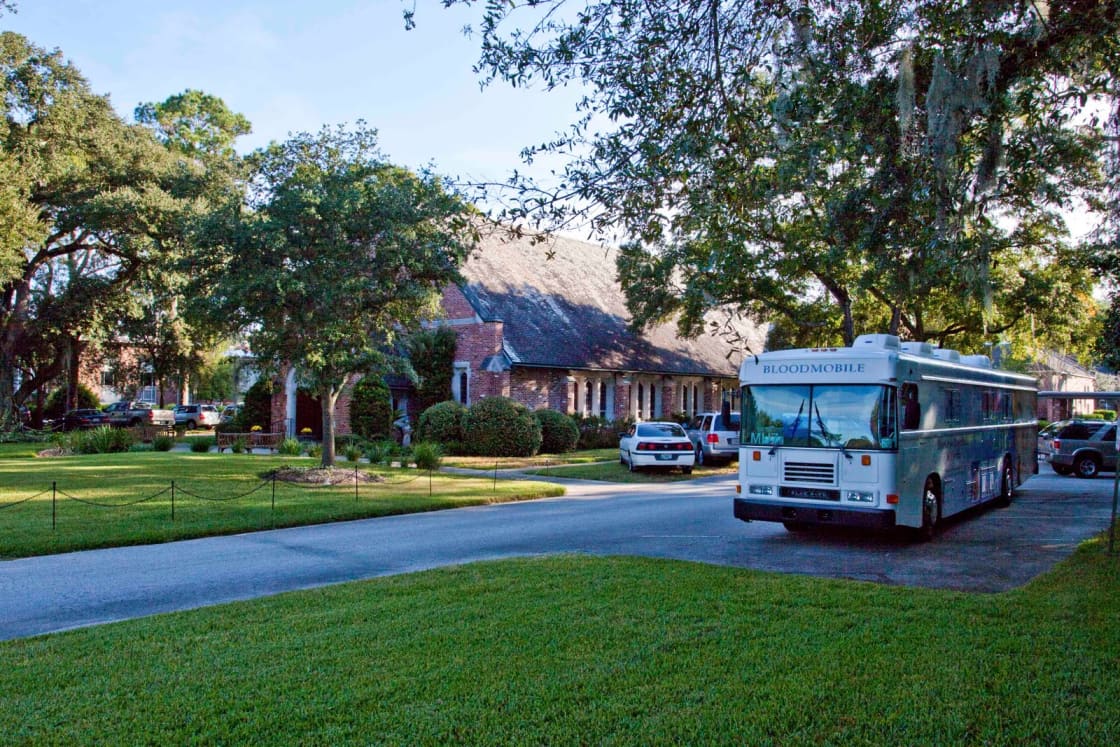
If you are running one for a congregation, a company, a student group or a neighborhood, the division of labor is clearer than people expect. The collecting organization brings staff, equipment, screening and the regulatory apparatus. They will tell you what they need from the venue — a room of a certain size, power, parking, a date booked well in advance.
What they need from you is a full appointment schedule. That is the whole job.
The failure mode of a volunteer-organized drive is never the room. It is a sign-up sheet with forty slots and eleven names, and a staffed team standing in a half-empty hall. A drive that runs at a third of capacity costs the collecting organization more than not holding it, and it is the reason an organizer who cannot fill the calendar should postpone rather than proceed.
So: book the date, then spend your energy entirely on the sign-up sheet. Confirm the day before. Overbook slightly, because deferrals and no-shows are normal and the schedule should absorb them.
Before you go
- Eat, and drink water. Most same-day problems are hydration and blood sugar rather than anything medical.
- Bring identification and an address that will reach you for the next eight weeks.
- Know your medications, including recent ones, and be prepared to be asked.
- Allow more time than the appointment length. Screening is the slow part.
- If you are deferred, ask whether it is temporary and when it lifts. Then put that date in your calendar.
- If anything about eligibility is specific to you — a tattoo, recent travel, a medication, an illness — call the organization first. Criteria are revised as the evidence changes, and a general article is the wrong place to settle a question that has a current, authoritative answer a phone call away.
The people who keep the supply steady here are not doing anything heroic. They are giving on a schedule, in the months when it is least convenient, and answering the address question honestly.
Campus drives, and the student donor problem
Two large universities sit inside this county, and campus drives are a meaningful share of local collection. They also concentrate every structural weakness of the donor base in one place.
Students skew toward the 110-pound minimum in 21 CFR § 630.10(f)(5) more than the general population does, which means more same-day turn-aways. They are disproportionately first-time donors, which is the group where vasovagal reactions cluster and where a bad first experience translates directly into never returning. They are the population most likely to donate on an empty stomach between classes. And they are the group most likely to give the eight-week contact address as a dorm they are about to leave.
Every one of those is fixable by the organizer rather than the donor. A campus drive that schedules around meal times, staffs the recovery area properly rather than treating it as a formality, and prompts explicitly for a permanent address rather than a current one will convert more first-time donors into repeat donors than one that simply fills slots.
The seasonal consequence is the one that matters most. Because campus drives carry so much of the load here, the collection calendar in Utah County has two structural holes cut into it — summer, and the stretch from mid-December through early January — that have nothing to do with willingness and everything to do with where the donors physically are. Community and congregational drives scheduled deliberately into those two windows are worth disproportionately more than the same drive in October.
Common reasons people wrongly assume they cannot donate
Several beliefs keep otherwise eligible people away, and they are worth checking rather than assuming.
Being deferred once is not a status — most deferrals are temporary, and low hemoglobin in particular fluctuates. Taking a common maintenance medication is frequently not disqualifying. Having a tattoo is not automatically disqualifying, though the specifics depend on where and when it was done. Age at the upper end is generally not a barrier on its own.
The honest instruction here is the same one that closes every reliable article on this subject: the criteria are revised as evidence changes, and the collecting organization is the authority on your particular question. A general article that tells you confidently whether your specific medication or your specific travel history disqualifies you is a general article that will be wrong for somebody. Call and ask. It takes two minutes and they answer this question all day.
The short version
Eat first, bring identification and an address that will still reach you in eight weeks, and allow more time than the appointment says. If you are deferred, ask whether it is temporary and when it lifts, then put that date in your calendar rather than treating one turn-away as a verdict. If you can only give twice a year, give in July and in late December, when both campuses are empty and the supply here reliably thins. And if a center calls you specifically, they have a reason a general appeal would not capture.
Related Guides
- How to Actually Volunteer in Utah Valley — the front door to the whole cluster
- Donating Plasma in Provo — the compensated side, and why it is not the same thing
- Volunteering with Shelters and Housing Nonprofits
- Service Hours for Students and Student Groups
- Volunteer Liability in Utah — the statutes behind the waiver
- Volunteering as a Tutor or Mentor
- Holiday Giving in Utah Valley
- BYU Student Guide · UVU Student Guide
Frequently Asked Questions
What is the minimum weight to donate blood?
Why do they want an address where they can reach me for eight weeks?
Do they have to tell me why I was deferred?
What is the skin examination they do before donating?
Is donating blood the same as donating plasma at a paid center?
Can I donate if I have a tattoo or recently traveled?
When are blood supplies short in Utah Valley?
How do I organize a blood drive for my congregation, company or student group?
Sources
The facts in this guide were checked against these sources. Hours, fees and rules change, so confirm anything time-sensitive with the source before you go. How we make Provo.com.
- eCFR (Office of the Federal Register). Checked October 12, 2026.