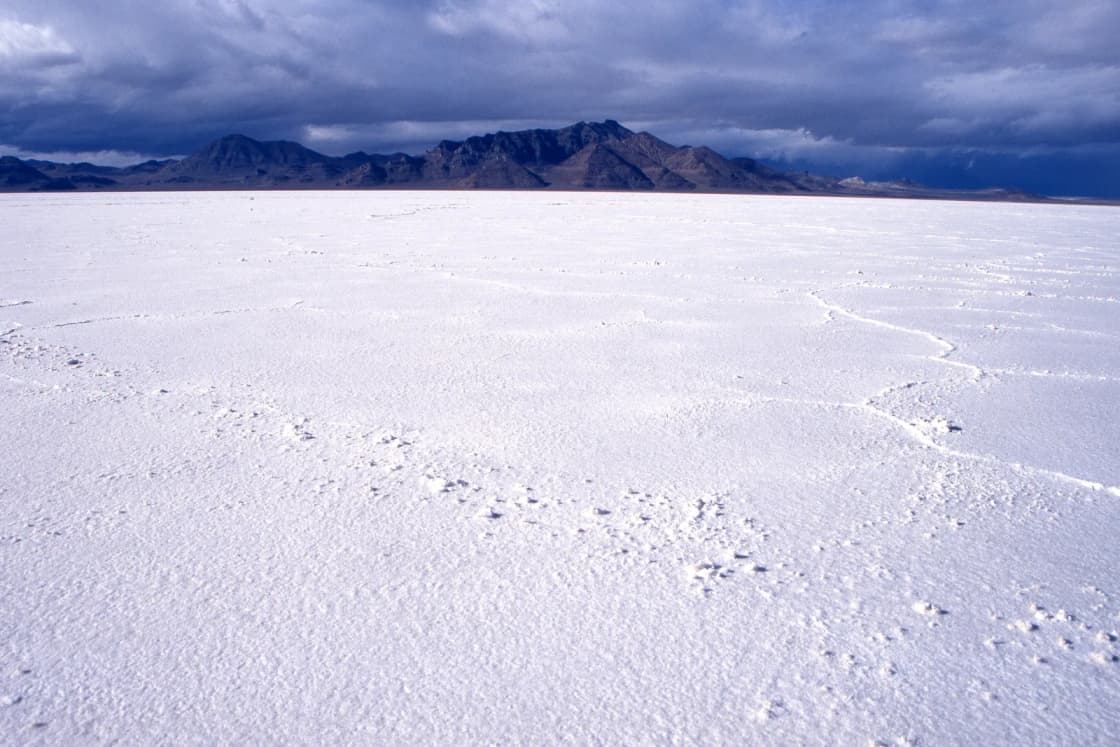
West of the Great Salt Lake, on the Nevada line, the remains of Lake Bonneville left a white salt crust so flat that for most of the 20th century it was the fastest place on earth. Every speed barrier from 300 to 600 mph fell on it, the BLM says. This is the story of how the salt became a speedway and what has happened to it since, from Utah's History To Go, the Bureau of Land Management, the University of Utah's Marriott Library and History.com. To see it for yourself, see our Bonneville Speed Week guide.
Quick facts
| Year | Driver | Speed | Source |
|---|---|---|---|
| 1914 | Teddy Tezlaff, Blitzen Benz | 141.73 mph (not recognized) | Utah's History To Go; BLM |
| 1932 | Ab Jenkins | 112.935 mph, 24-hour average (unofficial) | Utah's History To Go |
| 1935 | Sir Malcolm Campbell, Bluebird | 301.1202 mph | Utah's History To Go |
| 1938 | George Eyston, then John Cobb, then Eyston | 345.49, 350.2, 357.5 mph | Utah's History To Go |
| 1939 | John Cobb, Napier-Railton | 369.74 mph | Marriott Library |
| 1963 | Craig Breedlove, Spirit of America | 407.45 mph | History.com |
| 1964 | Craig Breedlove | 526.28 mph | History.com |
| 1965 | Craig Breedlove | 600.601 mph | History.com |
| 1970 | Gary Gabelich, Blue Flame | 622.407 mph | Marriott Library |
The salt
The flats are a remnant of Lake Bonneville, which covered more than a third of Utah between about 10,000 and 32,000 years ago, the BLM says. What is left is "about 12 miles long and 5 miles wide," a crust about 90% common table salt that is nearly 5 feet thick near the center and under an inch at the edges. Our guide to Lake Bonneville's shorelines covers the lake that made it.
1896 to 1914: a bicycle, a Pierce-Arrow and a Benz
The first person to see the salt as a racecourse came on a bicycle. In 1896, Bill Rishel was scouting a route for a coast-to-coast bicycle race when his bike bogged down in the mud, Utah's History To Go says. In 1907, he and two Salt Lake City businessmen tested the surface with a Pierce-Arrow. In 1914, Rishel talked Teddy Tezlaff into running his Blitzen Benz on the salt, and Tezlaff reached 141.73 mph. The automobile clubs refused to recognize the record. "Consequently the salt beds were forgotten," Rishel said later.
The Jenkins years
Ab Jenkins, a Salt Lake City driver, brought the flats back. In 1925 he raced a train to the Lincoln Highway dedication, and he later said he "realized the tremendous possibilities of those beds for speeding." In 1932, he set an unofficial 24-hour endurance record, averaging 112.935 mph, and Salt Lake newspapers waited a week to report it, Utah's History To Go says. The Marriott Library's collection shows him setting records in his Mormon Meteor in 1931, and in 1935 he averaged 154.76 mph for 24 hours.
1935 to 1939: Campbell, Eyston and Cobb
Jenkins helped bring Sir Malcolm Campbell to the flats, the BLM says. On Sept. 3, 1935, Campbell averaged 301.1202 mph over two runs in Bluebird, the first time he had topped 300 mph; he had been unable to do it at Daytona Beach, Utah's History To Go says.
Two more drivers followed. In 1938, George Eyston set the land speed record at 345.49 mph. His car had not registered on the timing equipment on an earlier run, so he painted it black. About two weeks later, John Cobb raised the record to 350.2 mph, and within two days Eyston took it back at 357.5 mph. On Aug. 26, 1939, Cobb drove his Napier-Railton 369.74 mph, the Marriott Library's collection says. Then the United States entered World War II, and the flats went unused for several years.
The jet age
By 1949 the course was the standard for world land speed records, the BLM says. The next jump came with jet engines. In October 1963, Craig Breedlove drove a three-wheeled Spirit of America, powered by a surplus Navy jet engine, to 407.45 mph, beating the 394.2 mph that Cobb had set in 1947, History.com says. Breedlove, Tom Green and Art Arfons "passed the land-speed title around like a hot potato." In October 1964, Breedlove became the first driver past 500 mph, at 526.28 mph, and lost his parachute and ended up in a salt pond. On Nov. 15, 1965, he averaged 600.601 mph, the first official run over 600.
On Oct. 23, 1970, Gary Gabelich drove the Blue Flame to 622.407 mph, the Marriott Library says.
The salt now
The crust is shrinking where people race on it. Studies over the past 20 years show it thinning in the racing areas, the BLM says, and it has reduced the area where racing is allowed, with officials raising concern that racing could someday be restricted entirely. Its response is a salt laydown project, with the racers' Save the Salt Foundation and the neighboring Intrepid Potash mine, that pumps brine left from potash mining back onto the flats to rebuild the crust.
Racing still happens, under BLM permits. The Southern California Timing Association's Speed Week is the biggest meet; the 2027 dates are July 31 to Aug. 6, and our Speed Week guide covers spectating.
Visiting
The BLM says day use is free. Take Interstate 80 to Exit 4 near Wendover, head north, follow the signs to the Speedway and turn right on Leppy Pass Road to the parking area. Driving on the salt is allowed except during posted seasonal closures, when the salt is wet, and during permitted races, when the flats close to general access. The flats are about 165 miles and a little under three hours from downtown Provo by an OpenStreetMap routing estimate. Our Great Salt Lake and salt flats guide covers the rest of the trip.
Related reading
- Bonneville Speed Week from Provo
- The Great Salt Lake and Bonneville Salt Flats from Provo
- Lake Bonneville's shorelines
- The transcontinental railroad at Promontory
Frequently Asked Questions
Who first raced on the Bonneville Salt Flats?
Who was Ab Jenkins?
When was the first 300 mph run at Bonneville?
What is the fastest anyone has gone at Bonneville?
Are the Bonneville Salt Flats shrinking?
Can you visit the Bonneville Salt Flats?
Sources
The facts in this guide were checked against these sources. Hours, fees and rules change, so confirm anything time-sensitive with the source before you go. How we make Provo.com.
- Utah's 'Ugly Duckling' Salt Flats, Utah Division of State History, Utah's History To Go. Checked November 27, 2026.
- Bonneville Salt Flats Special Recreation Management Area, Bureau of Land Management. Checked November 27, 2026.
- The race to save the Bonneville Salt Flats, Bureau of Land Management. Checked November 27, 2026.
- Bonneville Salt Flats photo exhibit, University of Utah J. Willard Marriott Library. Checked November 27, 2026.
- Craig Breedlove sets new land speed record, History.com. Checked November 27, 2026.