Angels Landing is the most famous hike in Zion National Park and one of the few trails in the National Park System where the Park Service runs a lottery to decide who may walk the last stretch. For a Utah Valley hiker, the planning problem is less about fitness than about paperwork: which lottery to enter, when it closes, what to do on the day, and what to do if the draw does not go your way.
This guide covers the permit system step by step, then describes the trail section by section, then gets to the questions most guides skip: who should turn around at Scout Lookout, and what a good Plan B looks like. It is a companion to the broader Zion and St. George from Provo guide, which covers the drive, lodging and the rest of the park.
A note on sources and timing. Everything below about permits, fees, shuttle hours and trail conditions comes from National Park Service pages checked on Nov. 6, 2026. Permit rules have changed since the program began, and the NPS describes the program as a pilot, so confirm the details on nps.gov/zion and recreation.gov before you apply or book anything.
Quick facts
| Item | Detail | Source page |
|---|---|---|
| Round trip | About 5.4 miles, about 1,488 feet of climbing | NPS permit page |
| Typical time | About 4 hours for most hikers, some take longer | NPS permit page |
| Permit needed | From Scout Lookout onward, not before | NPS |
| Cost | $6 application (up to 6 people) plus $3 per person if you win | NPS |
| Start point | The Grotto, shuttle stop 6 | NPS |
| Pets | Not allowed | NPS |
Getting there from Provo
Zion Canyon is a long haul from Utah County. The parent guide puts the drive at roughly four and a half hours without stops, almost all of it on I-15 south, with the last stretch on state routes through Hurricane and La Verkin. That makes Angels Landing a poor day trip from Provo, and it is the main reason the lottery shapes everything: you are driving down for a trip that has to be anchored to a specific date.
Most Utah Valley hikers will do this as a weekend, sleeping in Springdale, Hurricane or St. George. The day trips from Provo hub lists the other southern Utah options if you are comparing, and the ranking of Utah national parks from Provo shows where Zion sits for drive time against the rest of the state.
Once you reach the park, the trailhead is not at a parking lot. The hike starts at the Grotto, which is stop 6 on the Zion Canyon shuttle line. The NPS shuttle page lists the stops in order: Zion Canyon Visitor Center, Zion Human History Museum, Canyon Junction, Court of the Patriarchs, Zion Lodge, the Grotto, Weeping Rock, Big Bend and Temple of Sinawava. The shuttle is free and needs no reservation, but you still pay park entrance or hold a valid pass.
Shuttle hours matter more than they look
During shuttle season the Zion Canyon Scenic Drive is closed to private vehicles, including before the first shuttle and after the last one. Per the NPS shuttle page, which says the schedule is subject to change:
- Sept. 13 to Oct. 24: first departure from the Visitor Center at 7:00 a.m., last at 6:00 p.m.
- Oct. 25 to Nov. 28: first at 7:00 a.m., last at 5:00 p.m.
- Nov. 29 to Dec. 25: no shuttle service.
- Dec. 26 to Jan. 2: first at 8:00 a.m., last at 4:30 p.m.
The permit page tells hikers to check the seasonal schedule so they do not miss the last bus. In late fall the last departure is early, and a four-hour hike that starts in the afternoon can collide with it. In the weeks when the shuttle does not run, the NPS says private vehicles can usually drive the Scenic Drive, and you park on pavement near the trailhead. The Zion in winter guide covers that stretch of the calendar in more detail.
How the permit system works
There are two lotteries. Both run on recreation.gov, both charge the same fees, and the NPS says that in both of them every applicant has the same odds during the application window. Speed does not help. Applying early in the window is not an advantage, and applying late is not a disadvantage.
Fees
- Application fee: $6, non-refundable, covering up to six people including the applicant. It applies to both lotteries.
- Permit fee: $3 per person, charged only when a permit is awarded.
The permit page does not state how many permits are issued per day, so no sourced odds figure can be given. Treat any "your chances are X percent" claim you read elsewhere as unsourced.
The seasonal lottery
The seasonal lottery is the planning tool. You apply months ahead and rank the dates you could go. The NPS lists four windows, each running from 8:00 a.m. on the opening date to 11:59 p.m. Mountain Time on the closing date:
| Hike dates | Lottery opens | Lottery closes | Permits issued |
|---|---|---|---|
| Mar. 1 to May 31 | Jan. 1 | Jan. 20 | Jan. 25 |
| Jun. 1 to Aug. 31 | Apr. 1 | Apr. 20 | Apr. 25 |
| Sep. 1 to Nov. 30 | Jul. 1 | Jul. 20 | Jul. 25 |
| Dec. 1 to Feb. 28 | Oct. 1 | Oct. 20 | Oct. 25 |
You can rank up to seven days or day and time windows. If you are not selected, you can try the day-before lottery or wait for a future seasonal window.
As of Nov. 6, 2026, the lottery for hikes between Dec. 1 and Feb. 28 closed on Oct. 20 and permits were issued Oct. 25 according to that schedule, so that window has passed. The next one on the NPS table is the Jan. 1 opening for hikes between Mar. 1 and May 31. If you want a spring Saturday, put Jan. 1 on your calendar now. Confirm the dates for that year on the NPS page, since the table is a published pattern and the NPS can change it.
Step by step for the seasonal lottery:
- Pick the window that contains your hike dates from the table above.
- Create or check your recreation.gov account before the window opens, so the application itself takes minutes.
- Decide your group. The $6 fee covers up to six people. Because permits cannot be transferred and the group leader cannot be changed, apply only for people who are committed.
- Rank up to seven days or day and time windows, from the dates you most want to the ones you could live with.
- Submit before 11:59 p.m. Mountain Time on the closing date. Utah is on Mountain Time, so there is no conversion for a Provo applicant.
- Watch your email on the issued date. The result arrives from recreation.gov.
The day-before lottery
This is the lottery most Utah Valley hikers should plan around, because it rewards flexibility and a short drive notice. The window opens at 12:01 a.m. and closes at 3 p.m. Mountain Time the day before the hike. Permits are issued at 4 p.m. that day, and results are emailed after 4 p.m. The NPS example is plain: to hike Tuesday, apply Monday between 12:01 a.m. and 3 p.m.
So a Saturday hike means applying Friday, and the 3 p.m. cutoff arrives while many people are still at work or on I-15. If you are driving down Friday, apply from your phone before you leave Utah County rather than at the 3 p.m. deadline from a canyon with spotty service. The NPS notes that most people lack cell service in Zion Canyon itself.
The NPS shuttle page adds that same-day permits are not issued. If you miss the 3 p.m. cutoff the day before, there is no walk-up option on the morning of the hike.
If you win
Recreation.gov sends two emails: a reservation confirmation and a receipt for the permit fee. The NPS says the confirmation email is your permit. Print it or download it before you arrive, because cell service at the checkpoint is unreliable. Rangers can check permits at the Grotto, at Scout Lookout or on the trail at any time, day or night, and you may need to show ID.
The permit carries a start time, and the NPS says to arrive early enough to reach the Grotto before your printed time. Work backward from the shuttle: if your permit window is early in the morning, check that the first shuttle gets you to stop 6 on time, which depends on the season.
Changes and cancellations
The rules differ by lottery:
- Day-before permits: cannot be changed, and all fees are non-refundable.
- Seasonal permits: can be canceled until two days before the reservation date. The $3 per-person fee is refunded and the $6 application fee is not. You can also reduce the group size until two days before, with a $3 refund per person removed.
- Canceled seasonal permits roll over automatically to the day-before lottery, which means someone else may get your spot.
- Not allowed: changing the hike date, increasing the group size, transferring the permit or changing the group leader.
The practical lesson for a Provo family: if a seasonal win lands on a weekend that stops working, cancel at least two days out. A no-show gets you nothing back and wastes a permit someone else could use.
What the hike is like
The numbers first. The NPS permit page gives about 5.4 miles round trip and about 1,488 feet of elevation gain, with about four hours as the typical time. The approach to Scout Lookout is about 2.25 miles one way from the Grotto, with about 1,000 feet of climbing. The NPS trip page lists the Angels Landing section itself at 0.5 miles one way from Scout Lookout and 1 to 2 hours for that part alone, not counting the approach.
The trail is year-round, and the NPS lists day, dawn or dusk as times to go. Pets are not allowed.
The approach: the West Rim Trail
The route starts at the Grotto. You cross the road and the bridge to the sandy West Rim Trail and climb to Scout Lookout, where the Angels Landing trail begins. This part needs no permit. Reports from sources outside the NPS describe Refrigerator Canyon and the stacked switchbacks known as Walter's Wiggles along this approach, but the NPS pages I reviewed did not detail them, so this guide does not describe them further. Check the NPS trail page for the current approach description.
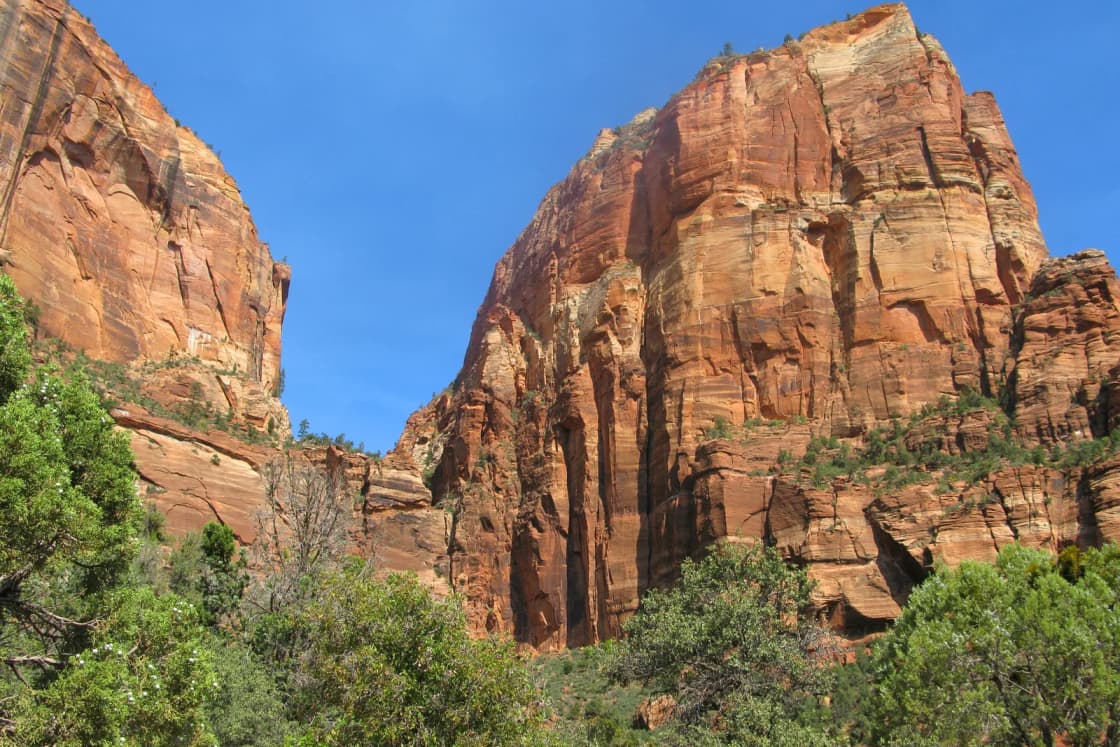
Scout Lookout offers views of Zion Canyon and of Angels Landing itself. Groups can split here, with some hikers continuing and others waiting, and regroup later. For many people it is a satisfying place to stop, and the section below on Plan B takes that seriously.
The chains section
From Scout Lookout the route follows a steep, narrow ridge for about half a mile. The NPS describes:
- A trail often less than 3 feet wide, and in some places only a few feet wide, fitting one person in many spots.
- Uneven steps cut into the rock.
- Chains anchored intermittently that act as handrails for several sections. The permit page describes a single metal chain to hold onto.
- Sheer drop-offs of up to 1,000 feet on each side.
- An unpaved, rocky surface.
- Hikers moving in both directions in limited space, so you must yield.
Near the end the trail widens slightly, with places to rest and views of Zion Canyon.
The NPS says to exercise extreme caution at all times, and it also says that most deadly accidents on this section have occurred since 1930. It does not give a fatality count in the pages checked, and this guide does not either. The agency's behavioral advice is concrete: stay on the path, take turns at narrow spots, be patient with slower hikers, and let faster hikers pass when possible. In winter the chains are very cold, and gloves can help.
What this means in practice is that the hard part is not endurance. It is traffic, exposure and judgment. A crowded chains section moves at the speed of the least comfortable person on it, and the people in front of you have the same right to the chain that you do.
Water, restrooms and gear
The NPS suggests about 1 gallon (4 liters) of water per person per day and says to fill bottles at the Grotto, since there is no drinkable water on the trail. The trip page lists water filling stations at the Grotto and restrooms at the Grotto and at Scout Lookout. The permit page advises using the flush toilets at the Visitor Center or Grotto before starting, and says that if you must go on the trail you pack out waste and toilet paper in a bag. Leaving waste can bring a citation and a fine.
Pack out all trash, including water bottles and hats. Do not throw anything off the trail, because climbers and nesting birds may be below. Keep your distance from wildlife and California condors, never feed animals, and do not leave your pack unattended.
A sensible kit for a Utah Valley hiker:
- Printed or downloaded permit confirmation, plus ID
- Water, as above, and snacks
- Shoes with real tread, since the surface is rocky and, in places, sandy
- A light layer, because winter daytime temperatures in the park typically range from 30 to 60 degrees Fahrenheit, according to the NPS conditions page
- Gloves for cold chains in winter
- A small pack that stays on your back, so your hands are free for the chain
When to go
The NPS says Angels Landing is open year-round, so the question is conditions, not season.
Summer daytime temperatures in Zion regularly exceed 100 degrees Fahrenheit, according to the NPS conditions page, and mid-to-late summer monsoons raise flash flood risk. Flash flooding is mostly a Narrows concern, but the same storms bring lightning. The NPS says thunderstorms are more common in the afternoon and that if you see storm clouds you should stop and descend.
A start at the permit's earliest time keeps you off the ridge during afternoon heat and storms. It also puts you ahead of the largest crowds, although the NPS does not publish crowd-by-hour data.
The NPS lists the following reasons not to ascend:
- Storm clouds nearby
- Wet or icy rock
- It is or will be dark before you finish
- A fear of heights
Winter hikers should expect cold and possibly icy rock. The conditions page gives typical winter daytime temperatures but does not forecast ice on this trail, so check the current alerts at the top of the NPS conditions page and ask at the Visitor Center. The Zion in winter article explains what else is open when the shuttle pauses.
Rockfall is another reason to be careful. The NPS advises moving away from cliffs and, if you are caught near a cliff base, sheltering behind a large boulder and covering your head with your pack. The conditions page also notes that the East Rim Trail is partially closed because of a large rockfall near Weeping Rock, and that Hidden Canyon is closed. Those are separate trails, but they are a reminder that trail status in this canyon changes.
Who should skip the chains
Skipping the chains is a normal, reasonable choice. The NPS gives the clearest guidance: do not go up if you fear heights, if the rock is wet or icy, or if darkness will catch you. Beyond that, consider the following as judgment calls rather than official rules, since the NPS pages checked do not set age, fitness or health cutoffs:
- Anyone who gets dizzy or freezes on exposed edges. The trail is often less than 3 feet wide with drop-offs of up to 1,000 feet on each side, and you cannot easily turn around in a line of people.
- Parents hiking with young children. The pages do not give an age minimum, so the decision rests on whether a child will stay calm, hold the chain and follow instructions.
- Groups with very different comfort levels. Because permits are issued for specific people and cannot be transferred, a group that splits is better off deciding in advance who will go past Scout Lookout. The NPS notes that groups may split at the lookout and regroup.
- Hikers who plan to start late. The darkness warning is the bluntest one on the list.
- Anyone who needs a dog along. Pets are not allowed on this trail.
None of this is a judgment on ability. A person who stops at Scout Lookout has still hiked about 4.5 miles round trip with about 1,000 feet of climbing, using the NPS approach figures.
If you lose the lottery
Most applicants will not win every draw, and the NPS says plainly that unsuccessful applicants can try again. Here is a sequence that works for someone based in Provo.
- Enter the day-before lottery. Apply the afternoon before at the latest, before the 3 p.m. Mountain Time cutoff. You can apply from anywhere with a connection, including the Wasatch Front. If it fails, you have lost only the application fee.
- If you are driving down regardless, build a trip that does not depend on the draw. Zion has plenty to fill a weekend, and the parent guide covers the main canyon, the quieter Kolob Canyons section near I-15, and St. George.
- Hike to Scout Lookout. It needs no permit, and from there you see Zion Canyon and the ridge you did not climb.
- Check Observation Point status. The NPS conditions page says it cannot be reached from Zion Canyon and can only be reached by hiking from the east. The parent guide describes Observation Point, when its access trails are open, as a viewpoint looking down on Angels Landing without the permit or chains. Confirm current status with the NPS before you plan on it.
- Try a different park. If you want a red-rock weekend without a lottery, see Bryce Canyon from Provo, and the national parks ranking linked above.
- Apply again. The next seasonal window on the NPS table is Jan. 1 for Mar. 1 to May 31 hikes.
One more point on strategy: because rolled-over seasonal cancellations go to the day-before lottery, people who cancel two days out feed the pool you are drawing from. That is a reason for your own group to cancel promptly if plans change.
What to check before you go
- The NPS Angels Landing permit page for current lottery dates, fees and rules
- Your recreation.gov account, and the permit confirmation email saved or printed
- The NPS shuttle page for last-bus times, which shrink in fall
- The NPS conditions page for closures, alerts, weather and any rockfall notices
- The forecast for storms and temperature on the day
- Entrance fee or pass. The NPS fee page lists a $35 private vehicle fee valid 1 to 7 days, a $70 annual park pass for U.S. citizens and residents, and a $20 per-person fee for people entering without a vehicle, with youth 15 and under free. Verify the amounts before you travel.
- Emergency plan. Call 911 if you have service; most people lack service in Zion Canyon, so find a ranger or volunteer on the trail or at a trailhead.
The short version for Utah Valley
Treat the permit as the thing that sets your calendar. Apply to the seasonal lottery if you know your dates months ahead, use the day-before lottery if you are flexible, and print the confirmation. Start early, watch the sky, yield on the ridge, and decide at Scout Lookout whether the chains are right for your group on that day. Many people who skip them still call the hike a good one. For the rest of the trip, the Zion and St. George guide covers where to sleep, what else to see, and how to drive home.
Frequently Asked Questions
Do I need a permit to hike Angels Landing?
How much does the Angels Landing lottery cost?
When does the seasonal lottery open?
How does the day-before lottery work?
Can I cancel or change an Angels Landing permit?
How long is the Angels Landing hike?
What should I do if I do not win a permit?
Is Angels Landing safe for kids or people afraid of heights?
Sources
The facts in this guide were checked against these sources. Hours, fees and rules change, so confirm anything time-sensitive with the source before you go. How we make Provo.com.
- Angels Landing Permits and Hiking, National Park Service, Zion National Park. Checked November 6, 2026.
- Zion Canyon Shuttle System, National Park Service, Zion National Park. Checked November 6, 2026.
- Hike Angels Landing, National Park Service. Checked November 6, 2026.
- Zion Conditions, National Park Service, Zion National Park. Checked November 6, 2026.
- National Park Service, Zion National Park: Zion Fees, National Park Service, Zion National Park. Checked November 6, 2026.