
From Provo, Utah's five national parks fall in a narrow band: the nearest is about 3 hours 35 minutes away and the farthest about 4 hours 36. None of them is a comfortable day trip. That leaves two questions that matter more than "which is best": which is the shortest drive from Provo and which one fits the month you can go. This page answers both with numbers you can check. For the places that do fit inside three hours, see 100 things to do in Utah from Provo.
How this list is ranked. By drive time from Center Street and University Avenue in downtown Provo to the visitor center for each park's best-known area, using OpenStreetMap routing estimates (OSRM) with no traffic. These are estimates: they do not know about construction on US-6 or a Friday afternoon on I-15, and your phone's app may give a different number. The season section uses only what the National Park Service publishes on each park's own pages: weather, shuttle seasons, permits and fees as listed in October 2026. We do not rank the parks by scenery.
The five, by drive time
| Rank | Park (visitor center) | From Provo (est.) | Vehicle fee |
|---|---|---|---|
| 1 | Capitol Reef (Fruita) | 181 mi, 3 hr 35 min | $20 |
| 2 | Arches | 187 mi, 3 hr 43 min | $30 |
| 3 | Bryce Canyon | 226 mi, 4 hr 4 min | $35 |
| 4 | Canyonlands (Island in the Sky) | 201 mi, 4 hr 11 min | $30 |
| 5 | Zion (Zion Canyon) | 265 mi, 4 hr 36 min | $35 |
Two second entrances change the picture. Zion's Kolob Canyons Visitor Center is about 226 miles and 3 hours 44 minutes from Provo, almost tied with Arches, because it sits right off I-15. Canyonlands' Needles Visitor Center is the opposite: about 264 miles and 5 hours 32 minutes, the longest drive of any visitor center here.
1. Capitol Reef
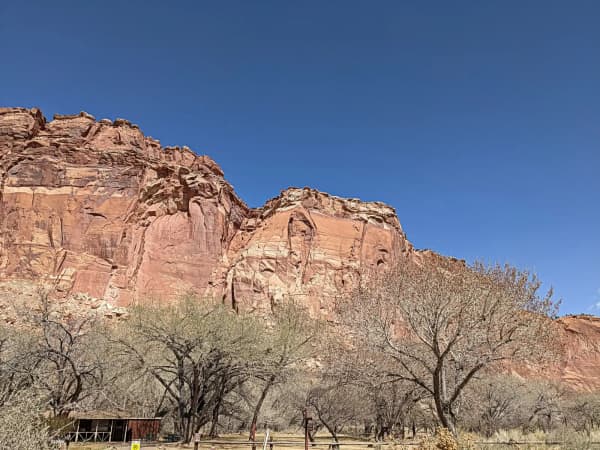
About 3 hours 35 minutes, 181 miles to the visitor center. The closest by our estimate, and the cheapest at the gate: $20 per private vehicle, or a $35 park-only annual pass. The Park Service says the park and its campgrounds are open year-round, though some roads can close for snow or other bad weather, and the visitor center is open daily except some major holidays, with hours that vary by season. The Gifford House Store and Museum is open from March 14 (Pi Day) through late November, 9 a.m. to 4:30 p.m. daily.
Season notes from the Park Service: an arid park that averages 7.91 inches of precipitation a year at the visitor center, much of it in the summer monsoon, usually July to September, when downpours can cause dangerous flash floods (and short-lived waterfalls). Weather varies widely across the long, narrow park, so the Park Service splits forecasts into Fruita, the North District with Cathedral Valley and the South District with the Burr Trail.
A note on the drive: this estimate is longer than the "two-and-three-quarter to three-hour" range on our older Capitol Reef from Provo page. That page covers the orchards, the Scenic Drive and where to stay.
2. Arches
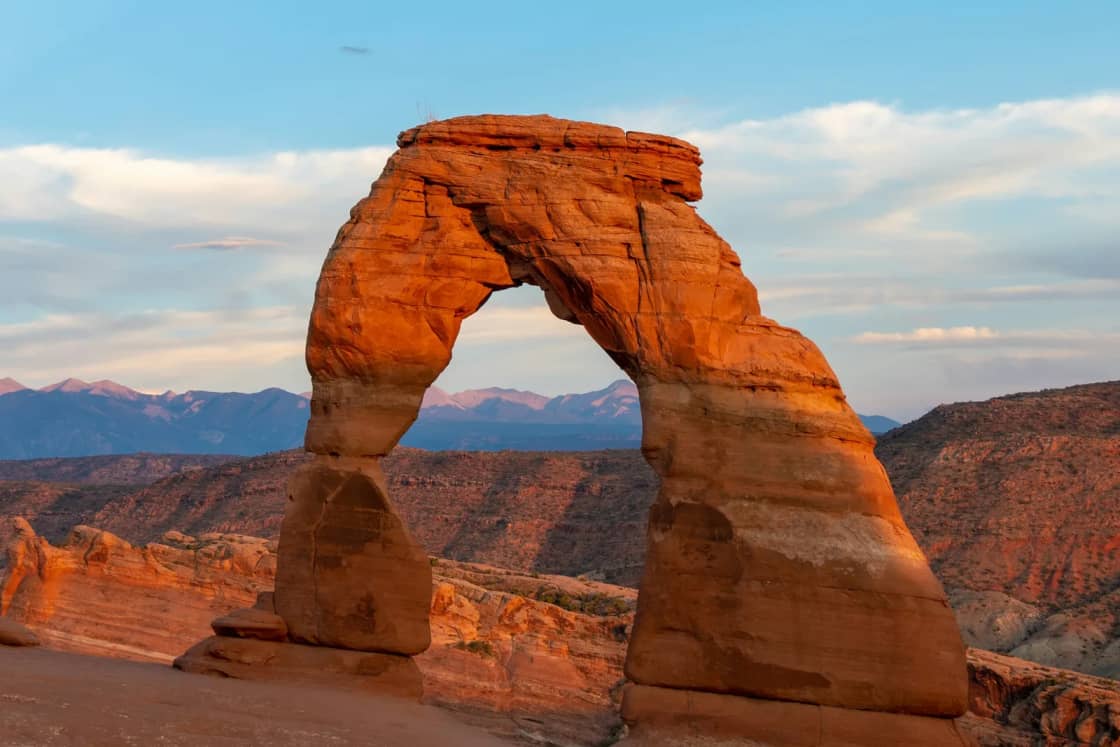
About 3 hours 43 minutes, 187 miles. $30 per private vehicle, or $55 for an annual pass that covers Arches, Canyonlands, Natural Bridges and Hovenweep (U.S. residents only). The entrance station takes credit or debit only.
The 2026 change: the Park Service says timed-entry reservations are not required at Arches in 2026. You can enter any time during operating hours, though vehicles may be diverted from the entrance when the park gets too congested. Reservations are still required for Devils Garden Campground and for Fiery Furnace hikes, self-guided or ranger-led.
Season notes: the Park Service calls spring (April through May) and fall (mid-September through October) the temperate and most popular seasons, with daytime highs averaging 60 to 80 degrees. Summer often tops 100 degrees, and late-summer monsoon storms bring flash floods. Winter highs average 30 to 50, with lows of 0 to 20; large snowfalls are uncommon, but small amounts of snow or ice can make trails and roads impassable. The visitor center is open daily through winter except December 25. Heavy traffic is typical spring through fall. A new free shuttle runs from Moab to the Arches visitor center and select park destinations. The full Moab weekend is in Moab from Provo.
3. Bryce Canyon
About 4 hours 4 minutes, 226 miles. $35 per private vehicle, or $70 for a park-only annual pass. Bryce does not accept cash. The park is open 24 hours a day all year and no advance reservation is needed to enter.
The shuttle: free with park admission, running through the Bryce Amphitheater area from April through mid-October. Its 2026 schedule began April 3.
Season notes: Bryce sits at high elevation, and the Park Service's average highs show it: 37 degrees in January, 75 in June, 80 in July and 77 in August. From October to May temperatures drop below freezing nearly every night; the coldest and snowiest stretch is December through February, and March and April storms can still bring heavy snow. July and August are the rainy season, with frequent, usually brief afternoon thunderstorms and lightning. Roads may close temporarily during and after snowstorms until plowing is done. May through September are the most popular months. More on the rim, the trails and the altitude in Bryce Canyon from Provo.
4. Canyonlands
About 4 hours 11 minutes, 201 miles to the Island in the Sky Visitor Center, the district closest to Moab; about 48 minutes and 29 miles from the Arches visitor center by the same estimate. $30 per private vehicle, or the same $55 four-park annual pass as Arches. The Needles district is a separate drive, about 5 hours 32 minutes from Provo.
Season notes: the Park Service publishes the same high-desert pattern as Arches. Spring (April through May) and fall (mid-September through October) are temperate, with highs of 60 to 80; summer often exceeds 100, with monsoon flash floods in late summer; winter highs average 30 to 50 and lows 0 to 20. The park is normally open year-round, 24 hours a day, with district visitor center hours that change by season, and some facilities close in winter.
5. Zion
About 4 hours 36 minutes, 265 miles to the Zion Canyon Visitor Center; about 3 hours 44 minutes to the Kolob Canyons Visitor Center. $35 per private vehicle for one to seven days, or $70 for a Zion-only annual pass, sold in person at entrance stations. Non-U.S. residents 16 and older pay an additional $100 per person unless they enter with an annual or America the Beautiful pass.
The shuttle rule: from early March through late November, the Zion Canyon Scenic Drive is closed to private cars and you ride the free shuttle from the visitor center. Shuttles also run for the holiday season near the end of December. Outside those windows (usually December through February), you can drive the Scenic Drive yourself. The Zion-Mount Carmel Highway, Kolob Canyons Road and Kolob Terrace Road stay open to private vehicles year-round.
Angels Landing: a permit is required for the chains section past Scout Lookout. The day-before lottery opens at 12:01 a.m. and closes at 3 p.m. Mountain Time; it costs $6 to apply for up to six people, and winners pay $3 per person. Hikes between December 1 and February 28 have their own application.
Season notes, by the Park Service's calendar: March is spring break and sees almost three times February's visitors; snowmelt can close the Narrows. May through September is hot, regularly over 100 degrees, with monsoon flash floods July through September, about half a million visitors a month, and parking often full by 9 a.m. October and November are calmer, with fall color reaching Zion Canyon in late October and early November. December through February is cold and often wet; nearly half of Zion Canyon's annual precipitation falls from December through March, and some trails close for falling ice. The St. George weekend around it is in Zion and St. George from Provo.
Ranked by season
These are sorted from the Park Service's own descriptions, not from our opinion of the parks.
Winter (December through February)
- Zion is the one park where winter changes access in your favor: the Scenic Drive opens to private cars outside the holiday shuttle week, and lows below freezing are the price.
- Arches and Canyonlands stay open, with highs averaging 30 to 50 and lows of 0 to 20.
- Bryce is at its coldest and snowiest, with average highs of 36 to 38. Roads can close after storms until plowed.
- Capitol Reef is open year-round; some roads can close for snow.
Spring (March through May)
- Arches and Canyonlands enter their temperate season in April and May.
- Zion gets its spring-break surge in March and the shuttle returns to full-time use; the Narrows may close for snowmelt.
- Bryce can still get heavy snow in March and April; its shuttle starts in April.
Summer (June through August)
- Bryce is the cool one, with average highs of 75 in June, 80 in July and 77 in August.
- Arches, Canyonlands and Zion often exceed 100 degrees.
- Capitol Reef, Arches, Canyonlands and Zion all warn of monsoon flash floods in late summer.
Fall (September through November)
- Arches and Canyonlands return to their temperate season from mid-September through October.
- Zion quiets in October and November, with color reaching the canyon in late October and early November.
- Bryce can see October snowstorms between sunny days, and freezing nights resume.
- Capitol Reef's monsoon season usually ends in September.
Pairing parks on one trip
By the same OSRM estimates: Arches and Canyonlands' Island in the Sky are about 48 minutes apart, which is why Moab is the usual base for both. Bryce to Zion Canyon is about 2 hours 14 minutes. Capitol Reef to Bryce along Highway 12 is about 3 hours 4 minutes, and Highway 12 is the drive; our scenic byways ranking covers it. Capitol Reef to Arches is about 2 hours 48 minutes.
The pass math
The America the Beautiful annual pass is $80 for U.S. citizens and residents. It covers the vehicle entrance fee at all five parks, plus other federal recreation lands, and is the only pass you need if you have it. U.S. residents 62 and older can get a $20 senior annual or $80 senior lifetime pass; current military and dependents, Gold Star families and veterans, U.S. residents with a permanent disability and U.S. fourth graders get free passes. Non-U.S. residents pay $250 for the annual pass.
- One park, once: pay at the gate ($20 to $35).
- Zion and Bryce on one trip: $70 at the gates.
- Zion, Bryce and Capitol Reef: $90 at the gates, so the $80 pass already wins.
- Arches and Canyonlands, twice in a year: the $55 four-park annual pass covers both.
Fee-free days left in 2026: the Park Service lists free entrance for U.S. citizens and residents on October 27 (Theodore Roosevelt's birthday) and November 11 (Veterans Day). Reservation and permit fees still apply.
The sixth one, in Nevada
Great Basin National Park, just over the state line, is about 193 miles and 4 hours from Provo by the same estimate to the Lehman Caves Visitor Center, closer than Bryce, Canyonlands or Zion Canyon. It has its own page: Great Basin National Park from Provo.
Frequently Asked Questions
Which Utah national park is closest to Provo?
Which Utah national park is farthest from Provo?
Can I do a Utah national park as a day trip from Provo?
Do I need a reservation for Arches National Park in 2026?
Do I need a permit for Angels Landing?
How much does it cost to enter Utah's national parks?
Which Utah national park is best in summer?
Which Utah national park is best in winter?
Sources
The facts in this guide were checked against these sources. Hours, fees and rules change, so confirm anything time-sensitive with the source before you go. How we make Provo.com.
- Arches: Fees & Passes, National Park Service. Checked October 20, 2026.
- Arches: Plan Your Visit (timed entry not required in 2026), National Park Service. Checked October 20, 2026.
- Arches: Operating Hours & Seasons, National Park Service. Checked October 20, 2026.
- Arches: Weather, National Park Service. Checked October 20, 2026.
- Arches National Park home page (Moab-to-Arches shuttle), National Park Service. Checked October 20, 2026.
- Zion: Fees & Passes, National Park Service. Checked October 20, 2026.
- Zion: Shuttle System, National Park Service. Checked October 20, 2026.
- Zion: Angels Landing Hiking Permits, National Park Service. Checked October 20, 2026.
- Zion: Operating Hours & Seasons, National Park Service. Checked October 20, 2026.
- Zion: Spring, Summer, Fall, and Winter, National Park Service. Checked October 20, 2026.
- Bryce Canyon: Fees & Passes, National Park Service. Checked October 20, 2026.
- Bryce Canyon: Shuttle, National Park Service. Checked October 20, 2026.
- Bryce Canyon: Operating Hours & Seasons, National Park Service. Checked October 20, 2026.
- Bryce Canyon: Weather, National Park Service. Checked October 20, 2026.
- Capitol Reef: Fees & Passes, National Park Service. Checked October 20, 2026.
- Capitol Reef: Operating Hours & Seasons, National Park Service. Checked October 20, 2026.
- Capitol Reef: Weather, National Park Service. Checked October 20, 2026.
- Canyonlands: Fees & Passes, National Park Service. Checked October 20, 2026.
- Canyonlands: Operating Hours & Seasons, National Park Service. Checked October 20, 2026.
- Canyonlands: Weather, National Park Service. Checked October 20, 2026.
- OSRM driving route estimates from downtown Provo, Project OSRM / OpenStreetMap. Checked October 20, 2026.