
The family reunion is a serious institution in Utah, and Utah Valley is unusually well equipped for it. Large extended families are the norm rather than the exception here, the canyons are minutes from the valley floor, and nearly every city maintains parks with covered pavilions built for exactly this purpose.
What catches people out is not the supply of venues. It is that the venues sit behind four separate reservation systems, each with its own opening date, its own fee structure and its own rules — and the best sites for the best weekends are claimed by people who understand those systems.
This guide is organized around that. Not a list of places, which would go stale, but a map of how booking works and how to think about matching a venue to a group.
First, three questions that determine everything
Before looking at any venue, settle these. Every subsequent decision follows from them.
How many people, honestly? Not the invitation list — the realistic attendance. Group sites have hard occupancy limits and hard vehicle limits, and a site rated for fifty is not a suggestion. Vehicle count catches people more often than headcount does, because a canyon group site with a twelve-car limit will not accommodate an extended family arriving in twenty-two separate cars.
Are people traveling in, or is everyone local? A gathering of relatives who all live between Lehi and Payson can be loose about logistics. A gathering where half the family flew into Salt Lake City needs a fixed location, a firm time and a contingency for weather, because those people cannot regroup at somebody's house.
What is the age spread? A group with a ninety-year-old great-grandmother and a group of adult cousins want different things. Shade, restroom proximity, walking distance from parking and seating are not amenities in the first case — they are the whole decision.
System one: national forest sites in the canyons
The canyons around Utah Valley are national forest land, and the group day-use areas and group campgrounds there are the classic Utah reunion venue.
Provo Canyon and American Fork Canyon both carry concentrations of these sites, set among trees at elevation, which in a Utah July is not a small thing — canyon sites are meaningfully cooler than the valley floor.
How booking works. Group sites on forest land are generally reserved through the federal recreation reservation system rather than by calling anyone locally. Reservations open on a fixed lead time ahead of the date, which produces a specific and slightly brutal dynamic: popular Saturdays are frequently claimed within a short window of becoming available. If a canyon site is your plan, work out the exact date reservations open for your target weekend and be at a computer that morning.
What to check. Occupancy and vehicle limits. Whether the site has potable water, restrooms, power and covered shelter, because these vary enormously. The operating season, since higher sites open late and close early. And whether the canyon itself carries a fee — American Fork Canyon sits within a fee area with its own vehicle pass requirement, which is separate from the site reservation.
The honest trade-off. Canyon sites are the most beautiful and the most weather-exposed. There is no indoor fallback at a forest group site, and a thunderstorm at four in the afternoon is a real August possibility.
System two: city park pavilions
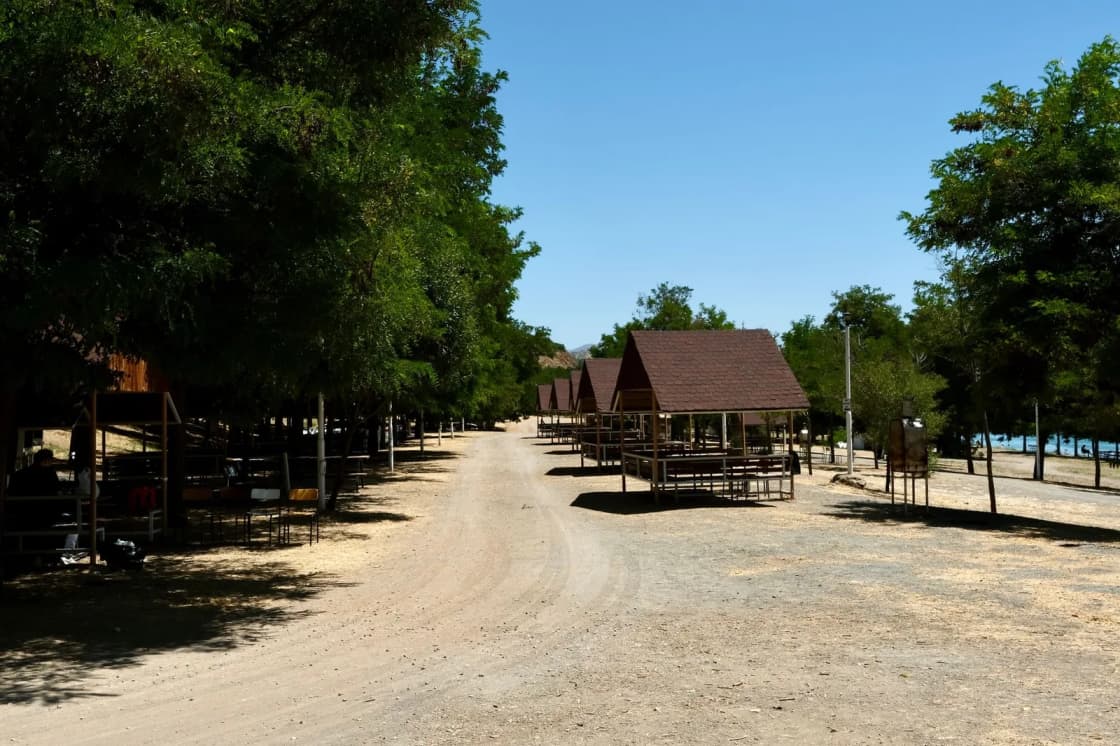
Every municipality in Utah Valley maintains parks, and most maintain reservable covered pavilions. This is the workhorse option and it is the right answer for a large share of reunions.
How booking works. Through the individual city — usually its parks and recreation department, increasingly through an online reservation portal. Each city runs its own system, its own fee schedule and its own opening date for the season, which commonly falls in late winter or early spring.
Why it often wins. Pavilions are cheap, particularly for city residents. They are on the valley floor, so nobody is driving a canyon road. They have restrooms and parking. They usually sit next to a playground, which occupies the children for free. And they are close to everything else, so somebody can leave for ice and come back.
What to check. Whether the reservation includes exclusive use or just priority. Whether power is available, which matters for anything requiring a cooler pump, a sound system or a slow cooker. Grill availability and whether charcoal is permitted. Whether alcohol rules apply. And the cancellation policy.
The tactic that works. Call the parks department rather than only browsing the website. Staff know which pavilions are good, which are next to a busy road, which have shade in the afternoon rather than only at noon, and which quietly go unbooked because they are less obvious.
System three: county and state facilities
A third layer sits between the cities and the forest.
Utah County maintains facilities and open space with their own arrangements, including areas around Utah Lake.
Utah State Parks operate day-use areas and group sites, several within reach of Utah Valley, with their own reservation system separate from both the federal one and the city ones. State park group areas often occupy a useful middle ground: more facilities than a forest site, more distinctive setting than a city park.
The reason to know this layer exists is that families searching only city parks and only the federal system miss it entirely, which means these sites are sometimes available when the obvious ones are not.
System four: indoor and private venues
Out-of-state relatives consistently underestimate how much this matters.
A July afternoon in Utah Valley is hot, an August storm can arrive fast, and a June evening at canyon elevation can be cold. A reunion with elderly attendees or infants benefits enormously from walls.
Recreation centers. Several Utah Valley cities operate recreation centers with rentable rooms, and for a group needing tables, chairs, restrooms and air conditioning this is often the best value available. Booking is through the city.
Reception and event centers. The valley has a substantial wedding and event industry, and those venues take other bookings. More expensive, more turnkey.
Church buildings. For families with access, cultural halls have hosted a large proportion of Utah reunions for generations. Availability runs through local leadership rather than a booking system.
Hotel meeting space. Worth considering when most attendees are staying at the same hotel anyway.
Large vacation rentals. A single big house is a common solution for extended families who want to be together across several days rather than for one afternoon. Two cautions: occupancy limits are enforced, and short-term rental regulation differs by municipality in Utah, so a listing's existence is not proof it is permitted.
Timing: the calendar nobody tells you about
Utah Valley's summer has a specific shape that affects reunion planning.
July is the crowded month, and not only because of the heat. Independence Day and Pioneer Day on the twenty-fourth both generate substantial local events, and the stretch containing both is the busiest of the year for venues, hotels and roads. If your family has always met in July, that is tradition rather than optimization.
June is often better. Warm but not extreme, ahead of the July congestion, and the canyons are at their greenest.
August works but starts colliding with school calendars, and those calendars now differ — UVU and BYU begin roughly two weeks apart, so a Utah Valley family may have students returning on different dates.
September is underrated for families without school-age children. The weather is frequently the best of the year and the competition for venues has collapsed.
Winter reunions are entirely viable indoors and almost nobody thinks of them, which means availability is excellent.
Permits, and when a gathering becomes an event
Most family reunions require nothing beyond a pavilion reservation. Some cross a line.
Cities commonly require a special event permit above a certain attendance threshold, or when a gathering involves amplified sound, inflatables or bounce houses, commercial catering, vendors, ticket sales or anything affecting streets and parking. Some require proof of insurance. Application timelines can run weeks.
Thresholds and rules vary by municipality, and a gathering that needs nothing in one city may need a permit in the next one over.
The practical rule: if you are wondering whether your event is big enough to need a permit, call the city's parks department, describe what you are planning, and let them tell you. That call takes five minutes and prevents the scenario where a bounce house company arrives and cannot set up.
Matching a venue to your actual group
Rather than ranking venues, here is which type suits which situation.
Twenty to forty people, mostly local, one afternoon. A city park pavilion. Cheap, easy, near a playground, restrooms on site. Do not overthink it.
Fifty to a hundred people, travelers included, one day. A larger city pavilion or a recreation center room, on the valley floor where directions are simple and nobody drives a canyon road with a rental car. If the weather forecast is uncertain, choose indoors.
Thirty to sixty people who want the mountains. A national forest group site in Provo Canyon or American Fork Canyon. Book the morning reservations open, and verify the vehicle limit against how your family travels.
A multi-day gathering where people stay together. A large rental house or a cluster of cabins, with a reserved pavilion or park for the one afternoon everybody converges.
Elderly attendees or infants central to the day. Indoors, with parking close to the door and restrooms inside. This is not the moment for a scenic canyon site with a walk from the lot.
More than a hundred people. Now you are running an event rather than a picnic. Talk to a city about a large facility and about whether a special event permit applies, and expect to need a committee rather than an organizer.
Food, which is usually the real logistics problem
The venue question gets all the attention and the food question causes most of the stress.
Potluck is the Utah default and it works, with one structural weakness: without coordination you get eleven pans of the same casserole and no ice. Assign categories rather than requesting dishes.
Catering removes the problem and introduces a permit question, because some cities treat commercial catering as a trigger for a special event permit. Ask before booking.
Grilling requires checking whether the site has grills, whether charcoal is allowed, and whether fire restrictions are in effect — which in a dry Utah summer is a live question rather than a formality. Restrictions can be imposed mid-season and they apply in canyons before they apply on the valley floor.
Ice and water are the two things every reunion underestimates. In August heat with a group of sixty, the quantity needed is roughly double what feels sensible when you are shopping.
Refrigeration and power determine what is possible. A pavilion without an outlet rules out anything requiring a slow cooker or a pump.
One local advantage worth using: Utah Valley has substantial grocery capacity and several large-format stores, so restocking mid-event is easy on the valley floor and impossible in a canyon. If you are up American Fork Canyon and you run out of ice, you are not solving that quickly.
Activities, and letting the valley do the work
The best reunions here tend to use the geography rather than programming everything.
Water. Utah Lake, the reservoirs and the splash pads in various cities absorb children for hours at no cost. Deer Creek and Utah Lake both support boating for families with access to a boat.
Easy trails. Several accessible walks near the valley floor and canyon mouths suit mixed-ability groups better than an actual hike.
Paid attractions. Thanksgiving Point at the north end and the various museums and recreation centers around the county give a rain plan and a teenager plan simultaneously.
Nothing at all. The most underrated option. A shaded pavilion, food, a field and several hours is what most families want, and elaborate programming frequently competes with the conversation people came for.
If you have relatives visiting from outside Utah, the mountains themselves are the attraction. A drive up Provo Canyon or the Alpine Loop costs nothing and produces the photographs everyone keeps.
Where out-of-town family should stay
A practical note, because reunion organizers are inevitably asked.
Utah Valley's lodging concentrates along the I-15 corridor, with clusters in Provo, Orem, American Fork and Lehi. Booking blocks at a single hotel simplifies everything — one meeting point, one breakfast, cousins in the same building.
Two timing cautions specific to this valley. University calendars create demand spikes: graduation weekends, the start of terms, and BYU home football Saturdays in the autumn fill hotels and raise rates across the county. And the July event cluster does the same thing.
If your reunion falls near any of those, book lodging before you book the venue. The venue can flex; a full county cannot.
What people forget
A short list drawn from the ways reunions go wrong.
Shade at the right time of day. A pavilion shaded at noon may be in full sun at four.
Restroom distance, which becomes the defining feature of the day for anyone with small children or limited mobility.
Parking capacity, and specifically whether a group site's vehicle limit matches how your family travels.
Power, for coolers, sound and anything electric.
A rain plan. Utah's summer storms are brief and heavy. Knowing where forty people go for twenty minutes is the difference between an anecdote and a disaster.
Ice and water, in quantities that seem absurd until the afternoon.
Somebody in charge of the reservation paperwork being physically present, because occasionally a city or forest employee will ask.
The short version
Utah Valley has abundant reunion venues across four separate booking systems: federal recreation for canyon group sites, individual cities for park pavilions and recreation center rooms, county and state parks for the layer in between, and private venues for indoor certainty. The canyon sites are the most beautiful and the first to go, so learn the date your target weekend opens and book it that morning. City pavilions are the cheap, practical default and the parks department will tell you which ones are good. Avoid July if tradition permits, plan for rain, and count vehicles rather than people.
The second regulator nobody mentions, and the deadline that runs off your advertising
The section above covers the city special event permit, which is the layer most reunion planners eventually find. There is a second one, administered by a different department, with its own threshold and its own timetable — and its deadline is triggered by something most people would never think of as a regulatory event.
The instrument is Utah Admin. Code R392-400, Temporary Mass Gathering Sanitation, authorized under Utah Code §§ 26B-7-402 and 26B-1-202. The regulator is the local health officer, not the city parks department. The two processes are separate: a pavilion reservation and a city permit do nothing about the health department's requirements, and vice versa.
The threshold, which almost every reunion is comfortably below
R392-400-3(14) defines a temporary mass gathering as an actual or reasonably anticipated assembly of 1,000 or more people, continuing or reasonably expected to continue for two or more hours a day, at a site used for a purpose different from the designed use and usual type of occupancy.
For the overwhelming majority of family reunions that settles it in one line. A gathering of eighty people at a park pavilion is nowhere near 1,000, and a pavilion hosting a picnic is being used for its designed purpose anyway. Two of the three tests fail, and R392-400 does not apply.
It is worth knowing where the line is, though, because a few events do cross it: a multi-generation family association reunion, a reunion combined with a public heritage day, or a family event bolted onto something larger. R392-400-2(2) is the exclusion that saves most of the rest — the rule does not apply to an assembly at a location with permanent facilities designed for that specific assembly unless designed occupancy levels are exceeded, which covers a reception hall or a booked event center doing what it was built to do.
The application deadline, and the trigger that surprises people
R392-400-6(1) requires the local health officer to prescribe the application process and to require the applicant to submit an application at least 15 days before the first advertisement of the gathering and at least 30 days before the first day of the gathering.
Read that first deadline again. It runs from the date you first advertise, not from the event date. For an event with a long promotional run — invitations mailed in February for a July weekend — the 15-day clock can expire months before the 30-day one, which means the application has to be in before the save the dates go out. It is an easy deadline to miss precisely because nobody thinks of a mailing as a regulatory milestone.
The health officer may grant an exception case by case, on the basis of the nature of the event, the scarcity of past problems, or other public health criteria — but that is discretion to be asked for, not a fallback to be assumed.
What the application asks for
R392-400-6(2) is a useful checklist even for an event far below the threshold, because it is a list of the things that go wrong. The application requires operator and property owner contact details, the number of people expected, a description of the gathering with dates and times, the estimated length of stay of attendees, and a site plan covering: the parking available for patrons; entrance, exit and interior roadways and walks; the location, type and provider of restroom facilities; water stations; food stands and the types of food; solid waste containers with location, number, type and provider; the operator's headquarters; a lighting plan; each parking area under the operator's control; and the location of each first aid station and emergency medical provider.
It goes on to require the names of the solid and liquid waste haulers, a site clean up plan, the number and qualifications of first aid personnel, a plan for directional and exit signs, a plan to address nuisances or health hazards associated with animals, a plan for hazardous conditions, information on any water feature the public may contact or ingest, and an emergency medical services operational plan.
Borrowing the checklist even when the rule does not apply
Three items from that list are worth stealing for a reunion of any size.
Estimated length of stay, not just headcount. The state's own restroom table is indexed on dwell time as much as on crowd size, and an eight-hour event is a materially different problem from a three-hour one at the same attendance.
A named person and a fixed spot. The rule requires an operator headquarters under R392-400-5. A reunion with an agreed base — a specific table, a specific person — solves most of the small problems before they escalate.
An animal plan, if animals are coming. It appears on the state checklist because it reliably causes trouble, and a family reunion with dogs at a public park is the ordinary version of the same issue.
Pavilion reservation systems, fees and city permit thresholds vary by municipality and change; confirm current requirements with the city and, where your numbers are large, with the county health department.
Related Guides
- Camping Near Provo
- American Fork Canyon, Utah
- Provo Canyon
- Best Parks in Provo & Orem for Families (2026)
- 28 Best Family Activities in Utah Valley (2026)
- Best Restaurants for Groups in Provo (2026)
- Activities for Large Groups in Utah Valley
Frequently Asked Questions
When should you book a family reunion venue in Utah Valley?
Where can large families gather outdoors in Utah County?
How do you reserve a group site in Provo Canyon or American Fork Canyon?
What is the cheapest way to hold a family reunion in Utah Valley?
Are there indoor options for a large family reunion?
Can you rent a cabin for a family reunion near Provo?
What is the best month for a Utah Valley family reunion?
Do you need a permit for a large gathering in a park?
Sources
The facts in this guide were checked against these sources. Hours, fees and rules change, so confirm anything time-sensitive with the source before you go. How we make Provo.com.
- 2025 Mass Gathering Application, Utah County Health Department. Checked October 12, 2026.
- Utah Admin. Code R392-400-3, Definitions, Cornell LII (Utah Administrative Code). Checked October 12, 2026.
- Utah Admin. Code R392-400-6, Application, Cornell LII (Utah Administrative Code). Checked October 12, 2026.