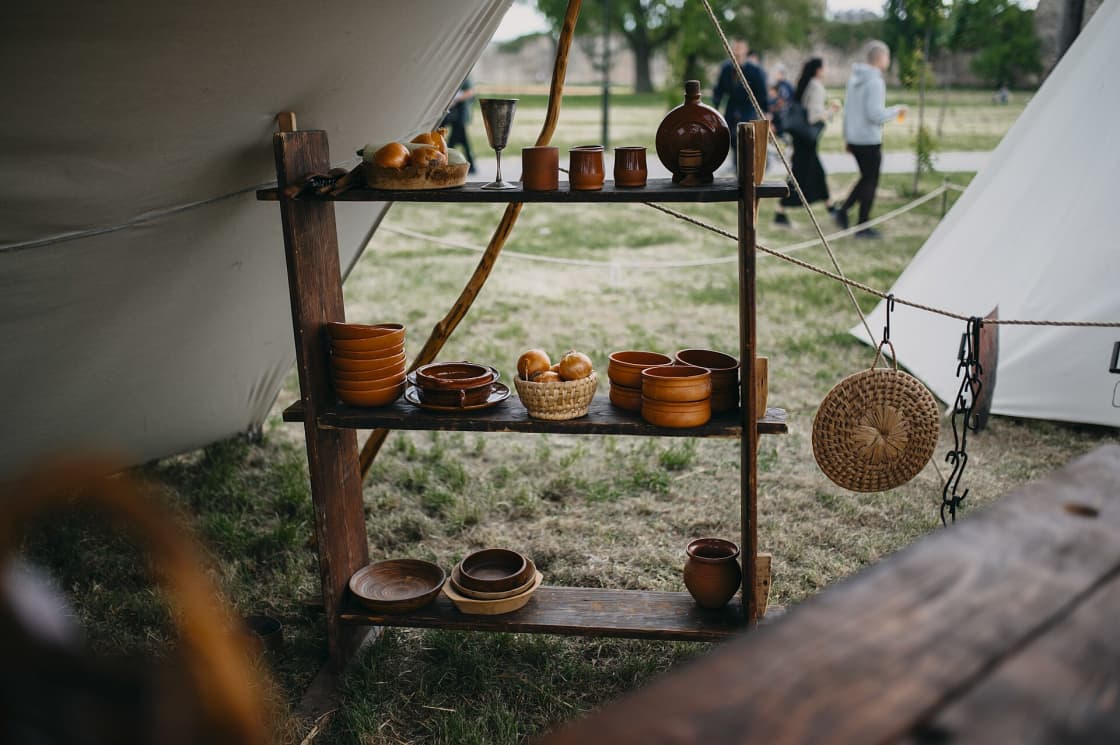

Utah Valley has more people making things by hand than its retail landscape suggests, and almost none of that activity is visible from a road.
The reason is straightforward. Storefront rent in a valley where retail concentrates into a handful of large centers is the one fixed cost an independent maker generally cannot carry on handmade volume. So the maker economy here routed around storefronts entirely. It lives in seasonal markets, shared booths, church-hall and school-gym craft fairs, direct social sales, and a modest wholesale trade into a few independent shops.
That structure has consequences for anyone trying to buy. The inventory is real and often excellent, but it is not sitting somewhere waiting to be browsed on a Tuesday. It appears on a calendar, and the calendar is earlier than most people expect.
The four channels, and what each one is good for
Seasonal outdoor markets run through the warm months and are the widest-selection option while they last. They mix produce, prepared food and handmade goods in proportions that vary by market. For a buyer, the value is comparison: several makers in one place, work you can pick up and examine, and the person who made it standing behind the table. Buying for a couple? Our wedding registries and gift shops guide covers registry etiquette and local shops.
Indoor holiday markets compress into a short late-autumn window and are the single most productive buying opportunity in the year. They are also the most crowded, and the best-selling categories go early.
Shared retail spaces — arrangements where a number of makers rent space or booths under one roof and the venue handles the transaction — are the closest thing to a permanent storefront the maker economy here has. They solve the browsing problem, because the work is there on a normal weekday. What they cost you is contact with the maker, since the person behind the counter usually did not make most of what is on the shelves.
Direct sales through a maker's own accounts are where custom and made-to-order work happens, and where the deepest version of any one maker's range lives. A market table is a curated slice of what someone makes; their own channel is the whole catalog.
Why the buying calendar is earlier than it feels
The thing that trips people up is treating handmade inventory like retail inventory. Retail restocks. A shop that sells out reorders, and the reorder arrives.
Handmade does not work that way. A person producing by hand has a ceiling on output per week that does not move when demand rises. If a maker can finish twenty pieces a week, then twenty is the number in a slow week and twenty is the number in the week before Christmas. Demand does not create supply; it just empties the table faster.
This has two practical consequences.
The first is that made-to-order work closes before finished-goods work does. If a piece has to be made after you order it, the maker has to count backward from their deadline through their production queue. That cutoff commonly lands well before the last date they will sell something already made. Anyone planning a personalized gift should ask for the order cutoff early and plan against it rather than against the holiday.
The second is that the good stuff at a holiday market is gone on the first day, not the last. Markets that run multiple days or multiple weekends are not offering the same selection throughout.
How handmade pricing works
There is a persistent assumption that buying direct from a maker should be cheaper than buying the equivalent at retail, because you are cutting out a middle layer. It is usually wrong, and understanding why makes the whole category easier to navigate.
A manufactured item spreads its setup, tooling and design costs across an enormous production run. Materials are bought at volume prices. Labor is specialized and fast. By the time a mass-produced ceramic mug reaches a shelf, the labor component of its price is small.
A handmade version of the same object inverts every one of those. Materials are bought in small quantities at retail-adjacent prices. There is no tooling to amortize because there is no run. And the maker's time is a direct input to each individual unit, not a fixed cost spread across thousands.
So the honest way to read a handmade price is not as a premium over the retail equivalent. It is closer to what the object costs to produce when nobody is producing it at scale. The retail price is the anomaly, not the handmade one.
This also explains why the discount conversation goes badly. Most independent makers here are pricing at or near the floor of what the work sustains, and a significant number undercharge for their own time. A request to come down is, in effect, a request that they work for less than they already are.
What does work is asking whether there are seconds — pieces with a cosmetic flaw that the maker cannot sell at full price and often would rather move than store. Asking whether a simpler version of a piece costs less. Or asking about a multi-item price if you are buying several. All three give the maker a way to say yes without devaluing the main line.
Commissioning custom work without it going wrong
Custom work is where the most satisfying purchases and nearly all of the disputes come from. The failures are boringly consistent, which means they are avoidable.
Settle four things before money changes hands: what is being made, what it costs, when it will be done, and what happens if you do not like it. Nearly every custom job that sours was vague on one of those.
Expect a deposit, and expect it to become non-refundable once materials are purchased. That is normal practice rather than a warning sign — the maker has converted your money into physical stock that may be useless for any other customer.
Send pictures rather than descriptions. The gap between the thing in your head and the words you used to describe it is precisely where custom work fails. Two reference images and a note about which parts of each you like will outperform three paragraphs of prose every time.
And give a real deadline with room in it. "Before Christmas" is not a deadline. A specific date two weeks before you need it is.
What this valley makes
Maker economies specialize, and they specialize around whatever the local inputs and the local buyers happen to be. Utah Valley's mix is legible once you notice it.
Fiber and textile work is especially visible — quilting, knitting, crochet, sewn goods and embroidery. This is not an accident of taste. It reflects a long domestic craft tradition in the region, a dense network of classes and guilds that teach the skills, and a substantial market of buyers who grew up around the work and know what good execution looks like.
Food and confection is the other large category, and it is the one most tied up in regulation. Utah's Home Consumption and Homemade Food Act (Utah Code Title 4, Chapter 5a) sets the terms for home producers selling directly to an informed final consumer, so what a home producer may legally sell is a narrower question than what they can make.
Woodwork and small furniture benefits from a construction-heavy regional economy, which means tools, offcut material and people who already know how to use both are unusually available.
Ceramics, jewelry, candles, soap and paper goods fill out the rest, and these are the categories where the university presence shows most clearly — a steady supply of people with studio access, design training and a need for income that fits around a class schedule.
Some specialties, such as high-end art glass, are harder to find locally, and you may need to travel or order in.
Pickup, shipping and the part nobody plans for
Buying direct solves the price and selection problem and creates a logistics one, which is worth thinking about before you commit rather than after.
Most makers here offer local pickup, and local pickup is truly local — often a porch, a driveway, or a handoff at a market they are already attending. That works well if you are in the same part of the valley and badly if you are not, because a twenty-minute drive each way to collect a modest item erases the convenience entirely.
Shipping is the alternative, and the thing to check is who is absorbing it. Handmade goods are frequently awkward to ship: ceramics and glass need real packing, textiles are light but bulky, and food has its own constraints. A maker who quotes shipping separately is being straightforward with you. A maker whose prices look higher than a comparable table at a market may simply have shipping built in.
The scheduling question matters more than either. If you are buying a gift, the delivery date is the deadline, not the order date, and a maker working through a queue may not be able to compress that. Ask when it ships, not just when it is ready.
Telling handmade from resold
Not everything at a market table was made by the person sitting behind it, and the mix varies. This is worth checking, and it is easy to check politely.
Ask how it is made. Someone who made the thing will tell you what it is made of, where the material comes from, how long one takes, and what tends to go wrong. The answers are specific because the knowledge is physical. A reseller answers vaguely or pivots to features and price.
The other reliable signal is variation. Genuine handwork produces small differences between supposedly identical pieces — that is what handwork is. A large inventory of perfectly uniform items at low prices is a manufactured inventory, whatever the booth signage says.
None of this needs to be adversarial. Most makers enjoy the question, because process is the part of the work they rarely get to talk about.
Judging quality, by category
The hardest part of buying handmade is knowing whether a thing is good. Price is a weak signal, because makers price inconsistently, and enthusiasm is a weaker one. But most categories have two or three tells that take seconds to check.
Ceramics. Turn the piece over. The foot — the ring the piece stands on — should be smooth enough not to scratch a table, and finished rather than raw and ragged. Look at where the glaze stops near the base; a clean, deliberate line is a sign of care, a drippy uneven one is not. For anything meant to hold food or drink, ask directly whether the glaze is food-safe and whether the piece is dishwasher and microwave safe. A maker who works in functional ware will answer instantly.
Textiles and quilting. Look at the back and the inside seams, which is where corners get cut because nobody is expected to look. Seams should be finished rather than raw. On quilted work, check whether the stitching density is consistent across the piece rather than dense where it shows and sparse where it does not. On knitwear, ask about fiber content and washing, because a garment that needs hand-washing is a different gift from one that does not.
Wood. Run a hand over it. Surfaces should be smooth in every direction, including the awkward inside corners. Check whether the grain has been matched at the joins on anything constructed, and ask what the finish is and whether it needs maintenance — an oiled board and a sealed one have very different care requirements, and the buyer who was not told will find out the hard way.
Candles and soap. These are the categories where the gap between hobby and craft is widest, and the tells are mostly on the label. For candles, ask what the wax and the wick are, and whether it has been burn-tested. For soap, ask how long it has cured; properly cured cold-process soap lasts far longer in use than an undercured bar.
Jewelry. Ask what the metal is, since "silver" covers a wide range. Check clasps and jump rings, which are where inexpensive components hide inside otherwise good work.
Across every category, the general principle holds: look at the parts that are not meant to be looked at. Anyone can finish the front.
What buyers most often get wrong
Three patterns account for most of the disappointment.
Treating the maker as a shop. A shop has staff, hours and a returns desk. A maker is one person who also has a day job, and the response time, the flexibility and the recourse are all correspondingly different. This is not worse, but it is different, and expectations calibrated to retail will be disappointed by an arrangement that is working exactly as intended.
Assuming a repeat is available. Handmade work is frequently a small run of a thing the maker felt like making, using materials they happened to have. The mug you loved may not exist again, because the glaze batch, the yarn dye lot or the piece of timber is gone. If you want two, buy two now.
Leaving the purchase to the last week. This is the recurring one, and it is not fixable by paying more, because the constraint is production time rather than price.
A buying strategy that works here
Split the list in two.
The many-small-gifts half — teacher gifts, neighbor gifts, gift exchanges, stocking items — should be bought early. This is the category that clears first at every holiday market, because it is everyone's default answer to the same problem. Consumables especially: candles, soap, baked goods, preserves.
The one-significant-gift half can wait longer if it is a finished piece, because higher-priced single items move more slowly. But it cannot wait at all if it is custom, for the production-queue reason above.
Then go early in the day and early in the run. A market's first hours on its first day is a materially different event from its last hours on its last day.
Finally, if you find a maker whose work you like, get their direct channel before you leave the table. The market is a sample. Their own catalog is the range, and it is where next year's buying gets much easier.
If you want to support makers beyond buying
Purchases are the obvious support and not the only useful one.
Reviews and tagged photographs matter disproportionately to people whose entire storefront is a social account, because discovery is their hardest problem and word of mouth is most of their marketing budget. A tagged photo of the thing in use is worth more to a small maker than a five-star rating with no image.
Turning up early at a market helps in a way that is not obvious: the first hour sets the tone, and a table with people at it attracts more people. Booth fees are paid whether or not anyone stops.
And referrals are the highest-value thing you can give. Makers here mostly grow through recommendation rather than advertising, because advertising at handmade margins rarely pays for itself. If someone made you something you liked, saying so to the next person looking for a gift is the most useful thing you can do.
Related Guides
- Shopping in Provo & Utah Valley — the malls, downtown and outlet geography
- Thrift & Vintage in Provo and Orem — the secondhand circuit
- Antique Shops in Utah Valley — booths, malls and estate sales
- Christmas in Provo — holiday events and lights
- Quilt Shops and Quilting in Utah Valley
Frequently Asked Questions
Where do Utah Valley makers sell their work?
When should I start buying handmade gifts for the holidays?
Why does handmade work cost more than the equivalent in a store?
Is it rude to ask a maker for a discount?
How do I commission custom work without it going wrong?
Are markets cheaper than buying from a maker directly?
How can I tell genuine handmade work from resold imports?
What sells out first at Utah Valley holiday markets?
Sources
The facts in this guide were checked against these sources. Hours, fees and rules change, so confirm anything time-sensitive with the source before you go. How we make Provo.com.
- Utah State Legislature. Checked October 12, 2026.