
Downtown Provo does not look like a place that produces national recording artists. It is a walkable, well-lit, mostly sober main street with soda shops and a temple at one end of it.
And yet, from one room on University Avenue: Imagine Dragons. Neon Trees. The Aces. The Moth & The Flame. Fictionist. The Backseat Lovers. The National Parks. Joshua James. Lindsey Stirling, who played the same stage before America met her on television.
The room is Velour Live Music Gallery, it opened in January 2006, and it has never sold a drink.
Most coverage treats that last fact as a charming quirk — a dry venue in a dry town, isn't that funny. It has the causation backwards. The alcohol-free policy is not the obstacle Velour overcame. It is a substantial part of why the place works.
The room
Velour sits at 135 N University Avenue, in the block above Center Street, in a downtown you can cross on foot in ten minutes.
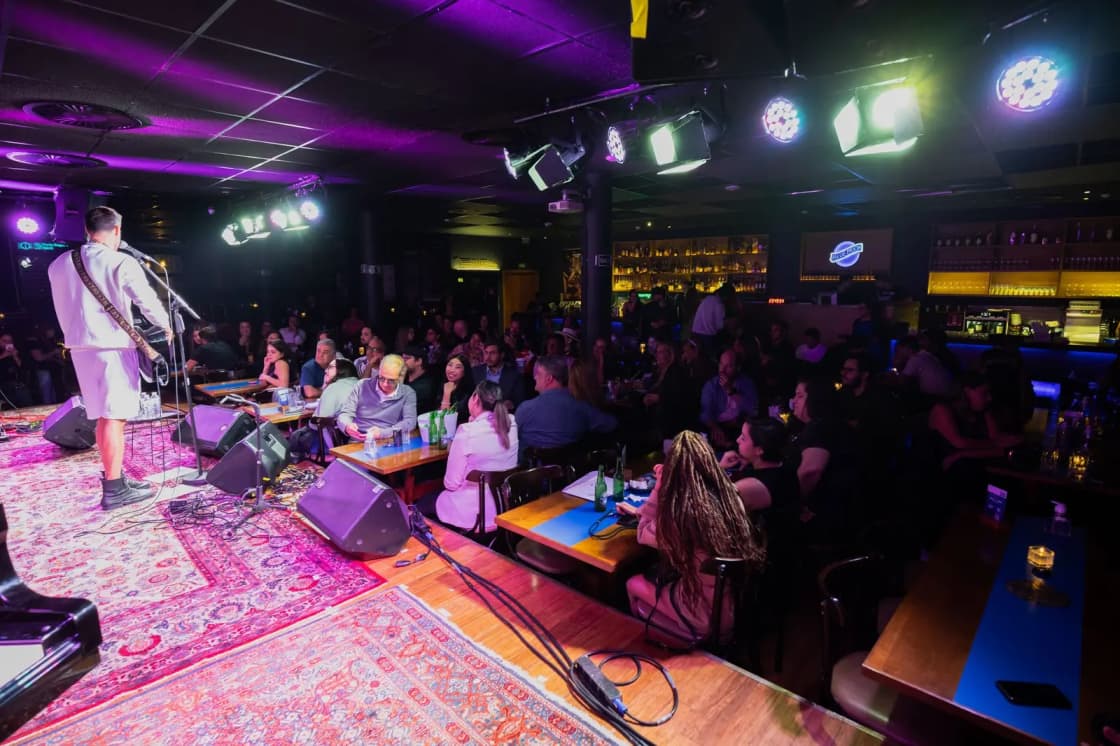
Inside, it does not look like a club. It looks like someone's very specific idea of a Victorian parlor that has been rearranged around a stage: velvet, stained glass, oil paintings, antique furniture in the corners, vintage objects on the walls that owner Corey Fox has collected and placed himself. The venue's own PR has compared the experience to a movie theater — you go in, the lights go down, and you are there for the thing on the stage rather than for the room.
That is a deliberate choice and it does real work. In a bar, the stage competes with the bar. Here there is nothing to compete with, which is why bands describe the audience at Velour as unnervingly attentive.
Corey Fox did not start here
The single most under-reported fact about Velour is that it is the fourth venue of Corey Fox's career, not the first.
By his own account in a 2011 interview, the sequence runs:
- Early 1990s — playing in and promoting shows in Utah Valley's ska scene, which was nationally respected at the time
- 1993 — begins managing the Salt Lake band Clover, who sold out rooms like Kingsbury Hall and got songs onto local radio and into film and television
- 1996 — first venue job, running the music half of Wrapsody, a 400-capacity restaurant-and-venue. He still calls it his favorite room to have worked
- 2000 — the restaurant side of Wrapsody fails and takes the venue with it. Fox's assessment: the closure "affected the scene for years"
- 2000–2002 — manages Johnny B's, a concert venue on weekdays and a comedy club on weekends
- 2003–2005 — manages Muse Music, the room he credits with bringing the local scene back to life after Wrapsody
- 2006 — opens Velour
That lineage matters, because it explains what Velour actually is. Fox did not open a venue because he wanted to run a bar with a stage in it. He opened one because, in his words, the quality of the bands in the area was rising faster than the rooms available to them, and they needed a more professional environment to progress. He had watched a scene collapse when a room closed, and he had spent six years running other people's rooms under other people's business models.
The venue that came out of that is a venue built around artist development first and ticket sales second. That is an unusual order of operations, and it is why the graduates list is as long as it is.
Why alcohol-free is the mechanism, not the handicap
Here is the argument nobody in the national coverage quite makes explicit.
1. No bar means no age limit. A 21-plus room can only book bands whose members are 21, or make awkward exceptions, and it can only sell tickets to adults. Velour can put a 16-year-old band on stage in front of a 16-year-old audience. Provo's most successful exports were teenagers when they started, and in most American cities a teenage band's only options are a garage, a church hall, or an early all-ages slot at a bar that would rather have the evening.
2. The audience here is disproportionately non-drinking anyway. Provo is a city built around BYU and UVU, and BYU's Honor Code prohibits alcohol outright. A conventional bar-venue in this town is not choosing between a big crowd and a small one; it is voluntarily excluding a very large share of the people who would otherwise buy a ticket. Going dry inverted the usual math.
3. Without bar revenue, the door has to work. A bar-venue can survive a mediocre night because the crowd still drinks. Velour cannot. Its entire business is people caring enough about a specific band to pay to stand in a room and watch them. That is a brutal incentive, and it is precisely the incentive that produces a genuine artist-development pipeline instead of a rotating cast of touring acts.
Put those together and the strange thing stops being strange. Provo did not produce Imagine Dragons and Neon Trees despite being a place where the music venue does not serve alcohol. The scene's shape — young, all-ages, unusually dense, built on repeat local attendance rather than bar traffic — is downstream of exactly that.
Battle of the Bands, and how a band actually gets in
Velour's front door for new acts is its Battle of the Bands, run twice a year — typically June and December — since the venue opened, with a small number of editions missed during the pandemic.
The format is simple: several bands play each preliminary night, judges pick who advances, and the finalists play a finals night that packs the room. Tickets have historically been cheap, in the range you would expect for a local show, and the prelims are where you see bands nobody has heard of yet.
Fox has been direct about what it is for. He has described the competitions as the most important part of Velour's growth structure and the main way the venue finds new talent to work into its normal rotation — a launching pad for the bands that take it seriously, and the mechanism that keeps the wider scene from going stale.
The alumni list is the argument: Neon Trees, Imagine Dragons, The Aces and The Backseat Lovers are all past winners.
If you want to understand Utah Valley music, a Battle of the Bands prelim night is a better use of an evening than a headline show. You are watching the intake valve.
The list, with the caveat it deserves
Velour's own summary is that six bands signed major-label record deals between 2006 and 2016, among them Grammy-winning Imagine Dragons, platinum-selling Neon Trees, The Moth & The Flame, The Aces and Fictionist.
A caveat worth stating plainly, because tourism copy tends to blur it: "played Velour early" is not the same as "formed at Velour," and the bands' own origin stories vary. Imagine Dragons has Las Vegas roots as well as Provo ones — we untangle which Utah Valley names are actually local in our guide to famous people from Provo and Utah Valley. Some of these acts were built in the valley from the start; others found their audience here. What is consistently true, and what musicians themselves say, is that the room functioned as the proving ground — the place where a Utah band found out whether it could hold a crowd.
The other thing that list undersells is everything that never signed. Velour has been running two competitions a year and shows most weeks for two decades. The great majority of the bands on that stage stayed local, and the scene works because they did.
What else happens in the room
Velour is not only a music venue:
- FilmQuest, the genre film festival, has used it as a home
- Les Femmes de Velour, an all-female music festival, has run there
- Fox is known for one-off staged concepts — the venue's slumber-party shows have involved converting the room into an enormous blanket fort
If you are building an evening around it, the venue sits inside a walkable downtown block with Center Street dining a minute away and the rest of downtown Provo's nightlife around it.
The rest of the machine
Velour gets the headlines, but a venue on its own does not make a scene. Provo has an unusually complete set of supporting parts, and knowing them is the difference between visiting the scene and understanding it.
The studio. June Audio Recording Studios, run by Scott Wiley, is where a large share of the valley's records get made. It is deliberately discreet — tucked behind other buildings, with an entrance that reads as a house — and it is where national outlets go when they want to film Utah bands working.
The magazine. Provo Music Magazine covers the local scene week by week. Its "Shows This Week" post, published on Mondays, is the single most useful link in Utah Valley music: every show at every venue, universities and house shows included. It also puts out free print editions distributed through Velour, local record shops including 3hive Record Lounge and Provo's Vintage Groove, Bill Harris Music, and June Audio.
The calendar. Darcie Roy, who co-founded Muse Music, has been building provomusicscene.com as a community-sourced show calendar and artist registry — anyone can add, anyone can see.
The other room. Provo is not a one-venue town. ABG's Libation Emporium books live music as well, and it is a bar — which means the two rooms are not competitors so much as two halves of a scene, one all-ages and one not. If you only ever go to Velour, you are seeing half of it.
The national validation. In November 2023, NPR's World Cafe spent four days in Provo and built a seven-episode Sense of Place series out of it, released the following January. The people they talked to are a fair map of the scene: Velour and ABG's, The Aces, The National Parks, Melody Clinger, Little Moon, JTM, Provo Music Magazine's Zach Collier and June Audio's Scott Wiley.
Rooms in this town do not usually last twenty years
Put Velour's run against the rest of the local venue history and the community fundraiser stops looking sentimental.
- Wrapsody closed in 2000 when the restaurant attached to it failed. By Fox's account the scene took years to recover.
- Johnny B's is gone.
- Muse Music, the room that revived things in the mid-2000s, ran a cafe model on University Avenue, closed there in December 2014, and reopened at 247 W Center Street in September 2015 without the cafe — which had never paid for the floor space it took. It ran a few more years in the new room and then closed for good. Its old locations are different businesses entirely.
- Across the valley, Orem's Boardwalk is mourned in the local music press as a recent loss.
Small venues fail because the economics are unforgiving and the margin is thin whether or not the room is beloved. Velour is the exception, not the rule, and the twenty-year run is why a generation of Utah musicians treats the place as infrastructure rather than as a business.
How to find out what is playing
Three sources, in order of usefulness:
- Velour's own site and Instagram for that room's calendar and ticket links.
- Provo Music Magazine's Monday "Shows This Week" for everything happening in Utah County, including the shows nobody advertises.
- provomusicscene.com for the community calendar.
What you should not rely on is a general events aggregator. Local shows at small rooms are announced on the venue's own channels and in the local music press, often days out, and they routinely never reach the national listing sites at all.
Practical notes for a first visit
Age. All ages, always. Bring the teenager.
Alcohol. None sold, none permitted. Also smoke-free.
When shows run. Generally midweek through Saturday, starting in the evening and finishing well before midnight — early by big-city standards, which is a feature if you have anything on the following morning. Velour's own listings are the only reliable source for a given week.
Tickets. Small-room pricing. Local shows and competition nights are inexpensive; touring acts cost more. Popular local bands genuinely sell this room out, so buying ahead is not paranoia.
Parking. There is no venue lot. Use street parking on University Avenue and the surrounding blocks, or the public downtown lots and structures; on a busy night, park two or three blocks out and walk. UVX bus rapid transit runs the corridor. Our University Avenue guide covers the parking geography of the whole street.
Capacity. Small. Published figures vary and the venue does not advertise one, so we are not going to print a number that might send you to the wrong expectation — assume an intimate room where a sold-out night means genuinely shoulder to shoulder.
Why it nearly did not survive, and what that tells you
In 2021, Velour hit its fifteenth anniversary while closed by the pandemic. What happened next is the part locals bring up: the community raised money to keep it open — donations, a fundraiser organized with people from the local recording community, hundreds of individual contributions.
That is not a normal relationship between a town and a bar. It is closer to the relationship a town has with a library or a theater, and it is the clearest evidence for what the venue actually is. A room that has spent twenty years putting unknown teenagers on a real stage with real sound accumulates a very large number of people who owe it something.
NPR's World Cafe built an entire Sense of Place segment on Provo around this idea, and the framing they landed on is the right one: a venue that became one of the most important in the state without ever selling a drink.
The short version
Velour opened on University Avenue in January 2006, the fourth room in Corey Fox's career and the first one he owned.
It is all-ages and alcohol-free, which in a university town full of people who do not drink is a bigger market rather than a smaller one, and which lets bands start at 16 instead of 21.
Twice a year it runs a Battle of the Bands that has functioned as the region's talent intake for two decades, and whose winners include Neon Trees, Imagine Dragons, The Aces and The Backseat Lovers.
It nearly closed during the pandemic and the town paid to keep it. Go on a prelim night, pay at the door, and watch four bands you have never heard of. One of them has a real chance of being the answer to this question in ten years.
More on the wider scene, including the free outdoor Rooftop Concert Series and the Covey Center, in our live music in Provo guide.
Related Guides
Frequently Asked Questions
What is Velour Live Music Gallery?
Does Velour serve alcohol?
What bands got their start at Velour?
What is the Velour Battle of the Bands?
Who is Corey Fox?
What is a show at Velour actually like?
Where do I park for Velour?
Is Velour still open?