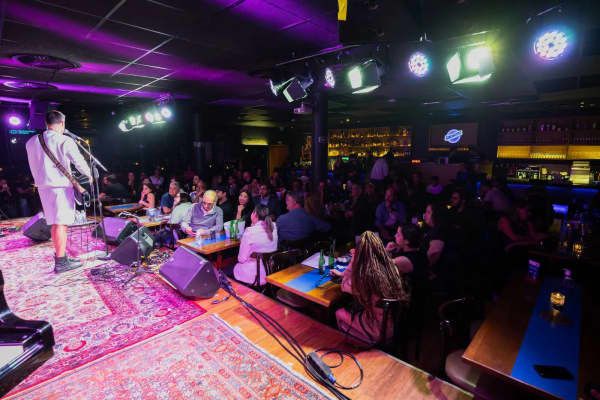

There is a genuinely strange fact about Provo, Utah that most people who live here have stopped noticing: this small college city is one of the more consequential places in American comedy.
Not because of a scene in the New York or Chicago sense — there is no ecosystem of twelve rooms and nightly open mics. It is stranger than that. Provo became the center of gravity for clean comedy, a category the rest of the industry mostly treats as a constraint, and it did so by building a production operation, a student pipeline, and an audience that would show up sober on a Friday. A comedy special filmed in a converted building on Center Street now reaches audiences measured in the billions of views.
This guide covers where to actually see comedy here, what each room is like, and the history that explains why a town of this size punches this far above its weight.
Dry Bar Comedy — 295 W Center Street
The headline venue, and the one people fly in for.
Dry Bar launched in 2017, founded by VidAngel — now Angel Studios — in a Center Street building that previously operated as the Madison. The premise was simple and, at the time, unfashionable: professional touring stand-up, filmed in front of a live audience, with no alcohol served and no blue material.
That premise turned out to be a very large business. Dry Bar built a library of full-length specials and short clips that circulate relentlessly online, and it has run for well over a dozen seasons of tapings. What this means for you as an audience member is unusual and worth understanding: you are not just watching a show, you may be sitting in a filmed one. The production values in the room reflect that — the lighting, the sound and the staging are built for camera, which makes it a better-looking room than most clubs its size.
What it is like. Intimate, is the word every reviewer reaches for. It is a small venue and there is not a bad seat, but it is also full most weekends. Shows run Friday and Saturday evenings. Snacks are available and get better reviews than snack counters usually do. There is a VIP ticket option that bundles a drink, popcorn and front-of-room seating.
The complaint to know about. More than one attendee has reported paying the higher ticket price expecting reserved seats and ending up in what felt like general admission. If seating position matters to you, confirm exactly what your ticket tier guarantees at the point of purchase rather than at the door. Separately, the room converted from tables to theater seating at some point, which fits more people in and which some longtime attendees miss.
Who plays it. A rotating mix of national touring comedians who work clean, plus rising names. Jeff Allen and comedians in that vein come up repeatedly. The booking is genuinely national — this is not a local-comics room.
Tickets sell in advance online, and weekend shows do sell out. It sits in the heart of downtown Provo, a short walk from most of the city's Center Street restaurants, which makes dinner-and-a-show the obvious template.
ComedyBox Utah — 36 W Center Street
Three blocks east, and a completely different product: competitive short-form improv.
The venue operated for years as ComedySportz Provo and now trades as ComedyBox Utah. The format survives the rename intact — two teams, a referee, games built from audience suggestions, and a scoreboard nobody takes seriously. If you have seen the format elsewhere, you know it; if you have not, it is the closest live-comedy equivalent to a sport, right down to the birthday song for anyone the crowd gives up.
What it is like. Shows are Friday and Saturday evenings only — this is not a nightly room, and the schedule catches people out. Reviewers are consistently warm about the performers' quick-wittedness and consistently clear about the register: this is squeaky-clean humor, and you should come expecting that rather than hoping otherwise. Audience participation is heavy, which is either the appeal or the reason to sit at the back.
The honest caveat is the one attached to all amateur and semi-professional improv: quality varies with the night, the cast and the crowd. A room full of engaged people produces a much better show than a quiet one, and reviewers say so plainly. It is inexpensive, it is reliably good-natured, and it is one of the safest bets in the valley for a group that contains a range of ages.
The BYU pipeline, which is the real story
Most of Provo's comedy output does not happen in a club at all. It happens on campus, and it has for two decades.
Divine Comedy is BYU's sketch troupe and the most important comedy institution in the valley. It has been running for over twenty years. Performers audition at the start of fall semester, and those who make the cast enroll in a course for credit, meet weekly, write their own material, and stage roughly three live shows a semester in a campus lecture hall. Tickets have traditionally cost a few dollars, sold at the Wilkinson Student Center information desk or at the door — and "at the door" has always been a gamble, because seating is limited and the shows fill.
The material draws heavily on Latter-day Saint culture and everyday college life, and each show traditionally ends with a longer parody of a popular film. The troupe's signature creation, the Shoulder Angel sketch, became well known far beyond campus.
Then, in 2012, ten past and present Divine Comedy members formed the founding cast of Studio C, a sketch series on BYUtv. In its first season, roughly three quarters of the sketches were adaptations of Divine Comedy material written by those same cast members. That is an extraordinary pipeline — a student club at a single university supplying the writing and performing core of a nationally distributed sketch show. In 2019 the original cast departed en masse, and the show continued with a new ensemble.
Humor U is the stand-up counterpart — a student-run club performing original stand-up rather than sketch or improv. It began off campus at amateur venues before forming as a club to accommodate bigger audiences, and it still runs shows for BYU crowds. Divine Comedy and Humor U have staged joint roast battles, which is exactly as chaotic as it sounds.
Laugh Out Loud covers improv, completing the trio of campus comedy clubs.
For students, these are the cheapest live comedy in the valley by a wide margin and a genuine part of the BYU student experience. For everyone else, they are worth watching for the same reason people watched Second City rooms — you are seeing the material two years before it reaches a screen.
The Covey Center and one-off bookings
The Covey Center for the Arts at 425 W Center Street is Provo's municipal performing arts venue, and comedy appears on its calendar alongside theater, concerts and dance. It is not a comedy club and does not program a regular comedy night, but touring comedians and local productions book it, and the room is a good one — small enough that sightlines work from everywhere, and priced well below comparable Salt Lake venues.
The practical advice is to watch the Covey's season calendar directly rather than assuming. Our guide to live theater in Utah Valley covers the venue's wider programming, and the Covey's own season turns over annually.
Notably, all three of Provo's comedy rooms — Dry Bar, ComedyBox and the Covey — sit on Center Street within about a half-mile of each other. Whatever else is true about the scene here, it is geographically tidy.
The drive north: Wiseguys
If what you want is a traditional comedy club — a bar, a two-drink minimum, a national headliner working blue if they feel like it — Utah Valley does not have one, and it is unlikely to get one.
Wiseguys is the answer, with three rooms in Salt Lake County and Weber County: downtown Salt Lake City at 190 400 West, Jordan Landing in West Jordan, and Historic 25th Street in Ogden. Downtown Salt Lake runs the fullest schedule, including weeknights, and books the biggest names. It is roughly forty-five minutes from Provo without traffic, which makes it a genuine evening commitment rather than a spontaneous one.
Reviewers rate the comedy consistently higher than the service; the recurring complaint across locations is slow drink service in a full room. Food is reasonably priced and reasonably good. For the logistics of getting there and back, day trips from Provo covers the northbound options.
Why clean comedy took root here
It would be easy to explain Provo's comedy scene as simply a consequence of local norms, and that explanation is incomplete in an interesting way.
The obvious part is real: this is a city where a very large share of the population does not drink, which removes the bar economy that funds comedy almost everywhere else. A traditional club runs on alcohol margins with the comedy as the draw. Take away the alcohol and the model breaks — unless you replace the revenue with something else.
What Provo did was replace it with production. Dry Bar's business is not primarily ticket sales; it is a library of filmed specials distributed at enormous scale, with the live room functioning as both venue and studio. That inverts the usual relationship: the audience is not the customer so much as part of the product, and the economics work at a size that would never sustain a conventional club in a city of 115,000.
The second ingredient is supply. Two universities produce a continuous stream of performers who have already spent years writing and staging comedy for campus audiences, in a register that happens to be exactly the register Dry Bar sells. Divine Comedy alone has been training sketch writers for over twenty years, and its alumni populated a national television show.
The third is audience habit. This is a valley that goes out in groups, on weekends, for activities rather than for drinks — the same demand pattern that produced an outsized number of escape rooms and kept the nickel arcades profitable. A ticketed comedy show at eight on a Friday is a natural fit for that pattern in a way it is not in most American cities.
None of that was planned. It is what happens when a constraint that looks like a disadvantage turns out to define a category nobody else was serving.
The screen layer, and why it matters to a live audience
Provo's comedy output reaches most people through a screen rather than a seat, and understanding that layer explains what you are actually walking into at a live show.
Studio C has been produced in Utah County for BYUtv since 2012 and remains the most visible sketch product to come out of the valley. Its founding cast came from Divine Comedy; its first season leaned heavily on adapted campus material. When the original ensemble departed in 2019 the show continued with new performers, and the departing cast went on to their own ventures — a pattern that has repeated often enough here that "Provo sketch performer becomes internet comedy business" is now a recognizable career path rather than an anomaly.
Dry Bar's clip economy is the other half. The specials filmed on Center Street are cut into short segments that circulate constantly on social platforms, and the aggregate audience runs into the billions of views. That has two consequences for anyone attending a live taping. First, the comedians on stage are frequently there specifically to record a special, which means they are working polished, road-tested material rather than trying new bits — the hit rate is high and the surprise factor is lower than at an open mic. Second, you may be on camera. Audience reaction shots are part of the product.
If you have watched a clean-comedy clip in the last few years without thinking about where it came from, there is a reasonable chance it was filmed a few blocks from Provo's city center.
If you want to perform
The path into comedy here is narrower than in a major metro and more structured, which cuts both ways.
If you are a student, the campus troupes are the front door and they are competitive. Divine Comedy auditions at the start of fall semester and casts a small number of new members each year; successful auditioners are looking to bring original sketch material, not just perform. Humor U is the stand-up route and has historically been more open, having started as students performing at amateur venues before formalizing. Laugh Out Loud covers improv. All three demand real time — writing, rehearsal twice a week, and performances clustered around the middle and end of term.
If you are not a student, the honest answer is that Utah Valley has thin open-mic infrastructure compared with a city its size, because the venues that host open mics elsewhere are bars. Nights come and go at coffee shops and small rooms, which means the reliable route is to follow local comics on social media rather than to look for a fixed weekly slot. Many valley comics build their reps by working Salt Lake rooms and returning here for booked shows.
The upside of the narrow path is that the ceiling in this specific niche is unusually high. A valley comic who works clean has a filmed-special venue in their own city, a national distribution operation attached to it, and a television production twenty minutes up the road. That combination does not exist in most cities of any size.
Practical planning
Book ahead for Dry Bar. Weekend shows sell out, and the room is small.
Check the day. Both Provo venues run Friday and Saturday. There is very little weeknight comedy here outside of campus.
Sunday is closed. As with essentially all commercial entertainment in this county, plan around it.
Parking downtown is manageable but tightens on Friday and Saturday evenings, particularly when the Covey has a show at the same time as Dry Bar. Center Street has metered and side-street parking within a few blocks.
Check the campus calendars if you want the cheap option. Divine Comedy, Humor U and Laugh Out Loud all perform on semester schedules, and tickets have historically been in the single digits. Shows cluster in the middle and end of each semester, and they do not run in the summer at anything like the same rate.
Bring the family, but read the billing. Dry Bar has no strict minimum age and the material is clean by design, but "clean" and "aimed at eight-year-olds" are not the same thing. ComedyBox's improv is the safer bet for younger children.
The short verdict
For professional stand-up: Dry Bar Comedy, Center Street, Friday or Saturday, booked in advance. There is nothing else like it in the valley, and its national reputation is earned.
For improv: ComedyBox Utah, also Center Street, also weekends. Cheap, warm, wildly variable in the way improv always is.
For the cheapest and most surprising: BYU's student troupes, on a semester schedule, tickets in the single digits.
For a bar and a headliner working uncensored: Wiseguys in Salt Lake County. Budget the drive.
Calendars, ticket tiers and show times all change; check the venue directly before you commit an evening, and buy weekend Dry Bar tickets earlier than feels necessary.
Related Guides
- American Fork Amphitheater: Free Monday Concerts, Weddings, and Two Different Addresses
- Provo's Covey Center is bringing Broadway-caliber shows downtown — at half the price
- Provo Nightlife & Evening Entertainment: What's Actually Open After Dark (2026)
- The Covey Center's 2026-27 season is out: country co-headliners, Kyiv ballet, and a world-premiere Boléro in downtown Provo
- Best Museums & Art Galleries in Provo (2026)
- Movies and TV Filmed in Utah Valley
Frequently Asked Questions
Where can I see stand-up comedy in Provo?
What happened to ComedySportz in Provo?
Is Dry Bar Comedy in Provo a real club you can attend?
Is comedy in Provo family friendly?
Where can I see improv comedy in Utah Valley?
What is Divine Comedy at BYU?
Are there comedy shows in Provo on weeknights?
Where is the nearest comedy club with a bar?