
Utah Valley in December runs one of the densest concentrations of nativity displays, crèche exhibits and live Bethlehem productions anywhere in the country. In a single season, within a thirty-mile stretch, you can walk through a constructed Bethlehem with live animals, stand in a room holding hundreds of nativity sets collected from dozens of countries, watch a fifteen-minute outdoor tableau in a church parking lot, and see a professionally produced walk-through experience with a ticketed entry time.
Most of it is free. Almost all of it is volunteer-run. And a surprising amount of it is difficult to find reliable information about, because the events are organized by congregations, small committees and community boards rather than by anyone with a marketing budget.
This guide explains what the formats are, what distinguishes them, how to plan a December that fits them in, and — importantly — which kinds of listings to treat with suspicion. For the wider seasonal picture, see our guides to Christmas in Provo and the Utah Valley Christmas lights map.
The short version
- Three distinct formats: crèche exhibits (objects), live nativities (people and animals), and walk-through Bethlehem productions (constructed sets with narration).
- Most are free; several free ones still require a reserved ticket for capacity.
- At least one major local crèche exhibit runs every other year, which changes how you prioritize it.
- Cluster your visits geographically. The valley's events concentrate at the north and south ends.
- Distrust secondhand listings. We found aggregator listings placing a major exhibit in the wrong city.
Why the tradition is so concentrated here
The crèche exhibit as a community event has a traceable lineage, and part of it runs through this valley.
The format — open a church building, fill it with hundreds of borrowed nativity sets from around the world, add live music, admit everyone free — was pioneered and popularized by exhibits that began decades ago and have been copied widely since. One of the best-documented originals has run annually in Palo Alto, California for well over thirty years, and its own description of the tradition traces the crèche back to Francis of Assisi, who in 1223 staged a nativity in an Italian village with live animals and torchlight after being struck by the sight of shepherds in moonlit fields.
The Utah connection is direct. Deseret News has reported the story of a collector whose personal crèche collection, begun over fifty years ago and eventually numbering in the hundreds, anchored one of the exhibits that started the whole movement — and who later moved to Orem, at which point portions of the collection were displayed locally, including at the BYU Bookstore.
Layer that lineage onto a valley with a very high density of congregations, each with a building, a volunteer base and a cultural expectation of doing something communal at Christmas, and the result is what you see: not one flagship event, but dozens of them, most operating independently and many unaware of each other.
There is also a national network for this. Friends of the Crèche maintains a directory of nativity and crèche exhibits across the United States and Canada, keyed to a season that runs from the first Sunday of Advent to the feast of the Baptism of the Lord — which is a useful reminder that these events cluster in a defined liturgical window rather than being scattered through December at random.
Format one: the crèche exhibit
This is the quiet one, and for a lot of people it is the best.
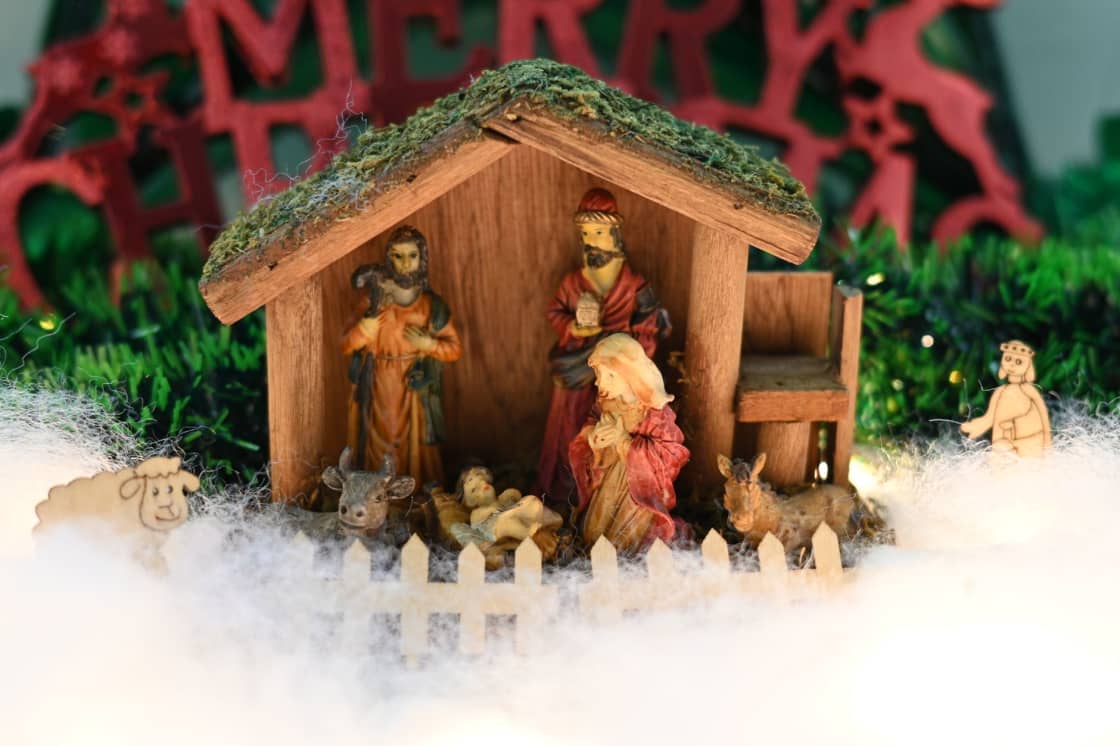
A crèche exhibit gathers nativity sets — frequently several hundred, occasionally more than a thousand — from private collections and displays them together, usually in a church building, usually for three to five days. The sets come from many countries, and the interest is in how differently the same scene gets rendered: carved olive wood from the Holy Land, painted ceramic from Latin America, cloth figures from West Africa, glass from Central Europe, and the santon tradition of Provence, where the nativity is staged as an entire village of local trades rather than a single stable.
Most exhibits run live music throughout, often continuously, performed by local musicians. Many include a children's area with sets that can be handled. Admission is typically free, with donations accepted.
Practically: these are indoor, warm, quiet and stroller-navigable, which makes them the reliable choice on a cold night or with a mixed-age group. They also tend to be less crowded on weeknights, and the last two days before they close are the busiest.
One local exhibit runs biennially. Regional event listings report that a large Utah County crèche exhibit operates on a two-year cycle with an off year in between, and the pattern of years it has been held is consistent with that. This matters for planning in a way an annual event does not: if the current December is an on year, it is worth prioritizing over things you can catch next time. Confirm on the organizer's own site, because volunteer-run events do occasionally change cadence.
Format two: the live nativity
A live nativity stages the scene with people, and usually with animals — sheep, goats, a donkey, sometimes a camel, borrowed from whoever locally owns one.
The scale varies enormously. At the modest end, a congregation sets up a stable in a parking lot or on a lawn, costumed volunteers hold the tableau, and you watch for ten or fifteen minutes, often with music and hot chocolate. At the larger end, live nativities are staged as part of a bigger community event with a market, food and performances.
Several Utah Valley events pair a live nativity with an indoor crèche display, which is a good combination — the objects indoors, the tableau outdoors — but be aware that the two halves are sometimes at two different addresses. At least one long-running community event in the south of the valley operates exactly this way, with indoor displays at one building and the outdoor live nativity at a separate site. If you turn up at one address expecting both, you will see half of it.
Practically: dress for standing outside in December after dark, and go early in the evening with young children. The animals are the entire point for anyone under six, and they are usually more accessible at the start of the evening than at the end of it.
Format three: the walk-through Bethlehem
This is the ambitious end of the spectrum and the one most likely to be ticketed.
A walk-through production builds a set — a street, a market, a stable — and moves you through it on a timed entry, with costumed characters, narration, live animals and often food. Some are run by congregations and stakes, some by community arts organizations, and some by independent organizers who have grown them into substantial annual productions.
Utah Valley has several, at varying scales, and they have a habit of moving venues between years as they outgrow sites or lose them. One newer Provo production was reported by Fox 13 as an outdoor walk-through with live animals, statues, a live market, food and fire pits, built on a north-Provo site by an organizer who described wanting to create something that would bring the community together after a difficult period locally. Another long-running ticketed production has operated in Lehi and has in some years added a second location in the Heber Valley.
Practically: these are the ones to book first. Timed entry means limited capacity, capacity sells out, and the good slots go early. They are also the most weather-exposed format — an outdoor walk-through in a cold snap is a different experience than the same event on a mild evening, and layers matter more than they do for a twenty-minute tableau.
How to look at a crèche exhibit
Most visitors walk a crèche exhibit in fifteen minutes and see very little. A few things to look for turn it into an hour.
Watch what the materials tell you. Nativity sets are made from whatever the maker's region has in abundance and knows how to work. Olive wood points to the eastern Mediterranean, where the trees are and the carving tradition is centuries deep. Fired and painted clay dominates in Latin America. Cloth, beadwork and gourd appear across West and Southern Africa. Porcelain and glass come out of Central European manufacturing towns. Before you read the label, guess the region from the material — you will be right more often than you expect.
Watch who has been added. The canonical scene is small: Mary, Joseph, the infant, shepherds, wise men, some animals. Traditions add to it freely. The Provençal santon tradition surrounds the stable with an entire village of ordinary trades — the baker, the fishwife, the knife grinder — on the logic that the whole community turns out. Other traditions add local figures, local instruments, local food. The additions are the most revealing part of any set.
Watch the animals. The ox and donkey are near-universal, but sets frequently substitute whatever animal the region keeps. Llamas and alpacas appear in Andean sets, camels in North African and Middle Eastern ones, and you will find water buffalo, reindeer and elephants without much searching.
Watch how the figures are dressed and who they look like. Most traditions render the holy family as local people in local clothing rather than as first-century Judeans. That is not an error; it is the whole theological point of the tradition, made visually.
Ask the volunteers. Exhibit hosts are frequently the people who own the sets, and asking about a particular piece will usually get you the story of where it was bought, by whom, and in what year. That is the part you cannot get from a label, and it is the reason to go in person rather than look at photographs.
Where the valley's events are
Geography should drive your planning more than the calendar does, because December traffic and parking in Utah Valley make cross-valley trips expensive in time.
The north end — Lehi, American Fork, Highland, Alpine, Pleasant Grove — carries a heavy concentration, and it is also where the valley's largest ticketed light attraction sits, at Thanksgiving Point in Lehi. Pairing a nativity event with the Ashton Gardens winter display is an efficient evening if you can get tickets to both.
The center — Provo, Orem, Springville — has church and community events plus the commercial displays at Provo's and Orem's shopping districts, which our Christmas lights guide maps.
The south end — Payson, Salem, Santaquin, Genola, Spanish Fork — is where several of the longest-running free community events sit, and where the drive is worth making as a dedicated trip rather than an add-on. The south-valley events are also generally less crowded, because most of the valley's population is north of them.
Just outside the county, the Heber and Midway area runs a substantial crèche festival of its own. It is not Utah County and we do not list it as ours, but it is close enough to be a genuine option for a Saturday, and the drive up Provo Canyon is pleasant.
Where the listings go wrong
This is the part worth reading before you trust anything you find online, including seasonal roundups.
While researching this guide we found a widely circulated regional event listing placing a major local crèche exhibit in Pleasant Grove, while the exhibit's own website gives its address in American Fork, next to the Timpanogos Temple. Those are adjacent cities, so the error is understandable and also completely sufficient to send a family to the wrong town on a December evening.
We also found the exhibit's own site apparently still displaying dates from a previous season, which is common for volunteer-run events between cycles and is exactly why a date you find in August should not be treated as a date you can rely on in December.
Three rules follow, and they apply to every event on this page.
Trust the organizer's own site over any aggregator for the address, and over any listing for the dates. Aggregators copy from each other and errors propagate.
Treat last year's dates as a rough guide only. Most of these events land in the same part of December each year, but the specific days move, and some events skip a year entirely.
Verify before you drive, particularly for anything at the south end of the valley or over a canyon, where a wasted trip is an hour rather than ten minutes.
This is not a counsel of despair — the events are real, they recur, and most of them have run for years. It is a counsel against building an evening on a date you read somewhere in autumn.
Planning a December that fits it in
A workable approach, in order.
Early in the season, identify the ticketed events and buy first. These have fixed capacity and they sell out. If a biennial exhibit is in an on year, treat it as a ticketed event for prioritization purposes even though it is free — you cannot catch it next December.
Then place the free events around them. Free walk-up displays are the flexible layer and can absorb a change of plan.
Cluster geographically. One north-end evening, one south-end evening, one Provo-Orem evening will cover more ground than three trips that criss-cross the valley.
Pair a nativity with a light display in the same town. Most towns with a nativity event also have lights, and the two together make one outing rather than two.
Go on weeknights where you can. The weekend before Christmas is the peak across every venue simultaneously, and parking rather than admission is usually the binding constraint.
Build in the cold. Outdoor formats in this valley are properly cold after dark in December, and the difference between an enjoyable evening and a curtailed one is usually gloves and a thermos. Our guide to winter activities around Provo covers the wider seasonal picture.
What makes these worth the trouble
There is a version of December in Utah Valley that is entirely commercial — lights on shopping centers, a mall Santa, a drive-through display with a ticket price. It is fine, and our Christmas in Provo guide covers it thoroughly.
The nativity and crèche events are a different register. They are almost entirely built by volunteers, for no money, for a few nights a year, and then packed away. The crèche exhibits in particular are quietly remarkable: hundreds of objects, each lent by someone who owns it and cares about it, arranged by people who will spend a week setting up a building and a day taking it down, so that strangers can walk through for free and look.
You do not have to share the belief to find that worth an evening. The international collections alone are the closest thing to a folk-art museum this valley produces, and it exists for four days a year.
A note on dates, prices and venues. Everything on this page describes formats, geography and how the events generally work. It deliberately does not publish specific dates, times, prices or capacities, because those change every season and a page that hardened them would be wrong by December. Check the organizer's own site for the current year before you go, and treat any third-party listing — including the address — as unverified until the organizer confirms it.
Frequently Asked Questions
What is a crèche exhibit?
What is the difference between a crèche exhibit and a live nativity?
Are nativity events in Utah Valley free?
Do I need tickets in advance?
Is there a nativity exhibit that only happens every other year?
Are these events religious, and are non-members welcome?
Which nativity events work best with small children?
How should I plan a December around these?