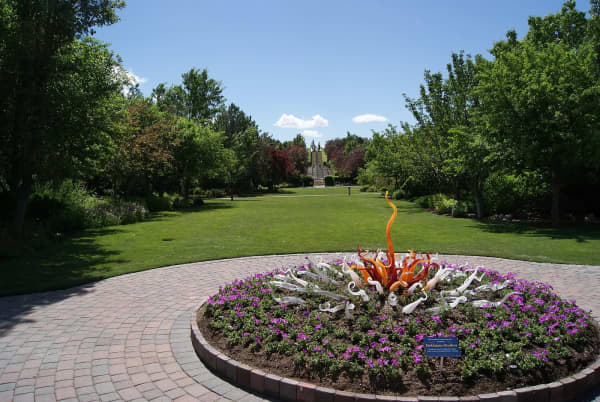

Ashton Gardens is the part of Thanksgiving Point that surprises people. The dinosaur museum is what gets Lehi on the map, but the gardens are the thing visitors talk about afterwards — 50 acres of deliberate, heavily engineered landscape sitting in what is, climatically, a desert basin. In summer, the gardens host Imaginaria, Thanksgiving Point's play festival for families.
It is also the venue at Thanksgiving Point where the published information is least reliable, and that is what this page is mostly about. If you want the wider complex — which venues exist, how the passes work, what to prioritize with kids — our full Thanksgiving Point guide covers that, and our things to do in Lehi guide puts it in the context of the rest of the city. This page is the gardens themselves, in detail.
Start here: the waterfall may not be running
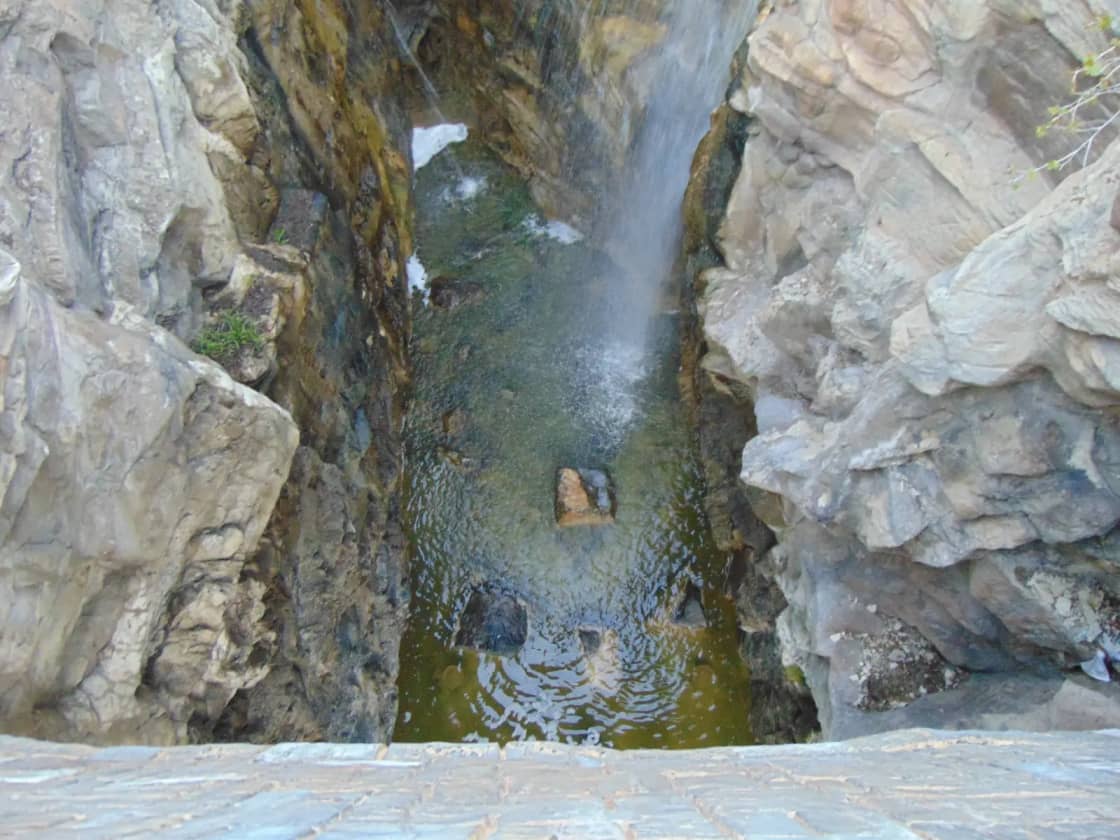
Every listing you will read about Ashton Gardens leads with the same claim — the largest man-made waterfall in the Western Hemisphere. Visit Utah says it. The state tourism listing says it. The American Horticultural Society says it. TripAdvisor says it.
Thanksgiving Point has posted a notice that the waterfall is temporarily turned off, in accordance with the Lehi Water Conservation Management Plan.
That is the operator, on its own Ashton Gardens page, about its own headline feature. And essentially nothing downstream of it has updated.
This is worth pausing on, because it is a repeatable trap rather than a one-off. The most-cited fact about a place is usually the oldest fact about it — it has had the longest to propagate, been copied into the most listings, and become the thing everyone knows. Which means when it changes, it is the slowest thing to correct. The more famous the detail, the more likely a stale version of it is what you will find.
There is a second, quieter wrinkle: the operator's own group-booking terms still list "Utah Symphony at the Waterfall" among the blackout dates on the same page carrying the shutoff notice. Whether that is boilerplate awaiting an edit or an event that runs regardless of whether water is falling is not determinable from outside, and this page is not going to guess. Check the notice on the day.
What it actually is
Thanksgiving Point describes Ashton Gardens as 50 acres organized into 17 themed spaces, with the design conceit that the gardens are laid out like rooms — trees, shrubs and grasses acting as living walls between one space and the next, so that you move through a sequence rather than across a field.
You will very frequently see 55 acres and 15 gardens instead, and the discrepancy has a history rather than being a simple error. The gardens opened partially in 1997 as Thanksgiving Gardens and fully in 2000, at a size widely reported then as 55 acres; the name changed to Ashton Gardens in 2016. Numbers set at a 2000 opening have been circulating for a quarter of a century. Use the operator's current figures and expect guidebooks to disagree — this is a case where two sources are describing the same place at different points in its life, not a case where one of them is lying.
The scale details that do hold up across sources: roughly 13 acres of turf grass, about a quarter of a million tulips in the spring display, and around seventy varieties of roses, maintained by a small permanent staff and a much larger seasonal gardening crew.
And the answer to the obvious question — how do you run this in a desert — is engineering. Thanksgiving Point operates a water reclamation system that captures runoff from across the property and from Interstate 15 for irrigation. Which makes the current waterfall shutoff read slightly differently: this is a site that has thought hard about water for a long time, choosing to switch off its most photogenic feature anyway.
Where it came from: a dairy farm bought on Valentine's Day
The gardens exist because of WordPerfect.
Alan and Karen Ashton — Alan co-founded the Orem software company that put Utah Valley on the technology map long before anyone said Silicon Slopes — bought the property on Valentine's Day, 1995. What they bought was a working farm: roughly 580 dairy cows and more than 350 acres of hay, barley and alfalfa. They named it Thanksgiving Point.
The gardens were Karen's. She had identified the land, and gardening was the thing she went to for peace; after WordPerfect was sold, Alan bought the parcel and gave it to her. The first venue to open to the public, in 1996, was the farm — the one now called Curiosity Farms. Thanksgiving Gardens opened partially in 1997 and fully in 2000, and was renamed Ashton Gardens in 2016.
That lineage matters for two reasons. It explains the acreage discrepancy above — the 55-acre figure dates from the 2000 opening. And it explains a design decision you can see everywhere on the grounds: this is a garden built by people who traveled, saw specific gardens, and copied them deliberately rather than aspirationally. The Monet section exists because the Ashtons went to Giverny.
Our Silicon Slopes explainer covers the WordPerfect half of that story — Alan Ashton and Bruce Bastian, a City of Orem contract in 1979, and what it turned into.
The gardens, one by one
This is the part most write-ups skip, and it is the part that determines whether you enjoy the visit. Fifty acres of "garden" is meaningless; fifty acres of specific, differently-themed rooms is a plan.
The count itself is a small comedy. Thanksgiving Point currently says 17 themed spaces. The widely-syndicated third-party description says 15 separate themed gardens — and then lists sixteen of them. Take the names, not the number.
- The Waterfall and Amphitheater. The centerpiece: a large series of falls built into the hillside, with the amphitheater below and a walking path that takes you above the falls. The rock was cast from molds taken in Provo Canyon — which is why a manufactured waterfall in Lehi reads as Wasatch rather than as landscaping, and which is a genuinely charming detail for anyone who has hiked the canyon it was copied from. The amphitheater hosts concerts and outdoor films. (See the waterfall notice above before planning around it.)
- The Italian Garden. Long, narrow and formal, modeled on 16th-century Italian Renaissance gardens, with a series of stone basins cascading down the hillside from one to the next. The most architectural thing on the property.
- The Secret Garden. A walled garden entered through a dark tunnel of vines, built as a deliberate interpretation of the children's novel — designed to look faintly overgrown rather than manicured. Benches, a fountain, and the strong sense you have found something. The best thing here for children who are bored of flowers.
- The Rose Garden. Over seventy cultivars, including David Austin and Downton Abbey roses, inside a rotunda framed by a curved pergola built from around 20,000 pieces of timber. Peaks mid-June and again in late October — the second window is the one nobody knows about.
- Monet Garden and Monet Lake. Water lilies, marshes, and the stylized bridge over a lily pond, taken from the Ashtons' visit to Giverny.
- Koi View Pier. Fish food is sold on site. With small children, budget more time here than you think you need.
- The Fragrance Garden. Raised beds so the plants meet you at nose height, and a planting list that goes well past the usual herb garden — fennel, rosemary, dill and lavender, but also lemon verbena, Cardinal basil, Scarlet Runner bean, Malabar spinach and Cuban oregano. Everything is labeled, which makes it the most quietly educational corner of the property.
- The Light of the World Garden. A 2.5-acre sculpture walk by Angela Johnson depicting scenes from the life and miracles of Jesus Christ — reported as fourteen New Testament scenes plus one depicting Joseph Smith's First Vision. Included with admission.
- Vista Mound. High ground, and the easiest way to orient yourself without a map.
- Grand Allée, Shepherd's Hill, Creek Garden, Butterfly Garden, Prairie Garden, Parterre Garden, Mountain Garden and a Learning Garden fill out the rest, along with the Women's Walk sculpture and The Tree of Life exhibit.
The Parterre is the French-formal one, the Prairie and Mountain gardens are where the planting turns native and looser, and Grand Allée is the long processional lawn that most wedding photographs you have seen from here were taken on.
All of it is kept up by a small permanent crew — reported as around six full-time staff — supported by roughly twenty-six seasonal gardeners in the growing months.
Beyond the gardens: what else runs here
Ashton Gardens is not only a place you walk through. Thanksgiving Point programs it heavily, and several of those programs are the actual reason locals hold memberships:
- Outdoor films at the amphitheater, typically Friday evenings across mid-summer, with the movie starting at dusk. Our outdoor movie nights guide compares it against the free and cheaper options elsewhere in the valley — this is the scenic one, not the budget one.
- Concerts in the same amphitheater.
- Luminaria, the ticketed winter light display, which is a separate event with separate pricing.
- The Tulip Festival in spring and the Labor Day Luau at the end of summer.
- Dog Walk Wednesdays, a rotating Secret Garden book club, veggie-garden classes and traveling national garden exhibits — the community-programming layer that never makes it into tourist listings.
- Imaginaria, a large summer family festival staged across the gardens themselves, which in 2026 ran from 1 June to Saturday 22 August on an America-250 theme. If you are visiting in high summer, the gardens are not just gardens — they have a festival built through them, which is either the draw or the thing you were trying to avoid.
Weddings are a substantial part of what happens here too, which is worth knowing simply as a crowd-and-access consideration on a summer Saturday. Our Utah Valley wedding venues guide covers that side.
Getting there
Thanksgiving Point sits at the north end of Utah County, in Lehi, roughly 25 to 30 minutes up I-15 from Provo and about 45 minutes south of the Salt Lake City airport — which is why the events here draw as heavily from Salt Lake County as from Utah Valley. Take the Thanksgiving Point exit and follow signage. Parking is free.
One navigational quirk: Ashton Gardens is not on the main Thanksgiving Point campus. It sits roughly a mile away, with its own entrance and its own visitor center. Directions aimed at "Thanksgiving Point" generally, or at the dinosaur museum, will not put you at the garden gate. Aim at Garden Drive specifically.
Buy the tickets online. Always.
Here is the most immediately useful thing on this page.
At the time of writing, Ashton Gardens regular season admission runs:
| In person | Online | |
|---|---|---|
| Adult | $27 | $24 |
| Youth (13–17) | $22 | $19 |
| Child (3–12) | $20 | $17 |
| Senior (65+) | $24 | $21 |
Children two and under are free. Thanksgiving Point members are free.
Every tier is about $3 cheaper online. Not a promotion, not a seasonal deal — a standing structural discount for buying before you arrive. Two adults and two children save around $12 for thirty seconds of phone work in the car park. Almost nobody mentions this, because almost nobody writing about the gardens has looked at both columns.
Prices move, so treat the figures above as a snapshot and the structure as the durable advice: check both columns, buy online.
Two other pricing routes worth knowing:
- Groups of 20 or more get 20% off regular admission, bookable in person or by phone, but the whole group has to enter and pay in a single transaction, and blackout dates apply around the big events — Luminaria, the Tulip Festival, the Labor Day Luau.
- Every Kid Counts provides discounted admission on presentation of a SNAP or WIC Electronic Benefits Transfer card and photo ID, covering up to six people from the household, with dependent children free and adults or teens at a reduced flat rate. In person only — it cannot be applied to an online purchase, which is the one case where the online-is-cheaper rule inverts.
If you expect to visit Thanksgiving Point more than about twice in a year, run the membership maths before buying anything. A membership covers free admission across all seven venues, and the break-even arrives quickly when a single adult garden ticket is in the mid-twenties.
Hours, and the September problem
Ashton Gardens runs Monday to Saturday, 9 a.m. to 9 p.m., and is closed Sundays, plus Thanksgiving and Christmas Day.
The part people get caught by is September. The gardens close completely for two multi-day events:
- Thursday 10 – Saturday 12 September for the Timpanogos Storytelling Festival
- Thursday 17 – Saturday 19 September for Garden of Quilts
That is six days of a four-week stretch when the gardens are not available as gardens. If you are visiting Utah Valley in early autumn, this is the one calendar check that will actually save you a wasted drive. Our Timpanogos Storytelling Festival guide covers what that first closure is for, and it is genuinely worth planning toward rather than around — the festival is the largest of its kind in the West and it takes over these grounds specifically because of the parking and the layout.
The photography rule that catches people out
Ashton Gardens is one of the most-used engagement and family photo locations in Utah Valley. It also has a stricter policy than almost anyone realizes.
Casual snapshots are fine. Photographs of the plants, the gardens, or the people you came with, for private use, need nothing.
A photography session requires a Photo Pass, reserved in advance. And Thanksgiving Point defines a session broadly: any occasion where a photographer takes a series of photographs of a posed subject using the property as a backdrop. The policy states explicitly that this applies whether the photographer is amateur or professional and explicitly includes mobile phones.
Commercial, promotional and business-use photography and videography are not permitted at all, and content shot there may not be used commercially.
The practical translation: if you and a friend are wandering and taking pictures, you are fine. If someone is directing a posed shoot — engagement, family, senior portraits, a brand shoot — that needs a pass booked ahead, or it is not permitted. Given how routinely these gardens turn up on lists of the valley's best engagement photo locations, it is worth knowing before a photographer's deposit is paid.
Smoking is prohibited throughout the gardens.
Rentals, accessibility and getting round 50 acres
Fifty acres is a lot of walking, and the gardens are laid out to be wandered rather than crossed efficiently. Plan on a half day if you intend to see it properly.
- Golf carts are first-come, first-served and cannot be reserved. On a busy Saturday there may simply be none. During the gardens' off-season, rental lengths are shortened.
- Electric scooters and wheelchairs can be booked online or taken in person, and this is the route to use if mobility is a genuine requirement rather than a convenience — it is the only one you can guarantee.
- Strollers and wagons are available in person.
- Nothing is rented out in the final 90 minutes before closing. If you arrive at 7:45 p.m. expecting a cart, you will be walking.
Most paths are paved and stroller- and wheelchair-friendly, with a few stepped or restricted sections. The visitor center and the higher ground make orientation straightforward without a map, though a map is available.
⚠ One documented oddity: the operator's own page gives the address as 3900 N. Garden Drive, Lehi, with a ZIP code that does not match Lehi's. Other listings give the same street address with the standard Lehi ZIP. Navigate by the street address, not the ZIP, and you will be fine — but if a satnav sends you toward Park City, that is why.
Eating there, and what else is on site
Trellis Café sits inside the Garden Visitor Center and runs through the garden season, with what is genuinely one of the better patios in the county. It is seasonal rather than year-round, which is a distinction worth holding onto: our guide to restaurants with a view in Utah Valley separates it from Harvest, the full-service restaurant elsewhere on the Thanksgiving Point property, and the two are not interchangeable.
Also on the grounds:
- The Garden Path Greenhouse, selling hanging baskets, plants and garden décor.
- The Garden Gift Shop, in the visitor center, with proceeds supporting Thanksgiving Point's Every Kid Counts program.
- The Light of the World Garden, a 2.5-acre sculpture garden by Angela Johnson walking through the life and miracles of Jesus Christ, included with regular admission.
- The Tree of Life, a bronze sculpture exhibit by the same artist, depicting Lehi's vision from the Book of Mormon — which is a quietly satisfying thing to encounter in a city named after the same figure. Also included with admission.
- Free guided Garden Walk and Tree Walk tours are part of the offer, led by garden docents, roughly two hours, included with admission. ⚠ Both were listed as on hiatus at the time of writing, on the same page that elsewhere invites you to reserve one. Do not build a visit around a tour without confirming it is running.
- An annual tulip bulb sale runs in late summer — buy now, plant in October, bloom in spring — at a fixed price per five dozen bulbs, with a member discount.
When to go
Spring is the peak and it is not close. The Tulip Festival is the reason most first-timers come, and a quarter of a million bulbs is a genuinely different order of display from a municipal planting. The dates move with the bloom rather than the calendar, so they are announced later than people would like.
Autumn is the underrated window — the light is better, the crowds thin after the September closures, and the foliage does real work in a garden with this much mature tree cover.
High summer is the honest weak spot, especially at the moment. Utah Valley in July and August is hot and bright, the tulips are long gone, and with the waterfall off, a mid-afternoon adult ticket buys a walk in the heat. Go early in the day or late in the evening — the 9 p.m. close is generous and the last two hours are the best two hours.
Winter belongs to Luminaria, the ticketed light display, which is a separate proposition from the gardens as gardens and priced separately.
The short version
Buy online. Check the waterfall notice before you decide the waterfall is the reason you are going. Avoid 10–12 and 17–19 September entirely. Book a scooter or wheelchair ahead if you need one, because the golf carts cannot be reserved. Book a Photo Pass if anyone is going to be posed. And if you are going to be at Thanksgiving Point more than twice this year, do the membership arithmetic first — it is the difference between an expensive afternoon and a year of free ones.
Related Guides
- Nativity & Crèche Events in Utah Valley
- Hines Mansion: Provo's Victorian Landmark, and the B&B That Says It Isn't One
- Lehi Roller Mills: The Footloose Landmark That Quietly Changed Its Name
- Museum of Natural Curiosity: A Complete Guide to Thanksgiving Point's Play Museum
- All-Together Playground: The Park 4,100 Volunteers Built in Six Days
- Butterfly Biosphere: Utah's Only Butterfly Conservatory
- The Soap Factory in Provo: What It Is and Whether It Is Worth It
- Luminaria at Thanksgiving Point: The Light Walk, Explained
- The Tulip Festival at Thanksgiving Point
- Quilt Shops and Quilting in Utah Valley
Frequently Asked Questions
How much does it cost to get into Ashton Gardens?
Is the Ashton Gardens waterfall running?
Do you need a permit to take photos at Ashton Gardens?
How big is Ashton Gardens?
When is the Tulip Festival at Ashton Gardens?
Is Ashton Gardens open on Sunday?
Can you rent a golf cart at Ashton Gardens?
Is Ashton Gardens worth it if you are only visiting once?