Upcoming dates

More on Springville: every guide we have published there, in one place.
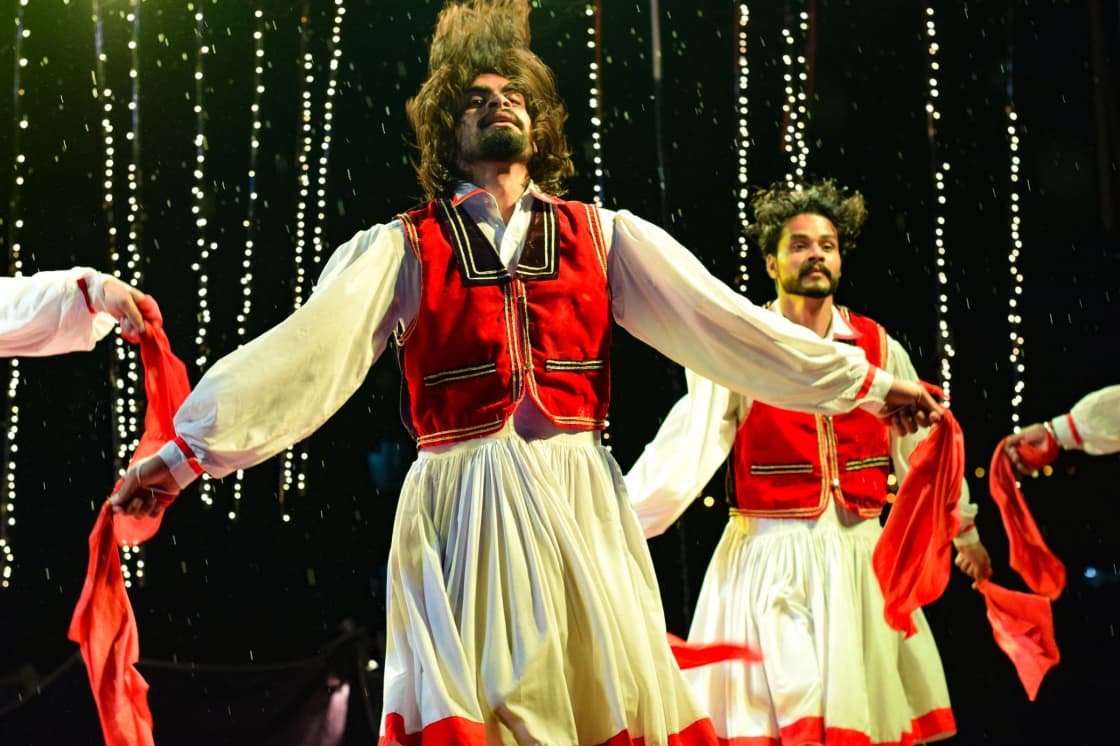
Once a year, dance companies from several countries fly into Utah Valley, stay with local host families, and perform in a park in Springville. They wear the clothing their great-grandparents wore, dance choreography that has been handed down rather than invented, and play instruments most of the audience has never seen.
This has been happening since 1986. In 2026 the World Folkfest marked its fortieth anniversary, and over those four decades it has hosted performers from around the world. It bills itself as Utah's only international festival of its kind, and a striking number of people in Utah Valley have never been.
Festival dates, pricing and programming change every year. Confirm details with the festival before planning around them.
What it is
The format is straightforward and the content is not.
Over several consecutive evenings, invited companies perform traditional folk dance and music from their home countries on an outdoor stage at Spring Acres Arts Park. Each group performs a set, and the evening moves between them, so an audience sees several distinct traditions in one sitting.
What makes it different from a generic cultural showcase is the seriousness of the participants. These are companies whose purpose is preserving specific regional traditions — the costumes are authentic rather than approximate, the music is played rather than recorded, and the choreography is inherited. The festival operates in the world of international folklore festivals, an established circuit with its own standards and organizing bodies.
The 2026 lineup gives a sense of the range, drawing companies representing Slovakia, Bolivia, Belgium, Korea and France, alongside Trinity Irish.
Where it sits in Springville's calendar
Springville has three arts events that outsiders reliably confuse, and it is worth separating them cleanly.
Art City Days is the city's own celebration, in June, with a parade, carnival, fireworks and a hot air balloon launch. It is the town's birthday party. Our Art City Days guide covers it.
The World Folkfest is in late summer, and it is the town hosting the world.
The Springville Art Festival, associated with the Springville Museum of Art, is a separate visual-arts event.
The clean way to hold them apart: one is a city celebration, one is international performance, one is visual art. If you care about the arts rather than the party, the Folkfest and the museum's programming are the two that give Springville its reputation as Art City.
When it happens
The main performances have consistently landed at the end of July, running into the first days of August. The 2026 edition ran July 30 through August 1.
Dates shift year to year, and the festival announces them ahead of each season. Because different pages and third-party listings sometimes carry different figures — including, in some years, the festival's own vendor information running to a slightly different span than its performance calendar — the safest approach is to check the festival's current schedule directly rather than trusting an aggregator or a remembered date.
For planning purposes, the reliable pattern is: late July, into the first weekend of August, several consecutive evenings.
How an evening runs
The shape has been consistent and it rewards arriving early.
Gates have opened around 5:30pm. A pre-show period follows in the early evening, and in 2026 the performances started at 6:45pm, with each group's time varying. The gap between gates and showtime is not dead time — it is when food vendors are working, when informal performance happens, and when you can look at costumes up close.
People who arrive at showtime get the concert. People who arrive at gates get the festival. The difference is about ninety minutes and it is the single best piece of advice about attending.
The finish is late by the standards of a family evening, which is the main thing to weigh with young children.
The venue, and what to bring
Spring Acres Arts Park is an outdoor venue on the east side of Springville, and seating is amphitheater-style on grass rather than fixed seating.
That means blankets or lawn chairs, and it means thinking about sightlines — arriving early gets you position as well as atmosphere. Evenings cool down noticeably once the sun goes behind the mountains, and people who dressed for a July afternoon regret it by the second act. Bring a layer.
Parking is directed to nearby lots, with the area around the high school commonly used. Expect a short walk and expect the exit to be slow at the end, which is normal for a single-venue evening event.
What it costs
The Folkfest is ticketed, with tiered pricing that has typically distinguished adults, seniors and students, and children, and tickets have been available both online and at the gate.
Pricing has historically been modest measured against comparable live performance, which is part of why it functions as an accessible family evening rather than a special occasion. Multi-night attendance is common among people who discover it.
Because ticket prices and availability change annually, confirm current figures with the festival rather than relying on any secondhand number, including this page.
The host family tradition
One aspect of the festival is invisible from the audience and is arguably the most interesting part of it.
Performers stay with local host families rather than in hotels. That is a substantial logistical undertaking and it is also the mechanism that turns an international performance into a community event — Springville households end the week having lived with a family from Bolivia or Korea, and the visiting dancers leave having seen a Utah Valley home rather than a Utah Valley hotel.
Families interested in hosting apply through the festival. It is a real commitment involving accommodation, meals and transport, and the people who do it tend to do it repeatedly.
Beyond the main stage
The festival has expanded past the Springville evenings into a wider week across Utah Valley.
In 2026 that included a free public jam session on Tuesday, July 28, from 6 to 9 p.m. at The Orchard at University Place in Orem, additional community programming in Orem, and library and community appearances. These events are typically free and considerably more informal than the main stage, which makes them a good way to see the performers without buying a ticket or committing an evening.
If the main performances do not fit your week, the surrounding events are a genuine alternative rather than a consolation.
Why it works as a family outing
Folk dance is unusually well suited to children, and the reasons are practical rather than sentimental.
It is visual and it changes constantly. Costumes are bright, formations shift, music is live, and no single group is on stage long enough for attention to lapse. There is no dialogue to follow and no plot to lose. A child who would not sit through a play will watch this.
The constraints are the late finish and the outdoor seating, both manageable with a blanket and a realistic view of bedtime. Younger children often do better in the pre-show window than in the main program, which is another argument for arriving at gates.
Making an evening of it in Springville
The festival gives you a reason to be in a town most Utah Valley residents drive past.
The Springville Museum of Art is the town's other cultural anchor and one of the more significant art museums in the state, which surprises people who expect a small municipal gallery. It is worth building into the same day.
For food, our Springville restaurant guide covers the options, and eating before the gates open is the sensible order given the timing. Things to do in Springville covers the town more broadly.
Getting there from Provo and Orem
Springville sits immediately south of Provo, and the drive is short — well under twenty minutes from most of Provo in normal conditions.
The complication is that the festival coincides with the busiest part of Utah Valley's summer events calendar, when the county fair and several city celebrations overlap. Allow more time than the distance suggests on those evenings.
Note also that US-6 and the I-15 corridor through this part of the county have been affected by construction, so check current conditions if you are coming from further south.
Forty years, and why that matters
An arts festival surviving four decades in a town of Springville's size is not a given, and the number is worth pausing on.
The festival began in 1986 and has run since, hosting performers from around the world over that span. Most volunteer-driven international festivals do not last that long. They depend on a small number of people doing an enormous amount of unpaid organizational work — visas, travel, housing, scheduling, translation — and they tend to collapse when those people stop.
That it reached forty says something about how embedded it is in Springville specifically. The host families, the volunteers and the audience are substantially the same community year after year, and a good number of the people running it grew up attending.
For a valley that sometimes struggles to point at cultural institutions with real depth, this is one.
What "folk dance" means here
The phrase can suggest something quaint, and the reality is more rigorous than that.
These are regional traditions with specific technical vocabularies — footwork, formations, partnering conventions and music that belong to a particular place and were developed over generations. A Slovak ensemble and a Bolivian one are not doing variations on a common form; they are doing different things that happen to share a category.
The costumes carry the same specificity. What reads to an unfamiliar audience as generic traditional dress is usually regional to a level of detail that would be obvious to anyone from that country — this village's embroidery, that valley's headdress.
Part of what the festival circuit exists to do is keep those distinctions intact at a moment when they are thinning, which is why the participating companies treat it as preservation rather than performance.
The international festival circuit
The Folkfest does not operate in isolation. It sits within an established international network of folklore festivals, associated with the body that coordinates them worldwide.
That affiliation is why the standard is consistent. Companies are vetted, the programming is curated rather than assembled from whoever volunteered, and touring groups often visit several festivals on one trip across a region or continent.
For an audience it means the quality does not swing much between years. The countries change and the general level does not.
Practical planning
A few things make the evening better.
Arrive at gates, for the reasons above. If you can only arrive at one time, make it 5:30 rather than showtime.
Bring chairs rather than only blankets if anyone in your group will struggle sitting on the ground for a couple of hours.
Bring cash as a backup for food vendors, though most take cards.
Eat beforehand or plan to eat there, but decide in advance, because the gap between gates and showtime is exactly long enough to eat and exactly short enough to be stressful if you did not plan for it.
Layer up. The temperature drop after sunset in late summer here is larger than visitors expect.
Accessibility and the ground
The venue is a grass park, which is worth knowing in advance for anyone with mobility considerations.
Grass seating on a slope is manageable for most people and difficult for some, and the walk in from parking adds to it. Contacting the festival ahead about accessible parking and seating is the sensible move rather than arriving and hoping.
For families with pushchairs, the same terrain logic applies — it is workable, and it is easier if you arrive early enough to choose your ground rather than taking what is left.
Where it fits in Utah Valley's summer
Late July and early August is the densest stretch of the local events calendar, and the Folkfest competes with a lot.
The county fair runs at the Spanish Fork fairgrounds around the same window, and the city-days celebrations cluster in the same fortnight — Lindon and Salem both hold theirs in early August. Our small-city celebration circuit guide maps how those overlap.
The competition is worth knowing because it is the reason many locals have never been: not disinterest, but a calendar in which four things happen on the same Saturday. If you want to see it, it needs to be a decision rather than a default.
What to expect if you have never been to a folk festival
Two things surprise first-time attendees.
The first is the technical standard. These are not amateur groups performing approximately. Many are serious companies with rigorous training, and the dancing is highly skilled.
The second is the emotional register. Folk dance carries a particular weight when performed by people preserving something their own country's modernization has been eroding. There is joy in it, and there is also something being deliberately kept alive. Audiences tend to arrive expecting a pleasant evening and leave having felt something more specific than that.
Volunteering
The festival runs substantially on volunteer labor, and that is the other way to be involved beyond buying a ticket.
Beyond host families, an event of this shape needs help with setup and teardown, gates and ticketing, hospitality for the visiting companies, transport between venues, and the many small logistical jobs that an international festival generates. Roles vary in commitment from a single evening to the full week.
The route in is the festival directly. For anyone who wants their family to encounter something truly international without leaving the county, this is a more involved version of that than sitting in the audience.
Why it deserves a wider audience
There is a reasonable case that the Folkfest is the most internationally significant recurring event in Utah Valley, and it does not have the profile locally that the claim implies.
The county's better-known summer events are city celebrations — parades, carnivals, fireworks — and they are good at what they do. None of them brings dance companies from five continents to a park for a week. The Folkfest does that annually and has done for four decades, largely on volunteer effort, in a town of modest size.
If you have lived in Utah Valley for years and never been, that is worth correcting once. The evening is inexpensive, it is short, and it is unlike anything else on the local calendar.
The short version
For forty years Springville has flown in dance companies from around the world, housed them with local families, and put them on an outdoor stage for several nights at the end of July. Arrive when gates open rather than at showtime, bring chairs and a layer for after dark, do not confuse it with Art City Days in June, and check the festival's own current schedule rather than trusting a remembered date.
Related Guides
- Art City Days in Springville
- The Small-City Celebration Circuit
- Springville Museum of Art
- Things to Do in Springville
- Festivals & Celebrations in Utah Valley
Frequently Asked Questions
What is the World Folkfest?
When does it happen?
Where is it held?
How does an evening run?
Is it the same thing as Art City Days?
What does it cost?
Is it suitable for children?
Do the performers do anything besides the main show?
Sources
The facts in this guide were checked against these sources. Hours, fees and rules change, so confirm anything time-sensitive with the source before you go. How we make Provo.com.
- Springville World Folkfest. Checked October 12, 2026.
- Springville City. Checked October 12, 2026.