
More on Springville: every guide we have published there, in one place.
Utah's first art museum was not founded by a millionaire, a university or a state legislature. It was accumulated, over three decades, by the students of Springville High School.
That is not a charming exaggeration. The Springville Museum of Art exists because in 1903 two artists gave a high school two artworks, the students got interested, and the collection they built eventually outgrew the school so completely that the town had to construct a building for it.
The museum is one of Utah's oldest arts institutions. It is fifteen minutes from Provo. Admission has traditionally been free. And a surprising number of people who have lived in Utah Valley for years have never been inside.
The two donations that started everything
In 1903, two artists made gifts to Springville High School.
Cyrus E. Dallin was born in Springville and became one of the most accomplished sculptors America produced in his generation — his equestrian and Native American subjects stand in public spaces across the country. Returning to Utah to lecture at the high school, he was moved enough by the students to donate the plaster model for one of his Paul Revere sculptures.
John Hafen was a Swiss-born, Utah-raised painter who had studied in Paris and come home carrying the salon culture he found there. He donated an oil painting, Mountain Stream.
Those two objects are the seed of the entire collection.
What made them consequential was what happened next. Other Utah artists, seeing where the works had gone, began donating too. An art committee had already been commissioned in 1901 to promote art in Springville's schools, so the ground was prepared. And by 1907, faculty and students at the high school were setting aside their own funds to purchase artworks — which is the moment this stops being a story about two generous artists and becomes a story about a community deciding what it wanted to be.
The students who built a museum
The collection grew through the 1910s and into the 1920s.
In the early 1920s, Springville High students held a Paris-inspired, salon-style exhibition — hanging work in the halls of their own high school. That show became annual, and it is still running today as the Spring Salon.
In 1925 the Springville High Art Association was formed to protect, collect and present fine art, and sixty-five works of Utah art were donated by Emma and George Smart. In 1929 the Polish-American artist Stan Poray, recently arrived from Japan, was given a major solo exhibition — at a high school, in a town of a few thousand people in rural Utah.
By the 1920s, the claim being made about Springville was that no high school in the United States could match its art collection. Whether or not that survives strict auditing, it was believed at the time and it was not obviously wrong.
The collection eventually became too large for the building holding it. The town's answer was not to disperse it. It was to build a museum.
The 1937 building, and the New Deal
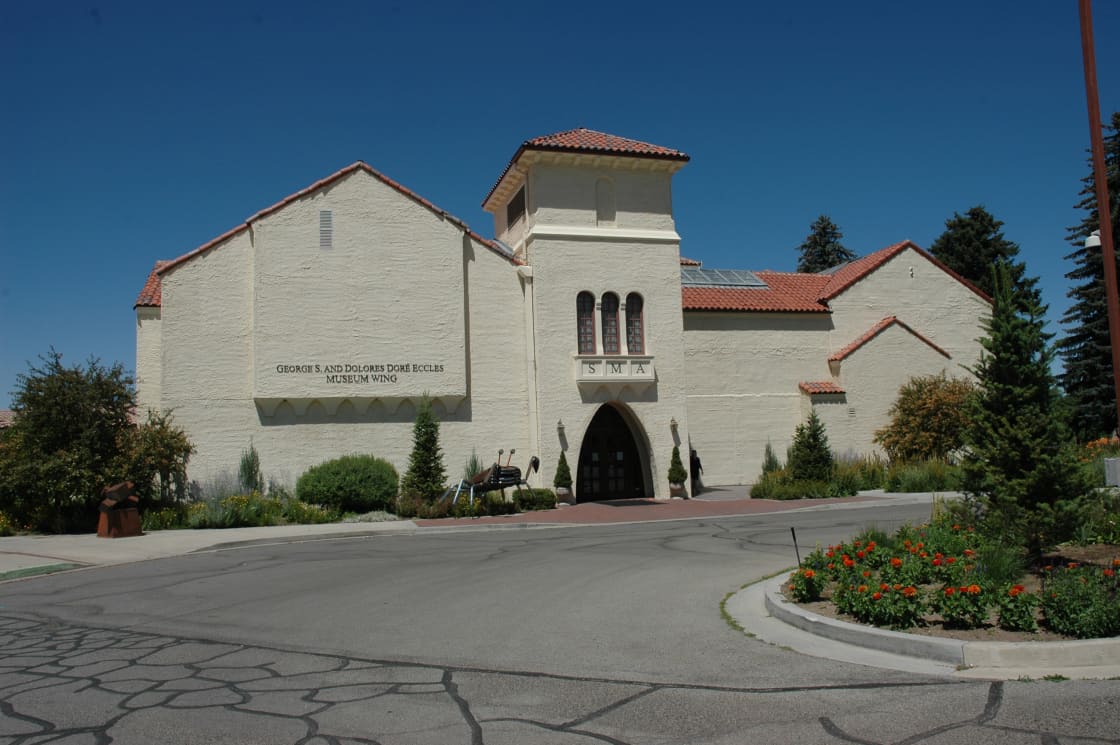
The museum building was completed in 1936–37 as a Works Progress Administration project — one of the thousands of public buildings the New Deal put up across America, and one of the more unusual ones in that its purpose was to house art rather than to administer government.
The architect was Claude S. Ashworth, and the style is Mission/Spanish Revival — arches, tile, stucco, the vocabulary that was fashionable for civic buildings in the American West between the wars. It is a handsome building and worth the visit on architectural grounds alone.
It was dedicated by David O. McKay, then a member of the First Presidency of the Church of Jesus Christ of Latter-day Saints, with a phrase the museum has kept ever since: a sanctuary of beauty and a temple of contemplation.
The building was added to the National Register of Historic Places in April 1986, listed under a thematic grouping of public works buildings — which is to say it is recognized not only as a museum but as a surviving artifact of the WPA program itself.
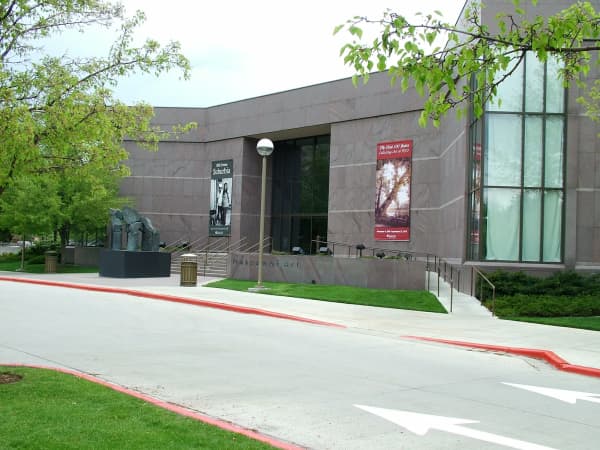
It has been expanded since. The Clyde Wing was added in the 1960s, with later additions following. Sources differ slightly on the exact year of that first expansion, giving both 1964 and 1965; the museum's own history says 1965.
The Spring Salon, and a contested founding date
The Spring Salon is the museum's defining annual event and one of the most significant art exhibitions in the Intermountain West.
Here is where the sources disagree, and we are going to leave the disagreement standing rather than pick a winner.
The museum's published timeline gives 1921 as the year of the very first Spring Salon exhibition. Salt Lake Magazine reports it as first held in 1922. The museum's own Salon 100 material dates the founding to "the 1920s" without committing to a year, and celebrated the 100th annual Salon in 2024.
Those are reconcilable but not identical. A start in 1921 with roughly three years missed during the Second World War — when fuel and other goods were rationed nationwide and the Salon paused — arrives at a hundredth edition around 2024. So the internal arithmetic favors the earlier date. But two credible sources print two different years, and a local guide that quietly picks one is pretending to a certainty nobody has.
What is not in dispute: it started with high school students, it has run annually except during the war, and it is now a juried exhibition open to all Utah artists that is widely regarded as the premier showcase of Utah art — particularly for artists working in representational and academic traditions.
The names that passed through
For a period the Salon was a national rather than regional show, and the roster of artists whose work appeared is startling for a small Utah town.
The museum's own Salon 100 material names Walt Disney, Norman Rockwell, Edward Hopper and Georgia O'Keeffe among artists shown across the Salon's history. Other accounts add Rockwell Kent.
In the last forty years or so the Salon has narrowed deliberately, shifting to tell the story of Utah artists specifically. That was a choice, and arguably the right one — a regional museum that competes nationally becomes a venue, while one that documents its own place becomes an archive. Springville chose to be the archive of Utah art, and it is why local painters describe showing there as conferring a kind of legitimacy.
The collection, including the part nobody expects
The permanent collection today runs to more than 2,700 works by the museum's own count, with three documented strengths.
Utah art is the core, and the reason the museum matters most. A century of donations from Utah artists, beginning with Hafen and Dallin, has produced a holding that no other institution can replicate.
American art forms the second strand.
Twentieth-century Soviet Realism is the third, and it is the one that stops visitors in the doorway. A Utah museum in a town of thirty-odd thousand people holds a substantial collection of Soviet Realist painting — described by a former director as the largest in the western half of the United States. It arrived through acquisition rather than any natural Springville connection, and the museum's position has been that its quality strengthens the Utah collection by giving local work serious company.
Whatever you think of the pairing, it is not something you will find in Provo or Orem.
Why Springville is "Art City"
The nickname predates modern place branding and it is earned.
A retired museum director traced the town's artistic self-conception back to 1848 — two years before Springville was even founded — when the pioneer artist Philo Dibble, then still at Winter Quarters in Nebraska, envisioned creating a fine arts museum or gallery. Dibble moved to Springville in 1858.
Then came Hafen, who brought salon culture back from Paris and, in the telling, became an instant celebrity for it. Hafen's own position was that art is not a luxury; it is a necessity — and the town appears to have taken him at his word.
That lineage runs directly into the present. Springville's annual city celebration is Art City Days, named for the same reason. The nickname is downstream of the museum, not the other way around.
Planning a visit
The museum sits at 126 East 400 South, Springville, a short detour off I-15 roughly fifteen minutes south of Provo.
Admission has traditionally been free, consistent with the museum's founding purpose of making art accessible. Confirm before you go — museum admission policies and hours do change, and the museum's own site is the source that settles it.
A few practical notes.
Give it more time than you think. People plan forty minutes and stay two hours, largely because the Utah collection rewards slow looking in a way that a quick loop misses.
Check what is on first. The program is substantial — historically including the Utah All-State High School Art Show, an exhibition of spiritual and religious art of Utah, and a quilt show, alongside rotating exhibitions and single-artist retrospectives. The Spring Salon is the headline, but the show that justifies your particular trip may be something else entirely.
Combine it with the town. Springville's restaurants and the wider things to do in Springville make a half day out of it, and Hobble Creek Canyon is minutes away if you want the drive.
What the place is for
The museum has articulated a purpose beyond exhibition — leadership has spoken about tying the institution to the idea of sanctuary and wellness, using the museum as a tool for community wellbeing and for people going through difficult periods.
That is a direct echo of the 1937 dedication phrase, and it is a fair description of the building's effect. It is quiet, it is free, it is rarely crowded on a weekday, and it is full of pictures of the landscape you just drove through.
For a valley whose cultural conversation is dominated by two universities and a film festival over the mountain, a hundred-and-twenty-year-old museum built by teenagers in a town most people only pass on the freeway is an unusual thing to have. It is fifteen minutes away. Go.
The WPA context, and why this building is unusual
It is worth pausing on what it meant for a town of Springville's size to get a WPA art museum in 1937.
The Works Progress Administration was a Depression-era federal employment program, and its physical legacy across America is enormous — schools, post offices, courthouses, bridges, dams, sidewalks. The overwhelming majority of what it built was infrastructure. Buildings whose purpose was purely cultural were a small minority, and art museums smaller still.
Springville got one because the argument was already won locally. The town was not asking the federal government to fund a speculative cultural amenity; it was asking for a building to house a collection that already existed and had nowhere to go. Thirty-four years of student purchases and artist donations had produced a genuine problem, and the WPA solved it.
That sequence — collection first, building second — is the reverse of how most museums happen, and it explains a good deal about the character of the place. The Springville Museum of Art was never designed around a donor's taste or a curator's thesis. It was built to fit what a community had already chosen to keep.
The dual listing on the National Register reflects this. The building is recognized both for what it is and for the program that produced it, filed under a thematic grouping covering public works buildings of the era. Visitors who care about New Deal architecture come for the building; visitors who care about Utah painting come for the contents; both are looking at the same artifact.
How to look at the Utah collection
A regional collection rewards a different kind of attention than a blockbuster museum does, and most visitors do not know what they are being offered.
Look for the same landscape twice. The Utah holdings span more than a century of painters working the same terrain — Mount Timpanogos, the Wasatch canyons, Utah Lake, the deserts south of here. Finding two treatments of a place you know, painted decades apart, is the single most rewarding thing you can do in this building. You are seeing not just how the place looked but how successive generations decided it should be seen.
Watch the light change with the century. Hafen and his contemporaries came out of a European training — many Utah painters of that generation studied in Paris, and it shows in the handling. Work from the mid-century onward pulls in modernist influence. The collection documents that shift in a compressed, legible way precisely because it was assembled locally and continuously rather than bought in fashionable blocks.
Read the labels for names you will start seeing everywhere. Once you have spent an hour here, the names recur — in the BYU Museum of Art, in church buildings, in the state capitol, on the walls of older Utah County homes. The museum functions as an index to a visual culture you are already surrounded by without having registered it.
Then go and look at the Soviet gallery. Put it last rather than first. Coming to it after an hour of Utah landscape painting is the point: two bodies of representational work made under completely different assumptions about what a picture is for, hanging in the same building in a small Utah town. Whatever conclusion you draw, the juxtaposition is the experience, and it is not available anywhere else in the state.
Cyrus Dallin, the local boy who is in Boston
The museum's founding donor deserves more than a line, because most Utah Valley residents have seen his work without knowing his name.
Cyrus Edwin Dallin was born in Springville in 1861, when the town was barely a decade old, and became one of the significant American sculptors of his era. He spent most of his working life in Massachusetts, and the pieces he is best known for are civic monuments on the East Coast — the equestrian Paul Revere that stands in Boston's North End, and Appeal to the Great Spirit, the mounted Native American figure outside the Museum of Fine Arts in Boston, which is among the most reproduced American sculptures of the twentieth century.
Closer to home, and less widely known outside Utah, Dallin sculpted the Angel Moroni figure placed on the Salt Lake Temple in 1892 — an image that has since become one of the most recognizable religious symbols in the American West.
So the plaster Paul Revere model he handed to Springville High School in 1903 was not a courtesy from a local hobbyist. It was a working study from a sculptor whose finished version would become a Boston landmark, given to the school in the town where he grew up, in a state he had largely left behind.
That is worth holding in mind while standing in the building. The museum exists because a boy from Springville got out, became nationally significant, came back to give a lecture, and was moved enough by the students in front of him to leave something behind.
Related Guides
- Things to Do in Springville, Utah
- Art City Days: Springville's City Celebration
- Museums in Provo and Utah Valley
- The BYU Museum of Art: A Complete Guide
- The Best Restaurants in Springville
- Hobble Creek Canyon
- Public Art in Provo
- Living in Springville, Utah
- Utah Valley Hidden Gems: 25 Places Locals Keep to Themselves
- Springville World Folkfest
Frequently Asked Questions
Is the Springville Museum of Art really Utah's oldest art museum?
When did the Spring Salon start?
How did a high school end up with an art museum?
Is the building historic?
Why does a Utah museum have a Russian collection?
How big is the collection?
Why is Springville called Art City?
What else is on besides the Spring Salon?
Sources
The facts in this guide were checked against these sources. Hours, fees and rules change, so confirm anything time-sensitive with the source before you go. How we make Provo.com.
- Springville Museum of Art: History, Springville Museum of Art. Checked October 12, 2026.
- About the Museum, Springville Museum of Art. Checked October 12, 2026.
- Plan Your Visit, Springville Museum of Art. Checked October 12, 2026.