Upcoming dates

Provo has a festival that draws more than 30,000 people, runs for four days, costs nothing to attend, and has been happening every Labor Day weekend for a quarter of a century. It takes over the lawn of the Utah County Historic Courthouse, one block from the intersection that the entire city's address grid is measured from.
And if you moved here recently, there is a decent chance nobody has mentioned it.
That gap between the festival's size and its visibility to a portion of the population is itself the most interesting thing about it. Festival Latinoamericano is not obscure. It is simply well known in one part of Utah Valley and largely invisible in another, in a county where those two parts do not overlap as much as they should.
The dates, and a warning about the listings
The organizers give the 2026 festival as September 4–7, on the Historic Courthouse grounds, with the closing day — Labor Day itself — running 10:00 a.m. to 10:00 p.m.
Check that against whatever else you find, because the secondary listings are unreliable this year. At least one events aggregator has published the 2026 festival as running August 29 to September 1 and placed it at Library Park. Both are wrong. Those dates are the previous year's Labor Day weekend carried forward without being updated, and Library Park is a different venue entirely, several blocks away.
This is a general hazard with annual events whose dates float against a moving holiday, and it is worth stating plainly: for this festival, the organizers' own site is the only source worth trusting on dates and venue. Labor Day 2026 falls on September 7, and the festival is built around that Monday.
It started as a neighborhood gathering
The origin story is unusually well documented and unusually modest.
The first festival, in 2001, was a small neighborhood gathering. It was organized by a small group of community members who wanted a space where the Latin American community could share its heritage with neighbors.
It outgrew that location almost immediately. The festival moved to accommodate a larger crowd, and eventually settled on the Historic Courthouse grounds on University Avenue, where it has become a fixture. Attendance has run around 30,000 for several years now.
From a neighborhood gathering to more than 30,000 people downtown, in a single generation, is a remarkable trajectory for a volunteer-founded community event.
How old is it, exactly? The sources disagree
Here is a small thing the festival's own materials do not settle, and it is worth flagging rather than papering over.
One page on the organizers' site describes a milestone marking twenty-five years of bringing Latin American culture to Utah Valley — which tracks cleanly from a 2001 founding to 2026. Another place on the same site cites fifteen-plus years running. An outside encyclopedia entry, undated as to when it was written, describes the festival as being in its twenty-third year and as a three-day event, where the organizers now clearly describe four days.
These are reconcilable if you assume different pages are counting different things — calendar years since founding, versus actual festivals held, versus how long the current organizing structure has run — but nobody has said which.
So: founded 2001, twenty-fifth year in 2026, four days now, and treat any specific "Nth annual" number you see with mild suspicion.
What happens there
The programming is built on four things: music, dance, food, and vendors.
Live music runs across the weekend on the festival's stages, spanning the range of Latin American traditions rather than a single national style. Folkloric dance is the visual signature of the event — traditional dress, regional dances, and groups that in many cases have been rehearsing all year for this weekend. Contemporary dance and performance sit alongside it.
Food is the reason a large share of people come, and it is worth arriving hungry rather than sampling politely. The vendors are drawn from across Latin America rather than defaulting to a single cuisine.
Artisan and community vendors fill out the grounds, and this is where the festival's original purpose is most visible. It was founded partly as a venue for nonprofit organizations and small businesses to reach the Spanish-speaking population — so alongside crafts and merchandise you will find genuine community-service booths.
In various years the festival has also featured carnival rides and lucha libre, the latter of which is exactly the crowd-pleaser you would expect and draws a substantial audience of its own.
The Sunday closure, which nobody warns you about
This is the single most practical piece of information in this guide.
On the Sunday of the festival weekend, vendor booths and food stalls are closed. The organizers state this directly. Performances and the day's programming continue, but the commercial side of the festival stops.
If you are planning a visit around eating your way through the vendors — which is a completely reasonable plan and the one most people have — Sunday is the wrong day, and nothing about a four-day festival's marketing would lead you to guess that.
It is also a quietly revealing detail about the place. A festival serving a community that is heavily Catholic and evangelical, in a county that is heavily Latter-day Saint, in a state where Sunday closure remains a live norm — the shutdown reflects a broad local consensus rather than any single tradition. Visitors from outside Utah are consistently caught out by this pattern, and not only at this festival.
Which day to pick
The four days are not interchangeable, and choosing well matters more here than at most festivals.
Friday is the softest opening. Smaller crowds, everything running, and the easiest parking of the weekend. If you dislike crowds or you are bringing very young children, this is the day.
Saturday is the biggest day and the fullest expression of the festival. Maximum vendors, maximum performances, maximum crowd. It is also when street parking disappears earliest.
Sunday is performances without the marketplace. Worth it if the music and dance are your priority, frustrating if they are not.
Monday, Labor Day itself, runs the full 10:00 a.m. to 10:00 p.m. and closes the festival out. It is busy again, with a different character — a holiday crowd rather than a weekend one, and closing performances at the end.
For a first visit, Saturday afternoon into the evening is the standard recommendation. For a better visit, Friday evening or Labor Day.
What to eat: a decoder for the unfamiliar
The food vendors are the part most first-timers under-use, because they default to the one or two things they recognize. A festival drawing from across Latin America puts a much wider range in front of you than Utah Valley's restaurant scene usually manages, and most of it is unfamiliar to people whose reference point is a burrito.
Some of what turns up, and what it is:
Elote and esquites — grilled corn, either on the cob or cut into a cup, dressed with crema, cheese, chili and lime. The cup version is easier to eat standing up and is the correct choice at a festival.
Pupusas — thick griddled rounds of masa stuffed before cooking with cheese, beans or seasoned pork, served with curtido, a tangy fermented cabbage relish, and salsa roja. El Salvador's national dish, and one of the few Latin American foods with a permanent restaurant presence in Provo.
Arepas — split corn cakes filled like a sandwich, Venezuelan and Colombian, and different from each other in ways their respective partisans will happily explain.
Empanadas — the pastry varies enormously by country: Argentine ones are typically baked and beef-heavy, Colombian ones are usually fried in a corn dough, Chilean ones run large.
Tamales — steamed masa in a corn husk or banana leaf, with the wrapper indicating the tradition as much as the filling does.
Ceviche — raw fish cured in citrus, and in a Peruvian version, expect it sharper and more aggressive than a Mexican-style one, often with sweet potato and corn alongside.
Horchata, agua de jamaica, and tamarindo — the standard aguas frescas: rice and cinnamon, hibiscus, and tamarind respectively. The hibiscus is the one people are least likely to have tried and most likely to go back for.
Churros and buñuelos for the sweet end, and in some years a shaved-ice or paleta cart, which in early September heat earns its line.
The general strategy that works: walk the full circuit once before buying anything, then eat small portions from three or four vendors rather than committing to one plate. Bring cash — card acceptance among smaller vendors is inconsistent, and the ATM queue is not where you want your afternoon to go.
The courthouse lawn is not a neutral venue
Where a festival happens carries meaning, and this one sits somewhere pointed.
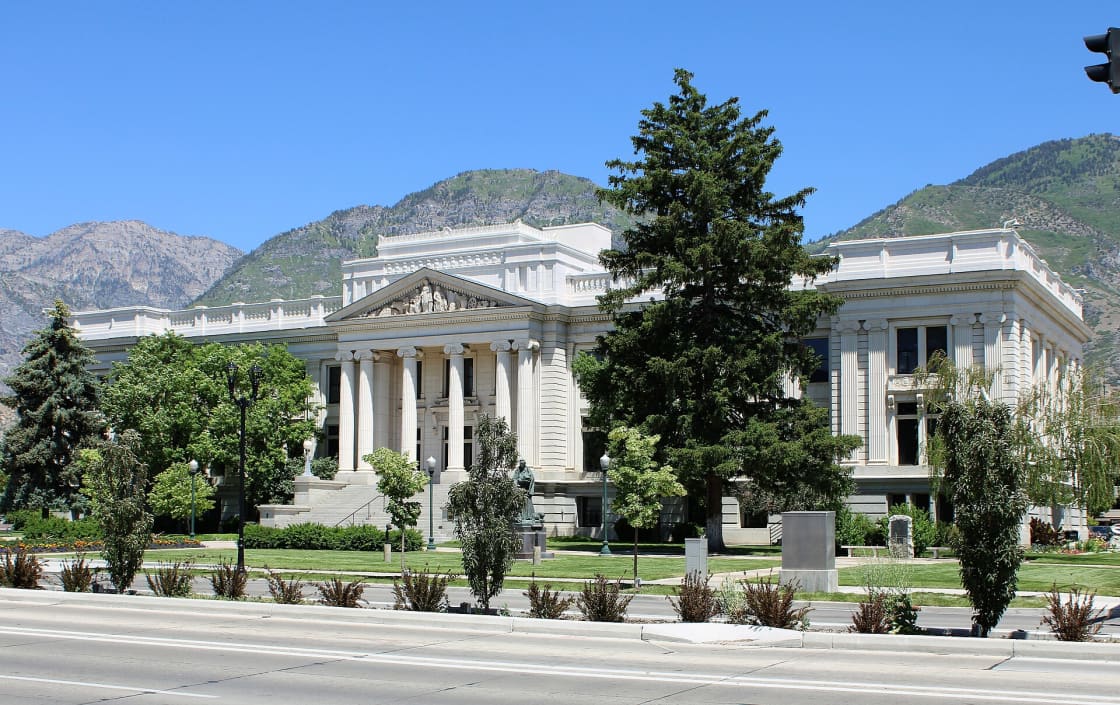
The Utah County Historic Courthouse is the county's most recognizable civic building — a domed, columned early-twentieth-century structure on University Avenue, a block from the Center Street intersection that Provo's entire address grid radiates from. It is the building that appears when the county wants to represent itself.
The festival's own account of its history describes finding a permanent home on University Avenue as the moment it became a Provo tradition rather than a community gathering. That framing is right. Moving from an apartment complex on the south side to the courthouse lawn was not just a capacity upgrade; it was a change in standing.
Early September heat is a real factor
Labor Day weekend in Utah Valley is still summer. Daytime temperatures in the nineties are ordinary, the courthouse lawn offers limited shade once the crowd fills in, and the elevation makes the sun harsher than the thermometer suggests.
The practical version: come in the late afternoon and stay into the evening rather than arriving at midday. Bring water or budget for buying it. Hats and sunscreen are not optional for a full day outdoors here, and the difference between a good visit and an exhausted one is usually just timing.
Evenings are the festival at its best anyway. The light goes, the temperature drops into something pleasant, and the stage programming is at its strongest.
Getting there, and why transit works here
The festival's location is one of the few in Utah Valley where leaving the car behind is straightforward.
The Provo City parking garage on Center Street is the reliable paid option, a short walk from the entrance, with multiple levels available across all four days. Free street parking exists on the surrounding blocks and is free, but it goes early on Saturday and Monday.
The Provo FrontRunner station is roughly a ten-minute walk, and UTA bus routes serve University Avenue directly. That is an unusually good transit position for an event in this county. One caution that applies to any Sunday plan in Utah: FrontRunner does not run on Sundays, so transit is a Friday, Saturday and Monday option only.
The main entrance is on University Avenue, with a secondary entrance from 100 South, and the grounds are flat and fully walkable.
What it does for downtown
The festival's economic footprint on downtown Provo over a long weekend is substantial, and it arrives at a useful moment in the calendar — after the summer festival season has wound down and as the student population returns.
The organizers frame the vendor structure explicitly as an economic-opportunity mechanism: local businesses, artisans and performers are actively recruited to participate, and the festival functions as a marketplace as much as a performance. For a small food business or a craftsperson, a weekend in front of 30,000 people is not a hobby stall.
The volunteer base is correspondingly large, and the organizers are open about the festival running on donated time.
The booths that are not selling you anything
Tucked among the food and craft vendors is a category of booth that explains why the festival was founded in the first place, and it is easy to walk past.
From the beginning, one of the stated purposes was to give nonprofit organizations and new businesses a route to reach the Spanish-speaking population directly. That function has persisted. Depending on the year, the grounds carry booths for health screenings and clinic outreach, legal-aid and immigration information, school district and adult education programs, financial literacy and credit union services, and community organizations of various kinds.
For a household that finds institutional Utah difficult to navigate — because of language, because of unfamiliarity with how American county services are organized, or simply because nobody has ever explained it — a Saturday afternoon where a dozen of those organizations are standing on a lawn answering questions in Spanish is worth considerably more than the sum of its brochures.
It also means the festival does real work that does not show up in an attendance figure. A cultural celebration is the visible layer; underneath it is an annual service fair that people attend because there is music and food.
If you run or volunteer for a community organization serving Utah County, this is the highest-traffic day of your year and the applications open well in advance.
Why it is worth going even if you have no connection to it
There is a version of attending a cultural festival that is a kind of tourism, and it is not a great look. That is not really what is on offer here, mostly because of the scale and the setting.
Utah County's Hispanic population is large, long-established, and central to the area's food, workforce and civic life — a fact more visible in Provo's west-side neighborhoods and in Orem than in the areas newcomers tend to land in. This festival is the one weekend a year when that community's cultural life occupies the most symbolically central lawn in the county, in front of the courthouse, at the origin of the address grid.
Going is not an act of appreciation from outside. It is showing up to the largest free thing happening in your town.
The honest assessment
Festival Latinoamericano is the best-value event on Provo's calendar and the least well-signposted.
It costs nothing. It is downtown, on transit, on a flat walkable site. It runs four days across a holiday weekend when most people are free. The food alone justifies the trip, and the folkloric dance is the kind of thing people travel to see elsewhere.
Against that: the organizers' web presence is thinner than the festival's size deserves, the third-party listings are actively unreliable this year, and the Sunday closure is buried where a first-time visitor will not find it. None of those are reasons not to go. They are reasons to plan from the organizers' own site and to pick your day deliberately.
Go on Saturday if you want the whole thing at full volume. Go Friday if you want to hear yourself. Either way, park in the Center Street garage, come hungry, and do not come on Sunday expecting to eat.
Related Guides
- El DMV de Provo, en español
- Cómo votar en el condado de Utah (guía en español)
- Latino Markets and Panaderías in Provo
- Pupusas and Salvadoran Food in Provo: Where to Go and What to Order
- Best Mexican Restaurants in Utah Valley
- Downtown Provo Parking: Where to Actually Put Your Car
- Downtown Provo: The Neighborhood Guide
- The Center Street Dining Guide
- Provo History: How the City Became What It Is
- Provo's Sister Cities: Meissen, Nanning and the BYU Connection
- Festival Latino de Payson
Frequently Asked Questions
When is Festival Latinoamericano in Provo?
Is Festival Latinoamericano free?
Where exactly is it held?
Are the food booths open on Sunday?
How big is Festival Latinoamericano?
Where do you park for Festival Latinoamericano?
How old is Festival Latinoamericano?
Is it suitable for children?
Sources
The facts in this guide were checked against these sources. Hours, fees and rules change, so confirm anything time-sensitive with the source before you go. How we make Provo.com.
- Celebrating Life and Culture at Utah's Festival Latinoamericano, Utah Division of Multicultural Affairs. Checked October 12, 2026.
- What To Do in Provo Fall, Provo City Library. Checked October 12, 2026.
- Festival Latinoamericano — Provo, Utah, Festival Latinoamericano. Checked October 12, 2026.
- Festival Information, Festival Latinoamericano. Checked October 12, 2026.
- About the Festival, Festival Latinoamericano. Checked October 12, 2026.