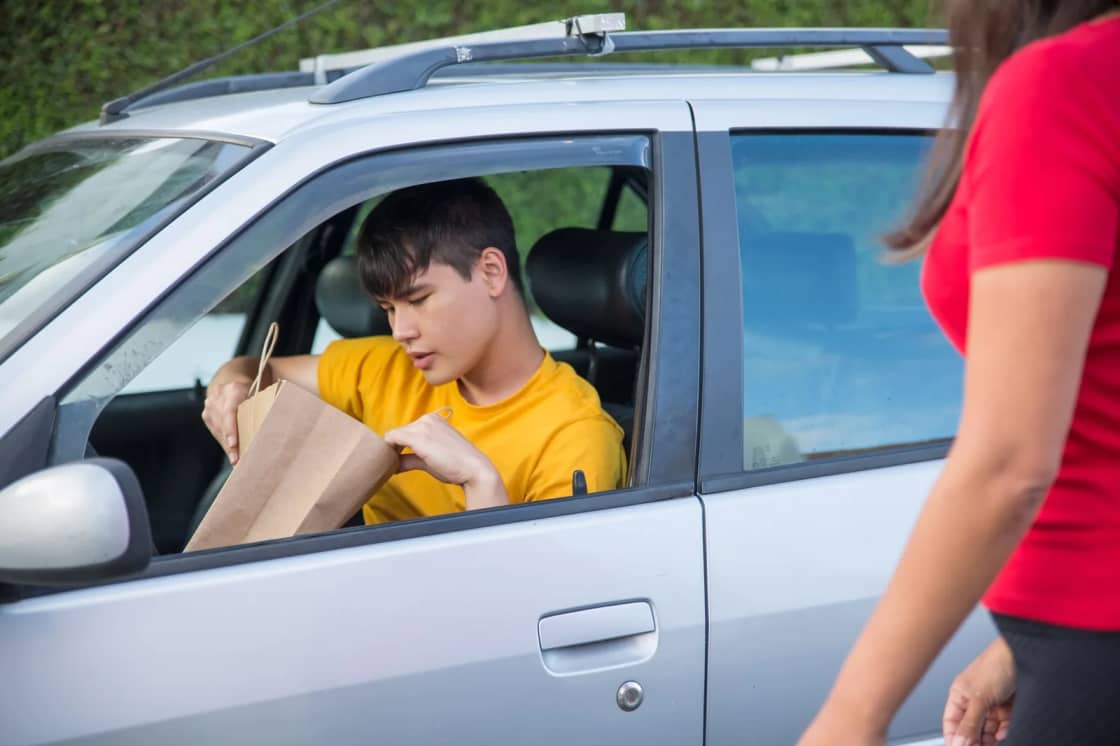

Food delivery works in Provo. It works less well than it does in a larger metro, and it works differently than newcomers expect, because three local facts shape it: the restaurants close early, the address grid is unusual, and Utah's alcohol law removes a category the apps sell everywhere else.
This guide covers the fee structure honestly, the specific local friction points, and the cases where ordering delivery is simply the wrong call.
The three platforms, and what changed under them
The delivery market consolidated sharply in the last two years, and the apps on your phone are not owned by who you think.
DoorDash has the widest restaurant coverage in the Provo–Orem market and is the default for most local independents that deliver at all. It completed its acquisition of the UK-based Deliveroo in October 2025, adding to a run of acquisitions that has made it the dominant global player in the category rather than merely the dominant American one.
Uber Eats runs second here on selection, with a well-built app and the meaningful advantage that its subscription bundles food delivery with the ride side of the business.
Grubhub is a distant third in Provo, as it is nationally. It was sold by Just Eat Takeaway to Wonder, the food-hall and delivery company founded by Marc Lore, in a deal that closed in early 2025, for a small fraction of what Just Eat Takeaway paid for it in 2020. It still surfaces the occasional restaurant the other two miss, which is the entire case for keeping it installed.
All three subscription programs — DashPass, Uber One, Grubhub+ — sit at around ten dollars a month, and all three waive delivery fees on qualifying orders while leaving the other charges intact.
The thing worth knowing about a market this size: restaurant coverage is not uniform across the three. A number of Provo independents partner with exactly one platform. A handful, particularly the ones with strong pickup business, are on none and run their own ordering page. If there is a specific restaurant you want, check the restaurant, not the app rankings.
What delivery costs
The single most useful thing to understand is that the "delivery fee" is not the cost of delivery. It is one line in a stack:
The menu markup. Restaurants routinely list higher prices on delivery platforms than they charge at the counter, to offset the commission the platform takes. This happens before any fee appears and it is invisible unless you have the in-store menu in front of you. It is also the part no subscription removes.
The delivery fee. The line people watch. It is the one a subscription waives.
The service fee. Usually a percentage of the subtotal rather than a flat amount, which means it scales with the size of your order. Subscriptions typically reduce but do not eliminate it.
A small-order fee, applied below a threshold — the mechanism that turns a single cheap item into a bad deal.
Tax and tip. In Utah, tax is applied to the food. The tip is the part that reaches the person driving.
Add those together and the gap between the counter price and the delivered price on a small order is frequently large enough to change the decision. This is the arithmetic behind the advice in our cheap eats guide: a cheap meal often stops being cheap the moment it is delivered.
The honest framing on subscriptions: they are a delivery-fee product, not a discount product. If your fees in a typical month exceed the subscription price, subscribe. If you order twice a month, it is close to a wash.
The Utah thing: you cannot add a drink to the order
If you have moved to Provo from almost anywhere else, this is the difference that will catch you.
Utah's alcohol system is state-controlled and unusually restrictive, and retail-to-home alcohol delivery of the kind that is routine in most states is not available here. Utah's alcohol code allows an alcohol-related activity only when the code expressly permits it, and a restaurant licensee may not sell or furnish alcohol through a window or door to anywhere off its licensed premises, so do not expect a courier to bring beer or wine to your door with dinner.
The rule extends into the mobile side of the food business too: Provo City Code states plainly that no alcohol may be sold or provided from a mobile food business, which is why you will never see it at a food truck rally here.
Because alcohol rules in Utah change more often than most people expect and the published summaries conflict with one another, we deliberately do not print a specific rule set. The Utah Department of Alcoholic Beverage Services is the authority, and it is the place to check rather than a delivery app's help page or a third-party blog.
Why your driver cannot find you
Provo has an unusual address grid, and it produces a specific, repeatable delivery failure that residents experience constantly and rarely diagnose.
Utah's state geospatial office lists Provo's address origin as Center Street for north–south and University Avenue for east–west. Most of its neighbors — Lehi, Lindon, Mapleton, Pleasant Grove, Salem, Spanish Fork — use Main Street as that east–west origin instead. Orem does not share Provo's origin either.
The consequence for a driver following a phone: a street that looks continuous across the city line is measuring from a different zero on the other side of it. The numbers renumber underneath them. A delivery to a north Provo address near the Orem boundary is one of the more common places for an order to go briefly, confusingly wrong, and the driver is not being careless — the grid is doing something the map is not explaining.
Three things fix most of it:
- Put a cross street in the delivery notes, not just the house number.
- Name the building or complex, especially in student housing, where several buildings share one street address.
- Say which city you are in if you live near a boundary. It sounds redundant. It is not.
Our University Avenue guide covers the grid in full, including why Provo has no downtown Main Street at all.
Delivering to campus
BYU and UVU addresses are harder than residential ones for reasons that have nothing to do with Provo specifically. Mapping apps tend to locate a large campus by its centroid rather than by a door. Residence halls have controlled entrances. Academic buildings have several, and the one nearest the road is rarely the one you are in.
The workable approach is to choose a meeting point and put it in the notes — a named building entrance, a parking lot, a landmark — and then watch the tracker rather than the doorbell. Drivers in a college town do this all day and will meet you where you say.
If you are a student weighing delivery against the alternatives, our student budget eating guide makes the case that delivery is the single most expensive way to solve the problem, and the food near BYU roundup covers what is within walking distance.
What travels well, and what does not
Delivery quality is mostly a physics problem — steam, time and structural integrity.
Travels well: pizza, which is engineered for it. Indian curries and rice, which arrive essentially as they left. Burritos and rice bowls, though bowls hold up better than burritos. Barbecue and other slow-cooked meat. Sandwiches with sturdy bread.
Travels badly: anything fried that is meant to be crisp, which steams itself soft inside a sealed container. Dishes plated with a temperature contrast. Delicate fish. Anything where the sauce is meant to meet the dish at the table.
A useful trick for the middle cases: ask for sauces and dressings on the side where the option exists. The dish that arrives assembled twenty minutes ago is a different dish.
Bear in mind too that Provo's better restaurants are not evenly represented on the platforms. Several of the places our best restaurants list rates highest do not deliver at all, and a few of the ones that do are noticeably better eaten in.
Where the delivery zone runs out
Provo's delivery radius is shaped by geography more than by population, and the edges are predictable once you know where they are.
The east bench thins out as you climb. Addresses up against the mountain, particularly the streets above the Y trail and toward the canyon mouth, sit at the far end of most restaurants' range. Orders take longer and fewer restaurants show as available.
Provo Canyon is effectively outside the practical zone. If you are staying up the canyon, plan on collecting food in the valley rather than having it brought up.
The west side toward Utah Lake and Vineyard has improved considerably as Vineyard has grown, but it still surfaces a shorter restaurant list than central Provo, and the drive time from the Center Street restaurant cluster is real.
South toward Springville, Spanish Fork and Payson, and north past Orem into Lindon and Pleasant Grove, you cross into what the apps treat as different markets. A Provo restaurant will often simply not appear.
The tell is the same in every case: if your available-restaurant list looks unusually short, that is a distance signal rather than a closed-kitchen signal. Widening the search radius in the app, where it offers one, sometimes surfaces places willing to travel.
How the tip works
Delivery in Provo is gig work, and the economics are worth understanding because they change your outcome, not just the driver's.
The platforms show drivers an estimated total payout — base pay plus tip — before they accept an order. A driver deciding between offers is comparing those numbers against distance. An order with a low or absent tip attached to a long drive sits in the queue while better-paid orders get taken, and the food sits with it.
That produces two practical consequences:
Tipping in the app up front, rather than after delivery, is what affects how quickly your order is picked up. A post-delivery tip is a thank-you; a pre-delivery tip is a bid.
Distance matters more than order size. A modest order going a short distance is a good offer. A modest order going to the far side of the valley is not, and if it is not moving, that is usually why.
None of that is Provo-specific, but it bites harder in a valley where the restaurant density drops off sharply outside the central corridor.
Ordering directly from the restaurant
A growing number of Provo and Orem restaurants run their own online ordering — usually through the point-of-sale system they already use at the counter — and take orders for pickup and sometimes for their own delivery.
This is consistently the cheapest way to order, because the menu is priced at counter prices and the commission stack is not there. It is also the least discoverable: these pages are on the restaurant's own website and social profiles rather than in an aggregator, so you only find them by looking.
The general rule that follows: check the restaurant's own site before opening an app, especially for pizza, where several operations have historically run their own drivers and can beat the platforms on both price and time.
When something goes wrong
Missing items and cold food are common enough that it is worth knowing the mechanics.
Report it in the app, not to the restaurant. The platform holds the payment and issues the credit; the restaurant generally cannot refund an app order. Reporting to the restaurant first mostly wastes an evening.
Do it promptly. Refund windows are short, and a report filed the next morning is materially less likely to be honored than one filed on arrival.
Photograph the problem before you deal with it. A picture of the missing-item bag or the wrong dish resolves the claim faster than a description does.
Separate the driver from the kitchen. A missing item was almost certainly packed wrong at the restaurant, and rating the driver down for it does real harm to someone who did their part correctly.
Grocery and everything else
Grocery delivery is comparatively strong here, with the major national services covering the valley's supermarkets and warehouse clubs. For anyone without a car — a large share of the student population — this is the more important half of the delivery economy, and the per-order economics are much better than restaurant delivery because the basket is larger and the fee spreads across it.
The same structural warning applies: platform prices on grocery items are often above shelf prices, and the saving from a membership program is a fee saving, not a price saving.
Late night is a kitchen problem, not an app problem
Provo closes early. Most sit-down restaurants are shut by nine or ten, a pattern shaped by the valley's predominantly LDS culture and a college-town rhythm that runs earlier than most American cities of comparable size.
What that means for delivery is simple and often misunderstood: the app staying open does not mean anything is cooking. After about ten, the available menu collapses to fast food and chain pizza, and after midnight it thins further. Our late-night food guide is the honest inventory of what is available, including which drive-throughs run latest.
Sunday is its own constraint — a large share of the valley's restaurants close entirely, which our Sunday dining guide covers.
When to just go get it
Pickup wins more often than the convenience framing admits. Ordering ahead for collection removes the delivery fee, the service fee and the tip, and usually the menu markup too, because most restaurants price their own ordering page at counter prices.
Within a ten-minute drive, on an order for one or two people, that gap is frequently larger than the meal is worth to have carried. Delivery earns its cost in three situations: when you cannot leave, when the weather is bad — which in this valley means the January inversion and the occasional canyon-wind day more than it means snow — and when the order is large enough that the fixed fees spread thin across it.
Who is responsible for the food between the kitchen and your door
Delivery raises a question that the fee breakdown never answers: once a courier takes the bag, whose problem is the food? The answer in Utah has two halves, and one of them is an absence.
The restaurant's duty follows the food out the door. Utah enforces the 2022 FDA Food Code through Utah Admin. Code R392-100-4, and the Food Code's definition of food establishment at ¶ 1-201.10(B) is written to reach delivery explicitly. A food establishment is an operation that stores, prepares, packages, serves or vends food directly to the consumer — and that "relinquishes possession of food to a consumer directly, or indirectly through a delivery service such as home delivery of grocery orders or restaurant takeout orders, or delivery service that is provided by common carriers."
That clause does real work. It means the restaurant's obligations — cooking temperatures under § 3-401.11, hot holding at 135°F or above and cold holding at 41°F or below under § 3-501.16, protection from contamination under Part 3-3 — are not discharged at the counter. The permitted establishment is the one on the hook for the condition in which the food leaves.
The courier is not a permitted food establishment. A driver carrying sealed containers is not preparing, storing or serving food within the meaning of the definition, and does not hold a health permit or, generally, a food handler permit. Nothing in the Utah rule creates a permit category for a person who transports a closed bag. That is a deliberate gap rather than an oversight — the protection is meant to come from the packaging being intact and from the trip being short.
Which is why the tamper-evident seal on a delivery bag is the most substantive thing on it. The sticker is doing the job the permit does not.
The statute Utah has not passed
Several states responded to the pandemic-era growth of delivery platforms by regulating the platform directly. California's Fair Food Delivery Act of 2020 prohibits a food delivery platform from arranging delivery of an order from a food facility without first obtaining an agreement with that facility authorizing it. New York and other states followed with written-authorization requirements, and Texas enacted its own framework in 2021 covering agreements and disclosure while preempting local commission caps.
Utah has no equivalent statute. There is no Utah provision requiring a platform to obtain a restaurant's written consent before listing it, no state cap on the commission a platform may charge, and no Utah requirement that a platform display the restaurant's own prices rather than a marked-up menu. Utah's consumer protection framework — the Truth in Advertising Act at Utah Code Title 13, Chapter 11a, which reaches likelihood of confusion as to source, sponsorship or approval — is general law of the kind that would have to be applied to a specific set of facts, not a purpose-built rule.
The consequence for a Provo diner is concrete. A restaurant appearing on a delivery app has not necessarily agreed to be there. An unaffiliated listing can carry a stale menu, wrong hours, wrong prices and an order the kitchen receives by fax or not at all — and the restaurant has no Utah statutory route to demand removal beyond asking the platform and relying on general trademark and consumer protection law. The platforms have publicly committed to consent-based listing and to honoring removal requests; that commitment is a policy rather than a Utah legal obligation.
What to do with that
Order direct when the restaurant offers it, which is the same advice this guide gives for reasons of cost, and now for a second reason: a direct order goes to a kitchen that has agreed to receive it. Several independents in this valley run their own ordering pages precisely to sidestep the problem.
Treat an app listing as unverified until the order confirms. If a small independent appears on a platform and its own social accounts say nothing about delivery, that is the pattern an unaffiliated listing makes. A phone call resolves it in under a minute.
Check the seal before the driver leaves, because the seal is the mechanism and it is the only part of this chain you can personally inspect.
And treat hot-held delivery food as being on a clock. Nothing about the drive suspends the temperature rules the food was cooked under; it simply moves the food outside anyone's monitoring. Food that arrives lukewarm has been in the zone the Food Code exists to keep food out of, which is a better reason to be annoyed about a slow delivery than the temperature of the fries. For the permitting layer that applies to the restaurant end of this, see food permits and inspections in Utah County.
Related guides
- Late Night Food in Provo
- Restaurants Open Sunday in Provo
- 30 Best Restaurants in Provo
- Cheap Eats in Provo
- Eating on a Student Budget
- University Avenue, Provo
- River Rock Cafe: Eating at Utah Valley Hospital When You Did Not Plan To
- Food Trucks in Provo & Orem: Where They Park, Why They Move, and Which Ones Are Left
- The Provo & Orem restaurant directory — every place we cover, with its address, filterable by cuisine and city
Platform coverage, fees and subscription pricing change frequently. Confirm current costs in the app before ordering.
Frequently Asked Questions
Which delivery app has the best coverage in Provo?
Can you get alcohol delivered in Provo?
Why do delivery drivers get lost in Provo?
How much does food delivery cost on top of the food?
Is DashPass or Uber One worth it in Provo?
Can you get food delivered late at night in Provo?
Does delivery work to BYU and UVU campus addresses?
When is pickup better than delivery?
Sources
The facts in this guide were checked against these sources. Hours, fees and rules change, so confirm anything time-sensitive with the source before you go. How we make Provo.com.
- Alcohol Enforcement Team FAQ, Utah State Bureau of Investigation. Checked October 12, 2026.
- Utah Code 32B-5-307 Bringing alcoholic product onto or removing alcoholic product from premises, Utah State Legislature. Checked October 12, 2026.
- Utah Code Title 32B Chapter 1 (general provisions), Utah State Legislature. Checked October 12, 2026.
- Provo City Code 6.32.030 Mobile Food Business General Requirements, Provo City. Checked October 12, 2026.
- R392-100 Food Service Sanitation, Utah Office of Administrative Rules. Checked October 12, 2026.
- DoorDash Completes Acquisition of Deliveroo (8-K Ex. 99.1), U.S. Securities and Exchange Commission (EDGAR). Checked October 12, 2026.