
Most guides to Koko Lunchbox tell you it is good. That part is not in dispute — it turns up near the top of Provo's Korean lists, its Japanese lists and its ramen lists simultaneously, which is unusual for a small counter-service place in a strip unit on Canyon Road.
What those guides skip is the thing that makes a first visit go badly or well: the menu is a grid, not a list. Once you see that, ordering stops being guesswork.
The basics
Koko Lunchbox sits at 1175 North Canyon Road in Provo, in a small commercial strip on the east side of the road, north-east of downtown and a short drive from the BYU campus. It was already open and drawing reviews as a family-run "ma and pa" place by spring 2016.
It is counter-service in format — order, sit, food comes out — rather than a full-service restaurant. The room is small and plain. Nobody visits Koko for the dining room, and no review pretends otherwise.
It is closed Sunday, which matters more in Provo than it would elsewhere, and hours on the other days have moved around over the years. Check before a late visit rather than trusting a number you read somewhere.
The grid, which is the whole trick
Here is the thing nobody tells you. Koko's menu is not a long list of unrelated dishes. It is a small set of formats, each of which can be built with a protein. Pick one from each column and you have ordered.
The formats, roughly:
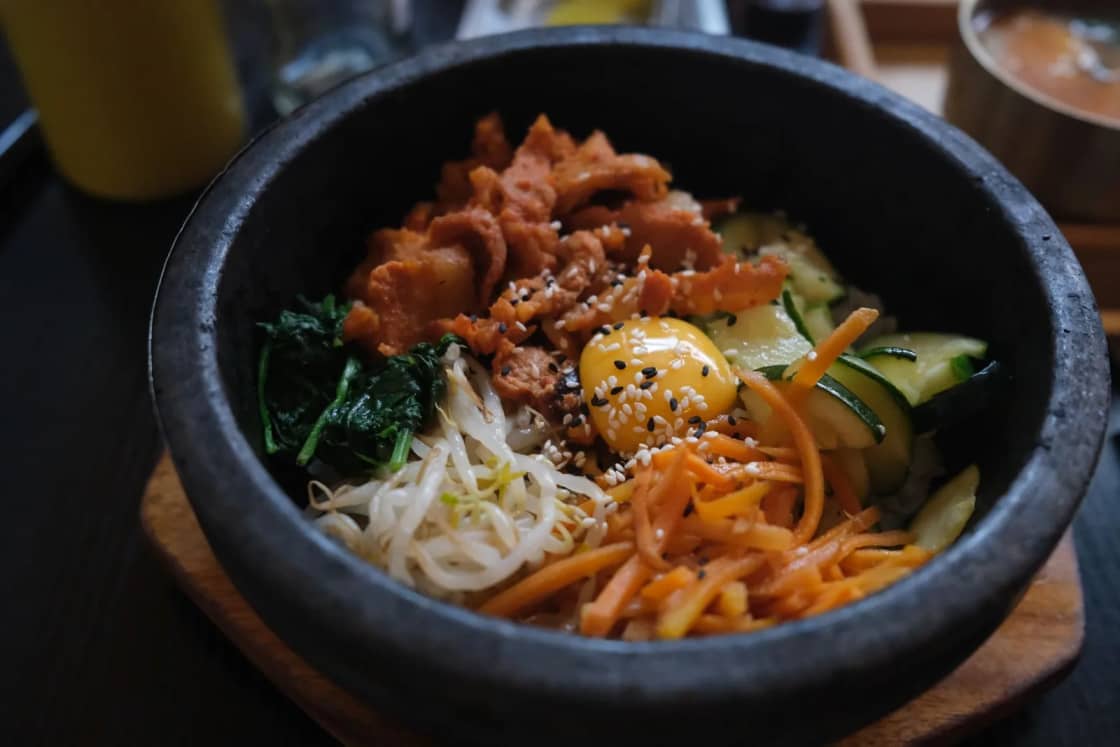
- Bibimbap — components arranged over rice, stirred together at the table. Available in a hot stone bowl.
- Dupbap — a topping served over rice. Simpler, no stirring ritual, no stone bowl.
- Ramen — noodle soup.
- Katsu — panko-breaded and fried cutlet, served with rice.
The proteins that rotate through those formats include spicy pork bulgogi, teriyaki chicken, beef, and tofu and vegetable builds.
So "beef dupbap" and "spicy pork bibimbap" are not two unrelated menu items you need to evaluate separately. They are two intersections on the same grid. Once that clicks, the menu shrinks from intimidating to about four decisions.
About that name
"Lunchbox" reads as childish in English, and at least one local reviewer admitted to bracing for something twee on the strength of the sign. That is a mistranslation of the idea rather than a fair reading of it.
Korea has a real and specific lunchbox tradition — dosirak, a packed meal in a compartmented container, carried to school or work. It is not a sad desk sandwich. A dosirak is a composed meal: rice, a protein, several sides, arranged so it travels. In its older form the box was shaken before eating so the contents mixed, which is recognizably the same instinct that produces bibimbap.
So a Korean restaurant calling itself a lunchbox is claiming something closer to complete, portable, everyday meal than packed snack. The lunchbox sets on the menu — a protein with rice, vegetables and kimbap, the seaweed-and-rice rolls that look like sushi and are not — are the most literal expression of that. They are also the best way to sample several things without ordering three entrees.
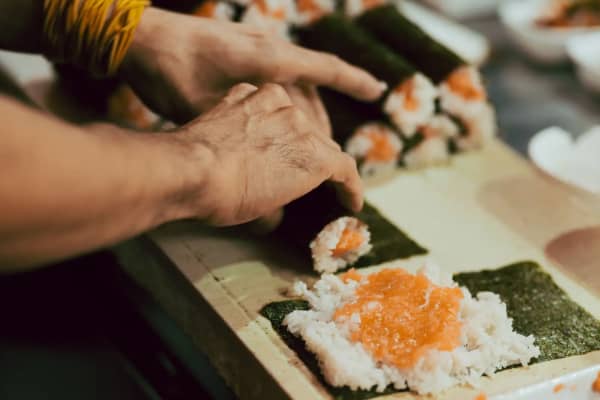
Kimbap deserves its own note, because people order it expecting sushi and are briefly confused. The rice is seasoned with sesame oil and salt rather than vinegar, the fillings are usually cooked rather than raw, and it is picnic food rather than restaurant ceremony. Judged as sushi it is disappointing. Judged as kimbap it is very good.
The stone bowl question
If you order bibimbap, you will be asked — or you should ask — whether you want it in a stone bowl.
Say yes at least once.
The stone bowl arrives hot and stays hot. The rice pressed against the sides keeps cooking while you eat, and it turns into a browned, crisp crust at the bottom. Scraping that up at the end is the point of the dish. The Korean name for that crust is nurungji, and in a properly hot bowl it develops over the course of the meal rather than arriving pre-made.
The trade-off is time and temperature. A stone bowl takes longer to cool to an edible state, and if you are eating on a tight lunch break you may spend the first several minutes waiting. The regular bowl is the sane order when you are in a hurry.
One practical warning that reviewers repeat: stir it properly. Bibimbap that has not been mixed thoroughly eats as separate piles of things. The mixing is not optional garnish — it is how the dish is supposed to work.
What people order
The recommendations cluster tightly, which is a good sign in a small menu.
Bibimbap, stone bowl. The most-mentioned dish by a comfortable margin. Reviewers describe a bowl with rice, a fried egg on top, and a spread of vegetables — bean sprouts, carrots, cabbage, greens — plus the protein of your choice.
Kimchi fried rice. This has its own constituency, separate from the bibimbap crowd, and the enthusiasm for it is notably high. If you like kimchi at all, this is the dish that will tell you whether Koko's version is good. Several people describe driving out of their way specifically for it.
Teriyaki chicken. The safe order, and not a compromise. It is the dish people bring visitors and cautious eaters to, and it holds up.
Katsu. Thick pieces of pork, panko-breaded, fried, served with a sweet-and-sour style dipping sauce alongside rice. This is the most Japanese thing on the menu and one of the more filling.
Ramen. Present and ordered, including a tonkatsu-style bowl. It is not the reason most people are here, but it is the reason Koko shows up on ramen lists.
The side dishes are not an afterthought
Korean meals traditionally come with banchan — small side dishes, refreshed rather than treated as a single serving. Kimchi is the one everyone knows. Japchae, the sweet-potato-noodle stir fry, is another common one.
Two pieces of advice come up repeatedly from people who eat here often. First, do not skip them. Second, use the sauces on the table. More than one regular specifically recommends adding the available sauces rather than eating the bowl plain, on the grounds that the dish is built with them in mind.
Portions, and the leftovers problem
Plan for leftovers.
This is not a minor note. It is one of the most consistent observations in every review pool — people arrive hungry, order confidently, and take half of it home. One reviewer's summary of the stone bowl was simply to be ready for leftovers.
The practical implication for a couple or a small group: order one fewer entree than you think you need, add a side, and see where you land. You can always order more. The reverse costs money and food.
Drinks, and the boba worth knowing about
Koko pours boba and fruit smoothies alongside the food, which is not universal at Korean restaurants in the valley and is a genuine convenience when you are feeding a group with a range of ages.
The mango boba smoothie gets specific praise, and a shared one is a reasonable way to finish a meal you were never going to finish anyway. If you have not had boba, the tapioca pearls sit at the bottom and come up through a wide straw; they are chewy rather than dissolved, and that texture is the point rather than a defect.
For anyone tracking it, this is one of the reasons Koko works as a study stop as much as a meal — a bowl and a boba is a legitimate two-hour arrangement in a way that a burger is not.
Check that it is open, from the right source
This is the most useful practical warning about Koko, and it comes up more than once.
The restaurant has closed temporarily in the past — most memorably when the owner traveled to Korea for an extended visit — and the aggregator listings did not keep up. People arrived to find it shut. Worse, the opposite also happened: at least one visitor reported that a major review site was showing Koko as permanently closed while the restaurant was open and serving, and they only found out by taking a chance on the drive.
A small family-run restaurant does not have someone whose job is correcting third-party listing data. So:
- Treat "permanently closed" on an aggregator as unverified, not as fact.
- Call ahead if you are making a special trip. The phone is answered.
- Posted hours across different platforms disagree by about half an hour on the open time. The restaurant's own channels are the ones to believe.
None of this is unique to Koko — it is the standard condition of independent restaurants — but Koko has been bitten by it visibly enough that it is worth saying out loud.
Takeout, delivery and feeding a group
Takeout is a first-class option here rather than an afterthought, which follows naturally from a menu built on portable formats. Rice bowls travel well. A stone bowl does not — the crust that makes it worth ordering depends on the bowl staying hot, so order that one to eat in.
Third-party delivery has been available, though which platforms carry any given small restaurant changes without notice and the restaurant keeps more of the money when you order directly.
For groups, the format grid becomes an advantage. Everyone picks their own intersection, the kitchen is not being asked to improvise, and the bill stays in casual territory. It is also listed as good for kids, and the milder rice bowls give you something to put in front of a cautious eater without a separate children's menu.
Timing your visit
Koko is close enough to campus that the midday rush is real, and the kitchen cooks to order rather than assembling from a steam table. Those two facts combine into a wait at peak times.
Several regulars are explicit about this: the food is made fresh, so be ready to wait. That is a fair trade, but it is a bad surprise if you have fifty minutes between classes.
The workable windows are early lunch, mid-afternoon, and early evening. Friday and Saturday run later than the weekday close.
And again — Sunday, no.
Where to park
Canyon Road has a strip-mall parking arrangement in front of the unit, which is adequate outside peak hours and tight during them. The unit sits back from the road, so the sign is easier to spot than the storefront.
If you are coming from campus, this is a short drive rather than a comfortable walk for most people, particularly in January. Our guide to food near BYU covers the places you can reach on foot.
How it compares to the other Korean options
Utah Valley's Korean scene is small but no longer thin, and the options are not interchangeable.
Koko occupies the fast, cheap, family-run corner of it. It is not Korean barbecue, where you cook at the table and the meal takes two hours. It is not Korean fried chicken, which is a specific double-fried technique and a different night out entirely. Our Korean food guide lays out the full set and which is which.
What Koko does that the others do not is span Korean and Japanese in one small menu at a low price point. That is why it functions as a group-conflict solver. It is also why it appears on the sushi and Japanese roundup despite not being a sushi restaurant in any purist sense.
The authenticity question, briefly
Reviews of Koko contain an unusual number of people asserting that it tastes like home — including people who have lived in Korea and are comparing against that memory rather than against other American Korean restaurants.
That is a stronger signal than a star rating. It is also worth holding lightly: "authentic" is doing a lot of work in restaurant writing, and Korean food is regional and varied enough that no single restaurant represents it. What can be said fairly is that the cooking here is not obviously adjusted downward for an audience assumed to be nervous about it.
Who this restaurant is not for
Worth stating plainly, because the enthusiasm around Koko can oversell it.
If you want atmosphere, this is the wrong choice — the room is small and unremarkable, and a birthday dinner deserves better staging. If you are on a strict clock, the cook-to-order model works against you. If you need a Sunday option, it does not exist here.
And if you have a serious allergy, a small kitchen working with shared equipment, soy, sesame, fish-based pastes and gluten in several places is a conversation to have with staff directly rather than a menu to read optimistically.
What it costs, roughly
Koko has historically sat in the inexpensive tier for Provo, and it still reads that way to the people eating there — the portion size does a lot of work in that perception.
Actual prices have moved since the restaurant opened, as they have everywhere, so any specific number printed here would be wrong within a year. The useful framing is comparative: Koko is priced as a casual weekday lunch rather than an occasion, and it sits comfortably in the same tier as the other counter-service international places near campus. Our cheap eats guide puts that tier in context.
The short version
Order a stone bowl bibimbap with a protein you like, add kimchi, stir it properly, and expect to take some of it home. Go outside the lunch rush. Do not go on Sunday.
That is most of what a first visit needs. The rest of the menu will still be there.
Hours, menu items and prices at independent restaurants change. Confirm current details with the restaurant before making a special trip.
Last updated: August 2026.
A note on the space itself, and the law behind it
Small independent restaurants in older commercial buildings vary enormously in how easy they are to get into and move around, and that variation surprises people who assume a single standard applies everywhere. It does not, and the reason is worth a paragraph.
Restaurants are places of public accommodation under Title III of the Americans with Disabilities Act, with the operating rules at 28 C.F.R. Part 36. For a building already standing, the requirement is readily achievable barrier removal — removing architectural barriers where that is "easily accomplishable and able to be carried out without much difficulty or expense" (§ 36.304(a)). The regulation lists the kinds of steps normally expected, including ramps, curb cuts, repositioned shelving, rearranged seating, wider doorways and offset hinges (§ 36.304(b)).
It also sets real limits, and those limits are why small spaces look the way they do. Rearranging tables and chairs is not readily achievable to the extent it causes a significant loss of serving space — which, in a room with a handful of tables, it very quickly does. The obligation does not reach areas used exclusively as employee work areas. And where barrier removal is not achievable, the duty becomes one of providing goods and services by readily achievable alternative methods instead (§ 36.305).
A newly built or substantially altered space is a different matter, measured against the 2010 ADA Standards for Accessible Design rather than the existing-facility test, with a safe harbor for elements that already met the 1991 Standards (§ 36.304(d)(2)).
For a first visit the practical consequence is this: seating configuration, counter height, doorway width and restroom layout in a compact independent restaurant are shaped by the building as much as by the operator, and none of it is reliably reported on delivery apps or listing sites. If it matters, call and describe the specific thing you need. Small restaurants here are generally straightforward about answering that question, and the answer you get by phone is worth more than any icon on a listing page.
Related Guides
- Barry's Parkview Drive Inn: The Spanish Fork Burger Stand That Made the Drive-Thru Line Worth It
- The Kolache Place: Why Hruska's Changed Its Name
- The Best Restaurants in Springville, Utah (2026)
- Best Healthy & Clean Eating Restaurants in Provo (2026)
- The Provo & Orem restaurant directory — where this place sits among everything else we cover, with the address and the city
Frequently Asked Questions
Where is Koko Lunchbox in Provo?
What should I order at Koko Lunchbox the first time?
Is Koko Lunchbox open on Sunday?
What is the difference between bibimbap and dupbap?
Is Koko Lunchbox good for people who do not eat spicy food?
Does Koko Lunchbox have vegetarian options?
How big are the portions at Koko Lunchbox?
Is Koko Lunchbox a Korean restaurant or a Japanese one?
Sources
The facts in this guide were checked against these sources. Hours, fees and rules change, so confirm anything time-sensitive with the source before you go. How we make Provo.com.
- KoKo Lunchbox of Provo dishes out plentiful portions of amazing, authentic Korean, Daily Herald. Checked October 12, 2026.
- Lunch ladies go cuckoo for KoKo Korean, Daily Herald. Checked October 12, 2026.