
Somewhere in the last year, a Provo institution changed its name and a good number of its regulars did not notice, because they had been calling it the new name for a decade already.
Hruska's Kolaches is now The Kolache Place. The shop at 434 W Center Street is the same building with the same family in it baking the same things, and the reasoning behind the switch is unusually well documented — the founders wrote it out themselves rather than letting it happen quietly. It is a small story, but it is a genuinely interesting one about what happens when a family surname becomes a business asset and then becomes a liability.
This guide covers the rebrand and why it happened, what a kolache actually is for anyone who has never had one, what to order, and the practical business of getting one.
The rebrand, in the founders' own words
The announcement came from the business itself, and it is worth reading closely because it is more candid than these things usually are.
The core observation was that after roughly twelve years, much of the community had stopped using the shop's actual name. People said "the kolache place." The founders' response was not to correct that but to lean into it — they described it as something positive, and as a reflection of an identity the business and its customers had built together rather than one the family had imposed.
Then two harder reasons.
The first was privacy. They noted that when they started, using the family surname was a signal of personal accountability — putting the name on the door meant standing behind the product. As the business grew, and as the family grew, that calculus changed. Trading under your own surname means your surname is public property, and they wanted some of it back.
The second was growth. A single-family name is a constraint on a business that intends to expand beyond one family. Rebranding, in their framing, let the operation "grow beyond a single family name and move into the future while still honoring our roots."
They were also explicit about what the change was not. Their own wording is that the rebrand "isn't just a 'clean break' but rather a commitment to our future." The founders continue to lead the business, now across five locations. The recipes are unchanged — the sourdough of the whole operation is a great-grandmother's recipe, and that is the thing they were most careful to say had not moved.
The Hruska siblings are still the ones running it. Cory Hruska has been the public face of the change in Utah press coverage.
If you want the marker of how recent all this is: the old domain still resolves and still carries the about page explaining the change, and plenty of review sites still file the business under the old name with the new name in brackets. Both names will be in circulation for years. They are one business, and anyone listing them as two is wrong.
What a kolache actually is
For a food that has been in Provo since the early 2010s, the kolache remains poorly understood locally, so here is the short version.
A kolache is Czech in origin — a round of soft, enriched, slightly sweet yeasted dough with a filling. In the Czech tradition the filling is sweet: poppy seed, prune, apricot, sweet cheese. Czech and Moravian immigrants took it to central Texas in the nineteenth century, and Texas did what Texas does, which was put sausage in it.
That savory version has its own proper name — a klobásník — and pedants will tell you so. In practice, in Texas and everywhere Texas kolache culture has spread, the whole family gets called kolaches and nobody outside a Czech heritage society minds.
The Texas-style kolache that arrived in Provo is therefore two things at once: a sweet fruit pastry and a savory filled roll, sharing a dough. The dough is the constant — buttery, tender, yeasty, closer to a soft roll than to laminated pastry. It is not a croissant and it is not a doughnut. The shop's own description, that it is "kinda like a danish and a bagel had a delicious baby," is imprecise but conveys the texture better than a technical one would.
Why it matters for breakfast: a kolache is a self-contained hot breakfast you can eat with one hand in a car. Utah Valley has a great deal of sit-down breakfast and comparatively little excellent grab-and-go, which is a large part of why this shop found its market.
What they make, and how
The operation is more scratch-based than a bakery of this size normally is, and the specifics are worth knowing because they explain the price.
Fruit, vegetables and meats are bought locally. Eggs are cracked by hand. Meats are cut in-house. The jams and jellies in the sweet kolaches are made on site from real fruit rather than bought as pastry filling. Savory fillings are cooked in-house over open flame — hand-cracked eggs, fresh vegetables, house sausage.
Everything is made daily, and the business is cheerfully upfront about the consequence of hand-cracking eggs at volume: their own copy warns that you may find a real eggshell in your kolache. That is an unusual thing to advertise and it tells you something about the shop's relationship with its customers.
The range splits cleanly:
Savory is the signature. Sausage, egg and cheese in various combinations, with the jalapeño-sausage direction being the one regulars name first. Chicken-and-cilantro appears on visitors' lists repeatedly. These are what the shop is famous for and what got it national attention.
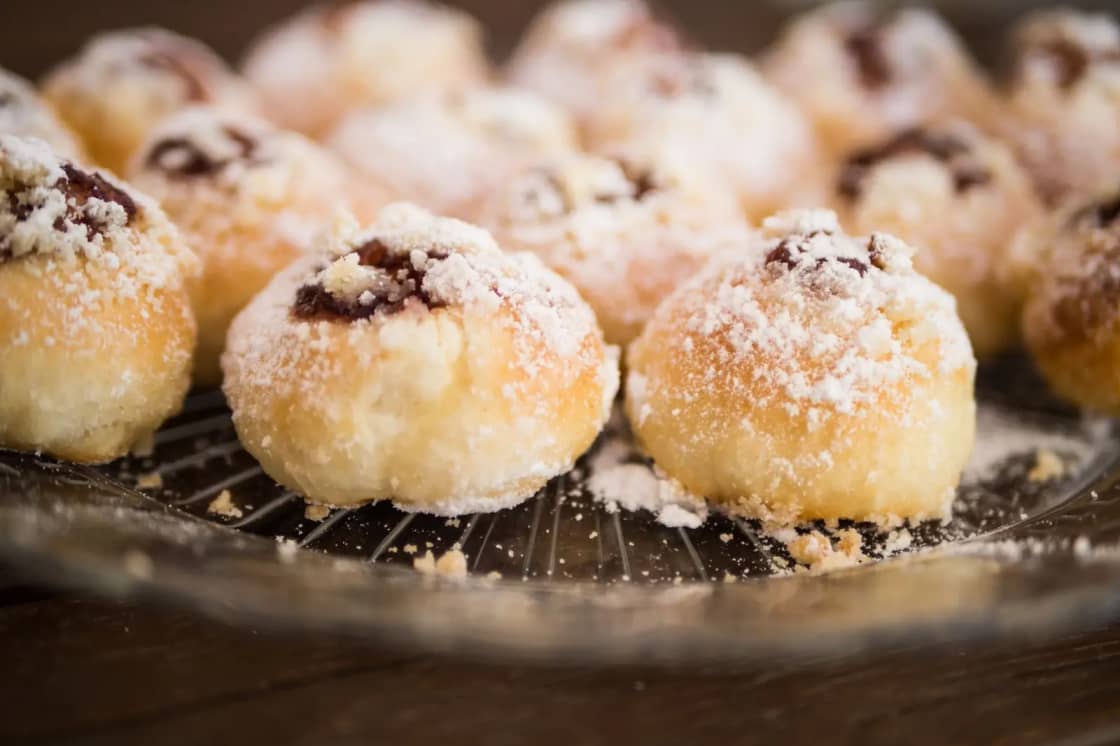
Sweet runs to fruit and cream fillings, made from the house jams. Mixed berry and cinnamon cream both come up often. They are less of a dessert than the appearance suggests — the dough is not very sweet, so a sweet kolache reads as a breakfast pastry rather than a pudding.
Seasonal. The business runs a Mardi Gras king cake in February, individually sized as well as full, which is a genuinely unusual thing to be able to buy in Utah County.
The Tuesday thing
Here is a small piece of information worth more than it looks: the business has been running Tasty Tuesdays through the summer — every Tuesday, stop in at any location and get a sample of a featured mini kolache flavor, no purchase required.
That is an unusually generous promotion, and it solves the exact problem a first-time kolache buyer has, which is that you do not know whether you like savory pastry until you have had one and the only way to find out is to buy one.
It is a promotion rather than a permanent fixture, so it will end at some point and we are not going to pretend otherwise. Check their current social posts before making a special trip. But if you have been curious and unconvinced, a Tuesday is the day.
Why a Texas pastry ended up in Provo
The kolache did not arrive in Utah by the usual route, which is worth a paragraph because it explains why the shop had to teach the product as well as sell it.
Czech and Moravian families settled central Texas in numbers during the nineteenth century, and they brought the pastry with them. Over generations it became a Texas thing rather than an immigrant thing — a fixture of small-town bakeries along the corridor between Dallas and Austin, and eventually a road-trip ritual, the sort of food where the stop is part of the drive. Anyone who has driven I-35 in Texas has passed signs for kolaches whether or not they knew what one was.
None of that happened in Utah. Before this shop there was effectively no kolache culture in Utah County at all — no bakery making them, and no shared idea of what one should taste like. That is an unusual position for a new food business to be in. Most restaurants open into an existing expectation and are judged against it. This one opened into a blank, which meant no competition and no reference point, and it had to spend its first years explaining the noun.
You can still see that in how the business talks. Its own early copy framed kolaches as "a new style of breakfast" arriving in Provo — pitching a category, not a product. Twelve years later the category is established enough that the shop could rename itself after it.
The transplant angle also explains something about the customer base. Utah moves a great many people in and out of Texas, and a meaningful share of the shop's early enthusiasm came from people who already knew exactly what they were buying and had been missing it. If you grew up anywhere near the Texas kolache belt, this place will land differently for you than it does for a Provo native.
What separates a good kolache from a bad one
Since most people in Utah Valley have no baseline, here is one.
The dough is the whole thing. A kolache should be soft, faintly sweet, and tender enough to pull rather than tear. It is an enriched yeasted dough — closer to a dinner roll or a brioche than to anything laminated — and when it is right it is pillowy. When it is wrong it is dry, and there is no filling generous enough to rescue a dry kolache.
The filling-to-dough ratio matters more than the filling. A good savory kolache is not a sausage in a bun. The dough should enclose the filling completely, and the proportions should be such that no bite is all bread and no bite is all meat.
It is a hot food. This is the point that explains the most common complaint you will find in reviews. A filled yeasted pastry is at its best within minutes of leaving the oven and declines noticeably as it cools — the dough firms, the cheese sets, the whole thing gets denser. Reviewers who report cold kolaches and slow lines are, in most cases, describing the same event. Buy at a quiet hour, and eat it in the car park rather than at the office. If you are collecting for a group, that is an argument for phoning ahead so they are boxed at the last minute rather than sitting.
Savory and sweet are different products. Do not judge one by the other. Plenty of people love the sausage-and-jalapeño version and find the fruit ones underwhelming, and plenty of people are the reverse. This is exactly why a first-timer should buy one of each, and why the free Tuesday sample is more useful than it looks.
Buying for a group
The kolache is well suited to a job most Provo food is not: feeding a room of people early in the morning.
They travel in a box, they need no cutlery, they are individually portioned, and there is a savory option for people who do not want a sweet breakfast and a sweet option for people who do. For a ward activity, an early meeting, a move-in day or a family gathering, this is a genuinely practical order — and it is the reason the shop is a fixture of Provo office breakfasts.
Two practical notes. Phone ahead for anything beyond a handful. The shop has been through a menu rebuild with online ordering temporarily down and call-in pickup continuing, so the phone is the reliable route regardless. And build in time: weekend mornings queue, and a large order collected at 9 a.m. on a Saturday is a different proposition from the same order at 7:15.
Finding it, and the Center Street context
The original shop is at 434 W Center Street in Provo — the western end of the downtown corridor, past the concentration of restaurants that most people picture when they think of Center Street. That western stretch is quieter, easier to park on, and increasingly where interesting food is going.
It works well as the first stop on a downtown morning. Our Center Street dining guide covers what else is along the corridor, and the downtown Provo neighborhood guide covers the geography if you are new to the area.
The business has since grown well past that one shop, with five locations including a newer Salt Lake City site in Sugar House. Hours differ between them — check the specific shop you are heading to rather than the brand, and assume Sunday closure unless you have confirmed otherwise, which is the safe default for independent food businesses across Utah Valley on a Sunday.
Parking. The Center Street corridor's parking is manageable at breakfast time and difficult at lunch. If you are going at 7:30 a.m., this is a non-issue.
Queues. Weekend mornings back up, and regulars report that the line moves slower than it used to as the business has become better known. Order ahead by phone if you are collecting for a group — that has become the standard route, particularly while their online ordering has been offline during a menu rebuild.
Where it sits in Provo's food scene
The Kolache Place occupies a specific and slightly odd position locally.
It is one of a very small number of Provo food businesses with a national television credit, and that credit does real work — it is why the shop turns up on road-trip itineraries written by people driving between Las Vegas and Idaho, and why its Tripadvisor position sits near the top of a very large field of Provo restaurants despite being a bakery rather than a restaurant. Review platforms are notoriously bad at surfacing bakeries in restaurant rankings, and this one has broken through anyway.
Locally it fills the breakfast and early-morning gap rather than the brunch one. It is not a sit-down weekend brunch; it is a hot thing in a bag before work, and the brunch guide for the wider valley is where to go for the other kind of morning.
It also belongs in the small category of Provo food businesses that brought something genuinely new to the valley rather than a variation on something already here — a claim the history of Provo's food scene puts in context. Before this shop, there was effectively no Texas kolache culture in Utah County. There is now.
The short version
Same shop, same family, same recipes, new sign. The name changed because the customers had already changed it, because a surname on a storefront costs a family its privacy, and because a business that plans to grow eventually outgrows one family's name.
Go on a Tuesday if you have never had one. Order one savory and one sweet. Expect the savory to win.
Delivery and Pickup: Kolaches Are Better Than Most Pastry at This
A kolache is an enclosed pastry with a filling baked inside it, and that construction makes it unusually robust in a bag.
Nothing about it depends on a crisp shatter the way a croissant does. It does not have a sauce to soak the base. It is dense enough to hold its heat for a while and sturdy enough not to be crushed by whatever else is in the order. Sweet and savory versions both survive the drive in good condition, which is more than can be said for most bakery items.
What does change is temperature, and with it some of the appeal. A kolache is at its best warm, and it arrives somewhere between warm and room temperature depending on the route. That is easily fixed: a few minutes in a low oven brings one back close to fresh. A microwave works but softens the outside, so the oven is worth the wait.
The practical constraint is timing rather than transport. A bakery sells what it baked that morning, and the selection thins as the day goes on. An order placed late in the day may come back short on the things you wanted, and a platform's menu does not always reflect what is actually left on the shelf. Ordering earlier gets you the full range.
For a group or an office run, this travels well enough that collecting a box and bringing it in is a genuinely good option.
Our food delivery guide covers the platforms and the cost stack.
Related Guides
- Koko Lunchbox, Provo: How to Order at the Korean Place Everyone Recommends
- Root's Place Burgers & More: American Fork's Gourmet Burger Counter
- Tommy's Burgers: The Provo Chili Burger Institution That Became a Truck
- The Best Steakhouses in Utah Valley: Every Format, and Which One You Actually Want
- Five Sushi Brothers: How Two Brothers and a Borrowed Kitchen Became Provo's Late-Night Institution
- Provo's Best Kept Secret Restaurants (2026)
- 30 Best Restaurants in Provo (2026)
- The BYU Creamery: History, Flavors, and Which Location to Actually Go To
- Strap Tank: The Brewery Named After a Motorcycle
- The Provo & Orem restaurant directory — where this place sits among everything else we cover, with the address and the city
Frequently Asked Questions
Is The Kolache Place the same as Hruska's Kolaches?
Why did Hruska's change its name?
What is a kolache?
Where is The Kolache Place in Provo?
Is there really a free sample on Tuesdays?
What should a first-timer order?
Has The Kolache Place been on TV?
Do they open on Sundays?