Fry bread is flour, salt, baking powder and water, fried in hot fat until it puffs. In Utah you can find it on a restaurant plate in Monument Valley, at a powwow in Orem, at a fundraiser or under a pile of chili, cheese and lettuce as a Navajo taco. Its history is harder to swallow. The Navajo Times traces it to the rations the U.S. Army issued to Navajo people held at Bosque Redondo in New Mexico in the 1860s, and Native writers, cooks and health workers have argued for years about what the food means. This guide covers that history, attributed to the sources that tell it, then lists places in Utah where we could confirm fry bread is being served, and closes with the Navajo Nation's own rules for visitors.
| Topic | What the sources say | Source |
|---|---|---|
| Origin of fry bread | Made from Army rations of flour, sugar and lard during captivity at Fort Sumner (Bosque Redondo) | Navajo Times |
| The Long Walk | More than 10,000 Navajo forced from their homelands beginning in 1863 | Smithsonian's National Museum of the American Indian |
| Return home | Treaty signed June 1, 1868; the walk home began June 18, 1868 | Law Library of Congress |
| First Navajo taco | Created in 1964 by Lou Shepard at the tribally owned Navajo Lodge | Navajo Times |
| A Navajo taco near Monument Valley | Traditional and vegetarian versions on the current menu | Goulding's Stagecoach Restaurant |
| Photography on the Navajo Nation | Ask before photographing Navajo people; commercial work needs a permit; no drones | Navajo Nation Parks and Recreation |
What fry bread is
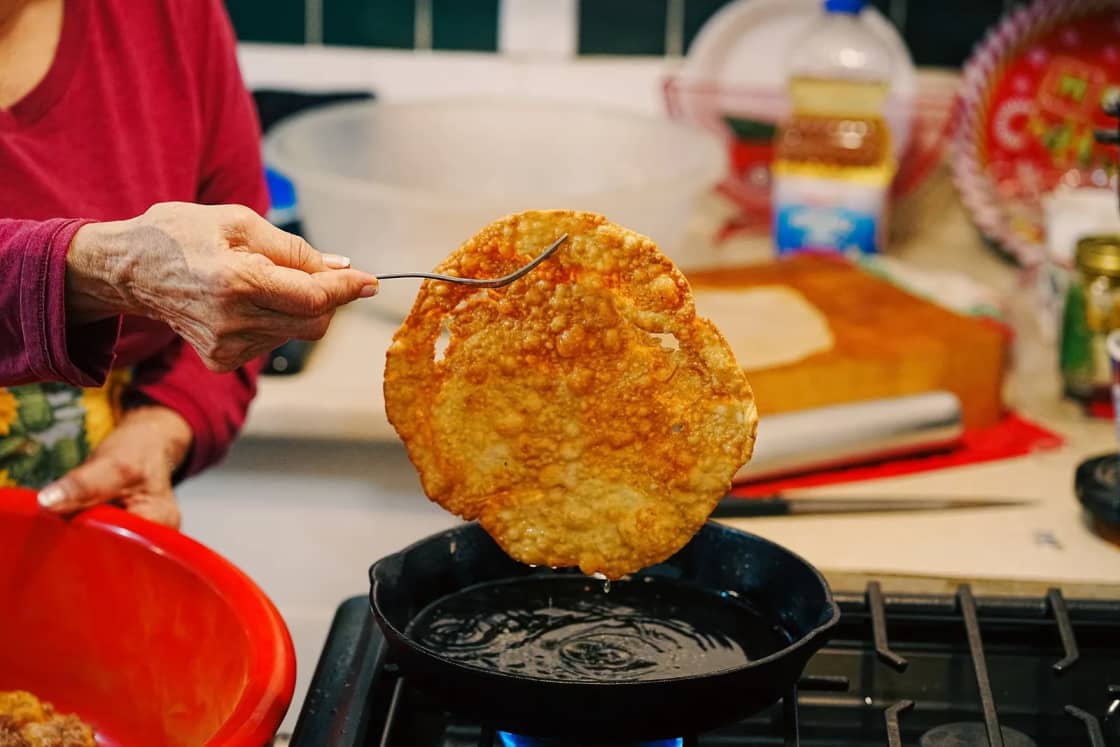
At its simplest, fry bread is a soft dough patted into a round and dropped into hot oil. A recipe by Brenda Beyal, published by America250 Utah, calls for 4 cups of flour, 1 teaspoon of salt, 1 1/2 tablespoons of baking powder and about 2 cups of very warm water. Her recipe notes that "many Navajos use Bluebird flour," and says to pat the dough into a small plate-size circle, poke a small hole in the middle and fry it until the edges turn golden. She suggests eating it with salt, honey butter or jam, "or make a Navajo taco."
The America250 Utah recipe page, run by the Utah Department of Cultural and Community Engagement, lists the dish by its Navajo name, Dah diníilghaazh, and describes it as "an Indigenous classic, the Navajo way." That recipe is credited to the Navajo Nation and the BYU Native American Curriculum Initiative.
Families make it differently. Visit Utah published the recipe used by the Goulding's Stagecoach Restaurant in Monument Valley, whose staff the state tourism office describes as 100% Navajo. Each staff member had a family fry bread recipe passed down through generations, and the team combined them into one. Their version adds room-temperature Sprite to the dough, which Visit Utah says helps the bread brown faster without overcooking. The page also passes on a saying: "In Navajo culture it is said that the bread must be made with love and happiness for it to turn out well!"
Fry bread is eaten plain, with honey and powdered sugar, or alongside stew, chili or soup, according to the Goulding's recipe. Visit Utah notes that many people outside the Navajo Nation know it mainly as "a sweet fried bread found at state fairs around the southwest, sprinkled with powdered sugar and honey."
The Long Walk and Bosque Redondo
The history starts with forced removal. Writing for the Smithsonian's National Museum of the American Indian in 2018, Dennis Zotigh said that beginning in 1863 the U.S. Army forced more than 10,000 Navajo from their homelands in the Four Corners region on a 300-mile march to Bosque Redondo, in eastern New Mexico. The Army kept interning bands of Navajo resisters until 1866. The land at Bosque Redondo, Zotigh wrote, "had proved unsuitable for farming," and the Army struggled to support the people it held there.
The Law Library of Congress, in a 2018 post by Jennifer Davis, gives the same rough scale: about 10,000 Navajo, along with 500 Mescalero Apache, forced to the Bosque Redondo Reservation. The post identifies the place by its Navajo name, Hwééldi, and with Fort Sumner. Many people died of starvation, dehydration and exposure, it says, and family oral histories describe elders and sick people being shot along the way. Estimates say one in four Navajo died, though some sources say 20%; the post notes that no list of names exists.
Food was part of the suffering. The Library of Congress post says soldiers handed out foods the Navajo did not know, including bacon, coffee and white flour, that many people did not know how to cook them, and that the food made people ill and sometimes killed them.
The captivity ended by treaty. Navajo leaders signed it on June 1, 1868, on pages cut from an Army ledger book, according to the NMAI. It was signed by 29 Navajo leaders, including Barboncito and Manuelito, and the museum says the Navajo became the only nation to use a treaty to reverse their removal and return to part of their homelands. At the treaty talks, the NMAI quotes Barboncito: "Bringing us here has made many of us die, also a great number of our animals." The Library of Congress post says the Navajo began walking home on June 18, 1868, roughly 450 miles from Hwééldi to the area around Window Rock, Arizona, and back to what it calls their "four sacred mountains." The treaty is also known as the Treaty of Bosque Redondo, the Treaty of 1868 and, in Navajo, Naaltsoos Sání.
How the rations became fry bread
The Navajo Times told the fry bread part of the story in a 2018 "50 Years Ago" column by Bill Donovan. During the captivity at Fort Sumner, the column says, the Army gave families canned goods, white flour, processed sugar and lard, since vegetables and beans were scarce, and Navajos "used the flour, sugar and lard to make what they named 'frybread.'" It quickly became a valued food, the paper wrote, both for Navajos and for the soldiers guarding them.
Smithsonian magazine's 2008 feature on fry bread, by Jen Miller, describes the same origin: the government supplied canned goods, white flour, processed sugar and lard, "the makings of frybread," to prevent starvation among people moved onto land that could not easily support their traditional foods. Visit Utah's summary puts it this way: "According to Navajo tradition, fry bread was created in 1864 using the flour, sugar, salt, and lard given to them by the government." Before that, the same Visit Utah page says, traditional foods included beans, squash and corn, along with deer and small mammals; sheep are raised today, and mutton is popular.
The dish did not stay with one nation. The Navajo Times column notes that other tribes adopted fry bread. Smithsonian magazine describes it as central to powwows, which grew partly as a reaction against 19th-century federal bans on intertribal gatherings. Leonard Chee, a history teacher and part-time fry bread vendor quoted in that piece, put it plainly: "A powwow won't function without frybread," and "Frybread connects tribes."
How the Navajo taco was born
The Navajo taco is much younger than fry bread, and the Navajo Times has a specific story for it. In a Jan. 9, 2020, column, Bill Donovan wrote that the first Navajo taco was created by Lou Shepard, who managed the Navajo Lodge, a tribally owned motel and restaurant, in the 1960s.
According to that account, a man named Allen Yazzie came in on a cold winter night in 1964, the only customer, after a day of walking and hitchhiking from Forest Lake, Arizona. He asked to be surprised. Shepard used Navajo fried bread as the base and added beans, red chili, tossed salad and green chili. Yazzie called it "one of the best things he had ever tasted."
Shepard put it on the menu the next day as "Lou's Special," and it soon became the most popular item, the column says. A customer later asked for it as a "Navajo taco," and the name stuck. Shepard made as many as 75 a day, and many customers ordered one three or four times a week. Many people believed the dish was a traditional Navajo food, but Shepard said he created it. "You could take almost anything you wanted and put it on frybread and it would taste good," he said. The column adds that the dish was blamed for tribal officials dozing off in afternoon meetings, and that border-town restaurants soon sold their own versions.
The Deseret News, in a 2023 explainer on Utah scones and fry bread, cited the same Navajo Times account and described a Navajo taco simply: "Think of a taco with fry bread instead of a taco shell."
Why Native communities disagree about fry bread
No single view speaks for Native people on fry bread, and the sources show the range.
A reminder of captivity. Writer and activist Suzan Shown Harjo argued in a 2005 Indian Country Today essay, as quoted by Smithsonian magazine, that "Frybread is emblematic of the long trails from home and freedom to confinement and rations." Smithsonian reported that her critique also linked fry bread to obesity, diabetes and other health problems.
A health concern. Smithsonian magazine cited the USDA figure of about 700 calories and 25 grams of fat in one large slice, and quoted nutritionist Chaleen Brewer of the Genesis Diabetes Prevention Program on the Gila River reservation, who said commodity foods, including lard, are partly responsible for a "diabetes epidemic." The Navajo Times, looking back at 1968, said the paper at the time framed traditional foods combined with a growing reliance on sugary sweets as a crisis on the reservation, with Indian Health Service officials starting to see diabetes in younger people.
A symbol of survival. "Frybread is the story of our survival," filmmaker Sherman Alexie told Smithsonian magazine. The Navajo Times noted that Alexie's film Smoke Signals used fry bread as a symbol of Indian strength, with a character wearing a "Frybread Power" T-shirt. Musician Keith Secola, whose song "Frybread" is about perseverance, argued in the Smithsonian piece that fry bread is a scapegoat for wider problems, and that the real causes are poor food access, nutrition education and health care.
A food to cook better, not erase. In a 2017 Navajo Times piece by Stacy Thacker, JD Kinlacheeny, catering coordinator at Navajo Technical University, described working at chapter houses across the Navajo Nation on healthier cooking. "We try to look at what a person would have on the rez, in their kitchen," he said. For Navajo tacos, he suggests more vegetables, ground turkey or leaner ground beef. He also wants young Navajo students to learn traditional foods: "It's who we are as Navajo, as Diné, as Indigenous people."
Holding those views together is a reasonable way for a visitor to approach the dish. It is a celebrated food at powwows and family tables, and it also carries a history that many Native people do not want forgotten.
The Navajo taco in Utah
The Deseret News reported in 2023 that several Utah restaurants serve Navajo tacos, and that fry bread often holds deeper meaning for members of the Navajo Nation. The Utah scone, a fried dough served with honey butter, is a close cousin; that Deseret News piece called the Utah scone "more commonly fry bread, not a biscuit." Our Utah food culture explainer covers the scone and the rest of the state's fried-dough habits.
Navajo tacos also turn up as fundraisers. In March 2018, Fox13 reported on a Salt Lake City Girl Scout, Cheyenne Trujillo, whose mother, Cindy, signed her up just as cookie sales were wrapping up. To raise about $550 for cooking camp, the family sold homemade Navajo tacos from its own recipe instead. They sold 75 within hours and ran out. "I was shocked at how the word spread," Cindy Trujillo told the station.
If you are buying at a fundraiser, a school event or a powwow, the person frying may be raising money for a family, a team or a dance group, so bring cash as well as a card.
Where to find it in Utah Valley
Fry bread in Utah Valley is easiest to find at Native-led events, which change dates each year. These are the ones we could confirm from organizer pages or listings fetched for this guide.
The UVU Powwow, Orem. Utah Valley University's Native Excellence and Tribal Engagement office lists "Native vendors, food, competition" among the activities. The 2026 powwow ran Friday, Nov. 20, and Saturday, Nov. 21, with three grand entries: 6 p.m. Friday and noon and 6 p.m. Saturday. The page says, "You don't need to know anything about powwows to attend." In 2025, the university moved the event to the UCCU Center on its Orem campus because organizers expected more than 2,500 people, which would make it the largest in the event's history. Admission was free in 2025. For the venue, see our UCCU Center guide, and check uvu.edu for 2027 dates.
The Native Nations Festival, Orem. University Place's free afternoon festival was held Saturday, Sept. 19, 2026, starting at 3 p.m. at 575 E. University Parkway, according to a KSL events listing that includes food among the offerings. Our Native Nations Festival guide has the details on past years, when fry bread was sold on site.
Black Sheep Cafe, Provo. The Deseret News named Black Sheep Cafe among the Utah restaurants serving Navajo tacos in 2023, and our Black Sheep Cafe profile covers its menu and history. Its website blocked our automated check for this guide, so we could not confirm current hours today. Call or check its own pages before you go.
Where to find it around Salt Lake City
We could not confirm a Salt Lake restaurant's current status from its own website or an official listing today, so this section sticks to events.
The University of Utah pow wow. The university's Center for Native Excellence and Tribal Engagement hosted its "Threading Our Legacies" pow wow on Saturday, March 21, 2026, at the Jon M. Huntsman Center in Salt Lake City. The Daily Utah Chronicle reported it was the university's 54th annual pow wow, with more than 200 dancers, seven drum groups and more than 1,000 people attending. The university's page mentions vendor booths but does not list food vendors, so check closer to the 2027 date. The page's etiquette guidance applies at any powwow: "Ask permission before taking photos of dancers in regalia," "Never touch a dancer's regalia," and call it regalia, "not costume." Visitors may join intertribal dances when the MC invites them.
The Utah State Fair. The fair's 2026 concessions page does not name its food vendors' menus, and applications for 2027 open in spring, so we cannot confirm which stands will sell fry bread next year. Our Utah State Fair guide covers getting there from Utah Valley.
Where to find it in southern Utah and near the Navajo Nation
The Navajo Nation covers more than 27,000 square miles across parts of northwestern New Mexico, northeastern Arizona and southeastern Utah, according to Visit Utah. The Utah portion includes Monument Valley, about seven hours from Provo; our Monument Valley guide covers the drive, fees and the Valley Drive.
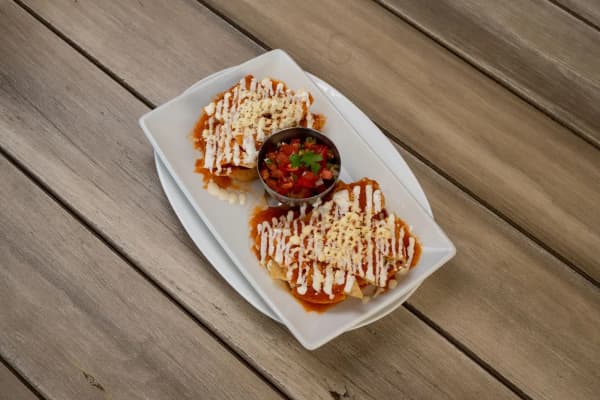
Goulding's Stagecoach Restaurant, Oljato-Monument Valley. At Goulding's Lodge, 1000 Gouldings Trading Post Road, the restaurant's current all-day menu lists a Navajo taco section with a traditional version (fry bread, chili con carne, shredded cheddar, lettuce, tomatoes and white onions) and a vegetarian version with pinto beans. The menu also offers fry bread on its own with honey and powdered sugar, beef stew served with fry bread, and burgers served on Navajo fry bread. The restaurant says it is open daily; winter hours are breakfast 7 to 11 a.m., lunch 11 a.m. to 4 p.m. and dinner 11 a.m. to 8 p.m., and it says hours may vary seasonally. Call (435) 727-3231 to confirm.
Roadside stands near the Monument Valley Visitor Center. The Navajo Nation Parks and Recreation page for Monument Valley says Navajo vendors sell arts, crafts, native food and souvenirs at roadside stands about one mile before the Visitor Center, and it encourages buying directly from artisans. What is for sale changes with the vendor and the season. The same page says the Haskenneini Restaurant at the Visitor Center, serving Navajo and American cuisine, operates during the summer months.
Twin Rocks Cafe, Bluff. At 913 E. Navajo Twins Drive in Bluff, the cafe's own site lists hours of Friday through Monday, 8 a.m. to 3 p.m., closed Tuesday through Thursday. The Four Corners Free Press reported in 2021 that its menu included plain fry bread, a traditional Navajo taco, a burger on fry bread and a Navajo pizza with a fry bread crust; the cafe's current site does not post a menu, so call (435) 672-2341 to check. Visit Utah repeats a local claim that the cafe invented Navajo pizza and says that claim "cannot be confirmed."
Visiting the Navajo Nation respectfully
The Navajo Nation sets its own rules for visitors. Navajo Nation Parks and Recreation publishes its visitor rules at navajonationparks.org, and these are the ones most likely to matter on a food trip.
| Rule | What Navajo Parks and Recreation says |
|---|---|
| Photographing people | "Obtain permission before taking pictures of the Navajo people." |
| Homes and private areas | Do not enter residential areas, disturb property or walk through homesites |
| Commercial photos or video | Prohibited without a valid permit from Navajo Parks and Recreation |
| Photography at Monument Valley | Photography, filming, weddings and painting require a Special Use Permit |
| Drones | Prohibited at all Navajo Tribal Park locations and will be confiscated |
| Alcohol and drugs | Consumption or possession is "strictly prohibited on the Navajo Nation" |
| Hiking | Allowed only in specific areas, with a Backcountry Hiking and Camping Permit |
| Climbing | Climbing and BASE jumping are prohibited in tribal park areas |
| Rocks, plants, artifacts | Do not disturb or remove them; collecting needs special permits |
| Off-road driving | Off-road vehicles are prohibited in tribal park areas; stay on designated routes |
A few more points from the same pages:
- The parks are sacred. The rules page says all Navajo Tribal Park scenic areas are considered sacred sites and are protected by Navajo Nation law. It asks visitors to leave no trace and not to scatter cremated remains.
- Guides are required in places. At Monument Valley, landmarks such as Ear of the Wind can only be reached on guided tours run by Navajo operators, the park says. The permits page says all Navajo tour guides must be used.
- Dogs stay home. The Navajo Nation Parks homepage says dogs are prohibited at all park locations.
- Fees are separate. Monument Valley's page lists $10 per person per day and $15 per vehicle. Permits do not include the park entry fee. The National Park Service pass is not accepted, as our Monument Valley guide explains.
- Holiday closures. The park is closed on Thanksgiving, Thursday, Nov. 26, 2026, as well as Christmas and New Year's Day. Winter hours began Oct. 17, with the Scenic Drive open 8 a.m. to 5 p.m. and last entry at 2:30 p.m.
For permit questions, Navajo Nation Parks and Recreation lists its office on Arizona 264 in Window Rock, Arizona, with phone numbers (928) 871-6647 and (928) 357-4207. Our Bears Ears visitor guide covers etiquette on nearby public lands that are sacred to several tribes.
Practical tips for eating fry bread
- Ask what is on it. Fillings vary: chili con carne, pinto beans, ground beef, green chile. Goulding's lists a vegetarian version, and Kinlacheeny's suggestions in the Navajo Times offer lighter options for home cooks.
- Buy from Native cooks when you can. At powwows and at the Monument Valley roadside stands, your money goes straight to the family or group selling. The Navajo Nation Parks page encourages buying directly from artisans.
- Ask before photographing the cook. The Navajo Nation rule on photographing people applies at a food stand too, and so does the powwow guidance on dancers.
- Check hours before a long drive. Twin Rocks Cafe closes Tuesday through Thursday, Goulding's runs winter hours, and the Haskenneini Restaurant operates only in summer.
Related Guides
- Utah Food Culture Explained: Fry Sauce, Funeral Potatoes and Dirty Soda
- Monument Valley From Provo: The Navajo Tribal Park, the Loop Drive and What to Know
- The Native Nations Festival at University Place
- Black Sheep Cafe in downtown Provo
- Bears Ears National Monument: Where Visitors Can Start and How to Behave
- The Utah State Fair From Utah Valley
Frequently Asked Questions
Where did fry bread come from?
Who invented the Navajo taco?
Is a Navajo taco the same as an Indian taco?
Why do some Native people criticize fry bread?
Where can I eat a Navajo taco near Monument Valley?
Do I need a permit to take photos on the Navajo Nation?
Can I make fry bread at home?
Is Monument Valley open on Thanksgiving?
Sources
The facts in this guide were checked against these sources. Hours, fees and rules change, so confirm anything time-sensitive with the source before you go. How we make Provo.com.
- Naaltsoos Sání and the Long Walk Home, Law Library of Congress. Checked November 21, 2026.
- Rules and Regulations, Navajo Nation Parks and Recreation. Checked November 21, 2026.
- Navajo Nation Parks and Recreation: Permits, Navajo Nation Parks and Recreation. Checked November 21, 2026.
- Monument Valley Navajo Tribal Park, Navajo Nation Parks and Recreation. Checked November 21, 2026.
- Navajo Nation Parks and Recreation home, Navajo Nation Parks and Recreation. Checked November 21, 2026.
- Navajo: Fry Bread, Tacos, Pizza, Visit Utah (Utah Office of Tourism). Checked November 21, 2026.
- Goulding's Fry Bread/Navajo Taco Recipe, Visit Utah (Utah Office of Tourism). Checked November 21, 2026.
- America's Potluck Recipes, America250 Utah, Utah Department of Cultural and Community Engagement. Checked November 21, 2026.
- Frybread recipe (8 Nations Menu, Recipes, and Information), America250 Utah. Checked November 21, 2026.
- Smithsonian Magazine: Frybread, Smithsonian Magazine. Checked November 21, 2026.
- Treaty that reversed a removal: Navajo Treaty of 1868 goes on view, Smithsonian's National Museum of the American Indian. Checked November 21, 2026.
- 2026 UVU Powwow, Utah Valley University. Checked November 21, 2026.
- Annual UVU Powwow Celebrates Native American Community, Utah Valley University. Checked November 21, 2026.
- University of Utah Center for Native Excellence and Tribal Engagement: Pow Wow, University of Utah Center for Native Excellence and Tribal Engagement. Checked November 21, 2026.
- Stagecoach Restaurant, Goulding's Lodge. Checked November 21, 2026.
- Stagecoach Restaurant All Day Menu, Goulding's Lodge. Checked November 21, 2026.
- Twin Rocks Cafe. Checked November 21, 2026.
- Utah State Fair Concessions, Utah State Fair. Checked November 21, 2026.
- 50 Years Ago: A part of Diné culture: Frybread, Navajo Times. Checked November 21, 2026.
- 50 Years Ago: Navajo taco bursts flavorfully onto scene, Navajo Times. Checked November 21, 2026.
- Eat like who you are, Navajo Times. Checked November 21, 2026.
- Twin Rocks is a hub for Four Corners visitors, Four Corners Free Press. Checked November 21, 2026.
- The Daily Utah Chronicle: Pow Wow 2026, The Daily Utah Chronicle. Checked November 21, 2026.
- 2026 Native Nations Festival, KSL Events. Checked November 21, 2026.
- Why are Utah scones different?, Deseret News. Checked November 21, 2026.
- Utah Girl Scout turns to Navajo tacos after missing chance to raise funds with cookies, Fox13. Checked November 21, 2026.