
Every state thinks its food is normal. Utah's is unusually not, and the gap is wide enough that newcomers spend their first year quietly confused — about the orange sauce that arrives unrequested with fries, about being handed a casserole with a name that implies somebody died, about the drive-through with a forty-item menu of ways to modify a Diet Coke.
None of it is random. Utah's food quirks are what you get when a specific set of conditions holds for a long time: very large families, an unusually dense calendar of congregational and community gatherings, widespread abstention from alcohol, coffee and tea, and a mid-century culture of thrift and preparedness that never entirely went away. Change those inputs and you get different food. Keep them for a century and you get fry sauce.
This is the decoder.
Fry sauce
Start here, because it is the one you will encounter within hours of arriving.
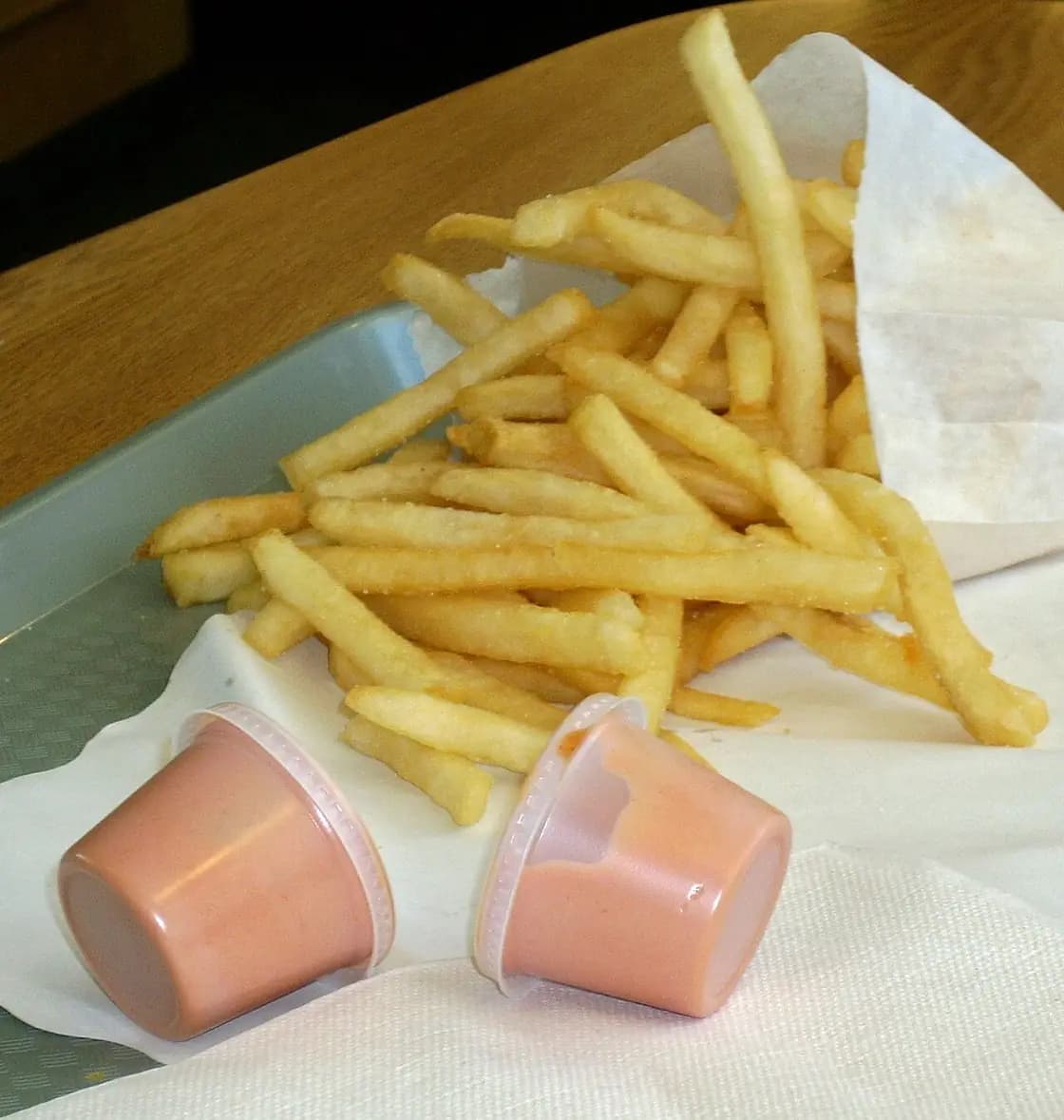
Fry sauce is mayonnaise and ketchup, roughly two to one, usually with something extra — pickle brine, vinegar, a shake of paprika, sometimes a little barbecue sauce or Worcestershire. Every restaurant that makes its own has a version, and people have strong opinions about which is best.
Its origin is generally credited to Arctic Circle in Salt Lake City in the 1940s, and while variations on the mayo-ketchup theme exist in Argentina, Iceland, Puerto Rico and elsewhere, none of them colonized their local food supply the way this one did. In Utah it is not a specialty item. It is the default. Order fries at a fast-food counter, a sit-down restaurant or a stadium concession and you will be asked, or simply given some.
The thing that surprises transplants most is not the sauce itself but the sincerity of the attachment. Utahns who move away have it shipped. National chains have added it specifically for their Utah locations. It functions as a small piece of state identity in a way that a condiment usually does not.
Funeral potatoes
A casserole dish of shredded or diced potatoes bound with cheese and sour cream or cream of chicken soup, topped with crushed cornflakes or crushed potato chips, and baked until the top goes golden and the edges crisp.
The name is not a joke and not ironic. It is the dish that gets made and delivered when somebody in a congregation dies, because it solves the specific logistical problem a grieving household has: it feeds a lot of people, it survives a car journey, it can be assembled the night before, and it reheats without deteriorating. Multiply that by a community with a structured system for looking after its own, sustained across generations, and the dish acquires a name.
It has long since escaped the funeral. It turns up at Sunday dinners, holiday tables, ward parties, church potlucks and Thanksgiving, which is why people who grew up here sometimes find the name faintly absurd — the overwhelming majority of funeral potatoes any given Utahn has eaten were served in entirely cheerful circumstances.
Dirty soda
The most recent of these to become nationally visible, and the one that best illustrates the underlying logic.
A dirty soda is a fountain drink modified: coconut syrup and cream in a Diet Coke is the canonical build, but the category has expanded to include fruit purees, flavored syrups, half-and-half, and combinations with names. It is ordered from a drive-through, often in a very large cup, often mid-afternoon.
Why here? Because the social slot it fills was vacant. In most of the country, the ritual of going somewhere to get a drink and sit with a friend for twenty minutes is filled by a coffee shop or a bar. In a state where a large share of the population does not drink either coffee or alcohol, that ground was open, and fountain soda took it. What looks like an eccentric beverage trend is really a substitution effect — the same social function, a different liquid.
The industry that grew around it is substantial, with competing drive-through chains, and it has since spread well outside Utah. Provo has its own set of shops, which we cover separately.
Green Jell-O
The stereotype is older than most of the people repeating it, and it is grounded in something real: Utah did lead the country in Jell-O consumption for a sustained period.
The reasons are the same ones behind funeral potatoes. An inexpensive dish that could be made in quantity, prepared well ahead, molded into something festive and stretched with fruit or shredded carrot or cottage cheese was extremely practical for a culture that fed large groups often. Congregational gatherings ran on food like this.
Utah's response to being teased about it has been to embrace it thoroughly. A green Jell-O pin circulated among the collectible pins of the 2002 Salt Lake Winter Olympics, and Jell-O has been named an official state snack. The reality has faded somewhat — a young Utahn today is not eating notably more gelatin than anyone else — but the stereotype has a genuine origin rather than being invented at the state's expense.
Utah scones
An ordering hazard for visitors. A Utah scone is not the British baked good and not a biscuit. It is yeast dough, deep-fried, puffing into a hollow chewy slab roughly the size of a small plate, served hot with honey butter and often powdered sugar.
Its lineage runs through frontier fried dough and is closely related to Navajo fry bread, which is served across the Southwest and carries its own considerably more painful history tied to government commodity rations. The Utah scone is the same basic technique put to dessert and side-dish use.
You will find them at the state fair, at ski resorts, at a handful of long-established local restaurants, and at family gatherings where somebody has a deep fryer. If you order a scone anywhere in this state and expect clotted cream, you will be disappointed in an interesting way.
The pastrami burger
A cheeseburger topped with griddled pastrami and a special sauce, and one of very few regional burger styles in the American West.
It comes out of the Greek-American burger stand tradition along the Wasatch Front, spread through the Crown Burgers family of restaurants and the wide field of relatives, spin-offs and imitators that followed. The combination sounds like too much and is, which is the point.
It is not universal in Utah Valley the way fry sauce is — this is more a Salt Lake–centered institution that reaches down here — but it is on enough menus that it counts as part of the regional vocabulary.
The dessert economy
Once you notice the substitution logic behind dirty soda, you start seeing it everywhere.
Utah has an outsized number of cookie chains, ice cream counters, shaved-ice stands, candy shops, dessert cafes and drive-through soda shops relative to its population. Several national dessert brands were founded here. The after-dinner or late-evening social outing that ends at a bar in most of the country ends at a dessert counter here, and it does so on a weeknight, with children present.
This is also why so much of the valley's social infrastructure is open late but alcohol-free, and why a nine o'clock cookie run is an ordinary thing for adults to do rather than a novelty.
The preparedness pantry
One of the least visible but most structurally important pieces of Utah food culture is that a great many households here keep a serious food store.
The practice comes out of a long-standing church emphasis on self-reliance and having a supply laid in against hard times, and it has shaped the retail landscape in ways that are obvious once pointed out. Home storage centers sell staples in bulk for long-term storage. Case lot sales — where grocery chains discount entire cases of canned goods for a few weeks at a time — are a genuine seasonal event here in a way they are not in most states, and people plan around them.
Downstream of that you get a home-canning and food-preservation culture that never lapsed, a high tolerance for cooking from shelf-stable ingredients, and a cuisine of casseroles built on cream soups and canned vegetables that some food writers sneer at and that makes total sense once you understand it was engineered for a pantry rather than a farmers market.
It also explains a certain kind of Utah cooking competence: a lot of people here can produce a meal for fifteen with two hours' notice from what is already in the house, which is not a common skill elsewhere.
Ward dinners and the potluck economy
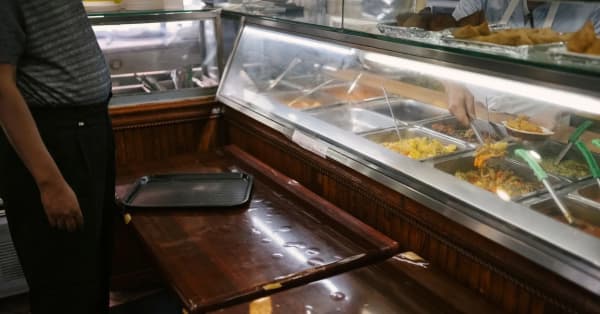
Most of the dishes in this article were optimized for the same venue — a room with folding tables, a warming oven, and eighty people who need to be fed at once.
Congregational gatherings happen frequently and at scale here, and the food that survives that environment has particular properties. It has to be transportable in the dish it was cooked in. It has to hold at temperature for an hour without collapsing. It has to be portioned by a stranger with a serving spoon. It has to be cheap per head. And it cannot require any finishing step at the venue.
Funeral potatoes satisfy every one of those constraints, which is why it is the archetype. So do the gelatin salads, the sheet-pan desserts, the enormous pans of baked pasta, the crockpot meatballs and the rolls. What reads from outside as a lack of culinary ambition is better understood as a set of very tight engineering requirements, met repeatedly, for generations.
The potluck also explains the recipe-sharing culture — the handwritten card, the ward cookbook, the fact that a particular family is known for a particular dish. Those are the artifacts of a community that eats together on a schedule.
The university creameries
A small but genuine Utah oddity: the state's universities make and sell their own dairy.
BYU runs a creamery in Provo that produces its own ice cream and milk and sells them at an on-campus store that functions as a local institution rather than a student amenity — families drive to it. Utah State University's Aggie Ice Cream in Logan does the same thing and is the older and more famous of the two.
These exist because both institutions have working agriculture and food-science programs, and a teaching dairy needs somewhere for the output to go. The result is that ice cream in Utah has a collegiate dimension it does not have in most states, and that arguing about BYU versus Aggie is a real if low-stakes rivalry.
The rule underneath most of this
It is worth naming the thing the rest of this article keeps gesturing at, because newcomers often absorb the effects without ever being told the cause.
The Church of Jesus Christ of Latter-day Saints observes a health code known as the Word of Wisdom, which members understand to prohibit alcohol, tobacco, coffee and tea. In a state where a large share of residents observe it, that single rule cascades outward through the whole food economy: it is why the soda shops exist, why the dessert sector is so large, why many restaurants see no reason to hold a liquor license, and a significant part of why the state's alcohol regulations are shaped the way they are.
Two clarifications save a lot of confusion. First, caffeine as such is not the issue — the restriction is generally understood as coffee and tea specifically, which is exactly why a caffeinated Diet Coke can anchor an entire beverage industry here without contradiction. Second, observance varies between individuals, and a substantial and growing share of Utah's population does not belong to the church at all.
The effects described here are real and widespread, then, but they are tendencies across a population rather than rules that apply to everyone you meet.
Sunday, and the practical consequences
The most useful thing a newcomer can internalize is not a dish at all: a large share of independently owned restaurants in Utah Valley close on Sundays, and some close Mondays instead to compensate. Chains vary. Grocery stores are generally open.
This catches people out constantly — a planned Sunday dinner that dissolves into a search for anywhere serving food. The practical rule is to check the specific restaurant's own page rather than an aggregator, and to have a fallback. We keep a guide to restaurants open on Sunday in Provo, because it is among the most frequently asked questions this site receives about eating here.
Jell-O aside, the food here is better than the jokes
The stereotypes are affectionate and mostly earned, but they describe the state's home cooking and church-potluck tradition rather than its restaurants, and the restaurant scene in Utah Valley has changed enormously in twenty years.
The valley now has deep Thai, Korean, Japanese, Vietnamese and Chinese categories, a large and genuine Latin American presence, Pacific Islander cooking, Indian restaurants, and a specialty coffee scene that exists in defiance of the demographics. Some of that is driven by immigration and some by the very large number of residents who have lived abroad and come back wanting the food they got used to.
So the honest summary is that Utah food culture is two things at once: a distinctive and slightly strange domestic tradition that produced fry sauce and funeral potatoes, and a restaurant landscape that has very little to do with any of it. Both are worth eating your way through.
The parts of Utah food regulation that are genuinely Utah
Food culture is usually explained through what people eat. It is also worth explaining through what the state has decided to write down — because Utah, like every state, adopts a national food code and then amends it, and the amendments are a surprisingly direct record of what this place cares about.
Utah incorporates the 2022 FDA Food Code at Utah Admin. Code R392-100-4(1)(b) — Chapters 1 through 8 plus Annex 1 Parts 8-6 through 8-9 — and then rewrites it in around forty places. A few of those rewrites are purely technical. Several are not.
Utah kept the old vocabulary alive
The national Food Code abandoned the words critical and non-critical years ago in favor of three risk-based classes. Utah adopted the new classes and then, at R392-100-4(3)(a), wrote the old words back in as synonyms:
- a priority item is also referred to as critical 1 — a provision that directly eliminates, prevents or reduces a foodborne illness hazard, where no other provision controls it more directly;
- a priority foundation item is also referred to as critical 2 — a provision that supports, facilitates or enables one or more priority items;
- a core item is also referred to as non-critical.
In the Food Code's own text these are marked with a superscript P and Pf, and anything unmarked within a section is a core item. The reason this is worth knowing is that it is the single most useful piece of vocabulary for reading any inspection result. A report showing several core violations and no priority violations describes a fundamentally different kitchen from one showing the reverse, even where the totals match — and Utah's dual naming is why local language sometimes says "critical" where the national language says "priority."
Utah's own additions, in the order they surprise people
Wild mushrooms are out. R392-100-4(3)(d) rewrites ¶ 3-201.16(A) to say that mushroom species picked in the wild shall not be offered for sale or service by a food establishment. In a state with a real wild mushroom season, that is a choice.
Eggs got their own rule. R392-100-4(3)(e) replaces § 3-202.13 with a Utah text: shell eggs may not exceed the restricted egg tolerances for U.S. Consumer Grade B under Rule R70-410, except for eggs from a small producer, and may not be addled or moldy or contain black spot, black rot, white rot, a blood ring, adherent yolk, or bloody or green albumen. The small-producer carve-out is defined by reference to Utah Code Subsection 4-4-103(11), and it is the provision that keeps small Utah egg operations supplying commercial kitchens.
Coffee machines are named in the plumbing code. R392-100-4(3)(j) requires an ASSE 1022 dual check valve with an intermediate vent downstream of any copper in the water supply and upstream of any carbonated beverage dispenser, coffee machine, or noncarbonated beverage dispenser. The model code does not name coffee machines there; Utah added them.
Dogs got a patio. R392-100-4(3)(m) adopts the 2022 edition's new pet-dog allowance with Utah's own specifics — a separate outside entrance to the patio, an eight-foot exclusion zone around interior entrances, and signage at least 8 inches by 10 inches with lettering at least 5/8 of an inch high.
The establishment definition was widened. R392-100-4(3)(a)(iii) adds seven categories to the Food Code's definition of food establishment, among them an agritourism food establishment, a mobile food business and a microenterprise home kitchen — three categories that did not meaningfully exist in Utah a generation ago and that each represent a legislative decision to bring an emerging format inside the system rather than leave it outside.
Managers and employees are both named in statute. R392-100-4(3)(b) requires at least one supervisory employee to be a certified food safety manager under Utah Code § 26B-7-412 and Rule R392-101, and (3)(c) adds a section that does not exist in the model code at all — § 2-102.13, Food Employee Training — pointing to § 26B-7-413 and Rule R392-103.
The penalty was set locally. Utah's Annex 1 amendments cap civil penalties at $5,000 per violation and provide, at R392-100-4(3)(kk), that a person who violates the rule may be assessed a civil penalty as provided in Utah Code § 26B-1-224.
What the amendments say about the place
Read together, the pattern is fairly clear: Utah is permissive about who may produce food and strict about the mechanical systems around it. Home kitchens, agritourism operations, mobile businesses and small egg producers all have express routes into the regulated system. Meanwhile the plumbing amendments are more detailed than the national text, the training requirements point to two separate statutes, and the person in charge must have actual authority to take corrective action.
That is a recognizable Utah combination — wide latitude for small producers, tight specification of infrastructure — and it lines up with a food culture built on home production, church and neighborhood cooking, and a very large number of small family businesses. The rules did not create that culture. They were written around it, and they are worth reading as evidence of it.
Related Guides
- Dirty Soda in Provo: The Shops, the Vocabulary, and Where It Came From
- Best Burgers in Utah Valley
- Best Desserts & Bakeries in Provo & Orem
- 30 Best Restaurants in Provo
- A Short History of Provo: From Fishing Camp to College Town
- Best Pho & Vietnamese Food in Provo & Orem
- Best Grocery Stores in Provo & Orem
- Restaurants Open on Sunday in Provo
- Drinking in Provo: Utah's Alcohol Laws & Where to Drink
- The BYU Creamery: A Complete Guide
- The Provo & Orem restaurant directory — every place we cover, with its address, filterable by cuisine and city
- Best Fried Chicken in Utah Valley
Frequently Asked Questions
What is fry sauce?
What are funeral potatoes?
What is dirty soda?
Why is green Jell-O associated with Utah?
What is a Utah scone?
What is a pastrami burger?
Why does Utah have so many soda shops and dessert places?
Do you have to be a member of the LDS Church to understand Utah food culture?
Sources
The facts in this guide were checked against these sources. Hours, fees and rules change, so confirm anything time-sensitive with the source before you go. How we make Provo.com.
- R392-100 Food Service Sanitation (2022 Food Code edition), Utah Department of Health and Human Services (via Southeast Utah Health Department). Checked October 12, 2026.