Southeast Utah has two uranium stories. One is a boom: in the 1950s, a federal buying program and one big strike turned Moab into a prospecting capital. The other is fallout: about 100 atmospheric nuclear tests in Nevada sent radioactive material over parts of Utah. Both stories end in the same federal law, the Radiation Exposure Compensation Act, which was reauthorized in July 2025 and now treats all of Utah as a downwind area. This guide sets out what state historians, the National Cancer Institute and the Justice Department say.
Quick facts
| Question | Answer | Source |
|---|---|---|
| Steen's Mi Vida strike | July 6, 1952, Lisbon Valley, southeast of Moab | Beehive History (Utah Historical Society) |
| Scale by the mid-1950s | Almost 600 producers on the Colorado Plateau and more than 8,000 workers in mines and mills by the mid-1950s | Beehive History |
| End of the boom | 1964; federal buying stopped in 1970 | Beehive History; Utah History Encyclopedia |
| Moab mill | Opened 1957; sold to Atlas Corporation in 1962; shut down in 1984 | Utah History Encyclopedia |
| Tailings removed | 17 million tons, as of Sept. 29, 2026 | U.S. Department of Energy |
| Nevada atmospheric tests | About 100 | National Cancer Institute |
| RECA payment | $100,000, one time | U.S. Department of Justice |
| RECA filing deadline | Dec. 31, 2027 | U.S. Department of Justice |
Before the boom
Uranium was a wartime secret before it was a rush. During World War II, the Manhattan Project, "a top-secret branch of the U.S. Corps of Engineers," needed uranium, and the only known domestic source was the Four Corners area, Raye C. Ringholz writes in Beehive History, a publication of the Utah Historical Society. Vanadium had been a waste product of the region's radium mines, and the project went back to the old radium-vanadium dumps to recover uranium.
After the war, the Atomic Energy Commission became the only legal buyer of uranium ore. It "guaranteed the rates for ten years" and "added a $10,000 bonus for each separate discovery and production of high-grade uranium from new deposits," Ringholz writes.
The boom
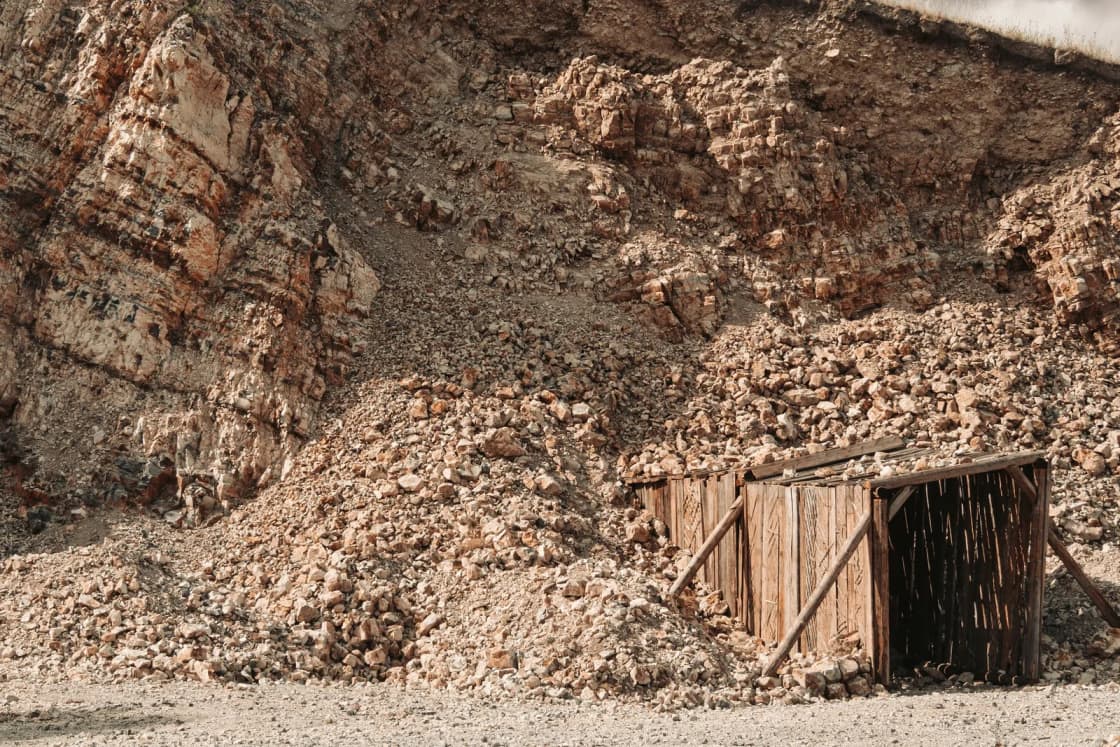
On July 6, 1952, Charlie Steen struck uranium at his Mi Vida mine, southeast of Moab in the Lisbon Valley. Within six months the mine had "shipped a million dollars worth of ore," Ringholz writes. In 1957 Steen opened what Ringholz, writing in the Utah History Encyclopedia, calls the "nation's first large independent uranium mill, in Moab." It was sold to the Atlas Corporation in 1962 and shut down in 1984.
Moab, "the once sleepy farming town," became known as the uranium capital of the world, the encyclopedia says. The numbers grew across the Colorado Plateau: by the mid-1950s almost 600 producers were shipping uranium ore and employment topped 8,000 workers in the mines and mills, according to Beehive History, and 309,380 claims were filed in four Utah counties between 1946 and 1959, according to the encyclopedia.
The bust
In 1964 the Atomic Energy Commission said "it is no longer in the interest of the Government to expand production of uranium concentrate." The market was saturated, Ringholz writes, and known reserves stood at 71 million tons. The commission announced a limited buying program and stopped buying uranium in 1970. A brief second boom followed in the mid-1970s, but foreign competition, federal regulations and nuclear fears "virtually put an end to domestic uranium mining," the encyclopedia says.
The miners
The encyclopedia records that health scientists warned that radiation in the mines was dangerous, and that hundreds of miners in the four-state region died of lung cancer before safe radiation levels were imposed. Uranium workers are one of the groups covered by the Radiation Exposure Compensation Act: the Justice Department pays qualifying uranium workers a one-time, lump-sum payment of $100,000.
The tailings by the river
The Moab mill left an estimated 16-million-ton pile of uranium mill tailings near the Colorado River on a 480-acre site, according to the U.S. Department of Energy, which runs the cleanup as the Moab Uranium Mill Tailings Remedial Action Project. The department says the processing facility operated under private ownership from 1956 to 1984; the encyclopedia dates the mill's opening to 1957.
Since 2009, crews have moved the tailings by rail to an engineered disposal cell about 30 miles north near Crescent Junction. On Sept. 29, 2026, the department reported that crews had removed 17 million tons from the riverbank. Work still ahead, the department says, includes a final groundwater compliance plan, removing remaining contaminated soil under and next to the pile, finishing the disposal cell cover and stabilizing the site. It did not give a completion date.
The downwinders
The second story began in Nevada. During the Cold War, the U.S. conducted "about 100 nuclear weapons (atomic bomb) tests in the atmosphere at a test site in Nevada," the National Cancer Institute says. One product of those tests was iodine-131, a radioactive form of iodine that collects in the thyroid gland and breaks down quickly, with half gone in about eight days.
According to the institute:
- Most exposure came from drinking fresh milk from cows or goats that grazed on contaminated grass, and much of the health risk "occurred among milk-drinkers," usually children.
- The larger amounts of I-131 from the Nevada site fell over parts of Utah, Colorado, Idaho, Nevada and Montana.
- I-131 exposure may increase the risk of thyroid disease, including thyroid cancer. The institute notes that thyroid cancer is usually slow-growing and curable, and that few exposed people develop it.
- Anyone who can see or feel a lump or nodule should see a doctor. The institute's online Thyroid Dose/Risk Calculator estimates dose and risk from fallout, and its Cancer Information Service answers questions at 1-800-4-CANCER.
RECA today
The Radiation Exposure Compensation Act was reauthorized under the One Big Beautiful Bill Act, Public Law 119-21, enacted July 4, 2025, the Justice Department says. Its page, updated Nov. 25, 2026, sets out the current rules:
- Who is covered in Utah. The affected downwind areas "include the states of Idaho, New Mexico, and Utah." A claimant must have been in an affected area for one year between Jan. 21, 1951, and Nov. 6, 1962, or for the entire period from June 30 to July 31, 1962, and must meet the program's illness requirements.
- What it pays. A one-time, lump-sum payment of $100,000 for qualifying downwinders, and the same for qualifying uranium workers.
- The deadline. "All claims must be filed by December 31, 2027."
- How to file. Online through the RECA Claim Portal at reca.justice.gov, or by mail with the claim form and original or certified documents to the U.S. Department of Justice, Radiation Exposure Compensation Program, P.O. Box 146, Ben Franklin Station, Washington, DC 20044-0146. The department says it cannot accept emailed applications.
Check the Justice Department's page for the illness list and current forms before filing; the rules changed in 2025 and may change again.
Related reading
- Moab from Provo
- Radon testing in Utah Valley
- The Ute people of Utah, history and today
- Utah's railroads beyond the Golden Spike
- Provo history
Frequently Asked Questions
Who was Charlie Steen?
When did the uranium boom end?
Who counts as a downwinder in Utah?
How much does RECA pay, and what is the deadline?
What happened to the Moab uranium mill tailings?
What health effect is linked to fallout from the Nevada tests?
Sources
The facts in this guide were checked against these sources. Hours, fees and rules change, so confirm anything time-sensitive with the source before you go. How we make Provo.com.
- Utah's Uranium Boom (Raye C. Ringholz, Beehive History 16), Utah Historical Society, History to Go. Checked November 27, 2026.
- Uranium Mining in Utah (Raye C. Ringholz, Utah History Encyclopedia, 1994), Utah Historical Society, History to Go. Checked November 27, 2026.
- Moab UMTRA Project, U.S. Department of Energy, Office of Environmental Management. Checked November 27, 2026.
- Moab Marks Removal of 17 Million Tons of Uranium Mill Tailings (Sept. 29, 2026), U.S. Department of Energy, Office of Environmental Management. Checked November 27, 2026.
- Radioactive I-131 from Fallout, National Cancer Institute (National Institutes of Health). Checked November 27, 2026.
- Radiation Exposure Compensation Program, U.S. Department of Justice, Civil Division. Checked November 27, 2026.