
Utah has the lowest adult smoking rate in the United States. Lung cancer is still the leading cause of cancer death in the state.
Those two facts sit uncomfortably together, and the Utah Department of Environmental Quality has been pointing at the gap between them for years. A substantial part of the explanation is a colorless, odorless, tasteless radioactive gas that seeps up out of the ground into houses, and that roughly a third of tested Utah homes have in concentrations the EPA considers worth fixing.
Radon is the most quietly consequential thing about the ground under Utah Valley, and it is also the easiest household hazard on this list to resolve. The test is cheap. The fix is a known quantity. The only difficult part is the first step, because a house with a serious radon problem feels exactly like a house without one.
What radon is, in one paragraph
Uranium occurs naturally in soil and rock throughout the Intermountain West. As it decays it produces radium, which decays in turn into radon — a radioactive gas. The gas migrates through soil and, where it reaches the surface in open air, disperses to nothing. Where it reaches the underside of a building instead, it accumulates.
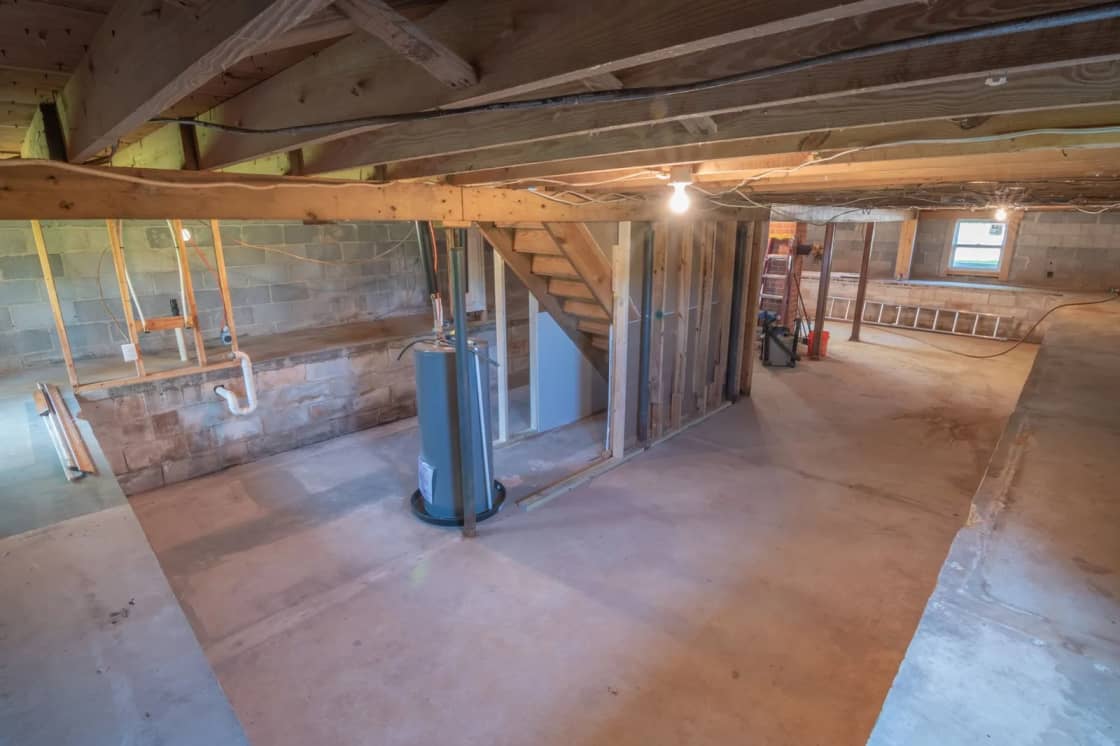
Houses pull it in actively rather than passively. Warm indoor air rises and escapes at the top of a structure, which lowers pressure at the bottom, which draws soil gas up through every available opening: slab cracks, the joint where the slab meets the foundation wall, sump pits, floor drains, crawlspace floors, and the gaps around plumbing and utility penetrations. A house in winter, sealed against the cold and running its furnace, is a fairly efficient pump.
That mechanism explains most of what follows — including why the season matters, why basements read highest, and why the answer next door does not transfer.
The Utah numbers, from the state's own program
The DEQ's Division of Waste Management and Radiation Control runs the state's Indoor Radon Program, funded in part through an EPA state grant, with the stated goal of getting indoor radon concentrations in Utah below the EPA action level.
The published figures:
- About one in three Utah homes that have been tested come back above 4 pCi/L, the EPA action level.
- The EPA's figure for the average indoor level is around 1.3 pCi/L.
One methodological caution, stated because it matters: these describe homes that were tested, not a random sample of all Utah homes, and people with a reason to suspect a problem are more likely to test. That could bias the figure upward. It is also true that Utah's testing rate is low enough that most homes here have never been measured at all, so the population of untested homes is large and unknown. The honest reading is that elevated radon is common enough in Utah that testing is the default rather than a precaution for the worried.
The DEQ also publishes short-term test results by county and ZIP code, which is the closest thing to a local answer available without testing your own house. It is worth looking up your ZIP before you decide how urgent this feels.
The Provo–Orem map almost nobody knows about
Here is a piece of local history that is useful.
The Utah Geological Survey has published radon-hazard-potential studies for specific Utah areas, and one of them is for the Provo–Orem area of Utah County — issued in its Public Information Series in the early 1990s alongside companion studies for the Sandy–Draper area and St. George.
Radon hazard potential mapping combines the factors that drive radon entry across an area: uranium content in the underlying geology, soil permeability, and depth to groundwater. Coarse, permeable valley-fill deposits let soil gas move readily; finer, wetter soils impede it. Utah Valley has a varied surficial geology — alluvial fans off the Wasatch, Lake Bonneville shoreline deposits, and lakebed sediments toward Utah Lake — and those differences are exactly the kind of thing a hazard map captures.
What it does not do is tell you your number. The maps are explicitly about potential across an area, and the UGS is careful about that distinction. Two houses a hundred yards apart, one on permeable fan gravel and one on lakebed clay, will differ — and so will two houses on identical soil with different foundation details.
Use the map the way it is meant to be used: as a reason to test, not as a substitute for testing.
Why your neighbor's result is worthless to you
This is worth its own section because it is the belief that stops most people from testing.
Radon concentration in a specific house is the product of three things that vary house by house:
- What is in the soil directly beneath that foundation, and how easily gas moves through it.
- How the foundation is built and penetrated — slab-on-grade versus full basement versus crawlspace, the number and condition of cracks and openings, whether there is a sump, how utility penetrations were sealed.
- How the building breathes — its tightness, its heating system, whether it has a radon-relevant ventilation pattern, and how the occupants live in it.
Only the first is shared with the house next door, and even that varies over short distances. The result is that identical-looking homes on the same street, built by the same crew in the same year, routinely produce very different readings. Utah's own radon materials make this point explicitly: living in an area with predicted elevated levels does not automatically mean your home is affected, and the reverse is equally true.
There is a corollary that catches people. A previous test is not a permanent answer. If you finish a basement, change your heating system, do significant air-sealing work, or start using a lower level you did not use before — a basement bedroom, an office, a gym — retest. The house you measured is not the house you now have.
Testing: short-term, long-term, and which one you want
Short-term tests sit in place from two days up to ninety, though the common consumer kit is a two-to-seven-day charcoal device. They are cheap, fast, and comparatively noisy — radon swings day to day and season to season, so a short-term result is a snapshot rather than an average. Where you need an answer quickly, the standard approach is to run one, and where the result is near the action level, run a second to confirm.
Long-term tests run more than ninety days, typically using alpha track detectors, and produce a figure much closer to your true year-round average. If you are testing because you want to know how you live rather than because a transaction is pending, this is the better instrument.
Practical protocol, regardless of type:
- Test the lowest level you occupy or plan to occupy. Not an unfinished crawlspace you never enter — the lowest lived-in level.
- Place the detector well away from drafts, exterior doors, windows and vents, at roughly breathing height, and not in a kitchen, bathroom or laundry.
- Follow closed-house conditions if the kit specifies them: windows and exterior doors kept shut except for normal entry and exit, for twelve hours before and throughout a short-term test.
- Winter tends to read higher than summer, for the stack-effect reasons described above. A summer test that comes back marginal is worth repeating in the cold months.
- Mail it promptly. Charcoal devices are time-sensitive and a kit that sits on the counter for a week produces a number that means nothing.
Where to get one: the state program's site, radon.utah.gov, has historically offered discounted mail-in kits to Utah residents at a nominal price — DEQ has publicized a figure around eleven dollars. Prices and availability change, so check rather than assume. Hardware retailers stock kits, and you can also hire a certified measurement professional, which is the usual route in a real estate transaction where an independent result is wanted.
What mitigation involves
If your result comes back at or above 4 pCi/L, the fix is well established and not experimental.
The standard method is active sub-slab depressurization. An installer cuts a hole through the concrete slab, excavates a small pit beneath it, and runs PVC pipe from that pit up through the house or along an exterior wall, terminating above the roofline. An inline fan runs continuously, maintaining slight negative pressure in the soil beneath the slab so that soil gas is drawn into the pipe and vented above the building instead of being pulled indoors.
Variations handle other foundation types. Crawlspaces are typically treated with a sealed membrane over the soil, with suction drawn from beneath it. Homes with a sump often use the sump pit as the suction point, with a sealed lid.
Two points that matter for expectations:
Sealing alone is not a fix. Caulking cracks is worth doing and supports a system, but on its own it is generally not an effective standalone remedy — the pressure differential simply finds the next opening.
A system needs verification and monitoring. A post-mitigation test is what proves the installation worked; without it you have a pipe and a hope. Systems include a manometer — a small U-shaped gauge on the pipe — and its two liquid columns being at different heights is what tells you the fan is running. Learn to read it, and check it occasionally. Fans do fail, usually silently.
Retest periodically even with a working system, and after any significant change to the building.
On cost, installation prices vary with the foundation and move over time, so get several current quotes rather than budgeting from an old reference figure.
New construction is where this is cheap
The one place radon economics are dramatically favorable is before the concrete is poured.
Radon-resistant new construction is a set of passive features built in during the foundation stage: a layer of clean aggregate beneath the slab, a plastic sheeting barrier, sealed joints and penetrations, and a vent pipe run from beneath the slab up through the building and out the roof. If a later test comes back high, a fan is added to the existing pipe and the passive system becomes an active one — a small job rather than a retrofit.
The Utah Geological Survey has put the incremental cost of building this in at a few hundred dollars in a new home, against the four-figure cost of retrofitting later. Utah Valley is building a great deal of new housing, and this is a reasonable thing to ask a builder about directly.
Radon and buying or selling a house here
Radon turns up in Utah real estate transactions routinely, usually through inspection and disclosure rather than through a standalone statutory testing requirement.
If you are buying, a radon test is a small line item against the price of a house and it is worth including. Ask for a test under closed-house conditions, and be aware that short-term results near the action level warrant confirmation rather than a shrug in either direction.
If you are selling and have mitigated, keep everything: the original result, the installation documentation, and the post-mitigation test. A documented system is a resolved issue rather than an open question, and open questions are what slow transactions down.
If you are selling and have tested high but not mitigated, this is a disclosure conversation to have with your agent, not a general-guide question — what must be disclosed turns on the contract forms in use and on what you know. Our guide to buying a home in Provo covers the wider inspection and disclosure picture that radon sits inside.
Why the health risk is real but not immediate
It helps to understand what radon does, because the mechanism explains why the risk framing sounds strange.
Radon itself is chemically inert — you breathe it in and most of it goes back out. The problem is what it decays into. Radon's short-lived decay products are metallic rather than gaseous, they carry an electrical charge, and they attach to dust and aerosol particles in indoor air. Inhaled, those particles lodge in lung tissue and continue decaying there, emitting alpha radiation directly into cells lining the airway over years of residence.
That is why radon behaves like a long-exposure risk rather than an acute one. There is no radon poisoning event, no symptom, no bad day. There is a cumulative dose accrued across the years you sleep in a particular basement, and a probability that shifts accordingly.
It is also why the smoking interaction matters so much. Radon and tobacco smoke are strongly synergistic — the combined risk to a smoker in a high-radon home is considerably greater than either factor alone would suggest. In Utah, where smoking rates are the lowest in the country, that has an unexpected consequence: a larger share of the state's lung cancer burden falls on people who never smoked, and radon is a leading suspect in that pattern. Health agencies describe radon as the leading cause of lung cancer among nonsmokers nationally, and second only to smoking overall.
None of that argues for alarm. It argues for treating a radon test as ordinary preventive maintenance, on the same footing as a smoke detector — a small, one-time action against a risk that is otherwise silent and cumulative.
Radon in well water, and when it matters
Most radon in a house comes from soil gas beneath the foundation. A minority of homes have a second pathway worth knowing about: private well water.
Groundwater moving through uranium-bearing rock can carry dissolved radon, which is then released into indoor air when the water is agitated — showers, dishwashers, washing machines. The airborne contribution from water is usually modest relative to soil gas, and it is essentially never an issue for homes on municipal culinary water, because treatment and storage allow dissolved gas to escape before it reaches the tap.
Where it is worth investigating is a home on a private well that has already tested high in air, particularly if mitigation of the soil-gas pathway has not brought the number down as far as expected. In that situation a separate water test is the diagnostic step, and treatment — aeration or granular activated carbon at the point of entry — is a different installation from a sub-slab system.
For the large majority of Utah Valley homes, on city water, this section is background rather than an action item. Test the air.
The honest summary
Radon is the rare household hazard where the science is settled, the test is cheap, the fix is routine, and the intervention is worth making — and where almost nobody does anything, because there is no symptom to prompt them.
Utah's own numbers say roughly one home in three here is above the level at which the EPA says to act. Provo and Orem sit in an area the state's geologists thought worth mapping specifically. And none of that tells you about your house.
Order the kit. Put it in the basement. Mail it back. It is a two-week question you can close permanently, and it is the single highest-value thing on the whole list of things a Utah Valley homeowner could do this month.
Figures in this guide are drawn from published Utah Department of Environmental Quality radon program materials, Utah Geological Survey publications, and EPA guidance. Prices for test kits and mitigation are perishable and are given as reference points only — verify current figures at the source.
Related Guides
- Funeral Homes, Obituaries and Death Records in Utah County: The Practical Guide
- Garage Doors in Utah Valley: Two Federal Dates, One Spring, and the Test You Should Run Tonight
- Asbestos and Lead in Older Utah Valley Homes: The Exemption Turns on Whether You Live There
- Getting Rid of the Big Stuff in Utah Valley: Mattresses, Paint, TVs and the Couch
- Finding a Plumber in Provo: Who Owns Which Pipe, and What Actually Breaks Here
- Locksmiths in Provo: The City License Almost Nobody Asks to See
- Pest Control in Utah Valley: What You'll Actually Deal With
- Tree Removal in Utah Valley: The Tree Out Front Probably Isn't Yours
- Appliance Repair in Utah Valley: Utah Deliberately Does Not License the Person Fixing Your Dryer
- Chimneys and Fireplaces in Utah Valley: Even an EPA-Certified Stove Is Illegal on a Mandatory Day
- Fences, Sheds and Setbacks in Utah Valley: Why Every City Answers Differently
Frequently Asked Questions
How common is high radon in Utah?
What radon level is considered dangerous?
Where do I get a radon test kit in Utah?
How long does a radon test take?
My neighbor tested low. Do I still need to test?
How much does radon mitigation cost in Utah?
How does a radon mitigation system work?
Does radon have to be disclosed when selling a house in Utah?
Sources
The facts in this guide were checked against these sources. Hours, fees and rules change, so confirm anything time-sensitive with the source before you go. How we make Provo.com.
- Radon Program - Utah Department of Environmental Quality, Utah Department of Environmental Quality. Checked October 12, 2026.
- Health Risk of Radon | US EPA, U.S. Environmental Protection Agency. Checked October 12, 2026.