The Golden Spike gets the monument, but the transcontinental line only touched the northern edge of Utah. Within a few years of 1869, local companies were laying track south through Utah Valley, narrow-gauge lines were climbing canyons to mines and coal camps, and by the 1910s electric interurban cars ran between the Wasatch Front towns. This is a short history of those railroads, with Utah County's part in it, and what is left to see or ride from Provo.
Quick facts
| Event | Year | Source |
|---|---|---|
| Utah Central finished, Ogden to Salt Lake City | January 1870 | Utah History Encyclopedia |
| Utah Southern begins building south from Salt Lake City | May 1871 | Utah History Encyclopedia |
| First railroad reaches Provo | 1872 or 1873 | Provo City Library |
| American Fork Railroad completed | 1873 (some accounts say 1872) | Utah History Encyclopedia |
| Rio Grande line from Denver to Salt Lake City completed, through Provo | March 1883 | Provo City Library; Utah History Encyclopedia |
| Heber branch completed | September 1899 | Provo City Library |
| Salt Lake & Utah interurban completed to Payson | 1916 | Utah History Encyclopedia |
| Last Salt Lake City streetcar | 1946 | Utah History Encyclopedia |
The local lines south
The first railroads built after 1869 connected Salt Lake City to the new main line. The Utah Central, finished in January 1870, linked Salt Lake City to the national rail system, railroad historian Don Strack writes in the Utah History Encyclopedia. Construction of the Utah Southern started south from Salt Lake City in May 1871, and the line reached Milford by 1880. Along the way it came to Provo: the Provo City Library's history timeline dates the first railroad's arrival to 1872 or 1873.
Narrow gauge and branch lines to the mines
Through the 1870s and 1880s, smaller railroads, many of them narrow gauge, pushed into Utah's mining districts and coal fields. Strack lists:
- American Fork Railroad, a narrow-gauge line up American Fork Canyon toward the silver mines, completed in 1873 by Strack's count; other accounts, including the one in our history of American Fork, have it finished in November 1872.
- Wasatch and Jordan Valley and Bingham Canyon and Camp Floyd, both completed in 1873.
- Utah Western, completed in 1877 between Salt Lake City and a point just north of Stockton called Terminus; Union Pacific took control in 1881.
- Utah and Pleasant Valley, built south from Springville in 1879 to reach the newly discovered Winter Quarters coal mines.
- Utah Eastern, a narrow-gauge line between Coalville and Park City completed in 1880, which Union Pacific shut down in December 1883.
- Salt Lake and Eastern, completed up Parleys Canyon from Salt Lake City in 1890.
- Utah and Northern, built north from Brigham City and later connected with Ogden.
The Rio Grande through Utah Valley
The Denver and Rio Grande reached Provo in 1881, the Provo City Library's timeline says, and in March 1883 its line from Denver to Salt Lake City was completed, running right through Provo. Strack describes it as a narrow-gauge line through what is now Carbon County, serving the Price Canyon coal mines, with an extension to Ogden two months later.
The Denver-to-Salt Lake route passes through Spanish Fork Canyon, where the 1983 Thistle landslide "severed railroad service between Denver and Salt Lake City," the Utah Geological Survey says. A railroad tunnel at the site was built after the slide buried the original grade. Our Thistle landslide history covers the slide and the lake it formed.
The Heber Creeper
"Heber Creeper" was the nickname of the Denver and Rio Grande branch that ran between Provo and Heber, the Provo City Library says. It was completed in September 1899 and ran until 1967. In Provo, the library notes, the line came right down 200 West, then called H Street, and joined the other tracks below 600 South.
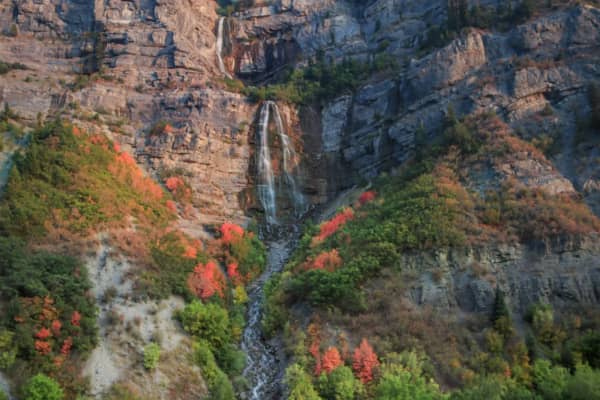
After it closed, part of the line was revived and ran from Heber to Bridal Veil Falls until the late 1980s, then was shortened to Vivian Park. In 1992 the Utah Legislature created the Heber Valley Historic Railroad Authority and appropriated $1,000,000 to restore the railroad, which runs today as the Heber Valley Railroad, between Heber and Vivian Park in Provo Canyon. Our Heber Valley Railroad guide covers riding it now.
Through lines to the coast
Two more main lines made Salt Lake City a crossroads. The Los Angeles and Salt Lake completed its route to Los Angeles in 1905, and the Western Pacific, begun in 1906, was completed between Salt Lake City and Oakland, California, in 1909, Strack writes. The Southern Pacific, meanwhile, shortened the original transcontinental route by building straight across the Great Salt Lake on a wooden trestle, replaced by a rock causeway in 1959; our Lucin Cutoff history tells that story.
The interurbans
Between the 1890s and the 1910s, a set of interurban and resort lines, electric or later electrified, linked the Wasatch Front towns, according to Strack:
- Salt Lake, Garfield and Western began in 1891 as the Saltair Beach Railway, was electrified by 1919 and converted to diesel in 1951.
- Bamberger. Simon Bamberger's line was completed to Ogden in 1905; the company became the Bamberger Electric Railroad in 1917.
- Utah-Idaho Central began as the Ogden, Logan and Idaho. The Logan Rapid Transit reached Preston, Idaho, in 1912, and the Ogden-to-Logan connection by way of Brigham City was completed in 1915.
- Salt Lake and Utah, an electric line built south from Salt Lake City to Provo and completed to Payson in 1916. In Utah Valley it is remembered as the Orem line, and the city of Orem shares its name; our Orem Line history tells that story.
Salt Lake City's own streetcar system had grown to "over 146 miles of tracks" by 1918. Buses began replacing streetcars in the late 1920s, and the last streetcar ran in 1946.
The interurbans did not last much longer. The Utah-Idaho Central and the Salt Lake and Utah held on only until the late 1940s, Strack writes; the Bamberger ended passenger service in 1952 and ran freight until 1958; and the Salt Lake, Garfield and Western stopped passenger trains in the early 1960s.
What you can see or ride from Provo
Drive times are OpenStreetMap (OSRM) routing estimates from downtown Provo without traffic, rounded to the nearest 5 minutes.
| Place | What is there | From Provo |
|---|---|---|
| Heber Valley Railroad, Heber City | Excursion trains on the old Heber branch | About 28 miles, 40 min |
| Thistle, Spanish Fork Canyon | The 1983 landslide, the town ruins and the Rio Grande route; the Utah Geological Survey describes a turnout with an overview and signs about 12.7 miles up US-6 from I-15 exit 261 | About 24 miles, 35 min (to the town site) |
| Golden Spike National Historical Park | Where the transcontinental line met in 1869 | About 130 miles, 2 hr 25 min (to the visitor center) |
For more train trips, see our guide to train days from Provo, which pairs the Heber Creeper with Golden Spike's steam and a same-day ride east.
Related reading
- The Orem Line: the electric railroad that named a city
- The Heber Creeper and the Heber Valley Railroad
- The 1983 Thistle landslide
- The Lucin Cutoff: the railroad that crossed the Great Salt Lake
- Spiral Jetty, Golden Spike and the Promontory day from Provo
- Eureka and the Tintic ghost towns
- A short history of American Fork
- Provo history
- The transcontinental railroad at Promontory, 1869
Frequently Asked Questions
What was the first railroad to reach Provo?
What was the Heber Creeper?
When did the Denver & Rio Grande reach Utah Valley?
Was there a railroad in American Fork Canyon?
What were Utah's interurban railroads?
How did the Thistle landslide affect the railroad?
Sources
The facts in this guide were checked against these sources. Hours, fees and rules change, so confirm anything time-sensitive with the source before you go. How we make Provo.com.
- Railroads in Utah (Don Strack, Utah History Encyclopedia, 1994), Utah Historical Society, History to Go. Checked November 27, 2026.
- Historical Places: Provo City Timeline, Provo City Library. Checked November 27, 2026.
- Historical Places: The Heber Creeper, Provo City Library. Checked November 27, 2026.
- GeoSights: Thistle Landslide Revisited, Utah County, Utah (Mark Milligan, Survey Notes, May 2005), Utah Geological Survey. Checked November 27, 2026.