
Moab is the trip Utah Valley families talk about doing and then don't, usually because they have quietly filed it under "day trip" and the arithmetic never works. It isn't one. At three and a half to four hours each way, Moab is a weekend, and once you plan it as a weekend it becomes one of the best ones available from Provo.
There is also a specific reason to revisit it in 2026: the single biggest barrier to a spontaneous Arches visit was removed this year, and a large share of the internet has not noticed.
The headline: Arches dropped timed entry for 2026
From spring 2022 through the 2025 season, visiting Arches National Park during peak hours meant booking a timed-entry ticket in advance — a specific arrival window, a booking fee, and for popular dates a genuine scramble the moment slots opened.
On February 18, 2026, the National Park Service announced that Arches would not require timed-entry reservations for the 2026 season. Vehicles may enter at any point during operating hours.
This is the part that matters for planning: an enormous number of sources have not updated. Third-party travel guides, itinerary blogs and trip planners still walk readers through booking a 7 a.m. slot. At points even Recreation.gov's own Arches page has continued to carry the reservation language — the booking fee, the 7 a.m. to 4 p.m. window, the one-vehicle-per-ticket rule — alongside a note to check the park's website for updates. If you plan this trip by following the first instructions you find, you will spend an evening trying to book something that no longer exists.
What has not changed:
- You still need an entrance pass. Buy it at the entrance station, in advance online, or at the Moab Information Center in downtown Moab, which is the fastest option if you are already in town.
- Parking still fills, and rangers still close things. When the lots at Delicate Arch, the Windows or Devils Garden reach capacity, staff can temporarily restrict access to those areas, and those closures can run for hours. The Park Service specifically asks visitors not to queue in the roadway waiting for a space.
- Arrive early or late. Before 8 a.m. or after 4 p.m. is the standing advice between roughly May and October. Removing the reservation did not remove the crowd; it removed the paperwork.
There is a live webcam at the entrance station, which is the single most useful pre-drive check available. It is at go.nps.gov/archeswebcam.
One caution about future years. The Park Service could bring reservations back in a future season. So 2026 is settled and 2027 is not. Do not carry this article's advice forward into a season it does not cover.
The drive, and the part of it that deserves respect
The standard route from Provo is southeast on US-6 from Spanish Fork, up through Spanish Fork Canyon, past Price and out to Green River, then a short run east on I-70, then south on US-191 into Moab.
US-6 is the part to think about. It carries heavy freight between the Wasatch Front and the coal country around Price, it has long two-lane sections with limited safe passing, and it has a poor local safety reputation that is not folklore. It is not a road to drive tired, and it is not a road on which to take a marginal passing opportunity because you are running late. In winter, or leaving Provo in the dark before dawn, it is the leg that most deserves your caution.
The alternative — south on I-15 and east on I-70 — is longer in miles and usually similar or slightly longer in time, but it is freeway nearly the whole way. In poor weather that trade is often worth making.
Practical notes for the drive itself: fuel and food thin out badly between Price and Green River, so top up rather than pressing on. Green River is the last real services stop before Moab. And the stretch of I-70 you use is short, but the wider corridor west of it includes one of the longest stretches without services in the interstate system — worth knowing if you end up improvising a route. The same corridor also connects west toward Goblin Valley and Capitol Reef via UT-24 through Hanksville — a pairing our Capitol Reef guide covers. Green River itself is worth a stop; see our Green River guide.
Do not plan the whole weekend around Arches
The most common Moab mistake made by first-time visitors is treating Arches as the destination and everything else as filler. Arches is small — about 119 square miles — and it draws very large crowds. It is spectacular and it is busy.
Canyonlands National Park, Island in the Sky. Roughly 40 minutes from town, on the same road as Dead Horse Point. Vastly bigger than Arches, meaningfully less crowded, and the overlooks are on a different scale entirely — you are standing on a mesa looking down into canyon systems rather than walking up to individual formations. Grand View Point and Mesa Arch are the two everyone names; Mesa Arch at sunrise is the famous one and is correspondingly busy.
Dead Horse Point State Park. On the way to Island in the Sky, and the single best overlook-per-minute-of-effort in the region. A Utah state park, so a separate entrance fee from the national parks and not covered by a national parks pass.
Utahraptor State Park. Newer, closer to town, and much less visited — the Park Service itself names it among the alternatives when Arches is congested. If you are looking for the option nobody in your group has already seen photographs of, this is it.
State Route 128 along the Colorado River. Free, requires no pass and no reservation, and is one of the best drives in Utah. It leaves US-191 just north of town and follows the river northeast under red cliffs. If you have an evening and no plan, this is the answer.
The hikes, ranked by what they ask of you
Arches is a driving park with short walks attached, which is why it absorbs so many visitors. Knowing which walk is which saves you the classic mistake of arriving at 2 p.m. in July and starting the hardest one.
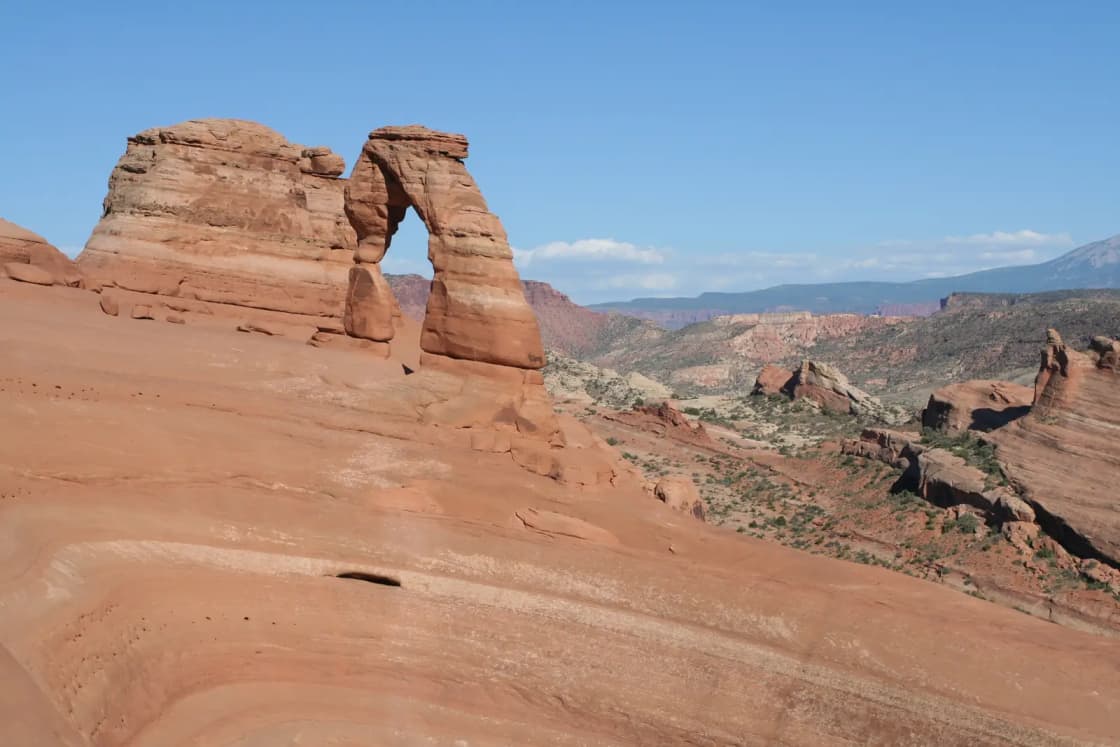
Delicate Arch is the signature and the most demanding of the popular routes — roughly three miles round trip with a real climb, much of it up open slickrock with no shade at any point. It is a bad idea in the middle of a summer day and a wonderful one at sunrise or in the last hour of light. There is also a lower viewpoint reachable by a very short walk if the full route is not on.
The Windows Section is the best return on effort in the park. Several large arches sit within short, mostly flat walks of one parking area. If you have children, limited time, or limited heat tolerance, this is where to go.
Devils Garden is the long one, and it contains Landscape Arch, the longest arch in North America and improbably thin in a way photographs undersell. The walk to Landscape Arch itself is straightforward; the trail beyond it becomes considerably more serious, with scrambling and exposure, and is where people get into difficulty.
Fiery Furnace is the maze, and the only part of Arches that still requires advance planning — a permit for self-guided entry or a ticket for a ranger-led trip, both through Recreation.gov. It is not a hike you should improvise.
The free things outside the park
Several of the best stops around Moab cost nothing and need no pass, which matters if you are managing entrance fees across a weekend.
Potash Road (SR-279) runs along the Colorado west of town and carries roadside petroglyph panels and, further along, dinosaur tracks, both signed from the road. Corona Arch is on the same road — a substantial arch on a moderate trail, outside the national park boundary and therefore free.
State Route 128 northeast along the river is the other one, and it is the drive locals send people on. Fisher Towers, the dramatic spires off that road, are recognizable from a great deal of film and advertising.
The La Sal Mountains are the escape valve nobody plans for. They rise to over 12,000 feet immediately southeast of town, which means that on a 105°F afternoon there is alpine forest a short drive away. The La Sal Mountain Loop Road connects back around to SR-128. In a summer trip this is the answer to the middle of the day.
Mountain biking deserves its own line, because for a large share of visitors it is the actual reason to come. Moab's slickrock riding is internationally known and the network is enormous, ranging from beginner-friendly to expert. If you ride, budget a day for it rather than treating it as a side trip.
The dark sky is the underrated reason to stay the night
Arches is an International Dark Sky Park, and the Park Service actively encourages visiting after hours. This is the argument that converts the trip from a long day into an overnight, because it is a thing you cannot do from Provo and cannot do on a day trip.
There is no timed entry to worry about at night, the parking problem evaporates, the temperature drops to something civilized in summer, and the sky over southeastern Utah is among the darkest accessible from a paved road in the lower 48. If you have been photographing the Milky Way from the canyons above Utah Valley — our stargazing near Provo guide covers those spots — Moab is a substantial step up.
Canyonlands is four parks, and most visitors only see one
This is worth understanding before you plan, because it explains why advice about Canyonlands is so inconsistent. The park is divided by the Green and Colorado rivers into districts that do not connect to each other by road inside the park.
Island in the Sky is the one almost everyone means — about 40 minutes from Moab, paved, with the famous overlooks. The Needles is roughly an hour and a half south of Moab by road and is a hiker's district rather than a viewpoint district. The Maze is one of the most remote areas in the lower 48, requires high-clearance four-wheel drive and serious self-sufficiency, and is not a casual visit under any circumstances. The rivers themselves form the fourth district.
So when a source tells you Canyonlands is empty and another tells you the parking was full, both may be right about different districts. From Provo on a weekend, Island in the Sky is the realistic answer.
One safety note that is not optional here. This is high desert, the humidity is very low, and you will lose water faster than you notice. Summer temperatures on exposed slickrock run well above the air temperature, there is no shade on most of the famous routes, and there is no water on the trails. Carry considerably more than feels necessary, and treat the middle of a summer day as time to be indoors, in the river, or up in the La Sals rather than on a trail.
Season by season
Spring (March–May) and autumn (September–October) are the correct answers. Comfortable temperatures, long usable light, everything open. They are also when Moab is busiest and when lodging books furthest ahead.
Summer is hot in a way that changes what you can do. Well over 100°F is routine, hiking windows compress to early morning and evening, and popular trailhead parking fills early. It is manageable if you invert your day — out before 8 a.m., back to town or the river through the middle of the day, out again at 5 p.m.
Winter is the underrated one. Red rock under snow is worth the drive, the parks are quiet, and rates drop. The trade-offs are short daylight, some icy trails and slickrock, and a US-6 drive that requires more planning.
There is one other timing consideration specific to Moab: the town hosts several large events through the year, particularly around off-road vehicle recreation, and during those weekends lodging and restaurant capacity are fully absorbed. Check what is on before booking a spring weekend blind.
What to book, and when
Book lodging first and everything else second. Moab is a small town serving a very large visitor load, and spring and autumn weekends sell out well in advance.
Inside Arches, Devils Garden Campground is the only campground — 51 sites, reservations required from March 1 through October 31 via Recreation.gov. Fiery Furnace, the maze section, requires a permit for self-guided entry or a ticket for a ranger-led trip, also through Recreation.gov, and this is one of the few things at Arches that still requires advance planning.
Off-highway vehicles are prohibited inside Arches, which surprises people who associate Moab with them. The OHV recreation is on the surrounding BLM land, not in the national park.
The honest recommendation
Leave Provo on a Friday afternoon or evening, drive US-6 in daylight if you can, and sleep in Moab. Spend Saturday split between Arches early and Canyonlands or Dead Horse Point in the afternoon, and go back into Arches after dark for the sky. Drive home Sunday with a stop somewhere on SR-128.
That is two nights, roughly seven to eight hours of total driving, and it uses the two things this trip has that a day trip cannot: the early morning and the night.
For shorter options in the same direction, or for everything within about three hours of the valley, see our day trips from Provo guide.
Sand Flats, and the Case for the Land Outside the Parks
The two national parks absorb almost all the attention and most of the visitors, which means the most interesting decision on a Moab trip is often about the ground in between them. That ground is mostly federal, mostly managed by the Bureau of Land Management out of its Moab field office, and it operates on a completely different set of rules from a national park.
Sand Flats Recreation Area is the clearest example and the one worth understanding, because it is where a large share of the region's slickrock riding, four-wheel-driving and dispersed-style camping happens. It sits immediately east of town, it is co-managed rather than run like a park, and it charges its own day-use and camping fees separately from anything else you have paid. That is the first practical point: a national parks pass does not cover BLM recreation area fees, and arriving with an America the Beautiful pass and no cash or card for Sand Flats is a very common and entirely avoidable misunderstanding.
The second point is that the rules are different in kind, not just in price. Camping in a designated BLM campground means numbered sites, a fee, and the ordinary expectations. Camping outside one, on open BLM ground, is a different activity with different obligations — and around Moab specifically, the areas where that is permitted have contracted over the years in response to exactly the damage you would expect from thirty years of increasing traffic. Do not extrapolate from what was allowed on a trip a decade ago, and do not extrapolate from general advice about BLM land elsewhere in Utah. The Moab field office publishes current designations and closures, and the situation near a town this heavily visited does change.
Third: the toilet question is a real one and it is not squeamishness. In the slickrock country around Moab there is frequently no soil to speak of. Standard backcountry burial advice assumes a depth of soil that does not exist there, which is why portable waste systems are required rather than recommended for a lot of activities in the area, and why they are sold in every outfitter in town. If you are camping outside a developed campground, find out what is required for the specific area before you go rather than discovering it at a trailhead.
Why any of this is worth the trouble. The land outside the park boundaries is where the pressure is lowest and the freedom is highest. There are no timed entries, no lines at an entrance station, and no shuttle. On a weekend when Arches is at capacity and the Devils Garden lot is full by mid-morning, a slickrock overlook fifteen minutes from Main Street can be nearly empty. The trade is that nothing is curated for you: no ranger at the trailhead, no railing at the drop-off, patchy signage and patchier phone coverage. That trade suits some visitors enormously and suits others not at all, and knowing which one you are is more useful than any specific recommendation.
The practical version for a first trip from Provo: give the parks the mornings, when the light is best and the crowds are still arriving, and give the BLM ground the late afternoons and evenings, when the parks are at their worst and the low sun on red rock is at its best. It costs nothing to plan that way, and it is the single change that most reliably turns a good Moab weekend into a memorable one.
Related Guides
- The Lavender Farm in Mona: What to Know Before You Drive Down
- Logan and Cache Valley from Provo: The Other College Valley
- Zion and St. George from Provo: The Southern Utah Weekend
- Bear Lake from Provo: Turquoise Water, Raspberry Shakes, Real Distance
- Dispersed Camping Near Provo: The Rules, The Roads & What Most Guides Get Wrong (2026)
- Camping Near Provo: Best Campgrounds & Tips (2026)
- Heber Valley & Midway from Provo: The Day Trip Through the Canyon
- Park City from Provo: The Year-Round Day Trip Guide
- Vernal and Dinosaur National Monument from Provo: The Wall of Bones, and the Side of the Park With No Dinosaurs
- Spring Break from Provo: The Student Version
- Goblin Valley and the San Rafael Swell from Provo
Frequently Asked Questions
How far is Moab from Provo?
Do I need a timed-entry reservation for Arches National Park?
Is the timed-entry requirement coming back?
Can you do Moab as a day trip from Provo?
What is the best time of year to go to Moab from Utah Valley?
What should I know about the drive on US-6?
Is Arches the only thing to do in Moab?
Where do you stay, and do you need to book ahead?
Sources
The facts in this guide were checked against these sources. Hours, fees and rules change, so confirm anything time-sensitive with the source before you go. How we make Provo.com.
- Arches National Park Lifts Entry Reservation Requirement for 2026, National Park Service, Arches National Park. Checked October 12, 2026.
- Visitor Access and Experience Plan, National Park Service, Arches National Park. Checked October 12, 2026.
- Arches National Park Quick Facts, National Park Service. Checked October 12, 2026.