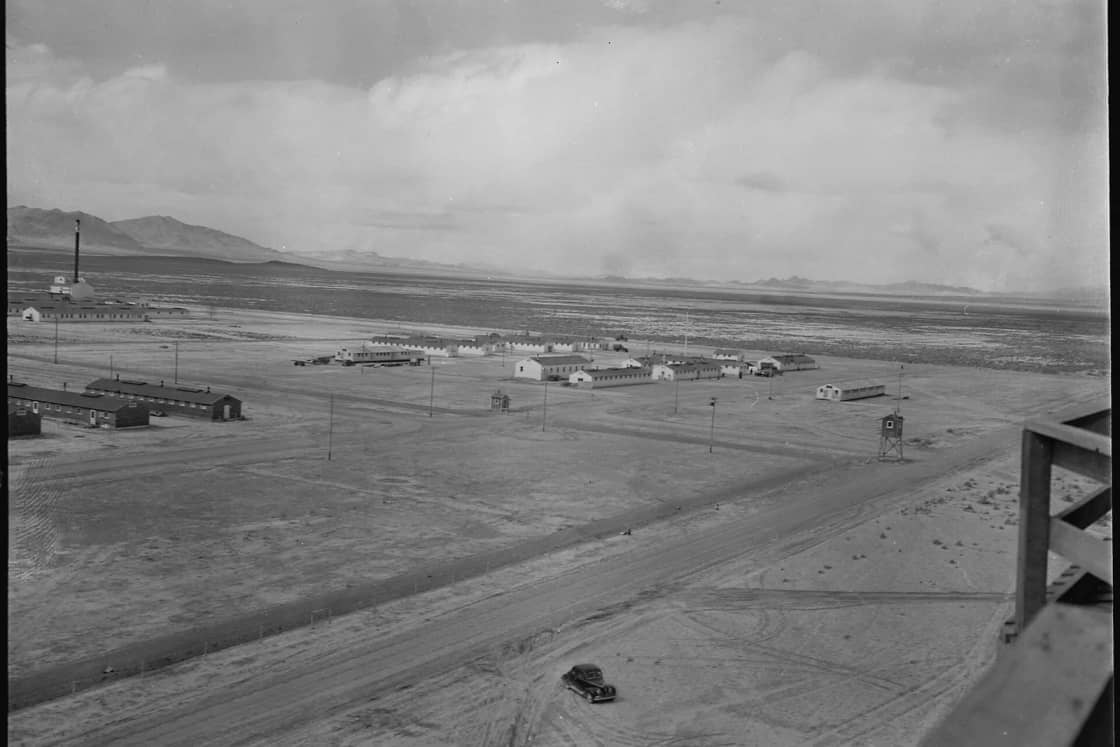
About 16 miles northwest of Delta, in the flat greasewood country of Millard County, a square mile of desert holds the remains of Topaz, one of ten camps where the federal government confined people of Japanese ancestry during World War II. The Topaz Museum says 11,212 people were processed into the camp between its opening on Sept. 11, 1942, and its closing on Oct. 31, 1945. Most came from the San Francisco Bay Area. Today the site is a National Historic Landmark, owned and cared for by the Topaz Museum, which runs an exhibit building on Delta's Main Street, about 91 miles from downtown Provo. This guide covers the history as the museum, the National Park Service, the National Archives and the Utah Division of State History tell it, what is at the site now, and how to plan a respectful visit.
| Item | Detail | Source |
|---|---|---|
| Official name | Central Utah Relocation Center, known as Topaz | NPS, Topaz Museum |
| Operated | Sept. 11, 1942, to Oct. 31, 1945 | Topaz Museum |
| People processed | 11,212 | Topaz Museum |
| Peak population | 8,100 to 8,300 (NPS: over 8,000) | Topaz Museum, NPS |
| Total area | 19,800 acres including farmland; living area 640 acres | Topaz Museum |
| Museum address | 55 W. Main St., Delta | Topaz Museum |
| Museum hours | 10 a.m. to 5 p.m., Monday through Saturday | Topaz Museum |
| Admission | By donation | Topaz Museum |
| Site monument GPS address | 10750 West 4500 North, Delta | Topaz Museum |
| Distance from Provo to Delta | About 91 miles (routing estimate) | OSRM |
A note on the words
The language used for this history has changed over the decades, and the sources this article relies on do not all use the same words. That matters before a visit, because the museum's exhibits and the National Park Service's materials use terms deliberately.
The title of this article uses "internment camp" because that is the phrase most people search for. The Topaz Museum itself describes Topaz as a "confinement site," calls the people held there "incarcerees," and describes the program as incarceration. The National Archives titles its page on the 1942 order "Executive Order 9066: Resulting in Japanese-American Incarceration (1942)," while the same page also uses period terms such as "relocation centers," "assembly centers" and "evacuation." Utah's History to Go entry, written for the Utah History Encyclopedia by Jane Beckwith, the museum's founder, uses "relocation center" and "internee."
A National Park Service article on terminology, last updated Nov. 30, 2023, explains the distinctions this way:
- Internment, according to the NPS article, describes the confinement of residents who were not U.S. citizens, which it says "was in alignment with the Geneva Conventions of 1864, 1906, and 1929." The NPS distinguishes Department of Justice and Army internment camps from the ten War Relocation Authority (WRA) sites like Topaz.
- Incarceration, the NPS article says, "does not include a value judgment of a person's wrongdoing - it refers to someone being confined somewhere," and the ten WRA facilities "can be referred to accurately as incarceration or confinement sites."
- Relocation center is the wartime government name. The NPS article advises using it "only when necessary in a historical context as part of a proper name."
- Evacuation is a term the NPS article recommends replacing with "forced removal," "expulsion" or "mass removal."
- Concentration camp, the NPS article says, is considered accurate by scholars broadly, and it "may be included, with context, in exhibits or publications."
The NPS article also lists generational terms you will see in the museum: Issei (the immigrant first generation) and Nisei (the second generation, born in the United States). Utah's History to Go entry notes that Issei were denied U.S. citizenship at the time.
How Topaz came to be
On Feb. 19, 1942, President Franklin D. Roosevelt signed Executive Order 9066. According to the National Archives, the order authorized the secretary of war and military commanders to "prescribe military areas" from which "any or all persons may be excluded." The National Archives says "approximately 122,000 men, women, and children were forcibly moved to 'assembly centers,'" and that "nearly 70,000 of the evacuees were American citizens." The Topaz Museum gives a figure of 125,284 people of Japanese ancestry removed from the West Coast and says about two-thirds were American citizens. The NPS terminology article refers to "more than 110,000 people." The figures differ because the sources count slightly different groups and periods; each is given here as its source states it.
The National Park Service says Executive Order 9102, signed in March 1942, created the War Relocation Authority, the civilian agency that ran the ten camps. The National Archives says the camps were located in six western states and Arkansas.
Before Topaz was ready, the Topaz Museum says, people were held at the Tanforan and Santa Anita racetracks in California, where many lived in horse stalls. Utah's History to Go entry says internees from the San Francisco area had been held at Tanforan since March and were brought to Delta by train.
Why central Utah? The History to Go entry describes the setting: pioneers had worked to tame the tail end of the Sevier River with dams, canals and reservoirs, and by the 1910s Union Pacific was inviting Midwestern farmers to the area. Repeated crop failures left abandoned land. After Pearl Harbor, the entry says, officials and Delta residents held secret meetings in January and February 1942, and work began in June 1942 on the 17,000-acre Central Utah Relocation Center. The National Park Service gives construction dates of July 1942 to January 1943. The Topaz Museum puts the full site at 19,800 acres, or 31 square miles, including farmland, and the construction cost at $3,929,000.
The name changed twice. The Topaz Museum says the camp began as the Central Utah Relocation Center, became the Abraham Relocation Center, and was renamed Topaz because the original name was too long for postal forms and the nearby town of Abraham already had a post office. The name came from Topaz Mountain to the northwest. The museum is explicit on one point that comes up often: "The camp was never named after Delta."
Life inside the camp
The living area was one square mile, 640 acres, enclosed by a four-foot barbed wire fence with guard towers every half mile on three sides, according to the Topaz Museum. The NPS says each residential block housed roughly 250 to 300 people.
The museum's description of the layout:
- 42 blocks, of which 36 were used for housing. History to Go says administration buildings, warehouses and staff housing filled the first few blocks.
- Each block held about 250 people in 12 barracks, plus a mess hall, a latrine and laundry, and a recreation hall. The museum says recreation halls served the whole community as co-op stores, churches, an art school, libraries and preschools.
- Each barrack measured 20 by 120 feet and was divided into six rooms in three sizes, assigned by family size. Families larger than six received more than one room.
- Each room had no running water, one light and a coal stove.
History to Go adds that the barracks were pine planks covered with tarpaper and lined with sheetrock, that furniture was limited to army cots, mattresses and blankets, and that residents built tables and shelves from scrap lumber. The camp opened before it was finished. The entry says many barracks and the schools were incomplete in September 1942, that some residents finished building their own structures, and that some apartments had no windows when the first snow fell on Oct. 13, 1942. The major buildings were two elementary schools, a junior/senior high school and a hospital.
The climate was hard. The Topaz Museum says summer temperatures topped 100 degrees and winter temperatures fell below zero. The Utah Historical Society's I Love History site describes a windy, dusty desert with hot summers and bitterly cold winters, shared toilets and showers, meals in mess halls, and armed guards in watchtowers.
People worked camp jobs. The Topaz Museum says secretaries and janitors earned $14 a month and professionals, including medical doctors, earned $19 a month. History to Go gives a range of $16 to $19 a month for doctors and other skilled workers. The same entry says residents could get passes to shop in Delta and some found work in town.
The death of James Wakasa
On April 11, 1943, a military guard shot and killed James Hatsuaki Wakasa, 63, near the camp fence. The sources describe the location slightly differently: History to Go says he was near the southwest section of the fence, and the Topaz Museum says he was walking his dog near the camp's west fence. The museum says a court martial ruled the killing "justified" and that nearly 2,000 incarcerees attended his funeral. History to Go says guarding procedures changed after an outcry from the camp population. The NPS adds that about a month later a guard fired at a couple walking too close to the fence; the NPS page does not report anyone killed in that incident.
Loyalty questions, military service and leaving
On Jan. 29, 1943, according to History to Go, Roosevelt announced that volunteers would be accepted in a Japanese American combat unit. The War Relocation Authority then required everyone 17 and older in the camps to answer a questionnaire, the Topaz Museum says. History to Go describes the two questions that caused the most distress: Question 27 asked about willingness to serve in combat, and Question 28 asked for unqualified allegiance to the United States. For Issei, who could not become U.S. citizens, answering "yes" to Question 28 meant giving up their only citizenship without gaining another, the entry explains. The question was altered after protests.
The Topaz Museum says people who answered "no" to both questions were sent to the segregated Tule Lake camp in California and threatened with deportation to Japan. Men from Topaz were drafted or volunteered and served in the 442nd Regimental Combat Team and the Military Intelligence Service while their families remained in camp, the museum says. History to Go says 105 volunteers who qualified for service soon left Topaz for active duty.
People could also leave for school or work farther east. The Topaz Museum says some left as early as the summer of 1942, but the West Coast stayed off-limits until January 1945. History to Go says that in 1943 residents with sponsors were encouraged to move inland.
Closing and redress
Topaz closed on Oct. 31, 1945. According to History to Go, the buildings were dismantled and some were moved elsewhere, and the remaining traces at the site include cindered roads and the foundations of latrines and mess halls. Some of those moved buildings are still standing in Delta (see the driving tour below).
The Topaz Museum says a federal commission in 1982, the Commission on Wartime Relocation and Internment of Civilians, attributed the removal and incarceration to "race prejudice, war hysteria and a failure of political leadership." On Aug. 10, 1988, President Ronald Reagan signed the redress bill, History to Go says. The National Archives describes that law, Public Law 100-383, as having "acknowledged the injustice of the incarceration, apologized for it, and provided partial restitution - a $20,000 cash payment to each person who was incarcerated." The Topaz Museum says President George H.W. Bush later issued a formal apology and compensation to living survivors.
How the museum came to be
The Topaz Museum traces its own beginning to 1982, when Delta High School teacher Jane Beckwith had her journalism students research the camp. Visit Utah, the state's official tourism site, says that in the late 1980s she began displaying camp artifacts in a rented space in town, and that fundraising led to the $3.1 million museum building. Visit Utah says it opened in 2015 as a gallery and became a full museum in 2017 after the historical exhibits were completed. KSL reported that the museum's grand opening weekend began Friday, July 7, 2017, and quoted Hisashi Sugaya, who was just over 2 years old when his family left the camp, describing the Japanese word "ganbatte" as meaning "to endure and try to live through the thing."
The museum also owns most of the camp. Its site page says the board bought 639 acres of the original camp and is the legal steward of the site. Visit Utah says the remaining acre of the 640-acre living area belongs to Japanese American Citizens League chapters, which placed a monument there in 1976.
In 2026 the museum announced a new executive director, Meg Hutchins, and said Beckwith received the 2026 Award of Excellence from the American Association for State and Local History, according to its news page.
The Wakasa memorial stone
One part of the museum's recent history has been the subject of public dispute, and the sources are specific about it. According to the Topaz Museum's own page on the stone, in 2020 two archaeologists found a stone about four feet long, partly buried just inside the west fence, which they believed was a memorial to James Wakasa. On July 27, 2021, the museum board decided to move it to the museum courtyard "to protect it from possible vandalism." The museum's page now says the board "made the serious mistake of unilaterally deciding to move the monument" and did not invite the descendant community to the excavation.
High Country News, in an April 2025 article by Kori Suzuki, reported that descendants formed the Wakasa Memorial Committee after the removal and asked for the excavation video and an independent assessment, and that archaeologists criticized the loss of archaeological context. The museum's page says the stone is "safe and secure" in the courtyard under a wooden shelter built in 2024, with doors that open for viewing. It says the committee and museum representatives met in Oakland, California, on Aug. 28 and 29, 2026, and "agreed to jointly develop a Memorandum of Understanding to honor James Hatsuaki Wakasa's memory." The museum says planning for the stone's permanent location and interpretation is ongoing.
What's at the museum
Visit Utah, the official state tourism site, describes the exhibits as explaining Executive Order 9066 and conditions in the horse stalls at Tanforan and Santa Anita. It lists a miniature model of the camp layout, a restored barracks room visitors can enter, two six-minute films including home movies secretly filmed by incarceree Dave Tatsuno, and internee artwork and shell jewelry made from shells found in an ancient lakebed near the camp. Visit Utah also says a section of a recreation hall from Topaz sits beside the museum on its south side. The museum says its collection includes 150 pieces of original artwork made at Topaz, plus hundreds of artifacts, photographs and oral histories.
Visit Utah estimates the museum takes one to two hours. The museum, Visit Utah and the National Park Service all point visitors to the museum before the site. The museum's description of the site lists a monument, fence and ruins rather than exhibits, so the exhibit room is where the layout and context are explained.
Hours and cost. The museum's website, checked Nov. 11, 2026, lists 10 a.m. to 5 p.m., Monday through Saturday, year-round. It is closed on New Year's Day, Thanksgiving and Christmas; the homepage also lists Christmas Eve. It is closed Sundays. Admission is by donation, with no set fee. Thanksgiving this year falls on Thursday, Nov. 26, so plan around it. Call 435-864-2514 before a long drive, especially in winter.
Groups and guided site tours. Schools and groups can book through the museum's visit form, and docent-led tours of the camp site are by request through the museum's tour request form.
Accessibility. The museum's accessibility page says it is committed to an accessible visit and asks people with questions to call 435-864-2514. It does not describe accessibility at the camp site, which is open desert.
The Delta driving or biking tour
When the camp closed, buildings were sold and hauled away. The Topaz Museum publishes a driving or biking tour of Delta with more than a dozen stops, including barracks and hospital wings moved from Topaz and remodeled. Examples from the tour page:
- A former section of the Topaz hospital, remodeled into a home, at 195 North 300 West
- Another hospital section, also now a house, at 350 West 200 North
- A partial barrack with two doors at 170 North 400 West
- A hospital building that included the camp pharmacy and is now a thrift shop, at 350 West 100 South
Most of these are private homes today, so view them from the street. The NPS also mentions this self-guided bicycle tour of camp buildings moved to Delta.
Visiting the camp site
The National Park Service says the site is "open year round for self-guided tours." For navigation, the Topaz Museum asks visitors to enter 10750 West 4500 North, Delta, UT (the monument) into GPS rather than searching for "Topaz." The mile-square camp lies between 10000 West and 11000 West on 4500 North. Visit Utah says the monument is about 16 miles northwest of the museum and to watch for "Topaz Relocation Site" signs.
What you will see. The museum's site page lists:
- A Topaz monument (the NPS counts two monuments at the site, and History to Go notes the JACL monument erected in 1976)
- The original barbed wire fence, four strands, sagging in places
- Outlines of barracks, rock gardens and pathways, partly covered by greasewood
- A small rock wall near the administration area that once decorated the entrance
- Sheetrock "lines" marking the exact locations of some barracks
- A garden with two sunken barrels outlined in rock and cement
- Guard tower footings
- Scraps of wood and metal, and ditches where water pipes ran
The NPS adds building foundations, roads, gravel walkways, agricultural buildings and landscaping. The museum offers a historic site map and a virtual tour online, and both are useful to download before you go, since the site is a large, open area.
Road conditions. The museum's pages do not describe the road surfaces to the site. The routing estimate used below follows county roads for the last stretch. The museum's rules say plainly: "If the site is muddy, please do not enter." After rain or snowmelt, call the museum before heading out.
The rules. The site is private property managed by the museum, and its posted rules warn that "failure to follow these rules may result in trespassing charges." The rules ask visitors to:
- "Take only photographs; leave only footprints."
- Leave artifacts, objects, rocks and plants undisturbed
- Drive and park only on existing roads; no off-roading of any kind
- Pack out all trash
- Leave the historic fence alone
They prohibit metal detectors and digging, camping and open fires, shooting and fireworks, smoking and alcohol, and drones or other aircraft. Only service animals on a leash are allowed. Commercial filming and events need the museum's permission. The museum's site page adds one safety warning: "Be careful of rusty nails." Visit Utah's version of the same advice is to wear sturdy shoes.
Respect for the site. The museum's rules end with "Please Visit with Respect!" People were confined here and at least one man was killed here. Former incarcerees and their descendants return on organized pilgrimages; the museum's news page lists the most recent as May 2 to 4, 2024. The museum's rules, in short: stay on the roads, take only photographs, and leave everything as you found it.
Getting there from Provo
Delta is in Millard County, west of I-15. The Topaz Museum puts the site about 130 miles southwest of Salt Lake City; the NPS says about 140.
From downtown Provo (Center Street and University Avenue), an OpenStreetMap routing estimate (OSRM, no traffic) gives about 91 miles and about 1 hour 50 minutes to Delta. That route follows I-15 south to Nephi, State Route 132 west, then US-6 south into Delta. Visit Utah's directions from Salt Lake City use the same roads: take I-15 to exit 228 at Nephi, turn right at the 100 South light and drive about 34 miles southwest on SR-132, then turn left on US-6 at the T intersection and continue to Delta's Main Street. Visit Utah says the museum is about 0.7 miles along Main Street, on the left just past Center Street.
The other common route from Utah Valley, US-6 west from Santaquin through Eureka, comes out about the same: roughly 93 miles and just under two hours by the same routing estimate. Our Little Sahara guide covers that stretch of US-6.
To the camp site, the same routing estimate gives about 105 miles from downtown Provo, with the last several miles on county roads. Its time estimate for that leg is slower and less reliable, so plan on well over two hours each way to the site and do not count on a quick dash out and back.
Delta is on Mountain time, the same as Provo. If you are continuing west to Great Basin National Park, remember that Nevada is on Pacific time; Visit Utah puts the park about 100 miles from the museum.
What to bring and how to plan the day
- Fuel and food from Delta. The museum's site pages list no restrooms, water or other services at the camp. Fill up and buy water in town.
- Water and layers. The museum describes summer highs above 100 degrees and winter lows below zero, and the site has no shade beyond the greasewood.
- Sturdy, closed shoes. Rusty nails and scraps of metal are on the ground, by the museum's own warning.
- A downloaded map. Grab the museum's historic site map before you lose signal, and set GPS to 10750 West 4500 North.
- Time. One to two hours at the museum, per Visit Utah, plus the drive to the site and time on foot there. From Provo this is a full day.
- Go Monday through Saturday. The museum is closed Sundays and on the listed holidays, and the museum is meant to come first.
Who should skip it, or plan differently. Anyone hoping for reconstructed buildings will find mostly foundations, fence and outlines in the brush; the museum is where the history is told. Families with young children may want to plan a shorter site stop, given the heat or cold the museum describes and the nails on the ground. After wet weather, skip the site and visit the museum and the Delta driving tour instead.
Pairing it with other trips. Delta sits on the way to Great Basin National Park, and the trilobite beds west of town come up in our rockhounding guide. For more on what the war did to Utah Valley itself, see our history of Geneva Steel, built inland by the federal government during the same years. The story of the Japanese American community in Salt Lake City after the war is in our Obon and Japanese Utah guide.
Sources: the Topaz Museum (home, facts, museum, historic site, site rules, driving tour, Wakasa stone, news and accessibility pages), the National Park Service (Central Utah Relocation Center site page and its article on terminology), the National Archives (Executive Order 9066 milestone document), the Utah Division of State History (Utah History to Go entry by Jane Beckwith, and the Utah Historical Society's I Love History site), Visit Utah, KSL and High Country News. Route distances and times are OpenStreetMap (OSRM) routing estimates without traffic. Hours and admission were checked on the museum's website on Nov. 11, 2026; confirm before you go at 435-864-2514.
Related Guides
- The Water Wars: Utah Lake, Strawberry, the Central Utah Project, and Who Owns the River
- Great Basin National Park from Provo
- Little Sahara Sand Dunes from Provo
- Geneva Steel history
- Obon and Japanese Utah
- Day Trips from Provo
- Scofield 1900 and Castle Gate 1924: Utah's Worst Mining Disasters
Frequently Asked Questions
What was Topaz?
How many people were held at Topaz?
Is it called an internment camp or an incarceration camp?
Where is the Topaz Museum and when is it open?
How far is Topaz from Provo?
Can you visit the actual camp site?
What are the rules at the Topaz site?
What happened to the Wakasa memorial stone?
Sources
The facts in this guide were checked against these sources. Hours, fees and rules change, so confirm anything time-sensitive with the source before you go. How we make Provo.com.
- Central Utah Relocation Center Site, National Park Service. Checked November 11, 2026.
- Terminology and the Mass Incarceration of Japanese Americans During World War II, National Park Service. Checked November 11, 2026.
- Executive Order 9066: Resulting in Japanese-American Incarceration (1942), National Archives. Checked November 11, 2026.
- Topaz Relocation Center (Utah History Encyclopedia, Jane Beckwith), Utah Division of State History, Utah History to Go. Checked November 11, 2026.
- 1942-1945: Topaz Internment Camp, Utah Historical Society, I Love History. Checked November 11, 2026.
- Topaz Incarceration Camp and Museum, Visit Utah (Utah Office of Tourism). Checked November 11, 2026.
- The Story of Topaz Museum, Visit Utah (Utah Office of Tourism). Checked November 11, 2026.
- Topaz Museum home, Topaz Museum. Checked November 11, 2026.
- Facts About Topaz, Topaz Museum. Checked November 11, 2026.
- Topaz Museum: Museum, Topaz Museum. Checked November 11, 2026.
- Visit the Historic Site, Topaz Museum. Checked November 11, 2026.
- Historic Site Visit Rules, Topaz Museum. Checked November 11, 2026.
- Delta Driving or Biking Tour, Topaz Museum. Checked November 11, 2026.
- Wakasa Memorial Stone, Topaz Museum. Checked November 11, 2026.
- Topaz Museum: News & Events, Topaz Museum. Checked November 11, 2026.
- ADA Accessibility Information, Topaz Museum. Checked November 11, 2026.
- Topaz Museum preserves lessons learned from Japanese-American internment, KSL. Checked November 11, 2026.
- The murder, the museum and the monument, High Country News. Checked November 11, 2026.