On East Center Street in Provo sits Utah's state psychiatric hospital. It opened in 1885 as a territorial asylum on land the hospital itself describes as eight blocks from the nearest house, past a swamp and the city dump. Today it is a 312-acre campus serving patients from children to older adults. This is a short history built from the hospital's own account, the state's records and local reporting, with the places on the campus the public can visit.
A note before reading: the early history includes practices that are no longer used. They are described here as the hospital's historian and the record describe them, without embellishment.
Quick facts
| Question | Answer | Source |
|---|---|---|
| Opened | July 15, 1885, as the Utah Territorial Insane Asylum | Deseret News (1999 timeline); Utah State Hospital |
| Name since 1927 | Utah State Hospital | Deseret News |
| Peak population | About 1,500 patients, 1955 | Utah State Hospital; Deseret News |
| Beds today | 378 (154 forensic, 152 adult, 72 pediatric, per 2025 reporting) | Utah State Hospital; Deseret News |
| Campus | 312 acres | Deseret News |
| Accredited | The Joint Commission, since 1986 | Utah State Hospital |
| Run by | Utah Department of Health and Human Services | Utah State Hospital |
| Museum | Tuesday and Thursday, 1 to 5 p.m., 1300 E. Center St. | Utah State Hospital |
Before Provo
Utah's first mental health institution opened in 1869 at the mouth of Emigration Canyon, run and paid for by Salt Lake City, the Deseret News reported on the hospital's 140th anniversary in 2025. It became the Utah Territorial Insane Asylum after Dr. Seymour Young leased it. Territorial lawmakers then placed a new asylum in Provo.
1885: the asylum in Provo
The Deseret News's 1999 timeline dates the establishment of the Utah Territorial Insane Asylum to July 15, 1885. The hospital's own history describes Provo then as a day's travel from Salt Lake City, and the site as some eight blocks from the nearest residence, cut off from town by swampland and the city dump. For about 85 years it was Utah's only mental health facility, the Deseret News wrote.
The names followed the times. By the 1999 timeline:
| Year | Name or milestone |
|---|---|
| 1885 | Established as the Utah Territorial Insane Asylum |
| 1891 | Administration building completed; staff lived in part of it |
| 1896 | Renamed the Utah State Insane Asylum at statehood |
| 1903 | Became the Utah State Mental Hospital; a 600-acre campus extension planned |
| 1922 | Hyde building for women completed |
| 1927 | Renamed the Utah State Hospital; voluntary admissions allowed |
Early care, as the historian describes it
Janina Chilton, the hospital's historian, told the Deseret News in 2025 that early care was mostly custodial: "Therapeutic care was almost unknown in those early years." Patients considered violent were placed in strong cells, and others lived in very small rooms. Admission records listed 67 supposed "causes of insanity," among them epilepsy, poverty and reading novels. Restraint devices of the period, including the Utica crib, the Oregon boot and a tranquilizer chair, were in use, and some patients were kept in a cage until 1919, the paper reported. The hospital's own history calls the institution of that era "little more than a human warehouse."
Changing treatment
The record shows the shift came in steps:
- 1934: Drug-induced convulsive therapy began, the Deseret News reported, followed by electroconvulsive therapy from 1947. (The 1999 timeline dates electric shock to 1942.) The hospital stopped those treatments after medications emerged in the 1950s; the timeline records insulin and shock therapy ending in 1956.
- 1942: The hospital moved to smaller patient units, individual treatment plans and what the 2025 article called a more humane approach.
- 1950s: Phenothiazine medications arrived, and under superintendent Dr. Owen P. Heninger the hospital built small units with their own treatment teams.
- 1955: The patient population peaked at about 1,500, by both the hospital's and the Deseret News's accounts, then fell to about 800 by the 1960s as many patients were released to the community.
- 1963 to 1969: A 1963 federal law led to community mental health centers; Weber Mental Health Center became Utah's first in 1969, and 13 serve the state now. The hospital says that from 1969 it moved from being the state's only treatment facility to supporting those centers.
- 1986: The hospital earned full accreditation from The Joint Commission, which it has held since.
The buildings
Some of the changes were physical. The 1999 timeline records that in 1935 the administration remodeled buildings to shed a castle-like look, after the "Dracula" and "Frankenstein" films added to the stigma; that the main building was declared a fire hazard in 1971 and demolished in 1976; that the Lucy Beth Rampton building for civilly committed adults opened in 1994; and that a new forensic building was scheduled to open in 1999. The hospital's history adds that the old swamp was drained and the dump became a city park.
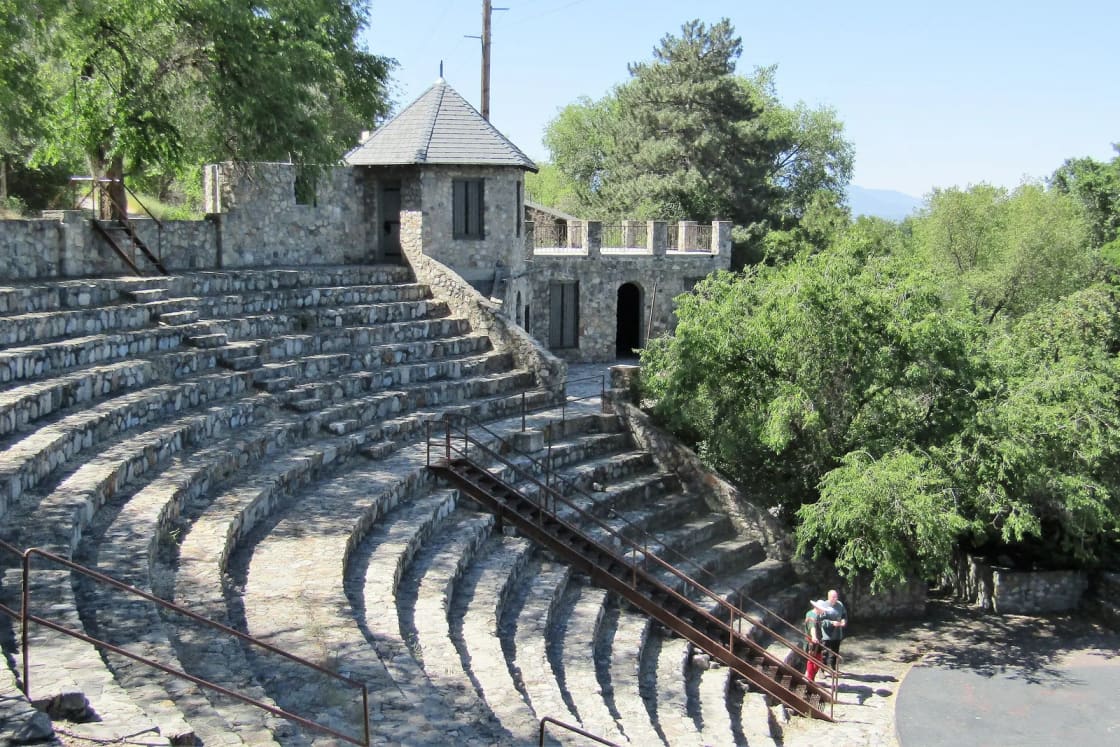
The one castle that stayed is outdoors. The Daily Universe reported in 2025 that the hospital added a castle-style amphitheater on its grounds in the 1930s for patient recreation. It sat mostly unused for years because it was hard to reach, was renovated in 1976 and is now a local historical landmark run by the hospital as a public park during campus hours. "We love the castle," Chilton told the Universe.
The hospital today
The hospital says it provides 378 beds for Utahns who need a more structured setting than community care, with patients from age 6 to old age and programs for children, adolescents, adults and forensic patients. The Deseret News reported in 2025 that the beds break down into 154 forensic, 152 adult and 72 pediatric, on a 312-acre campus with a K-12 school (Oak Spring School), clinics, a library, a kitchen and a greenhouse, and more than 800 volunteers.
State law now requires treatment in the least restrictive setting first, and civil commitment requires a risk of harm to oneself or others, the paper noted. A 2017 to 2022 settlement agreement addressed long waits for forensic patients needing competency restoration. Superintendent Dallas Earnshaw told the Deseret News that patients' conditions are "often trauma-based."
Remembering the patients
In October 2018, a memorial wall was dedicated at the Provo City Cemetery for 485 men and women who lived and died at the hospital between 1886 and 1960 and were buried there in unmarked graves, KSL reported. Chilton began the research in 2002, matching hospital records with cemetery records, and helped raise the money. Each name and death date is engraved in granite. "They really lost their identity in life, and we really felt like they needed to have that back," she told KSL. Our Provo City Cemetery guide covers the cemetery.
Visiting respectfully
The hospital is an operating psychiatric facility, not a historic site. What the public can visit, by the hospital's own FAQ:
- The museum, in the historic superintendent's home at 1300 E. Center St., the first building on the north side of the street as you enter. Open Tuesday and Thursday, 1 to 5 p.m. Group tours at other times can be arranged by calling the historian, Janina Chilton, at 385-277-0289, or volunteer services at 801-344-4254.
- The amphitheater, which state agencies and the public may reserve through Support Services at 801-344-4740 (donations required).
- The disc golf course, open in daylight only; maps and scorecards are in the Administration Building. Our disc golf guide lists the valley's courses.
Patients live on the campus, so treat it as you would a neighborhood: no photos of people, and no ghost hunting. Our haunted places guide covers the hospital's old Haunted Castle fundraiser and why it ended.
For more of Provo's past, start with our Provo history. If you or someone you know needs help now, our guide to mental health crisis resources in Utah Valley lists 988 and local options.
Frequently Asked Questions
When did the Utah State Hospital open in Provo?
What was the Utah State Hospital called before?
How many patients did the Utah State Hospital have at its peak?
How many beds does the Utah State Hospital have now?
Can you visit the Utah State Hospital museum?
What is the castle at the Utah State Hospital?
What is the memorial wall for Utah State Hospital patients?
Who runs the Utah State Hospital?
Sources
The facts in this guide were checked against these sources. Hours, fees and rules change, so confirm anything time-sensitive with the source before you go. How we make Provo.com.
- Utah State Hospital: Our History, Utah State Hospital. Checked November 27, 2026.
- Frequently Asked Questions, Utah State Hospital. Checked November 27, 2026.
- Utah State Hospital at 140: how mental health care changed, Deseret News. Checked November 27, 2026.
- Utah State Hospital timeline (1999), Deseret News. Checked November 27, 2026.
- A castle in Provo: the history of the amphitheater at Utah State Hospital, The Daily Universe. Checked November 27, 2026.
- Utah State Hospital honors forgotten patients with memorial wall, KSL. Checked November 27, 2026.