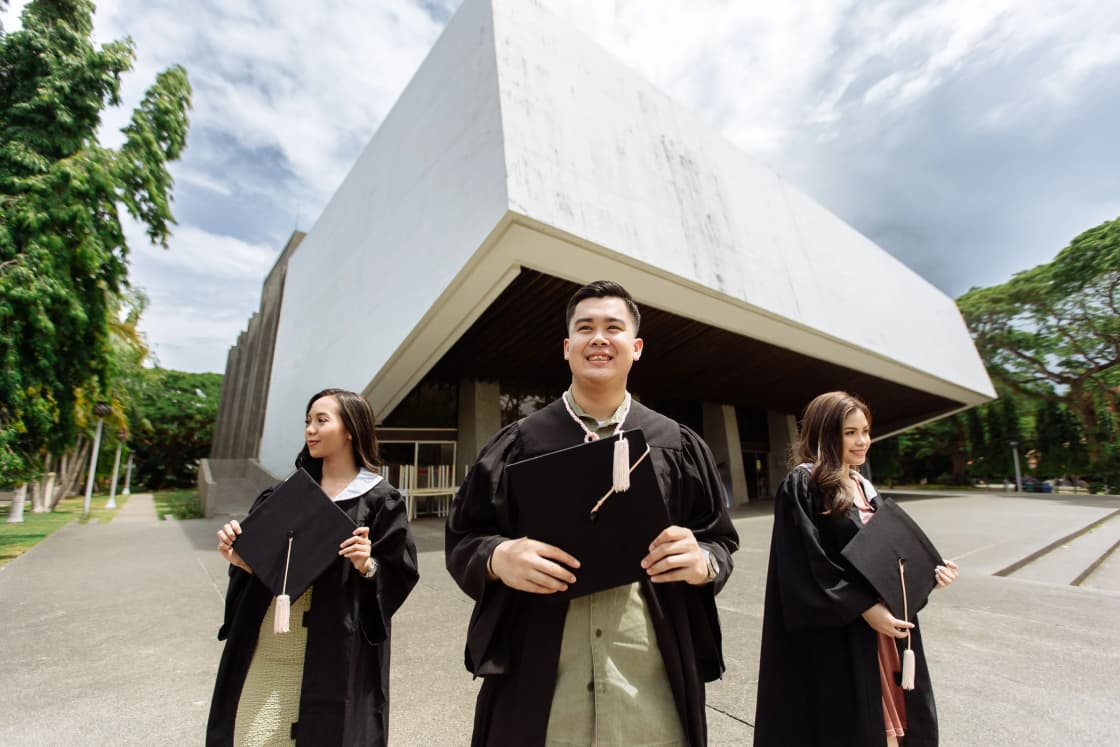

Graduation photos in Utah Valley have an unusual advantage and an unusual constraint. The advantage is that the mountains are right there, and in April they still have snow on them while the valley has gone green. The constraint is that everyone graduating has worked this out.
This covers where to shoot, when, and how to plan around two university ceremonies that run at opposite ends of the day. Dates, campus rules and access all change; confirm with the specific university and location before building a plan around anything here.
The timing problem nobody explains
BYU and UVU structure graduation almost inversely, and that changes when you can take pictures.
BYU's commencement is a morning event in April at the Marriott Center, with college convocations around it. Check the registrar for this year's schedule and reporting times.
UVU's commencement is held at the UCCU Center, followed by college and school convocations. Check UVU's commencement page for this year's times and where graduates gather.
So a BYU graduate's ceremony morning is gone before the light is good, and a UVU graduate's ceremony evening consumes exactly the golden hour. The photographs have to happen on a different day, or in the morning of the ceremony day for UVU students only.
The practical scheduling answer
For most families, the right move is to shoot on a separate day entirely, in cap and gown, and treat ceremony day as documentation rather than portraiture.
Shoot in the week or two before. Campus is quieter, the weather has a second chance if the first attempt is bad, and nobody is trying to be in three places at once wearing an unfamiliar gown.
If you must shoot on ceremony day: BYU graduates should plan for the afternoon after commencement, unless their convocation is late in the day. UVU graduates should check their call time and plan around it.
Commencement versus convocation, because it affects who is there
At both schools the university-wide commencement is the big ceremonial event, and the individual college's convocation is where the graduate's name is read and they cross a stage.
BYU spreads convocations across two days and several venues. UVU runs its college ceremonies over two days at the UCCU Center in timed blocks.
If relatives are traveling and can only attend one thing, convocation is usually the one they want, and it is also where the recognizable photograph — graduate, stage, name being read — happens.
Check the specific college's schedule rather than assuming. Both universities publish these separately from the main commencement page, and they are the details most often missed.
The BYU campus locations
The obvious one is the Y on the mountain, which does not require being on campus at all and is best shot from a distance with the graduate in the foreground. Hiking to the Y itself in a gown is a decision people make and regret.
The Marriott Center exterior gives the ceremony building, which matters to some families and not others.
The Brigham Young statue and the main quad are the standard campus establishing shots, and they are busy during graduation week.
The Harold B. Lee Library exterior and the surrounding walkways photograph well and are frequently less crowded than the central quad.
The tree-lined walkways through the middle of campus are the reliable choice — clean backgrounds, good light in the morning, and no need for a landmark to be in frame.
Note that BYU has had construction affecting parts of campus, which moves year to year. Walk the route a few days ahead rather than discovering a fenced-off building on the morning.
The UVU campus locations
The Fugal Gateway and the UCCU Center exterior are the ceremony-adjacent shots, and the plaza areas around them are open and easy to work in.
The Hall of Flags is a distinctive interior and part of the actual processional route, which makes it meaningful — but interiors are where permission questions arise, so ask.
The campus green spaces and the newer building frontages give clean modern backgrounds, and UVU's campus is less crowded than BYU's during graduation week simply because the ceremony structure spreads people out.
Looking east from campus puts Mount Timpanogos behind the graduate, which is the shot most people want and is available from a lot of the Orem side of the valley.
The mountain backdrops, which is why people come here
The single best asset Utah Valley offers a graduation photograph is a snow-topped ridge behind a green valley in April, and there are better places to get it than a campus lawn.
The Bonneville Shoreline and the benches above both cities give elevation, a valley view, and the mountains close behind. Early morning light here is excellent.
Provo Canyon and the mouth of the canyon give water, rock and trees within fifteen minutes of campus. Bridal Veil Falls is dramatic and extremely popular; the quieter pullouts along the canyon are often better.
The Provo River Parkway and the paved trail network give tree-lined paths with mountain backgrounds and easy parking, and they run for miles, so finding an empty stretch is straightforward.
The orchards and farmland on the east bench, particularly around Orem, Lindon and Alpine, give blossom in spring if the timing lines up. Blossom timing is unpredictable and moves by a couple of weeks year to year.
The water shots
Utah Lake gives an open western horizon, which makes it a sunset location rather than a sunrise one. The shoreline varies in quality and access, and lake conditions change seasonally — check before planning around it.
Deer Creek and Jordanelle, up Provo Canyon and beyond, give mountain reservoir backdrops. They are further out, roughly forty minutes, and worth it if you want something that does not look like everyone else's photos.
Tibble Fork Reservoir up American Fork Canyon is spectacular and can still be snowbound or have limited access in April, so verify conditions before driving up.
Temple grounds, handled properly
The Provo City Center Temple and the grounds of other temples in the valley are popular backdrops, and the gardens are beautiful.
They are also religious sites. The grounds are open to visitors, and photography happens there constantly, but the expectation is respectful conduct, modest presentation, small groups and no treating the space as a commercial studio.
Rules about professional and commercial photography on temple grounds exist and vary. If you are hiring a photographer and want temple grounds specifically, have the photographer confirm what is permitted rather than assuming.
Our guide to wedding and engagement photo locations in Utah Valley covers the same locations from the wedding side, including the permissions question in more detail, and much of it transfers directly.
The photos people wish they had taken
Asked afterward, graduates and families consistently name the same missing shots.
The one with the professor or advisor who mattered. These people are on campus during graduation week and are almost always glad to be asked, and nobody thinks of it until years later.
The one in front of the building where the degree happened — the specific lab, studio, library floor or lecture hall. The campus landmark shot is generic; the department shot is the one that means something.
The one with parents, taken properly, with everyone looking at the camera. There are usually a hundred photographs of the graduate and three of the family together, all of them accidental.
The one of the graduate alone, not posed, in the middle of the day — walking, sitting, laughing at something. Posed portraits record the event. Candid frames record the person.
Light, and the thing people get wrong
Utah Valley sits at roughly 4,500 feet with very clear air, and midday spring light here is harder than most people expect. It produces squinting, deep eye shadows and blown highlights on a white gown.
Shoot in the hour after sunrise or the hour before sunset. This is not photographer superstition; the difference in this valley is dramatic.
A mountain backdrop makes the timing more important, not less, because the terrain adds its own shadow. East-facing locations lose light early in the evening as the sun drops behind the valley's western horizon, while the mountains behind you stay lit — which can be beautiful or can leave your subject dark, depending on the exposure.
Overcast days are not a disaster. Flat light is forgiving on faces and on a white gown, and a gray sky over green mountains reads better than people fear.
Weather, and the April problem
It snows in Utah Valley in April. Not every year, not reliably, but often enough that a plan with no contingency is a bad plan.
Build in a backup date if you can. If you cannot, identify a sheltered location in advance — a covered walkway, a building entrance, a tree canopy.
And consider that fresh snow on the peaks with a green valley below is one of the better backdrops the year offers. Some of the best graduation photographs taken in this valley happened on days the family initially considered ruined.
Where the crowds are
Worth knowing so you can avoid them, because graduation photography in this valley is a competitive sport for about three weeks.
The BYU quad, the Brigham Young statue and the Y viewpoints are busiest, particularly on weekend afternoons in the fortnight before commencement. Bridal Veil Falls is busy for the same reason it is beautiful, and the parking is limited.
The reliably quiet options are the long stretches of the parkway trails, the bench and shoreline routes away from the main trailheads, the orchard roads on the east side, and anywhere at all before 8 a.m.
The single most effective crowd-avoidance tactic is going on a weekday morning. Most families schedule for weekend afternoons, which is when the light is worst and the crowds are heaviest — those two facts are related, and going against both solves them together.
Booking a photographer
Utah Valley has a deep supply of photographers, largely because of the wedding market, and graduation season overlaps with the start of wedding season.
Book months ahead if you want a specific person during ceremony week. The week around each school's graduation is among the busiest of their spring.
Ask specifically whether they have shot on the campus you want, because familiarity with where the light falls at 7 a.m. in a particular spot is most of what you are paying for.
Student photographers at both universities are a good-value option and frequently excellent, particularly for a straightforward cap-and-gown session.
The self-shot version
Plenty of families do this themselves and get good results.
Go early. Empty locations photograph better and you will not be waiting behind three other families at the statue.
Bring someone to hold the gown out of the dirt and to watch the tassel, which ends up on the wrong side in roughly half of all unsupervised graduation photographs.
Take more frames than feels necessary in each spot, particularly with groups, because someone blinks.
And take the boring documentary shots as well as the posed ones — the graduate with their advisor, with roommates, outside the building where they took the hardest class. Those age better than the posed portraits do.
Parking and access on ceremony days
Both campuses are extremely busy on their ceremony days. Check each arena's current bag and security rules before you go.
Plan for parking to be difficult and further away than usual, and for a walk in ceremony clothes. This is a real consideration for older relatives, and both schools publish accessibility information worth reading in advance.
If you are shooting on campus on a ceremony day, none of the normal parking assumptions apply. Another argument for shooting on a different day entirely.
What to wear under the gown
Gowns are thin, shiny and unforgiving, and they photograph what is underneath them.
Solid colors under the gown read better than patterns. Necklines matter because the gown opens at the front in most photographs. Shoes are in frame more often than people expect, particularly in full-length shots on a trail or lawn, and heels sink into grass.
Gowns arrive creased from packaging. Hang it or steam it a day ahead — creases are extremely visible in photographs and almost impossible to remove afterward.
Bring the cap but do not wear it for every frame. A significant share of the best graduation photographs have the cap in hand rather than on the head, partly because it casts a shadow across the eyes in bright light.
Group shots, and the logistics of them
Roommate and cohort photographs are frequently the ones people keep, and they are harder to organize than individual portraits because everybody's ceremony schedule differs.
Do them before ceremony week. Once convocations start, coordinating six graduating students across two universities and several colleges becomes impossible.
Pick a location with room to spread out and a background that stays clean behind a wide frame — a lawn, a long walkway, a shoreline. Landmarks that work for one person often do not survive being widened to eight.
And take one deliberately unserious frame. It is invariably the one that gets printed.
Shooting the ceremony itself
Arena photography is difficult. The lighting is mixed and dim, you are far away, and phone cameras handle it badly.
Accept that the long shot of the stage will not be good, and concentrate on what you can control: the walk in, the gathering outside, the moment they come out afterward, the family together. Those photographs are better anyway.
If someone has a camera with a long lens and a seat with a clear line to the stage, that is the one chance at the name-being-read frame, and it happens at convocation rather than commencement at both schools.
A short list, if you want one
Best all-round: a bench or shoreline trail location at sunrise with the valley below and the mountains behind.
Best campus shot: a tree-lined walkway on the graduate's own campus, early morning.
Best if the family wants the landmark: the ceremony building exterior, plus one with the Y visible for BYU.
Best if you want something different: a canyon or reservoir location up Provo Canyon, mid-week, before the crowds.
Best backup: anywhere with a covered walkway and a green background, because the weather here does not consult anyone's schedule.
For the rest of the graduation-week logistics, our guide to staying in Utah Valley after you graduate covers what comes next.
Frequently Asked Questions
When is BYU graduation?
When is UVU graduation?
What is the difference between commencement and convocation?
When is the best time of day to shoot?
Do I need permission to shoot on campus?
How far ahead should I book a photographer?
Can I shoot at the temple grounds?
What if it snows?
Sources
The facts in this guide were checked against these sources. Hours, fees and rules change, so confirm anything time-sensitive with the source before you go. How we make Provo.com.
- Gov. Spencer J. Cox and Lt. Gov. Deidre Henderson schedule, April 18-22, 2022, Office of the Governor. Checked October 12, 2026.