
Two universities in one valley graduate their classes within about a week of each other, and between them they turn a single stretch of late April into the busiest thing Utah Valley hosts that is not a football game. Tens of thousands of visiting family members arrive, every hotel room between Springville and Lehi is spoken for, and restaurants that normally seat you in ten minutes are quoting ninety.
Most of the advice that circulates about it is about where to eat afterwards. That is the easy part. The hard part is structural, and it is the thing families get wrong every single year: the ceremony with the name in it is not the ceremony most people book their flights around.
This guide covers how the two schools run graduation, what differs between them, and the practical decisions — travel, tickets, bags, parking, dinner — that follow from understanding the structure rather than guessing at it.
The distinction that decides your whole trip
Both BYU and UVU run graduation as two separate kinds of event, and they are not interchangeable.
Commencement is the university-wide ceremony. Everyone graduating that term is in the room at once. A president conducts it, an invited speaker addresses the class, honorary degrees are conferred, and at the end everyone moves a tassel together. It is the ceremonial, institutional event — the one with the big speech and the photograph of a full arena.
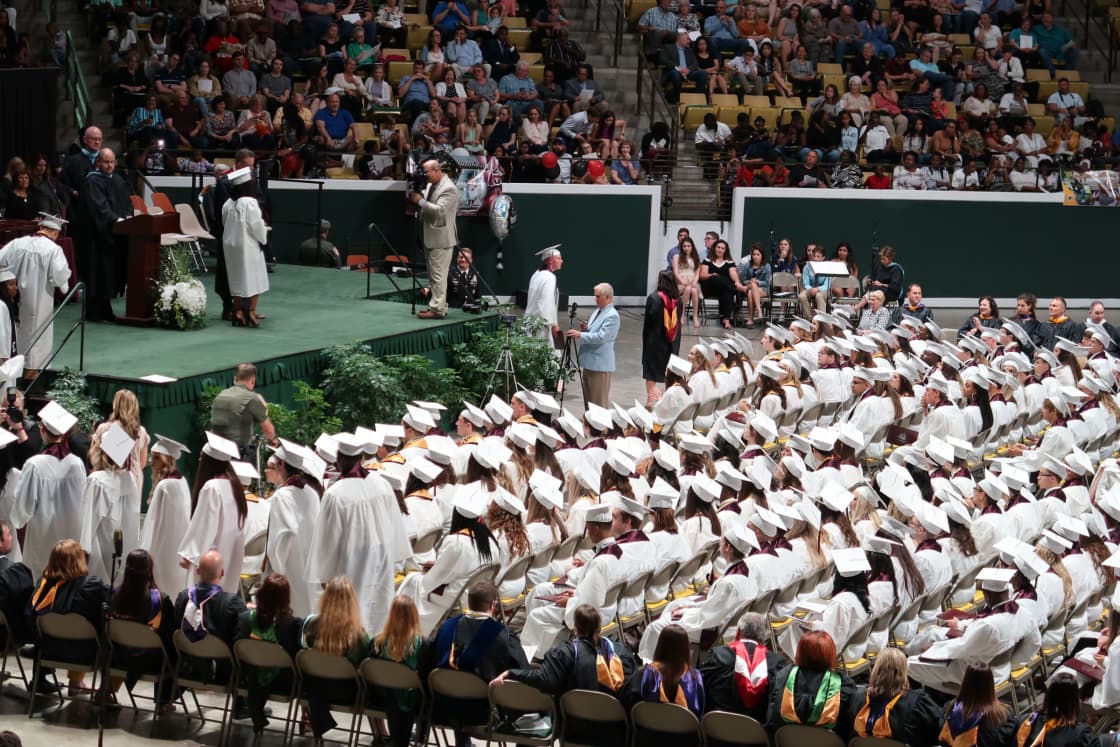
Convocation — which UVU also calls its college and school ceremonies — is the smaller one, held by an individual college or school. This is where each graduate's name is read aloud, they walk across a stage, and they are handed something. This is the part that families cry at. This is the part the grandparents flew in for.
BYU states this explicitly on its registrar's own pages: names are read at convocation rather than at commencement. UVU says the same thing about its college ceremonies, describing them as the event where your name is read as you walk across the stage.
The practical consequence is severe and it is entirely avoidable. A family that books a single night, attends commencement, and flies home the next morning has attended the ceremony where their graduate sat in a crowd of thousands and was not individually named. The walk they came for happened after they left. It happens every year, to people who did nothing wrong except assume that the event with the famous name was the main one.
If you take one thing from this page: find out which day your graduate's college holds its convocation, and build the trip around that.
How the two schools differ
They run the same two-part structure on different rhythms, and if you have attended one you should not assume the other works the same way.
BYU puts commencement on a Thursday morning in the Marriott Center. Its 2026 ceremony began at 10 a.m. and was expected to end by about 11:30, with graduates and faculty arriving at 8:45 for a processional that stepped off around 9:05. College convocations then run across that same Thursday and the Friday after it — BYU's 2026 arrangement had all college convocations on April 23 and 24. BYU's own academic calendar lists commencement on Thursday, April 22, 2027, with convocations following.
UVU runs commencement on a Wednesday evening. In 2026 the doors opened at 5:30 p.m., the processional began at 7, and the ceremony ran 7:30 to 8:30 in the UCCU Center at 800 W. University Parkway in Orem. Graduates checked in at 6 p.m. at the Fugal Gateway building and walked down the Hall of Flags through the Pope Science Building to the arena, led by bagpipers. Then UVU fills the next two full days with college and school ceremonies — eight of them in 2026, at 8 a.m., 11 a.m., 2 p.m. and 5 p.m. on each of Thursday and Friday.
That four-ceremony-a-day cadence at UVU is worth sitting with. It means the arena is loading and unloading a full house every three hours, and it means your college's slot could be first thing in the morning or last thing in the evening two days after the commencement everyone talks about.
The scale is not comparable to a normal campus event, particularly at UVU. The university reported its Class of 2026 as the largest in its history, with more than 13,400 students receiving more than 18,000 degrees and certificates, drawn from 47 states and 54 countries. The youngest graduate that year was 16 and the oldest was 83, which tells you something true about UVU that no brochure does.
What the buildings will not let you carry
This is the most common day-of problem after the convocation mix-up, and it is the easiest to solve in advance.
BYU's Marriott Center runs a no-bag policy. The published exception is a small clutch no larger than five by eight by one inches, with or without a strap. Medically necessary items and diaper bags are permitted after inspection. BYU has also stated that security measures including weapons-detection systems are in place. A ticket does not guarantee entry once the arena is full.
UVU screens everyone too. Graduates pass through a security checkpoint including a metal detector before entering the arena; for commencement they gather at the Fugal Gateway building and are screened toward the end of the processional. Guests enter through a single designated entrance on the northwest side of the UCCU Center, with the other entrances closed.
The practical version of all of that: take a phone, keys, a ticket if you have one, and nothing else. Put the camera bag, the diaper bag you do not strictly need, the umbrella and the water bottles in the car before you walk over. A family sorting out a bag problem at a closed door while the processional starts is a preventable way to miss the thing.
What you receive, and when
At both schools, what gets handed over on stage is a diploma cover. The folder. Not the document.
UVU says it directly: your name is read, you walk across the stage, you receive your diploma cover, and the actual diploma is mailed after graduation to the address on your graduation application. BYU's Kennedy Center describes the same arrangement, with diplomas mailed approximately six to eight weeks after graduation, once degrees have been officially awarded.
Two things follow that matter more than they sound.
First, check the mailing address on the graduation application. A great many Provo and Orem students move out of their apartment within days of graduating. The address the university has is frequently the one they are about to vacate, and the document arrives six weeks later at a house full of strangers.
Second, if something downstream depends on the physical diploma — an employer, a licensing board, a visa application, a graduate program — work backward from the mailing window rather than from the ceremony. The ceremony is in April. The document may not be in your hands until June. Those are different facts, and conflating them has cost people job start dates.
Booking a room, and why it is worse than you expect
Utah Valley has a finite number of hotel rooms and two universities graduating large classes inside roughly one week. Each graduate brings some number of people. The arithmetic does the rest. If you are making a weekend of it, see a weekend in Utah Valley for visiting parents.
Book as soon as your graduate's college ceremony slot is published, which is generally earlier than the point at which most families start thinking about it. If the choice is between a refundable room booked early and a cheaper non-refundable one booked later, take the refundable one — the college ceremony you are attending can move within the weekend even when the commencement date is fixed, and a slot that shifts from Thursday morning to Friday evening changes which nights you need.
Widen the search radius before you widen the budget. The valley runs north-south along I-15, and a room in a neighboring city is often a fifteen-minute drive rather than the hour the map's traffic estimate implies at ordinary hours. Our guides to hotels near BYU and cheaper places to stay in Provo cover where the rooms are.
Dinner is the other reservation nobody makes early enough. Every family in the arena has the same idea at the same moment, and they all have it within twenty minutes of the same ceremony ending. If you want a table rather than a ninety-minute wait, book it when you book the room, and pick a time that is deliberately out of step with the ceremony you are attending — early, or late enough that the first wave has cleared.
Parking, and the turnover problem
Both campuses are running large ceremonies back to back, which creates a specific and underappreciated problem: one ceremony's crowd is leaving while the next one's is arriving. The lots do not empty and refill cleanly. They churn.
Assume the closest lot is full. Assume the walk from where you park is longer than it looked. At UVU, doors open an hour before each college ceremony and guests are asked to be seated about ten minutes before the processional so they see the graduates walk in — which means the useful arrival target is well before the door time, not after it. BYU's guidance follows the same logic on a Thursday morning rather than an evening.
Arrive for the parking, not for the start time. And if the graduate is driving themselves, remember they have a separate, earlier check-in — UVU's college ceremonies ask graduates to arrive roughly forty-five minutes before their ceremony at the west-side, ground-level entrance of the UCCU Center — so the family car and the graduate's car are two different logistics problems.
If you cannot be there
BYU broadcasts commencement live on BYUtv from the Marriott Center. UVU has livestreamed its commencement on the university's own channels.
The catch is the same catch as everything else on this page: the streamed event is generally the commencement, and the commencement is not where the name is read. If a relative overseas specifically wants to hear the name, check what that particular college is doing with its convocation — availability varies by college and by year, and it is not safe to assume the commencement stream covers it.
The photographs
The ceremony itself is a difficult photographic environment: you are far away, the light is arena light, and you cannot bring the bag with the lens in it. The pictures people keep are taken outside, before or after.
Both campuses have obvious spots and non-obvious ones, and the obvious ones have queues on graduation day. Our guide to graduation photo spots in Utah Valley covers where to go and, more usefully, when — the light and the crowd both move through the day, and the best half hour is rarely the one immediately after the ceremony when everyone else is having the same thought.
One practical note: if the plan is a full photo session in regalia, doing it on a different day from the ceremony solves most of the problems at once. No crowd, no time pressure, no risk of missing the walk because the session ran long, and the gown is not yet creased from three hours in a folding seat.
If the degree finished in December
A large number of students at both schools finish their coursework in December and then face a question nobody prepares them for: is there a ceremony, and when is it?
The general shape at both universities is that the big spring event is the one that matters, and December finishers are folded into it. BYU's colleges have published convocation eligibility that covers December graduates of the previous year alongside that spring's finalized applicants — meaning a student who finished in December walks the following April, with the spring class, rather than at a separate winter ceremony of equivalent scale.
Two practical consequences follow, and they cut in opposite directions.
The good one: a December finisher gets four months to plan the trip, which is the opposite of the usual scramble, and relatives can book flights at sane prices well ahead.
The awkward one: by April the graduate has often moved away, started a job, or both. Coming back to Provo to walk is a deliberate decision with a plane ticket attached rather than something that happens because you are already here. It is worth making that decision consciously in December, while the family can still coordinate, rather than discovering in March that nobody booked anything.
The other thing to settle early is whether the degree is conferred at the point the coursework ends or at the point of the ceremony, because those are different dates and employers occasionally ask. That is a registrar question at both schools, and it is worth a phone call rather than an assumption.
Accessibility, which is better than it is advertised
Both arenas handle accessibility properly, and both do it in a way you have to arrange rather than discover on the day.
UVU publishes accessibility services alongside its ceremony information and routes all guests through a single designated entrance, which means the accessible route is the main route rather than a side door somebody has to find a key for. BYU's colleges have published ADA parking and drop-off arrangements for convocations, with reserved sections of specific lots and marked drop-off points near the venue.
The pattern at both is the same: it exists, and it is arranged in advance rather than requested at the door. If someone in the party uses a wheelchair, cannot manage a long walk from a distant lot, or needs seating where a companion can sit beside them, contact the college running that specific ceremony — not the university's general line — because convocations are run at college level and the seating chart belongs to them.
Do it when you book the room, not the week before. The accessible seating in an arena running four ceremonies a day is a finite allocation, and it goes the way every finite allocation goes.
A realistic timeline
Working backward from the weekend, here is the order the decisions need to be made in.
- As soon as the term's dates are published: confirm the commencement date, then immediately find out which day and time your graduate's college holds its convocation. Everything else depends on this and nothing else should be booked first.
- Then: book the room, refundable if possible, for the nights the convocation requires rather than the nights the commencement requires.
- Then: book dinner, deliberately off-peak relative to your ceremony.
- A month out: sort tickets through your graduate, and confirm how many guests the allocation covers.
- A week out: confirm the mailing address on the graduation application is somewhere the graduate will still be in six to eight weeks.
- The night before: empty the bags. Decide what is going in the small clutch or in pockets, and leave the rest in the car.
- The day itself: arrive for the parking. Be seated before the processional, not before the speeches.
What this fits into
Graduation is the front end of a decision a lot of people in this valley are quietly making that same week: whether to stay. Utah Valley keeps an unusual share of its graduates, and the reasons are structural rather than sentimental — the job market, the cost of moving, and a social network that is already built. Our guide to graduating and staying in Utah Valley covers what that choice looks like, and the Provo bucket list before graduation covers the other half of the week, which is the part about leaving well.
The short version
Find the convocation. Build the trip around it, not around commencement. Book the room the day the slot is published and make it refundable. Leave the bags in the car. Expect a folder on the day and a diploma in the post six to eight weeks later, and make sure it is going to an address that will still be theirs. Arrive early enough to park badly and still be seated before the processional.
Everything else about graduation weekend in Utah Valley sorts itself out. The one thing that does not sort itself out is turning up on the wrong day for the right reason.
Related Guides
- Graduation Photo Spots in Utah Valley
- Graduating and Staying in Utah Valley
- The Provo Bucket List Before Graduation
- Hotels Near BYU
- Cheap Hotels in Provo
Frequently Asked Questions
Is my graduate's name read at commencement?
How many days does graduation take at BYU and UVU?
Do guests need tickets for BYU commencement?
What can you bring into the Marriott Center and the UCCU Center?
When do you get the diploma?
How early should you book a hotel for graduation in Provo or Orem?
Where do you park for graduation, and how early should you arrive?
Can you attend graduation if you cannot travel to Provo?
Sources
The facts in this guide were checked against these sources. Hours, fees and rules change, so confirm anything time-sensitive with the source before you go. How we make Provo.com.
- UVU Graduation Information, Utah Valley University. Checked October 12, 2026.