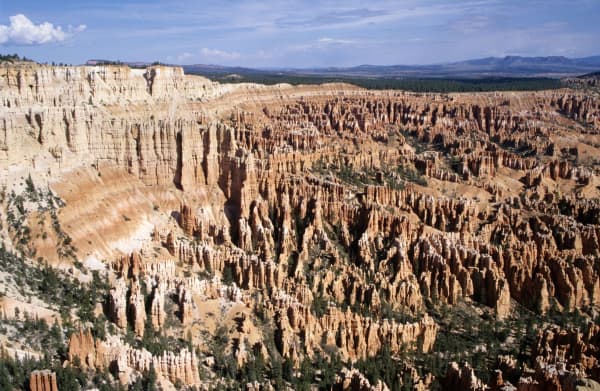
The parking problem at Bryce Canyon is not a mystery, and the National Park Service says so plainly. Most of the congestion in the amphitheater comes from a few popular overlook lots, and the biggest cause is people who park there for hours while they hike. The park's answer is a free shuttle, a recommended place to leave the car and a few habits that keep you out of the line of circling vehicles.
For Utah Valley families, this matters more than it does at a closer destination. Bryce is roughly four hours from Provo, as our Bryce Canyon from Provo guide explains, and time lost circling a full lot at the rim is a real share of a short day. This guide covers how the shuttle works, where to park, what Sunrise Point offers, and what changes now that shuttle season is over for 2026. Every operating detail below comes from National Park Service pages checked on Nov. 6, 2026. Hours, dates and closures change, so confirm them on the park's own pages before you drive.
Quick facts
| Question | Answer | Source |
|---|---|---|
| Shuttle cost | Included with park admission | NPS shuttle page |
| Shuttle frequency | Buses usually arrive every 15 minutes | NPS shuttle page |
| Full loop from the station | About 50 minutes, not counting stops | NPS shuttle page |
| Recommended parking | Bryce Canyon City Shuttle Station, free all day | NPS shuttle page |
| Sunrise Point stop to viewpoint | 0.2 miles | NPS shuttle page |
| Private vehicle entry | $35 at the entrance station | NPS shuttle page |
| Park hours | Open 24 hours a day throughout the year | NPS hours page |
Is the shuttle running now?
Not for a trip this month. The park's 2026 shuttle schedule runs from April 3 to October 18, with an 8:00 a.m. to 6:00 p.m. schedule in spring and fall and an 8:00 a.m. to 8:00 p.m. schedule from May 9 to September 20. The park's separate hours page describes the season as April through October 20. The two pages do not match by a couple of days, and the shuttle page itself uses both September 21 and September 22 as a boundary in different sections, so the exact changeover days may be off by one.
You do not need to settle that discrepancy to plan a winter or late-fall visit. By any reading, the shuttle is not operating in November. If you are planning a trip for next spring or summer, look at the shuttle page for that year's dates, because the 2026 schedule is the only one confirmed here.
That changes the logistics in a specific way. Without the shuttle, everyone who goes to the amphitheater drives, and the lots in the amphitheater are the only parking. The upside is that winter and late fall are far quieter than summer. The park lists May through September as the most popular visiting months, and the congestion warnings on its pages are tied to the shuttle and peak seasons. The downside is snow, covered below.
How the summer shuttle works
The shuttle is free once you are inside the park. The park says rides are included with admission, and a Vehicle Pass covers the driver and everyone in the vehicle for both the shuttle and private vehicle entry. Interagency pass holders show the pass to the driver when boarding. Pets are not allowed on the shuttle.
The loop starts at the Shuttle Station north of the park and takes about 50 minutes without stops. The park says buses usually arrive about every 15 minutes, and it links to a shuttle tracker that shows real-time timing. The park lists these stops, in order:
- Shuttle Station
- Old Bryce Town
- Best Western Plus Grand Hotel
- Best Western Plus Ruby's Inn
- Ruby's Campground
- Visitor Center
- Sunset Campground
- Bryce Point
- Inspiration Point
- Sunset Campground
- Sunset Point
- Bryce Canyon Lodge
- Sunrise Point
- Visitor Center
- Ruby's Campground
The stops are the same in both directions, though some are labeled southbound or northbound. In practice, that means a rider who boards at the Shuttle Station passes the hotels and campgrounds, reaches the Visitor Center, and then works through the four major amphitheater viewpoints before the lodge and Sunrise Point.
The shuttle only serves the amphitheater area. The park says no shuttle runs on the Southern Scenic Drive, the stretch from roughly Mile 3 to Mile 18 that leads to Agua Canyon, Natural Bridge, Swamp Canyon and Rainbow Point. A private tour may be available there, but the park's own wording stops short of promising it. Plan to drive that section yourself.
Last buses
The park lists last shuttle departures from the Shuttle Station, which matter if you plan to watch sunset. From May 9 to September 21 the last departure is at 7:30 p.m., returning at 8:20 p.m. In the spring and fall shoulder periods, April 3 to May 8 and September 22 to October 18, the last departure is 5:45 p.m., returning at 6:35 p.m. The last shuttle reaches Sunrise Point at 6:26 p.m. in the shoulder periods or 8:11 p.m. in the summer window.
Since the first shuttle runs at 8:00 a.m., the shuttle does not serve a true sunrise. Anyone who wants the view at daybreak is driving, which brings the lots back into the picture. That is covered in the Sunrise Point section.
Where to park: the Bryce Canyon City station
The park recommends the shuttle station in Bryce Canyon City, the lot at stop 1, as the place to leave your car. It offers free all-day parking. You can buy a park pass there and board with a shorter line than you would find at the entrance station. Oversize vehicles can park there too.
For a Provo family driving four hours, the logic is simple. You arrive tired, with kids who have been in the car for hours, and the easiest first move is to park once, ride, and not think about parking again until the evening. The park also names the Additional Parking Lot across from the Visitor Center as an option for people riding the shuttle.
The park's own advice for avoiding crowds is short:
- Ride the shuttle instead of driving. The park calls this the most predictable way to see the amphitheater area.
- Leave the car in the Additional Parking Lot across from the Visitor Center, or at the station, when you ride.
- Hike one way along the Rim Trail, getting off at one viewpoint and boarding at the next.
The last of those is the most useful trick. Instead of parking at Sunrise Point, hiking Queen's Garden and walking back to the same car, you can ride out, hike one direction on the Rim Trail and ride back. That keeps the overlook lots turning over rather than sitting full.
When the lots fill
Here is the limit of what the park publishes. Its parking page calls the amphitheater "the most congested area of the park" and says spaces can be scarce during peak seasons. It does not publish a fill time, such as "full by 10 a.m." The shuttle page says the same: it points to a separate parking page and a Check Busy Times tool but gives no hour. The page also says that when lots fill, they may close temporarily.
So the honest answer to "when do the lots fill" is that the park does not say, and any specific hour you read elsewhere is a guess. What the park does tell you is the cause. In its words, "The number one cause of parking lot congestion is hikers whose cars sit in popular overlook parking lots." A hiker who parks at Sunrise Point for three hours holds a space the whole time. A visitor who parks, looks over the rim for ten minutes and leaves frees it quickly.
That points to a practical pattern, even without a published fill time. The pressure comes from small lots and popular hikes that start from the same few places. The park gives the lot sizes:
| Amphitheater lot | Total spaces | Oversized spaces |
|---|---|---|
| Sunset Point | 115 | 7 |
| Sunrise Point | 113 | 3 |
| Bryce Point | 49 | 3 |
| Inspiration Point | 36 | 7 |
| Paria Point | 21 | 0 |
| Fairyland Point | 20 | 3 |
Those numbers are modest next to the crowds the park lists as its busiest months. In peak season, a lot of 36 spaces can fill quickly. The spaces at Inspiration Point and Bryce Point are especially limited. If you intend to drive and want the best-known viewpoints, Sunrise Point and Sunset Point have the largest lots and are the safer bet.
The park's Southern Scenic Drive lots are smaller still, according to the park: Rainbow Point has 56 spaces, Natural Bridge 30, Swamp Canyon 11 and Agua Canyon 7. Mossy Cave has 15. If you plan to reach Rainbow Point in summer, the drive is private-vehicle only, so go early or late in the day.
Oversize vehicles
If you are towing a trailer or driving an RV or a long van, read this part before you leave Provo. The park defines oversize as 23 feet or longer. During shuttle hours, these vehicles cannot park at the Visitor Center one-hour lot, Sunrise Point, Bryce Canyon Lodge, Sunset Point, Inspiration Point or Bryce Point. Paria Point is closed to oversize vehicles at all hours. The park lists these options instead: the Additional Parking Lot across from the Visitor Center, the Shuttle Station lot, or a park or Ruby's Inn campsite or lodging.
Vehicles over 23 feet may drive the Southern Scenic Drive and park at all its viewpoints, according to the park's parking page. That rule is easy to miss and useful for families in motorhomes.
Sunrise Point
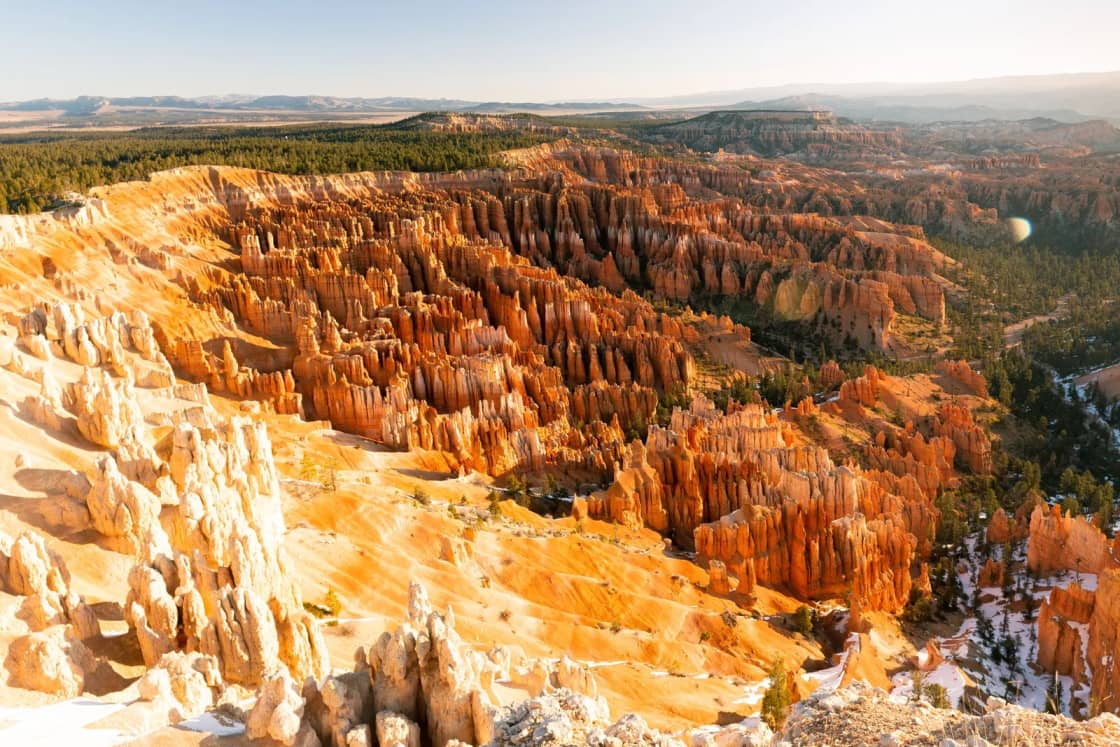
Despite the name, Sunrise Point is not the only place to watch the light come up, and the park does not rank viewpoints for sunrise. What it says is that Sunrise Point is the northernmost viewpoint in the Bryce Amphitheater, and that the view is "equally spectacular at daybreak and day's end."
The practical details come from the park's shuttle and parking pages:
- It is stop 13 on the shuttle loop, 0.2 miles from the stop to the viewpoint.
- Its lot has 113 spaces, 3 of them oversized, and serves the viewpoint year-round and the General Store seasonally.
- Hikers can start the Queen's Garden Trail or the Queen's Navajo Combination Loop from here. See our Navajo Loop and Queen's Garden hike guide for the trail itself.
- A paved Rim Trail runs about 0.5 miles to Sunset Point.
- The General Store and High Plateaus Institute are nearby.
The park is open 24 hours a day throughout the year, according to its hours page, so you can arrive before first light without an entrance-station schedule in your way. The hours page does not list entrance station staffing times, so if you arrive before the booth is staffed, check the park's page on how fees are collected, or buy a digital pass in advance. The shuttle page says digital passes can be bought on Recreation.gov and downloaded instantly as a PDF, and they can be upgraded to an Interagency Pass at the entrance station.
The park's pages do not state sunrise times, and they change through the year, so look up the time for your date from a source such as the National Weather Service. Plan to be in place before it. For a Provo trip, that usually means sleeping near the park the night before, as the parent guide suggests, rather than driving four hours in the dark.
The no-shuttle hours before 8:00 a.m. have a useful side effect. The shuttle is not running at dawn, which means everyone is driving, but the number of people at the rim is lower than at midday. The park does not publish crowd counts for dawn, so treat that as an observation about the schedule rather than a measurement. If Sunrise Point's lot is full, the lots at Sunset Point, which the park says is 0.5 miles away by the Rim Trail, offer another place to stand.
Winter: no shuttle, snow, and what stays open
From roughly late October on, you are in private-vehicle territory. The park describes the winter picture on its winter and parking pages:
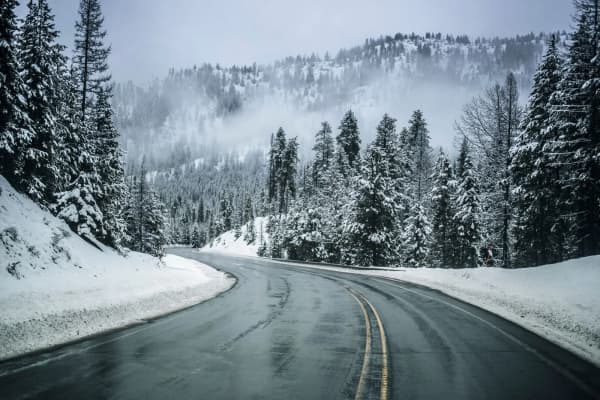
- The main park road can close beyond Mile 3 after winter storms while plows clear the higher elevations. Closures typically last a day or more.
- The amphitheater area, including Bryce, Inspiration, Sunset and Sunrise Points, is plowed first, so it stays accessible even when the Southern Scenic Drive is closed.
- Fairyland Point and Paria View spur roads close for winter once plowing is needed, but stay open to hikers, cross-country skiers and snowshoers.
- Two trails close for the winter: the Wall Street side of the Navajo Loop and the Rim Trail between Inspiration and Bryce Points.
- After a big snowfall, most day-hiking trails need snowshoes. After several days of melt and foot traffic, trails become icy, and snowshoes stop providing good traction.
- The park recommends traction devices throughout the park, especially in parking lots and paved areas. They are sold at the Visitor Center bookstore.
- The General Store at Sunrise Point closes in winter. Restrooms at Inspiration Point, the Peekaboo Loop and the General Store close, while those at Rainbow Point, Farview Point, Sunset Point, the Visitor Center and North Campground stay open.
- Skiing off the rim into the canyon is illegal.
The Visitor Center is closed on Christmas Day, closes an hour early on Christmas Eve and opens an hour late on New Year's Day. The park's conditions page, last updated Aug. 31, 2026 in the capture checked here, sends visitors to its alerts for current closures and to udottraffic.utah.gov for road conditions outside the park.
The drive itself is part of the winter risk. Before you leave Utah County, read our guide to Utah winter driving, the traction law and chains. The park's pages cover conditions inside Bryce, not on the highways that bring you there.
A plan for a Provo family
Leave Provo early enough to reach the park before the middle of the day, or plan to arrive late. The drive time in the parent guide is roughly four hours each way, depending on route and conditions, and that estimate does not include fuel stops or food. The guide also warns that fuel and food thin out once you leave the interstate.
In shuttle season, a workable plan looks like this:
- Arrive at the Bryce Canyon City Shuttle Station, park for free and buy your pass there if you do not already have one.
- Ride to the viewpoint you want first. If you want the classic hike, get off at Sunrise Point or Sunset Point.
- Hike one direction and ride back, rather than returning to a parked car.
- Use the station lot as your base, so you are not competing for a 36-space overlook lot at noon.
- Watch the last-shuttle times above if you plan to stay for evening light.
Outside shuttle season, drive in, accept that the amphitheater lots are the only choice, and expect them to be much easier than in July. Check the conditions page the morning you leave. If the main road is closed beyond Mile 3, the amphitheater is still plowed first, but plan for an icy walk from the lot to the rim.
If Bryce is part of a longer loop, our ranking of Utah's national parks from Provo and the Zion and St. George guide help you decide how to combine them, and Best Day Trips from Provo puts the drive in context against closer options.
Who should skip the shuttle plan
The shuttle is optional, and the park says no reservation is needed. A few groups may reasonably skip it:
- Visitors who want only a quick look at one viewpoint and are comfortable circling a lot may prefer to drive, especially outside the busiest months.
- Anyone heading to the Southern Scenic Drive, since the shuttle does not go there.
- Anyone with a pet, because pets are not allowed on the shuttle.
- Anyone arriving before 8:00 a.m. for sunrise, because the first shuttle runs at 8:00 a.m.
What to check before you go
- The park's shuttle page for the season dates, because the 2026 pages show a two-day mismatch.
- The park's conditions page for road closures, trail advisories and fire restrictions. The page notes lightning is most common in July and August.
- Udottraffic.utah.gov for road conditions outside the park.
- The park's hours pages for the Visitor Center, the General Store and Bryce Canyon Lodge, which each have their own season and hours.
- Your pass. Digital passes can be bought on Recreation.gov before you leave Provo, and the park is cashless, as the parent guide notes.
What to bring
Water, layers and sun protection come first, and the altitude is the reason. The rim sits above 8,000 feet, and the weather can differ sharply from St. George. In winter, add traction devices and, depending on conditions, snowshoes. In summer, bring a plan for the middle of the day: a picnic at the station lot, a break at a campground, or a late-afternoon return to the rim. The park does not publish crowd levels by hour, so your best tools are the shuttle tracker, the Check Busy Times tool on the park's site and a flexible plan.
The short version
The park gives a clear recommendation: park once at the Bryce Canyon City Shuttle Station, ride the free shuttle in season, and hike one way along the Rim Trail rather than parking at an overlook for hours. It does not publish an hour when the lots fill, so do not trust anyone who does. Sunrise Point is a 113-space lot with a 0.2-mile walk from the shuttle stop, a good starting point for the Queen's Garden hike and a viewpoint the park describes as equally spectacular at daybreak and day's end. In November, the shuttle is off, the amphitheater is plowed first, and your job is to check conditions, carry traction and enjoy a much quieter rim.
Related Guides
- Bryce Canyon from Provo
- Bryce Canyon Navajo Loop and Queen's Garden hike
- The Utah national parks from Provo, ranked
- Utah Winter Driving: The Traction Law, Chains and Canyon Rules
- Zion and St. George from Provo
Frequently Asked Questions
Is the Bryce Canyon shuttle running right now?
Does the Bryce Canyon shuttle cost extra?
Where is the best place to park for the shuttle?
How often does the shuttle come?
How far is the walk from the Sunrise Point shuttle stop to the viewpoint?
How many cars fit in the Sunrise Point lot?
What causes the parking problem at Bryce Canyon?
What changes at Sunrise Point in winter?
Sources
The facts in this guide were checked against these sources. Hours, fees and rules change, so confirm anything time-sensitive with the source before you go. How we make Provo.com.
- Bryce Canyon Shuttle, National Park Service. Checked November 6, 2026.
- Parking Information, National Park Service. Checked November 6, 2026.
- Hours, Access and Dates, National Park Service. Checked November 6, 2026.
- Winter in Bryce Canyon, National Park Service. Checked November 6, 2026.
- National Park Service: Viewpoints, National Park Service. Checked November 6, 2026.
- Current Conditions, National Park Service. Checked November 6, 2026.