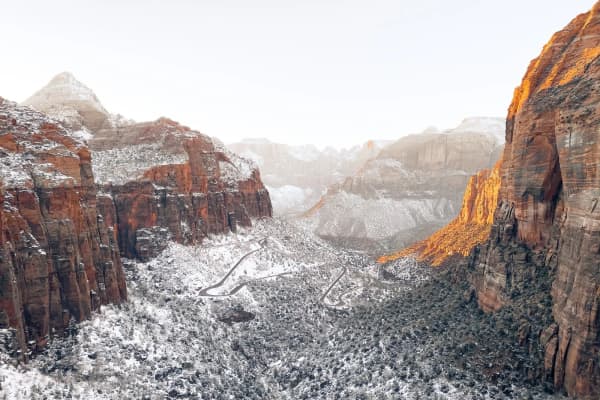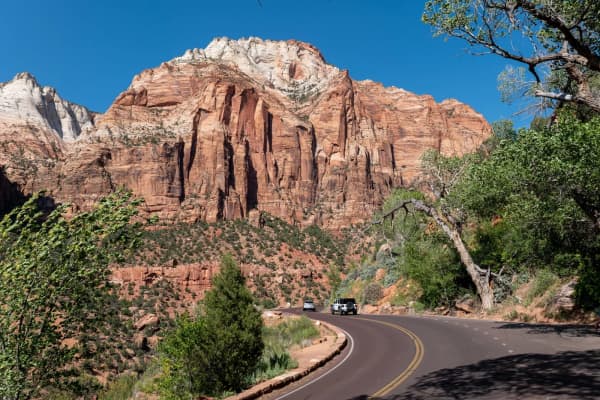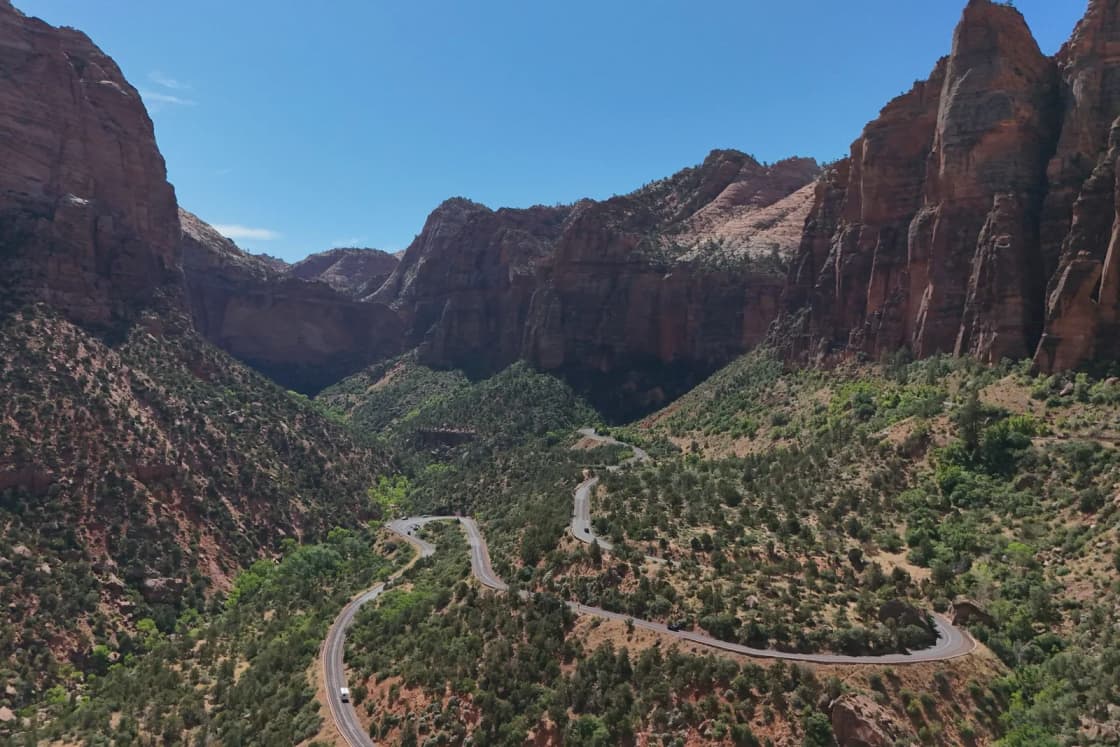
For most of the year you cannot drive your own car into the heart of Zion. From early March through late November, Zion Canyon Scenic Drive is open only to the park's free shuttle buses, and the parking lot at the start of the line is often full by mid-morning. That one rule shapes nearly every Zion day trip from Utah Valley: what time you leave Provo, where you park, when you need to be back at the bus stop and whether a winter visit makes more sense. This guide explains how the two shuttle lines work, where the stops are, what parking costs in Springdale, when private cars are allowed back on the Scenic Drive, the size limits that now keep large RVs off the Zion-Mount Carmel Highway, and how Kolob Canyons fits in. For the bigger picture of the trip south, start with our Zion and St. George from Provo guide.
The schedules, rules and prices here come from the National Park Service's Zion shuttle, traffic, directions, fees, hours, bicycling, accessibility, large-vehicle and Kolob Canyons pages, the park's 2026 Superintendent's Compendium, and the Town of Springdale's parking pages, all checked on Nov. 16, 2026. Shuttle dates in particular change from year to year, so confirm them on the park's shuttle page before you go.
Quick facts
| Item | Detail | Source |
|---|---|---|
| Shuttle cost | Free on both lines; no ticket or reservation | NPS shuttle page |
| Shuttle season | Daily March through November, plus a late-December holiday run | NPS shuttle page |
| Hours through Nov. 28, 2026 | First bus 7 a.m.; last up-canyon 5 p.m.; last out of Temple of Sinawava 6:15 p.m. | NPS shuttle page |
| No service | Nov. 29 through Dec. 25 | NPS shuttle page |
| Holiday run | Dec. 26 to Jan. 2, 8 a.m. to 4:30 p.m. up-canyon, last out 5:45 p.m. | NPS shuttle page |
| Ride time | About 40 to 45 minutes one way; about 1.5 hours round trip | NPS shuttle page |
| Visitor center parking | Free, more than 350 spaces, first come, first served | NPS traffic page |
| Springdale parking | $15 to $25 all day on street; enforced 6 a.m. to 5 p.m. daily | Town of Springdale |
| Entrance fee | $35 per private vehicle, $20 per person on foot or bike | NPS fees page |
| Large-vehicle limit on Zion-Mount Carmel Highway | 35 ft 9 in long, 7 ft 10 in wide, 11 ft 4 in tall, 50,000 lbs | NPS large vehicles page |
| Drive from Provo | About 265 miles and 4 hours 36 minutes to the Zion Canyon Visitor Center | OSRM routing estimate |
Who this guide is for
This is for anyone driving down from Utah County who wants to know the mechanics before they arrive: first-time Zion visitors, people planning a hike from the Grotto or Temple of Sinawava, families who need to know whether a stroller or wheelchair works on the bus, cyclists, and anyone towing a trailer or driving a motorhome. It is not a hiking guide or a family itinerary. It covers how you get into Zion Canyon and back out, and what each choice costs.
How to get there from Provo
The route is simple: I-15 south nearly the whole way, then State Route 9 east through Hurricane, La Verkin, Virgin and Rockville to Springdale. An OpenStreetMap routing estimate (OSRM) puts downtown Provo to the Zion Canyon Visitor Center at about 265 miles and 4 hours 36 minutes without stops. Real trips run longer once you add fuel, food and traffic in Springdale.
That drive time matters for the shuttle. If you leave Provo at 5 a.m., the routing estimate puts you at the park shortly before 10 a.m., which is right when the Park Service says the visitor center lot commonly fills. Many Utah Valley visitors handle this by sleeping in Springdale, Hurricane or St. George the night before. Our guide to where to stay for Zion compares those bases, including which ones put you within walking distance of a Springdale Line stop.
The park's directions page also notes a public transit option: SunTran, the St. George bus system, runs a Zion Route linking St. George, Washington, Hurricane, La Verkin, Virgin and Springdale. If you stay in St. George, that can replace the Springdale parking hunt entirely. Check SunTran's own schedule for times and fares.
Before you leave, check I-15 and SR-9 conditions on UDOT's traffic site. Our Utah road conditions guide lists the tools.
The two shuttle lines
Zion runs two separate free shuttle routes that meet at the park's south end.
The Zion Canyon Line runs inside the park, from the Zion Canyon Visitor Center up the Scenic Drive to the Temple of Sinawava at the end of the road. This is the bus most people mean when they say "the Zion shuttle." During its season it is the only way to reach the trailheads along the Scenic Drive other than walking or biking.
The Springdale Line runs through the town of Springdale, from Hotel DeNovo at the south end (Stop 9) to Zion Canyon Village (Stop 1) at the north end, next to the park's pedestrian entrance. It exists so that people who park or stay in town can reach the park without driving. Buses stop only when someone is waiting, and a full bus will not stop for more riders until seats open. To get off, tell the driver when you board or as your stop approaches.
To switch from one line to the other, get off the Springdale Line at Zion Canyon Village, walk across the pedestrian entrance footbridge, pay the entrance fee or show your pass at the pedestrian entrance, and walk to the visitor center to board the Zion Canyon Line.
Zion Canyon Line stops
The Park Service lists nine stops, in this order going up-canyon:
- Zion Canyon Visitor Center
- Zion Human History Museum
- Canyon Junction
- Court of the Patriarchs
- Zion Lodge
- The Grotto
- Weeping Rock
- Big Bend
- Temple of Sinawava
You can get on or off at any open stop, with two exceptions: you cannot board going up-canyon at Canyon Junction or the Human History Museum. Everyone has to get off at both ends, at the Temple of Sinawava and at the visitor center, so you cannot ride a loop without getting off.
The Temple of Sinawava, at the end of the road, is the last stop and the turnaround point, and the Park Service lists it as the place where the final buses of the day leave the canyon. Canyon Junction is where the Scenic Drive meets the Zion-Mount Carmel Highway, and it has a free bike repair station with an air pump and tools, as does the Grotto. Zion Lodge is the stop for lodge guests and the lodge front desk, which keeps the list of after-hours ride companies mentioned below.
Not every trail along the drive is open. The park's conditions page says Hidden Canyon is closed and that Observation Point can only be reached by hiking from the east after a large rockfall on the East Rim Trail. A shuttle stop being open does not mean every trail from it is.
Frequency, ride time and waits
The Park Service says Zion Canyon Line buses come about every 5 to 10 minutes and Springdale Line buses about every 10 to 15 minutes. On the Springdale Line, two buses loop between Hotel DeNovo and Zion Canyon Village, each making two to three loops an hour.
The ride from the visitor center to the Temple of Sinawava takes about 40 to 45 minutes, and a full round trip takes about 1.5 hours. Build that into any hike plan. A hike that ends at 5 p.m. at the Temple of Sinawava does not put you back at your car at 5 p.m.
Lines are the bigger variable. The park's traffic page says shuttle waits can exceed an hour during busy times, and it names the busiest holiday weekends: Easter week, Memorial Day weekend, July 4, Pioneer Day on July 24, and Labor Day weekend. Weekdays are less busy than weekends, and early mornings and evenings are quieter.
Season and hours
The Park Service describes the shuttle season as daily from March through November, plus a holiday period near the end of December. The park's current published schedule, last updated Oct. 4, 2026, runs like this for the end of this season:
- Oct. 25 through Nov. 28: Zion Canyon Line first bus leaves the visitor center at 7 a.m.; the last bus up-canyon leaves at 5 p.m.; the last bus out of the canyon leaves the Temple of Sinawava at 6:15 p.m. The Springdale Line's first bus leaves Hotel DeNovo at 8 a.m., and the last leaves Zion Canyon Village at 6 p.m.
- Nov. 29 through Dec. 25: No shuttle service on either line.
- Dec. 26 through Jan. 2: Zion Canyon Line first bus at 8 a.m.; last up-canyon at 4:30 p.m.; last out of the Temple of Sinawava at 5:45 p.m. The Springdale Line runs from 8 a.m. to a last bus from Zion Canyon Village at 6 p.m.
For comparison, the fall schedule that ended Oct. 24 ran the Zion Canyon Line from 7 a.m. to a last up-canyon bus at 6 p.m. and a last bus out at 7:15 p.m. The park's page does not yet list 2027 dates. If you are planning a spring trip, check the shuttle page in late winter for the March start date and hours.
Do not count on the last bus. The park says plainly that if the last shuttle is full or you miss it, you may have to walk about nine miles back to the visitor center, often in the dark. Rangers cannot give you a ride. The Zion Lodge front desk keeps a list of companies that offer after-hours van rides, but prices vary and availability is not guaranteed. Aim to be on a bus well before the last one.
Rules on the bus
The shuttle page and the Superintendent's Compendium set a short list of rules:
- No food or smoking. Eating is not allowed on the bus, and the only drink allowed is capped bottled water.
- No pets. Only service animals trained to perform tasks for a person with a disability may ride. The park counts therapy and emotional support animals as pets.
- Bikes on the front rack only. You load and unload your bike yourself. The shuttle page says up to three bikes per bus; the bicycling page says two. Fat-tire bikes and e-bikes are not allowed on the shuttle or the racks.
- Strollers are allowed, but they also go on the front bike rack, loaded by you.
- No watercraft. The compendium says operators will not board a shuttle with their watercraft.
Parking at the visitor center
The Zion Canyon Visitor Center has the park's largest lot, with more than 350 spaces and more than a dozen accessible spaces. Parking is free and first come, first served. Other in-park lots are small: the Human History Museum has 51 spaces, including four accessible, and the Nature Center has a 16-space front lot for Nature Center visitors and a 38-space overflow lot behind it.
The Park Service says parking often fills by early or mid-morning from early February through late November, and its advice is direct: do not wait for a spot to open. Move on and park in Springdale.
Across from the visitor center there is a Large Vehicle Lot with more than 20 spaces for large vehicles and 22 for motorcycles. Regular cars are not allowed in it.
Parking in Springdale
Springdale charges for parking on its streets and in a town lot, and the Park Service says parking rules there are strictly enforced, especially in summer. The town divides paid parking into three zones:
- Zone A: from the park entrance south to Springdale Line Stop 4, the closest to the park.
- Zone B: from Sundance Road to Anasazi Way.
- Zone C: all of Lion Boulevard.
The Town of Springdale's rates page lists these prices:
| Where | All day | Half day (after 1 p.m.) |
|---|---|---|
| Zone A, standard vehicle | $25 | $20 |
| Zone B, standard vehicle | $20 | $15 |
| Zone C, standard vehicle | $15 | $10 |
| Zone C, oversized vehicle | $30 | $15 |
| Bit and Spur Lot, 1212 Zion Park Blvd. | $20 | $15 |
On-street paid parking and enforcement run 6 a.m. to 5 p.m. daily. The rates page lists paid hours for the Bit and Spur Lot as 6 a.m. to 4 p.m., while the town's parking department page describes the lot as available "until 5 p.m.," so check the signs at the lot. Meters take payment for up to three consecutive days, and a vehicle can stay on the street up to three days in a row, but the town says sleeping or camping in vehicles is not allowed in any paid parking area. Neither town page mentions an off-season rate, so assume the daily rates apply unless posted signs say otherwise.
Oversized vehicles, which the town defines as motor homes, RVs, box trucks, semi-trucks or any vehicle longer than 24 feet, may not park on Zion Park Boulevard (SR-9). They must park on Lion Boulevard in Zone C. Private lots run by local businesses also sell parking, with their own prices.
The practical math: Zone A saves walking, while Zone C saves money and is the only legal on-street choice for an RV. With the Springdale Line running every 10 to 15 minutes in season, a cheaper zone usually costs you only a short bus ride. After the Springdale Line stops for the season, a far zone means a longer walk to the pedestrian entrance.
For questions, the town lists a kiosk help line at 435-772-5040, the parking department email parking@springdale.utah.gov, and town offices at 435-772-3434, open weekdays 9 a.m. to 5 p.m.
When you can drive the Scenic Drive yourself
During shuttle season, private vehicles are not allowed on Zion Canyon Scenic Drive, including before the first bus and after the last one. The 2026 Superintendent's Compendium makes this a formal rule: driving a private vehicle on the Scenic Drive during shuttle season is prohibited without a permit.
There are a few exceptions. Overnight Zion Lodge guests get an access code with their reservation and may drive to the lodge's guest parking. Guests with reservations for the lodge or Canyon Trail Rides can drive to designated parking with an access code. Visitors with certain medical needs can get a special permit, covered under accessibility below.
Outside shuttle season, the road opens to private cars. The Park Service says private vehicles are usually allowed during the non-shuttle season, usually December through February. With this year's schedule, that means the Scenic Drive should be open to cars from Nov. 29 through Dec. 25, closed to cars again for the Dec. 26 to Jan. 2 holiday shuttle, and then open to cars again until shuttles resume in March. Confirm those dates on the shuttle page before you go.
Winter driving comes with its own catch. When shuttles are not running, the park may close the Scenic Drive for the day once there are no legal parking spaces left along it, to keep people from parking illegally and blocking emergency vehicles. The Park Service says this often happens in December, January and February. Arriving early gives you the best chance. Our guide to Zion in winter covers what else is open and closed that time of year.
Some roads are never shuttle-only. The Zion-Mount Carmel Highway, Kolob Terrace Road and Kolob Canyons Road allow private vehicles year-round, weather permitting.
The Zion-Mount Carmel Highway, the tunnel and large vehicles
The Zion-Mount Carmel Highway (SR-9) leaves the Scenic Drive at Canyon Junction and climbs 10.7 miles of switchbacks to the East Entrance, passing through the 1.1-mile Zion-Mount Carmel Tunnel. The road was completed in 1930 and is on the National Register of Historic Places. It is the route east toward Mount Carmel Junction, Kanab and Bryce Canyon.
Large vehicles are now barred from that section. Starting June 7, 2026, the Park Service closed the highway between Canyon Junction and the East Entrance to any vehicle over these limits:
- Single vehicle: 35 feet 9 inches long, 7 feet 10 inches wide, 11 feet 4 inches tall, 50,000 pounds.
- Vehicle with trailer: 50 feet total length, with the trailer no more than 26 feet from hitch to rear axle, and the same width, height and weight limits.
The measurements include mirrors, tires and attachments such as air conditioning units, bike racks and satellite dishes. The park says the limits apply to the whole stretch, not only the tunnel. Its reasons: studies in 1989 and 2019, validated by the Federal Highway Administration, found that longer vehicles cannot stay in their lane on the curves, wider or taller ones cannot pass through the tunnel in a single lane, and vehicles over 50,000 pounds exceed the limits of four bridges. The highway borders protected wilderness, so the park says widening it is not an option.
The park previously ran a tunnel pass and escort system for large vehicles. With vehicles over the limits now barred from the highway entirely, the large-vehicles page mentions that system only as background and lists no tunnel pass or fee, and the park's fees page lists none either. If your vehicle is close to the limits, measure it, including the mirrors, and call the park at 435-772-3256 (rangers answer 10 a.m. to 5 p.m. Mountain Time) before you plan around the tunnel.
Oversized vehicles can still use the South Entrance through Springdale to park in the Large Vehicle Lot when there is room, stay at Zion Lodge with a reservation, camp at Watchman Campground, or drive the Scenic Drive during the shuttle off-season. They cannot continue past Canyon Junction. The park suggests these alternate routes:
- To Bryce Canyon: State Route 20 north of Cedar City, about 150 miles and 2.5 hours, which the park says adds about 42 minutes.
- To the Grand Canyon North Rim: State Route 59 southeast toward Jacob Lake, about 128 miles and just over three hours, adding about 10 minutes.
Bikes and people on foot cannot go through the tunnel at all. The compendium prohibits pedestrians and bicycle riders, including e-bike riders, inside the tunnel. They have to be carried through in a motor vehicle, and the park's bicycling page says rangers cannot transport cyclists or arrange a ride. The compendium also closes the tunnel to vehicles carrying hazardous materials in placarded quantities.
The highway itself can close for snow, ice, rockfall or traffic, according to the park's conditions page, so check alerts before planning a drive east.
Bikes in Zion Canyon
Biking is the one way to see the Scenic Drive on your own schedule during shuttle season. The park allows bikes on park roads and on the Pa'rus Trail only; every other trail is closed to bikes. The Pa'rus Trail runs along the river from near the visitor center and is the paved, car-free way to Canyon Junction. It has a 15 mph speed limit, and pedestrians have the right of way. The side trail to the Human History Museum is closed to bikes.
On the Scenic Drive, the main rule involves the buses: when a shuttle comes up behind you, pull completely off the road, stop and let it pass. Never pass a moving bus. The park also asks riders to go single file, keep groups to six or fewer, wear helmets (required for anyone under 18), and take extra care at Canyon Junction and Weeping Rock, where sight lines are short. The first two miles are steep, and the road levels out after Court of the Patriarchs. A common plan is to put your bike on a shuttle rack, ride the bus up, and coast most of the way down.
Only Class 1 pedal-assist e-bikes are allowed, meaning the motor helps only while you pedal and stops assisting at 20 mph. Because e-bikes cannot go on shuttle racks, e-bike riders have to ride both ways.
Cyclists enter through the bike entrance in Springdale next to Zion Outfitter and Zion Brew Pub, cross the small bridge to the pedestrian fee station, and walk their bikes through the visitor center plaza. Cyclists pay the $20 per-person fee unless they have a pass.
Accessibility
Every bus on the Zion Canyon Line is wheelchair accessible. The ramp has a combined weight limit of 1,000 pounds, and chairs can be no larger than 48 inches long or 32 inches wide.
If you cannot ride the shuttle, the park can issue a special permit to drive your own vehicle up-canyon. It is meant for people who need vehicle-supported medical devices, who cannot ride for medical reasons, or who are too large or heavy for the shuttle. The shuttle page says to ask at the Zion Canyon Visitor Center information desk, and the accessibility page says the permit is also available at the Zion Human History Museum.
Reserved accessible parking is available at the Zion Canyon Visitor Center, Human History Museum, Nature Center, Zion Lodge and Kolob Canyons Visitor Center. The park says no Zion trails meet ADA standards, but it considers three wheelchair-friendly at the visitor's discretion, possibly with help: the Pa'rus Trail, the Lower Emerald Pool Trail and the Riverside Walk. The visitor center lends an all-terrain wheelchair, and Zion Lodge also has one to borrow; the park does not provide standard wheelchairs.
Kolob Canyons: no shuttle, no parking scramble
If the shuttle and the parking math put you off, Kolob Canyons is the part of Zion that works like an ordinary national park drive. It sits at Exit 40 on I-15, about 17 miles south of Cedar City and about 40 miles from Zion Canyon. There is no shuttle; you drive the five-mile Kolob Canyons Road yourself, after showing a pass or paying the entrance fee at the visitor center.
From Provo it is also closer. An OSRM routing estimate puts downtown Provo to the Kolob Canyons Visitor Center at about 226 miles and 3 hours 44 minutes, roughly 50 minutes less than the drive to Springdale. The visitor center keeps hours of 8 a.m. to noon and 1 to 5 p.m., closing for an hour at midday. The road can close in winter for snow or ice, and the park says parking is limited, so have a backup plan on busy days. Our Kolob Canyons guide covers the drive and its two main trails.
Costs at a glance
- Shuttle: free on both lines.
- Park entrance: $35 per private vehicle for up to seven days, $30 per motorcycle, $20 per person on foot or bike, youth 15 and under free. A Zion annual pass is $70, and America the Beautiful passes are accepted. The fees page says card payment is preferred at entrance stations but cash is accepted. Non-U.S. residents 16 and older pay an extra $100 per person unless they enter with an annual or America the Beautiful pass.
- Parking: free at the visitor center when there is room; $10 to $30 a day in Springdale, depending on zone, time of day and vehicle size.
- After-hours rides: private vans listed at the Zion Lodge front desk, prices not published by the park.
When to go
Shuttle season, March through November: Expect full lots by mid-morning and possible hour-long shuttle lines on holiday weekends. Arrive early, or plan on Springdale parking from the start. Spring and fall are when the day-trip timing from Provo is hardest, because the drive puts you there right as the lot fills.
Late November and December: Shuttles stop after Nov. 28 on this year's schedule, and the Scenic Drive opens to cars from Nov. 29 until the Dec. 26 holiday shuttle starts. Crowds are generally lighter in December and January, except around the holidays.
January and February: Cars are usually allowed on the Scenic Drive, but the park may close it for the day once parking fills, and roads elsewhere can close for snow. The Park Service lists typical winter daytime temperatures of 30 to 60 degrees.
What to bring
- Your park pass or a card for the entrance fee, and a way to pay for Springdale parking.
- Capped water bottles, since that is the only drink allowed on the bus, plus food to eat off the bus.
- A headlamp if there is any chance you will be walking back after the last shuttle.
- A helmet and a flat kit if you are biking, and a willingness to load your own bike.
- For winter driving, traction gear and a full tank of fuel before you leave I-15.
Who should skip the shuttle plan
If you are traveling with a pet, the shuttle will not work, since only service animals can ride. Check the park's pets page for where pets are allowed before you plan around one. If you cannot be at the park by early morning and do not want to pay for Springdale parking, Kolob Canyons may be the better day. If your RV is over the size limits, plan to enter and leave through Springdale and route around the park to go east. And if you need to be home in Provo the same evening, remember that the last shuttle out, the ride to the visitor center and a 4.5-hour drive add up to a very late night.
Safety and conditions
The biggest shuttle-related risk is getting stranded. Missing the last bus can mean a walk of eight miles or more in the dark, and the park says rangers will not drive you out. Track the time, and watch for lines at the Temple of Sinawava late in the day.
On bikes, the risks are the buses, the narrow road and the tunnel. Pull off for every shuttle, and never try to ride or walk through the tunnel; the Park Service has issued releases about cyclists seriously hurt after illegally riding through it.
In winter, check the park's alerts for Scenic Drive and highway closures, and check UDOT for I-15 and SR-9 before you leave Provo.
What to check before you go
- The NPS shuttle page for the current season's dates, first and last buses, and any service changes.
- The NPS conditions and alerts page for Scenic Drive, highway and trail closures.
- The Town of Springdale parking rates page for current prices and zone rules.
- Your vehicle's measurements, including mirrors, if it might be near the Zion-Mount Carmel Highway limits.
- UDOT traffic for I-15 and SR-9 conditions.
- The park's phone line, 435-772-3256, for anything the pages do not answer.
For the wider southern Utah trip, our guides to Bryce Canyon's shuttle and parking and a long weekend at Zion and Bryce pick up where this one leaves off.
Frequently Asked Questions
Is the Zion shuttle free, and do I need a ticket?
When does the Zion shuttle stop running for the year?
When can I drive my own car on Zion Canyon Scenic Drive?
Where should I park for the Zion shuttle?
How much does parking cost in Springdale?
Can my RV or trailer go through the Zion tunnel?
Can I take a bike or a dog on the Zion shuttle?
Is the Zion shuttle wheelchair accessible?
Sources
The facts in this guide were checked against these sources. Hours, fees and rules change, so confirm anything time-sensitive with the source before you go. How we make Provo.com.
- Zion Canyon Shuttle System, National Park Service. Checked November 16, 2026.
- Traffic & Travel Tips, National Park Service. Checked November 16, 2026.
- Directions & Transportation, National Park Service. Checked November 16, 2026.
- Large Vehicles, National Park Service. Checked November 16, 2026.
- Zion National Park Prepares to Implement Large Vehicle Restrictions on the Zion-Mt. Carmel Highway, National Park Service. Checked November 16, 2026.
- National Park Service: Fees & Passes, National Park Service. Checked November 16, 2026.
- Current Conditions, National Park Service. Checked November 16, 2026.
- Operating Hours & Seasons, National Park Service. Checked November 16, 2026.
- National Park Service: Bicycling, National Park Service. Checked November 16, 2026.
- National Park Service: Accessibility, National Park Service. Checked November 16, 2026.
- Zion Canyon Visitor Center, National Park Service. Checked November 16, 2026.
- National Park Service: Kolob Canyons, National Park Service. Checked November 16, 2026.
- Superintendent's Compendium, National Park Service. Checked November 16, 2026.
- Bicyclist Seriously Injured after Eight Attempt to Illegally Bicycle Through Zion Tunnel, National Park Service. Checked November 16, 2026.
- Town of Springdale: Parking Rates, Town of Springdale. Checked November 16, 2026.
- Parking Department, Town of Springdale. Checked November 16, 2026.
- OSRM route estimate, Provo to Zion Canyon and Kolob Canyons visitor centers, Project OSRM / OpenStreetMap. Checked November 16, 2026.