
Utah County built a lot of playgrounds in the last fifteen years, and a handful of them are worth a drive. Provo and Orem get most of the attention — the big inclusive playgrounds there are deservedly well known — but the north and south ends of the county quietly assembled a set of destination parks that most valley families have never visited.
This is that set: what is out there beyond Provo and Orem, what makes each one distinct, and how to pick based on the age of the child you are bringing.
City parks change. Equipment gets replaced, splash pads open on city-specific schedules, and amenities listed here reflect what has been reported rather than a site visit on the day you go. Check the relevant city's parks page for hours and splash pad operating dates.
What makes a playground a destination
Three things separate a destination from a neighborhood park.
Scale, which buys you time — a big structure holds a child's attention long enough to justify the drive. A signature feature, something the child cannot get at home: a zip line, a climbing pyramid, a train theme, water. And the boring infrastructure — restrooms, shade, parking, a pavilion — which is what determines whether you last two hours or forty minutes.
Plenty of excellent neighborhood parks fail the third test and are therefore not on this list.
Adventure Heights, Spanish Fork
Adventure Heights is the south county's headline park and the one most often named when Utah County families talk about big playgrounds outside Provo and Orem.
Two things define it. The scale is large, with a distinctive structure and features including zip lines. And it is built as an all-abilities park, meaning the design intent is that children with and without disabilities play in the same space rather than in a token accessible corner. For families in Springville, Mapleton, Salem and Payson it is the obvious destination; for north county families it is a real drive and still a defensible one.
doTERRA Discovery Park, Pleasant Grove
Pleasant Grove's Discovery Park is the unusual one — repeatedly described as a park that works across a wide age range rather than targeting one band.
That is rarer than it sounds. Most large playgrounds are optimized for roughly five to ten and leave both toddlers and older children under-served. A park that holds a three-year-old and a nine-year-old simultaneously solves the actual problem most families have, which is that their children are not the same age.
Neptune Park, Saratoga Springs
Neptune Park's signature is a large rope-based climbing pyramid, distinctive enough that it has become the park's identity, alongside a mini zip line.
Rope pyramids are worth seeking out because they do something conventional equipment does not: they scale with confidence rather than with height. A cautious child stays low, a bold one goes up, and both are on the same structure. The park is also the venue for Saratoga Springs' Monday farmers market and its Monday Funday summer programming, which means a Monday evening visit gets you a playground, food trucks and a market in one stop.
Shay Park, Saratoga Springs
Shay Park is themed around trains, and for a certain kind of small child a themed park beats a bigger unthemed one every time.
Reported features include a pair of pavilions immediately beside the playground, which is a bigger deal than it sounds — it means you can bring food, sit in shade and still see the play area. That combination is exactly the boring infrastructure that turns a park into somewhere you can spend an afternoon.
Lehi Family Park
Lehi Family Park pairs a playground with a splash pad and open gathering space, and it is the north county's general-purpose family destination.
Lehi has grown fast enough that its parks provision has had to keep pace with a population that barely resembles the town of twenty years ago, and the newer parks reflect current thinking: water, shade, restrooms and a range of equipment rather than a single climbing frame on grass.
Ivory Ridge Park, Lehi
Ivory Ridge is worth naming for an unglamorous reason: it has been repeatedly praised for having good restrooms positioned close to the splash pad and pavilion.
Anyone who has taken a newly toilet-trained three-year-old to a park will understand why that ranks. The distance between the play equipment and the nearest bathroom is one of the most underrated variables in the entire category.
Art Dye Park and Robinson Park, American Fork
American Fork carries two parks worth the trip for different reasons.
Art Dye Park is the large multi-use site — playgrounds alongside sports courts and substantial open space, which makes it the choice when you have a mixed group and someone wants to run rather than climb. Robinson Park sits near the center of town close to the library and museum, which makes it the anchor of a downtown American Fork morning rather than a standalone visit. Each June the park also hosts Fork Fest, American Fork's festival of Utah bands.
Harvey Park and Cook Family Park, Pleasant Grove
Pleasant Grove has more than the Discovery Park. Harvey Park pairs playground equipment with a summer splash pad, and Cook Family Park is described as having multiple distinct areas serving different ages.
The multiple-areas point is the useful one. A park divided into zones lets siblings of different ages separate without leaving the site, which is the single most useful property a playground can have for a parent supervising alone.
The smaller north county parks
Several other north county parks show up consistently in local lists: Heritage Park in Cedar Hills, Eagle Summit Park and the Lehi Sports Complex playground in Lehi, Woodhaven Park in Eagle Mountain, and Vineyard Grove Park with its splash pad in Vineyard.
These are mostly neighborhood-scale rather than destinations. They are worth knowing if you live nearby or are already in that city, and they are worth adding to the itinerary when you are visiting the area for something else.
Thanksgiving Point, which is not a playground
The Children's Discovery Garden at Thanksgiving Point in Lehi appears on playground lists and it is worth being clear about what it is: part of a ticketed attraction rather than a free city park.
It is excellent, and it is a different category and a different budget. Do not send someone there expecting a free afternoon.
Why the county has so many good new parks
The abundance is not an accident of civic generosity. Utah County has been among the fastest-growing counties in the United States for two decades, and most of that growth landed in cities that were small towns within living memory — Lehi, Saratoga Springs, Eagle Mountain, Vineyard, Spanish Fork.
New subdivisions arrive with park requirements and impact fees attached, which means a city adding thousands of rooftops is simultaneously funding parks. The result is that the newest, best-equipped playgrounds in the valley are disproportionately in the places that have grown hardest, while older established neighborhoods often have older equipment on better trees.
That is the actual pattern behind this list, and it is why so much of it sits in the north county and along the west side of Utah Lake.
Inclusive design, and what it really means
All-abilities playgrounds are now a standard ambition rather than an exception, and it is worth understanding what the phrase covers, because it is broader than wheelchairs.
Good inclusive design means ground-level play elements so a child who cannot climb still has something to do, surfacing a wheelchair or a walker can cross, ramps rather than only ladders, equipment that supports a child needing trunk support, and quieter zones for children who find noise and crowding overwhelming. Fencing and a single entrance help children who bolt.
Several of the newer parks here incorporate parts of that without branding themselves as inclusive, which is arguably the better outcome — the point is a park everyone uses, not a separate facility.
Parking and arrival
The larger destination parks generally have dedicated lots; the neighborhood ones rely on street parking in residential areas.
Two practical notes. Saturday mornings in summer are peak for every park on this list, and a large park with a small lot will be full by mid-morning. And several of these sites host organized sports — a park with fields attached can be entirely full on a league Saturday for reasons that have nothing to do with the playground.
Pavilions and birthday parties
Almost every city here reserves pavilions through its parks department for a fee, and for a birthday in June through August, booking is effectively mandatory at the popular parks.
Reservation windows open months ahead in some cities and are frequently claimed early for weekend slots. If a park birthday is the plan, treat the pavilion booking as the first step rather than a detail to sort out the week before.
Splash pads and their short season
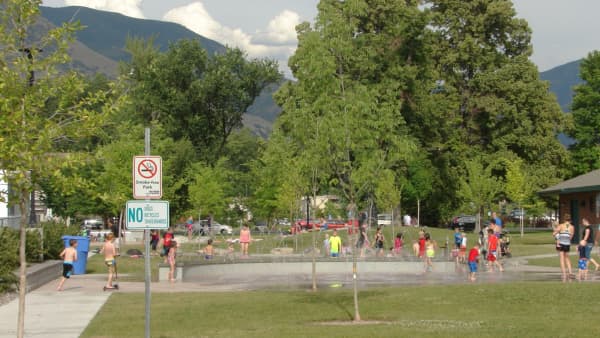
Splash pads have become close to standard in new Utah County parks, and they transform a summer visit — a playground plus water holds children roughly twice as long as a playground alone.
The catch is the season. Splash pads run on city-set schedules that typically start around Memorial Day and end well before the weather does, and some shut in mid-August when staffing changes. A September visit to a splash pad park is frequently a visit to a dry concrete pad. Check the city's page before driving.
Shade, and why it matters more here
Utah Valley sits at altitude with intense summer sun, and playground equipment gets hot enough to burn. Dark plastic slides in direct July sun are a genuine hazard rather than a discomfort.
Practical consequences: go in the morning or the evening in July and August, check a slide with your own hand before a small child uses it, and treat pavilions and mature trees as a feature worth choosing a park for rather than a bonus.
What to bring
A change of clothes if there is any water on site, because a child who was definitely not going to get wet will get wet. Sunscreen and hats. More water than seems necessary — this is a high desert and children do not notice they are dehydrating until they are.
Closed-toe shoes are worth insisting on at the big structures; sandals and rope climbing frames combine badly. A picnic blanket covers the case where the pavilion is taken. And if your child is small enough to lose in a crowd, a photo taken on arrival costs nothing and makes describing them trivial.
The unglamorous variables that decide the day
Ask any parent which park they return to and the answer is rarely about the equipment.
It is whether there is a bathroom and how far away it is. Whether there is shade at the hour you go. Whether you can see the whole play area from one bench. Whether parking is adjacent or a walk. Whether there is a fence between the playground and a road.
The parks on this list mostly score well on those, which is the real reason they earn a drive. A spectacular structure with no restroom and no shade is a forty-minute park regardless of how it looks in photographs.
Combining a park with the trail network
Several of these sites sit on or near Utah County's paved trail network, which turns a playground stop into a longer outing — ride or walk a stretch, stop at the park, ride back.
That works particularly well with children just confident on bikes, for whom a destination in the middle transforms a ride they would otherwise refuse. Our guide to every paved trail in Utah Valley sets out which paths connect where.
Picking by age
Under three: smaller and enclosed beats bigger. Sightlines are the whole game, and a large destination park with multiple exits is stressful rather than fun.
Three to six: themed and mid-sized parks work best — Shay Park's trains, the zoned parks with a toddler section.
Six to eleven: this is the destination-playground age. Adventure Heights, Discovery Park and Neptune Park's pyramid are built for exactly this band.
Twelve and up: most will be bored by equipment but not by a zip line, a rope pyramid or a park with courts attached. Art Dye's mix of playground and sports space is the pattern that works.
The county's older parks deserve a mention
This list skews new, because new parks have the features that justify a drive. But Utah County's older parks have something the new ones cannot manufacture for another thirty years: mature trees.
A 1970s park with modest equipment under full-grown cottonwoods is a better place to spend a July afternoon than a gleaming new structure on an unshaded lot, and parents of very young children often end up preferring them. If you are choosing a park for August rather than April, weight shade above equipment and the answer changes.
A note on the Provo and Orem parks this guide leaves out
The scope here is deliberately everything beyond the two big cities, because those are already well covered and well known.
Provo's and Orem's large inclusive playgrounds are among the best in the state and belong on any honest list of destination playgrounds in the valley — they are simply not this list. If you are starting from central Utah County, check those first and treat this guide as what to do once you have exhausted them.
Making a morning of it
The best of these visits pair the playground with something else in the same city. Neptune Park with the Monday market. Robinson Park with the American Fork library. A Pleasant Grove park with a stop on Main Street.
That framing also solves the drive problem. Twenty-five minutes for a swing set is hard to justify; twenty-five minutes for a morning out is not.
When the drive is not worth it
Worth saying plainly: if your child is under two, the nearest park with a swing beats the best playground in the county. If it is over ninety degrees at two in the afternoon, no playground is a good idea. And if the child is tired before you leave, a destination park is a long drive to a meltdown in an unfamiliar city.
The parks here reward a well-timed visit and punish a badly timed one more than a neighborhood park does, purely because you have committed a drive to them.
Two hours, planned
If you want a template rather than a list: leave early enough to arrive within an hour of opening in summer, bring water and a snack, plan for the child to get wet whether or not there is water, and have a second stop in the same city so the drive buys more than one thing.
Then let it run long. The mistake most parents make at a destination playground is treating it as a scheduled activity with an end time. The whole reason to drive to a big park is that it can absorb an entire morning, which is worth considerably more than the twenty minutes a neighborhood swing set buys.
Related Guides
- The Best Parks in Provo
- All Together Playground in Orem
- Trampoline Parks & Indoor Play Places in Utah Valley
- Toddler Activities in Utah Valley
- Utah Valley Farmers Markets, by Day of the Week
Frequently Asked Questions
What is a destination playground?
Which is the biggest playground in Utah County outside Provo and Orem?
Are there all-abilities playgrounds outside Provo and Orem?
Which playgrounds have splash pads?
What is at Neptune Park in Saratoga Springs?
Are these free?
What about winter?
Which is best for toddlers specifically?