
There is a second map of Utah Valley that most residents never see. It runs through city parks and trailheads, along the paved trails, up the canyons and across the benches, and it is marked by small containers hidden by strangers and logged by the people who find them. Geocaching has been running worldwide since the year 2000, and this valley, with its parks, trails and canyon roads, is well covered.
It is also one of the cheapest ways to get a family outside. You need a phone, a pen and an account, and suddenly an ordinary walk in a park becomes a search. This guide covers how the game works, the cache types and ratings, what to bring, the etiquette of trading and trackables, the rules that govern hiding a cache, and the land-access questions that matter here in particular.
The Short Answer
Create a free account, install the official geocaching app, and look at what is near you; there will be more than you expect. Start with traditional caches at low terrain ratings and larger container sizes, especially with children. Bring a pen, sign the logbook, put the container back exactly as you found it, and log your find. If you trade, leave something at least as good as what you take. If you want to hide your own cache, read Geocaching HQ's guidelines first: permission from the landowner is required, all local laws and land-management policies apply, and containers must sit at least 528 feet from another cache's physical stages.
How the Game Works
The mechanics are simple. Someone hides a container, gets accurate coordinates with a GPS-enabled device, and submits a cache page. A volunteer reviewer checks it against the guidelines, and once published, anyone can navigate to those coordinates and search.
Geocaching HQ's guidelines set out what a physical cache must contain: a logbook for geocachers to record their visit, which has to be physical, replaceable, easy to sign and enclosed in a container. That is the heart of the game. Finding the cache means signing the log, and an online find should follow an actual signature in the book.
The coordinates get you to within a few yards. The last stretch is the interesting part, because a cache might be a large ammo box under a deadfall or a magnetic container the size of a fingernail stuck under a railing. The listing's hint, its size and its difficulty rating are your guide.
The Cache Types You Will Meet
Traditional caches are the standard: a container with a logbook at the posted coordinates. Start here.
Multi-caches have at least one stage before the final container. The posted coordinates are the first stage, and each stage points to the next.
Mystery or puzzle caches require solving something before you can get useful coordinates. They range from trivial to fiendish.
Letterbox hybrids blend geocaching with letterboxing, the older hobby that uses written clues and a stamp.
EarthCaches have no container at all. Geocaching HQ partners with the Geological Society of America to run the program, and an EarthCache is an earth-science lesson that requires visiting a site; you log it by answering questions about what you see. In a state as geologically dramatic as Utah, these are worth seeking out.
Event caches are gatherings of geocachers, organized by geocachers for geocachers and anyone interested in learning the game. The guidelines note that anyone who physically attends may log one online and that attendees are not required to sign a logbook. Events called CITO, short for Cache In Trash Out, combine caching with cleaning up a park or trail.
Lab caches are an experimental type, played through a separate app and often set up as a series of stops around a town or attraction. They suit visitors and families, since there is no container to find.
Difficulty and Terrain, and Why They Matter Here
Every cache carries two ratings on a one-to-five scale. Difficulty is how hard the cache is to find once you are at the coordinates. Terrain is how hard it is to reach the coordinates at all.
In Utah Valley, the terrain rating deserves particular respect. A cache in a city park and a cache partway up a canyon trail can look equally close on a map, but one is a stroll and the other is a hike with a thousand feet of elevation, loose footing and no shade. Read the terrain rating and the recent logs before heading up.
For a family outing, our guide to scavenger hunts in Provo puts the rule well: filter hard for the easiest terrain rating and the largest container size, because small children find big boxes and give up on tiny magnetic containers. For teenagers, invert both and watch the same afternoon become a challenge.
What to Carry
A pen. The logbook has to be signed, and pens in caches are often missing or dried out.
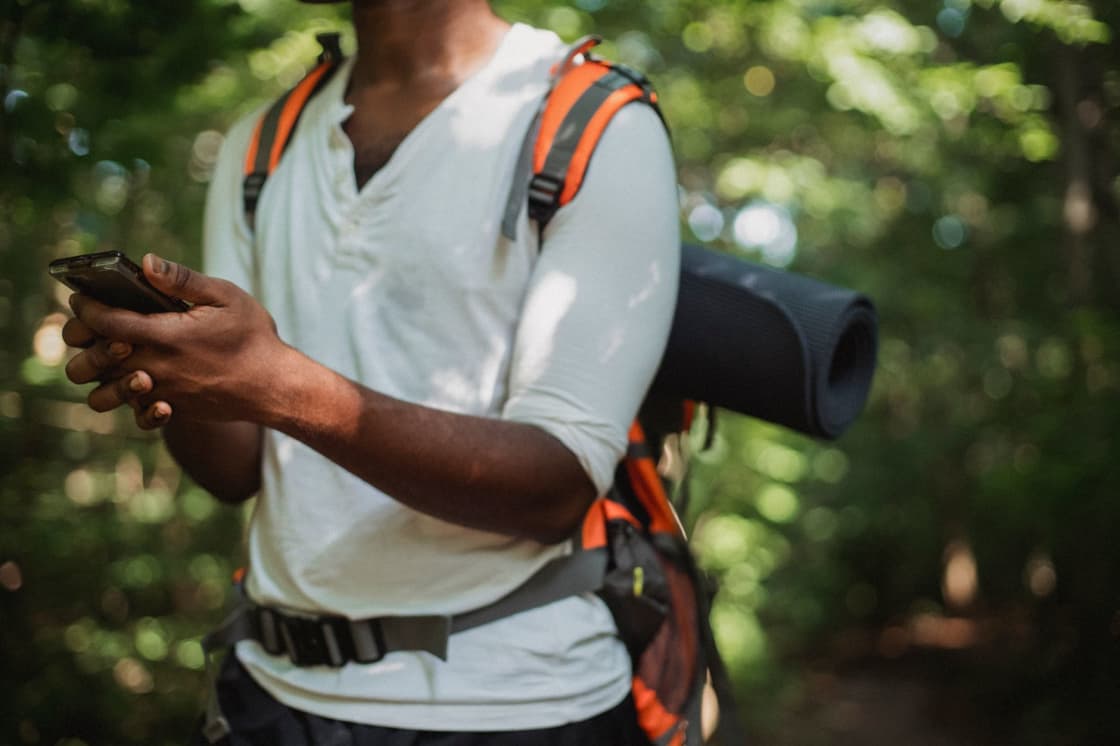
Your phone, charged, with the app and offline maps if you are heading into a canyon where service drops.
Water, sun protection and layers. This is high desert. Summer sun is fierce, canyon shade is cold, and the weather changes with elevation.
Sturdy shoes, since even easy caches often sit just off a path in gravel, brush or rocks.
Small trade items if you want to swap: inexpensive toys, keychains, foreign coins, patches.
Tweezers and gloves for tight hiding places, and a small flashlight for looking into crevices.
A trash bag. Picking up litter while you hunt is the CITO spirit, and it makes the activity welcome wherever you play.
The Etiquette of Finding
Sign the log and put the cache back exactly as you found it, in the same spot, the same way, camouflaged as it was. The next finder's experience depends on it.
Be discreet. Non-geocachers are called muggles in the hobby, and part of the game is finding the container without drawing attention to it. A cache that gets noticed by passers-by tends to disappear.
Trade fairly or not at all. Take nothing, or leave something at least as good.
Log honestly, including the ones you do not find. A did-not-find log is useful information for the cache owner and the next searcher.
Report problems. If a container is broken, soaked or clearly gone, say so in your log so the owner can fix it.
Leave no trace. Stay on trails where they exist, do not move rocks or damage vegetation to search, and take out whatever you brought in.
Trading, Swag and Trackables
The items in a cache, often called swag, are usually small and cheap, and the fun for children is the trade rather than the prize. Geocaching HQ's guidelines are firm about what may go in: contents must be suitable for all ages and for the outdoors, and the guidelines specifically prohibit illegal material; dangerous material such as explosives, ammunition, lighters, knives, drugs or alcohol; edible or scented items; items that can melt, such as crayons or lip balm; and items that can expand in the cold, such as liquids.
Trackables are the other layer. A trackable, often a travel bug, is a tag with a unique tracking number attached to an item, meant to travel from cache to cache while its owner follows the journey online. The etiquette is straightforward: before taking one, check its page to see whether you can help with its goal; log it promptly once you have it; and move it along to another cache reasonably soon, because trackables are meant to travel. Write down the tracking number before you drop it somewhere else, since you need it to log the move.
For children, trackables turn a find into a story. A tag that has crossed several countries and is now in a box in a Utah park makes the scale of the game suddenly real.
Where to Look in Utah Valley
We are not going to publish coordinates, partly because caches move and disappear and partly because the app does that job better. But some kinds of places are reliably productive.
City parks. Parks are the easiest starting point with children, because they usually come with parking, restrooms and a playground for afterward, and they are the kind of place cache owners favor.
Paved trails. The Provo River Parkway and the valley's other paved trails are lined with likely spots, and our guide to every paved trail in Utah Valley maps the routes. Caching by bike along a trail is one of the best versions of this hobby.
Trailheads and canyon pullouts. Canyon viewpoints, picnic areas and trailheads are natural cache territory, and Provo Canyon and the Alpine Loop have plenty of all three. Our Provo Canyon guide covers the stops.
Historic markers and downtowns. Caches often sit at places worth visiting anyway, which is the spirit the guidelines encourage. They quote a longtime member's advice to hiders: think about why you are bringing people to a spot, and if the only reason is the cache, find a better spot.
Geology. Filter for EarthCaches when you want the game to double as a field lesson; Utah's rock is the reason the type exists.
Land Access: The Part People Skip
This valley is a patchwork of city parks, county land, state land, Forest Service ground, private property and two university campuses, and the app presents them all the same way. Our scavenger hunt guide makes the point plainly: a cache in a city park, one on Forest Service ground, one on state trust land and one on a campus are four different legal situations.
As a finder, you are mostly insulated from this, but a few habits matter.
Obey posted signs, hours and closures, including park hours and gated trailheads.
Do not trespass to reach a cache. Geocaching HQ's guidelines say caches must not be placed where they require or encourage geocachers to trespass or pass markers that prohibit access, but mistakes get published. If reaching a cache would mean crossing a fence or ignoring a sign, log a note and move on.
Expect campus rules. Private campuses can ask you to leave for their own reasons.
Be ready to explain yourself. Someone poking around a parking lot with a phone attracts attention. A cheerful explanation usually ends the conversation, and many cache containers are labeled to help.
Hiding Your Own Cache
Hiding is where the responsibilities begin, and Geocaching HQ's guidelines are the authority. A few of their central points:
Find first. The guidelines encourage finding at least twenty caches before hiding one, because variety teaches you what makes a good hide.
Obey local laws. All local laws and land-management policies apply, to the placement and to the journey required to reach it.
Get permission. By submitting a cache page you agree that you have all necessary permissions from the landowner or land manager. On public property, that means permission from the agency or association that manages the land, and it is the cache owner's job to work out whom to ask. On private property, note the permission on the cache page.
Keep your distance. Containers and physical stages of different caches must be at least 0.1 miles, which is 528 feet or 161 meters, apart.
Choose the container wisely. It must hold the logbook and should be waterproof. The guidelines suggest labeling it as a geocache, using a transparent container so the contents are visibly harmless, and including instructions for finders. They also say to avoid containers that could reasonably be perceived as bombs or other dangerous items, and to permanently cover or remove military markings.
Hide close to home. Vacation caches are usually not published, because they are hard to maintain.
Maintain it. Owners are expected to monitor logs, respond to problems, post maintenance logs, update the page when conditions change, and disable the listing while a problem is being fixed.
Responsibility is yours. The guidelines state plainly that Geocaching HQ and its volunteers are not responsible or liable for caches or their placement, that all aspects of your cache and its placement are your responsibility, and that you may be held liable for the consequences.
Add to that the common-sense rule from our scavenger hunt guide: never hide anything near utility cabinets, bridge abutments, transformer housings, road structures or school perimeters. A taped container in one of those places does not read as a game to a passer-by.
A First Outing, Step by Step
Before you leave. Create an account, install the app and look at the map around your own neighborhood. Pick two or three caches with high find rates, low terrain ratings and recent successful logs, and read the most recent logs on each; a string of did-not-finds means the container is probably gone. Save them offline if you are heading anywhere with thin service.
At the coordinates. Expect the arrow to wander in the last few yards, because phone accuracy degrades near buildings, cliffs and heavy tree cover. Stop walking, look at the terrain and think like the person who hid it. Where would a container survive weather, landscapers and passers-by? The answer is usually a spot that is sheltered, reachable without climbing and not obvious from the nearest path.
Search systematically. Work outward from the coordinates in a spiral rather than wandering. Check the hint on the listing before you give up, and look at the size rating: a container listed as micro will never be under that log, and one listed as regular will not be inside a bolt hole.
When you find it. Step out of sight if anyone is watching, open it carefully, sign and date the log, look at the contents, and trade if you want to. Close it properly and put it back exactly where it was, including whatever rock or bark was covering it.
Afterward. Log the find in the app while it is fresh, mention anything the owner should know, and move on to the next one. Most people find the second cache far faster than the first.
Why It Fits This Valley
Geocaching suits Utah Valley for reasons that go beyond the number of hidden containers. It gives a purpose to walks that children would otherwise resist, which matters in a place with more family-sized households than most. It works in the gaps of a busy week: fifteen minutes at a park after school, a stop at a trailhead on the way home. It costs nothing beyond what you already own. And it rewards the thing the valley has in abundance, which is varied ground within a short drive, from lakeshore flats to canyon benches to alpine meadows.
It also travels. A family that starts caching here will find caches wherever it goes, and the habit of looking at an unfamiliar place and asking what is hidden nearby turns out to be a durable one.
Making It Work With Children
Pick easy caches and lots of them. Three quick finds beat one long hunt.
Let children hold the phone and call the direction, even when it is wrong.
Bring the trade items and let each child choose one swap per cache.
Set a time limit and be willing to walk away from a cache you cannot find; a did-not-find log is a normal part of the game.
Pair it with a destination, such as a playground, a picnic or an ice cream stop, so the outing is a success either way.
Our guides to family activities in Utah Valley and free things to do in Provo have more ideas for the rest of the day.
Seasons in This Valley
Spring and fall are ideal: mild temperatures, open trails and comfortable searching.
Summer means early mornings or evenings. Midday heat on an exposed bench is punishing, and shaded canyon caches are far more pleasant. Watch for snakes in rocky ground and check for ticks after brushy searches.
Winter closes the high country and buries ground-level caches. Many cachers switch to urban caches and parking lots, and some caches are seasonally disabled by their owners. Read recent logs before driving to a trailhead.
After storms, expect containers to have shifted or flooded, and be careful on wet rock and muddy trails.
The Short Version
Geocaching is a free, worldwide game that turns any walk in Utah Valley into a search. Get the app, start with traditional caches at low terrain ratings, carry a pen, sign the log, replace the container exactly as you found it, and trade fairly. Move trackables along. Respect posted signs and never trespass to reach a cache. If you decide to hide one, read Geocaching HQ's guidelines first, get real permission, keep 528 feet from other caches, choose a container nobody will mistake for something dangerous, and commit to maintaining it.
Related Guides
- Scavenger Hunts in Provo
- Every Paved Trail in Utah Valley
- Family Activities in Utah Valley
- Free Things to Do in Provo
- Provo Canyon: The Complete Guide
- Where to See Moose, Elk and Deer Around Utah Valley
Frequently Asked Questions
What is geocaching?
Is geocaching free?
Do I need a GPS unit, or will a phone do?
What do the difficulty and terrain numbers mean?
What should I take with me?
Can I take what is inside the cache?
Can I hide my own cache anywhere?
What is a trackable or travel bug?
Sources
The facts in this guide were checked against these sources. Hours, fees and rules change, so confirm anything time-sensitive with the source before you go. How we make Provo.com.
- Geocache hiding guidelines, Geocaching HQ (Groundspeak). Checked October 12, 2026.