
The snow day in Utah Valley is mostly a myth, and the reasons are instructive. The valley floor gets a handful of real storms a winter, the cities plow the arterials overnight, the school buses run on the plowed routes, and the three districts that educate the county's children have decades of practice running school through a foot of snow. When a storm does close them, it is a valley-wide event that people remember by year. What a Utah County parent actually deals with is the delayed start, the remote-learning day that replaced the closure after 2020, the wind day, the power-outage day, and — far more often than any of those — the red-air day when the inversion sits on the valley and recess moves indoors.
This guide is for the parent of a school-age child on the morning school does not happen the normal way. It covers how the districts decide and announce, what the alternatives to a closure look like, the other reasons school changes here, the sledding hills and the safety rules that matter on a valley where snow sits on ice, what is open indoors on a storm day, the free version, and the working parent's scramble. Our winter activities guide covers the season as a whole and the sledding guide rates the hills; this page is about the day itself.
Why Schools Here Almost Never Close
Three districts educate Utah County's public-school children — Alpine in the north (splitting into successor districts in 2027), Provo City in the middle, and Nebo in the south — plus the charters, which decide independently. All three close for snow rarely, for reasons that compound:
The plowing. The cities plow arterials and bus routes overnight as a matter of course, and a valley storm that would paralyze a Southern city is a normal Tuesday for a Utah County road crew. Our weather guide explains why the valley floor gets less snow than the benches and the canyons, which is the other half of the reason.
The buses. The districts' transportation departments run the routes on the plowed roads and delay rather than cancel when the side streets are bad; a one- or two-hour delayed start is the common response to an overnight dump, giving the plows and the daylight time to work.
The alternative. Since 2020, all three districts have a remote-learning-day option: school happens online from home, attendance is taken, and the day counts toward the state's required instructional days without a make-up. The districts have used it in place of a closure for the worst storms, which means the day school does not happen in person here is more often a remote day — with a child expected to log in at a set time — than a free one.
The culture. Utah is a state that treats snow as weather rather than emergency, and the districts reflect it. A parent from a state where two inches closes everything should recalibrate: the closure threshold here is a foot on the valley floor with more falling, or ice that the plows cannot beat by 6 a.m.
Full closures do happen — the storms that dropped a foot or more on the valley floor in a single night have closed all three districts a few times in the last decade — and when they do, the whole valley knows by breakfast.
How to Find Out
The district decides and announces; everyone else repeats it. The order of reliability:
- The district's parent-notification system — the texts and emails you signed up for at registration. This is why the phone number on file must be current. A morning decision typically goes out by 5:30 or 6 a.m.
- The district's website and social accounts, which post the same decision at the same time.
- The local TV stations and KSL, which carry a statewide closure list fed by the districts.
- Your school's own channels, for a school-specific closure (a power outage, a broken boiler).
Charter schools decide independently and announce on their own; several follow their host district's call, but check. Individual district schools do not close on their own for weather. The rule of thumb: no word by 6:15 means school is on, and the district site — not a neighbor's group text — is the authority when the texts conflict.
The three decisions a district makes, in ascending order of disruption: delayed start (one or two hours, buses late, breakfast programs adjusted); remote-learning day (log in from home at a set time, attendance taken); closure (no school, no remote, made up or absorbed under state rules). The announcement names which.
The Other Days School Changes
Wind. The canyon-mouth winds — the north county's bench cities, Lehi's Traverse Mountain, the mouth of Provo Canyon — have gusted past what a school bus can safely run in, and the districts have delayed buses or closed schools on the affected routes. It is the most common weather closure in the north county, and it comes with no snow at all.
Cold. An extreme-cold morning — the valley's inversions can trap single-digit air for days — has prompted delays for bus-stop safety, and the districts issue cold-weather guidance on what to wear at the stop.
Power outages. A storm that takes out a school's power closes that school, not the district; the announcement comes by school, often mid-morning after the building has tried to run without heat. Our power outage guide covers the household side.
Air quality. The inversion's red-air days do not close schools. They move recess indoors under the state's air-quality recess guidelines, reduce bus idling, and are the days a child with asthma should stay home; the school nurse and the district's air-quality page explain the thresholds. A Utah County school year has far more indoor-recess days than snow days, which is why the indoor-activity plan below is the one you will actually use. Our allergy and asthma guide covers the medical side.
Flooding and canyon closures. Spring runoff, not winter, and covered in our runoff guide.
The Sledding Hills
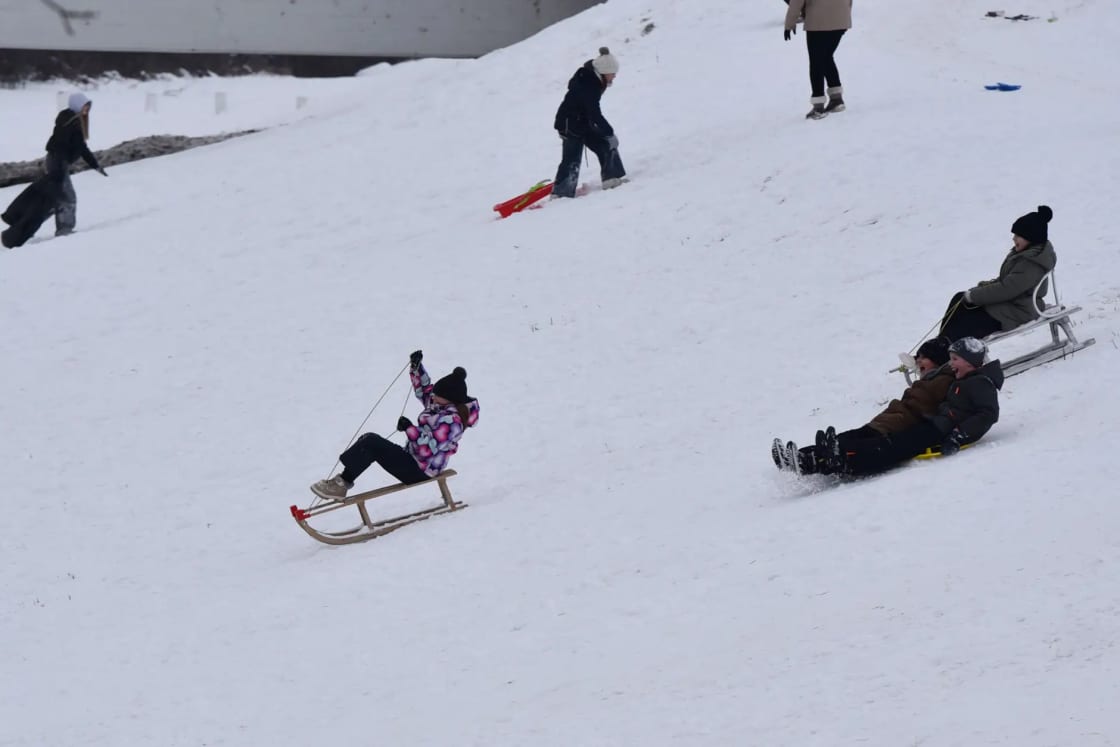
The valley's snow days come with ice underneath. Storms here often follow a thaw, so the new snow sits on a glazed layer on every sidewalk, driveway and hill, and the morning's soft snow becomes an afternoon luge track. Our sledding guide rates the county's hills by the thing that matters — the runout — because the hill that ends in a parking lot or a street is the one that produces the emergency-room visit.
The standards: Rock Canyon Park in Provo, the Orem hills near Lakeside and the cemetery, Kiwanis Park, the golf-course slopes when the courses permit it, and the neighborhood berms and church-lot mounds every kid in the county knows. The deeper snow is at the canyon pullouts — Squaw Peak Road's lower reaches, the closed gates of the Alpine Loop — once the road is plowed to them, with longer runouts and colder air. Go in the morning while the snow is soft; helmets on; nobody sleds toward a road; nobody sleds behind a vehicle, which the sheriff's office warns about every winter after someone does it anyway; and come in when the gloves soak through, because the valley's snow is wet at this elevation.
For the sanctioned version: Soldier Hollow's tubing hill in the Heber Valley, covered in our Soldier Hollow guide, runs lift-served tubing lanes with groomed runouts and is the county's answer to a sledding day with a small child who cannot climb.
What Is Open Indoors
The businesses that close on a valley snow day are the ones whose staff cannot get in, which is few; the good indoor places know a snow day when they see one and are full by 11.
The rec centers. Provo's, Orem's, Lehi's, American Fork's and the rest open on schedule, and the indoor pools — Provo's with its lazy river and slides — are the cheapest hour of energy-burn in the county on a day pass. Several have run snow-day and no-school-day camps on short notice. Our rec center guide covers Provo's.
The trampoline parks and indoor playgrounds. Open on schedule, full by mid-morning; our trampoline parks guide covers the age rules and the toddler-time windows, which are the calm ones.
The libraries. Open, warm, free, and running programs; the Provo City Library's children's floor is the county's best free morning.
The museums. Thanksgiving Point's museums in Lehi open on schedule; the BYU museums are free and empty on a weekday storm morning; our dinosaur museums guide and Provo museums guide cover them.
The movie theaters. Matinees run. The climbing gyms, the skating rinks, the bowling alleys. Open. Our indoor activities guide lists the rest.
Check the venue's social feed before driving on a bad-road morning; the exception — a place whose staff lives up a canyon that is not yet plowed — happens.
The Free Version
The snow itself, first: a snowman, a fort, a walk to the neighborhood hill, hot chocolate after. The libraries. A quiet walk on the plowed sections of the Provo River Parkway in falling snow. The free BYU museums. A drive to the mouth of Provo Canyon to watch the river and the snow, which is a valley tradition that costs a tank of gas and nothing else. And the spontaneous neighborhood gathering — someone's driveway, a group text, six kids and a hill — which is the version most of Utah County actually does, and which works because the county's neighborhoods are full of children the same age. Two additions that cost nothing: the plowed church parking lots become impromptu snow-fort grounds by mid-morning, and the county's bench parks — Rock Canyon, Kiwanis, the Orem cemetery hill — are where the whole neighborhood ends up by noon, sleds or not, which is the closest thing the valley has to a snow-day town square.
The Working Parent's Scramble
It is the same scramble as everywhere, with three local features. The county's large employers — the hospital systems, the universities, the tech companies of the Lehi corridor — mostly allow remote work on a storm day, and that is the actual childcare plan for a majority of Utah County parents. The extended-family density is the second: a large share of the county's parents have grandparents within twenty minutes, and the snow day is what they are for. The third is the ad-hoc camp: the rec centers and some indoor play places announce a snow-day camp on their social feeds the morning of, and the after-school providers that operate inside the schools often shift to a full day on a closure.
The remote-learning model complicates all of it. A child who must log in at 8:30 for attendance is not a child who can go to a camp or a grandparent's without a laptop and a connection; ask the district which model it is using — the announcement says — before you book anything. Our new parent guide covers the childcare landscape for the years before school.
A Plan by Age
Under five. The yard, for as long as the child lasts, which is twenty minutes; then the library or the toddler-time session at an indoor playground, which on a snow day is the calm window; then a nap. A small child on a real sledding hill is a passenger, not a sledder, and belongs on the gentle neighborhood slope with a parent at the bottom.
Five to nine. The hill, in the morning, for as long as the snow is soft; a warm-up at the rec center pool or the library; the fort in the yard in the afternoon. This is the age the snow day was invented for, and the age the safety rules are for.
Ten and up. The bigger hills — the canyon pullouts, the golf-course slopes — with friends and a parent who drives; the climbing gym or the trampoline park with the school-day crowd gone; a remote-learning-day child at this age can be trusted to log in and then go out, if the district's schedule allows it.
The teenager. Is asleep, and then wants a ride to the resort. Sundance and the Cottonwood resorts run on a storm day and the powder is the point; our learn-to-ski guide and ski pass guide cover the cost, and the canyon-driving rule applies doubly.
The Day After
The valley's snow days have a second act that catches newcomers: the morning after, when the plowed snow has frozen into ridges at every driveway apron and the sidewalks that were slush at 4 p.m. are sheet ice at 7 a.m. Cities require homeowners to clear their sidewalks — Provo's ordinance gives a set number of hours after the snow stops — and the walk to school on the day after a storm is more dangerous than the storm day itself. Salt or sand the walk and the driveway the evening before, send the kids out in boots with tread, and expect the bus to be late again. The frozen-pipe risk that follows a cold snap is covered in our frozen pipes guide, and the sprinkler-system version in the winterization guide, because the storm that closes school is also the one that finds the unwinterized hose bib.
The Safety Rules, Stated Once
Ice underneath, always. Helmets on sleds. No sledding toward a street or a lot. No sledding behind a vehicle. No playing on the plow berms at intersections, where drivers cannot see a child. Layers with a waterproof shell; in when the gloves soak. Kids off the roads — plow drivers and commuters on ice are the danger. Canyon roads are closed to a family car until the plows have been through twice; our canyon-driving guide explains why. And on a red-air day, the child with asthma stays in, and the rest play inside anyway; heavy exercise in the inversion is what the health department tells everyone to avoid.
The Short Version
Utah County schools almost never close for snow; they delay, or they run a remote-learning day, and the district's texts by 6 a.m. tell you which. Wind, cold, outages and red air change school more often than snow does. When the day is free: the neighborhood hill in the morning while the snow is soft, with a helmet and a runout that ends in grass; the rec center pool, the library, the trampoline park or the museum when it is not; the driveway and the hot chocolate for the free version. The ice underneath is the whole safety story. Keep your number current with the district, check the announcement for "remote" before you plan a camp, and treat the canyons as closed until plowed.
Related Guides
- Things to Do in Provo in the Snow: The In-City List
- Sledding in Utah Valley
- Winter Activities in Provo and Utah Valley
- Indoor Activities in Provo
- Trampoline Parks and Indoor Play Places
- Provo Recreation Center: The Complete Guide
- Provo Weather, Explained
- Soldier Hollow: The Complete Guide
- Winter Tires and Canyon Driving in Utah
Frequently Asked Questions
How often do Utah County schools actually close for snow?
How will I find out if school is closed or delayed?
What other reasons do schools close or change here?
Where can kids sled?
What is open indoors on a storm day?
What can we do that is free?
What do working parents do when school is closed?
What are the safety rules for a Utah Valley snow day?