
Utah Valley sits at the foot of some of the best big-game country in the West, and every so often the wild comes down to meet the suburbs. Mule deer browse the ornamental shrubs in foothill neighborhoods on winter mornings. Elk herds appear on snowy benches at dusk. And a moose, the biggest and least predictable of the three, occasionally wanders out of a canyon and into someone's backyard, to the delight of the neighbors and the alarm of the Division of Wildlife Resources.
Seeing these animals is one of the real pleasures of living here, and doing it well takes a little knowledge: when and where to look, how close is too close, why feeding them does harm, and how to keep a sighting from turning into a collision on the drive home. This guide covers all of it, drawing on the Utah Division of Wildlife Resources, the state agency that manages the animals, and on Provo's own city code.
The Short Answer
Look at dawn and dusk, when the animals are active and out in the open. Mule deer are the easiest to see, especially in winter along the benches on the east side of the valley. Elk move to lower ground in winter and can sometimes be seen from canyon and bench roads at first and last light; for a close look, the DWR's Hardware Ranch in Cache County runs sleigh and wagon rides among wintering elk. Moose live in the canyons and forested mountains, favoring willows and water, and they are occasionally seen in Provo Canyon and along the Provo River corridor; the Uinta Mountains are among the best places within a day's drive to find one. Whatever you see, keep your distance, keep dogs leashed, never feed the animals, and slow down on canyon roads after dark.
Meet the Three
Mule deer are the common deer of Utah Valley, named for their large, mule-like ears. They are the animal most residents see most often, and in winter they are almost routine in the foothill neighborhoods on the east side of the valley. Bucks grow antlers each summer and shed them in late winter; does usually give birth in late spring, and a fawn lying still in the grass is almost always waiting for a mother who is nearby.
Rocky Mountain elk are Utah's state animal, and they are much larger than deer, with pale rumps and, in bulls, sweeping antlers. Elk live in herds, spend summer high in the mountains, and drift down to lower, less snowy ground in winter. In early fall, during the breeding season known as the rut, bulls bugle, a high, eerie call that carries across canyons at dusk and is one of the great sounds of the mountain West.
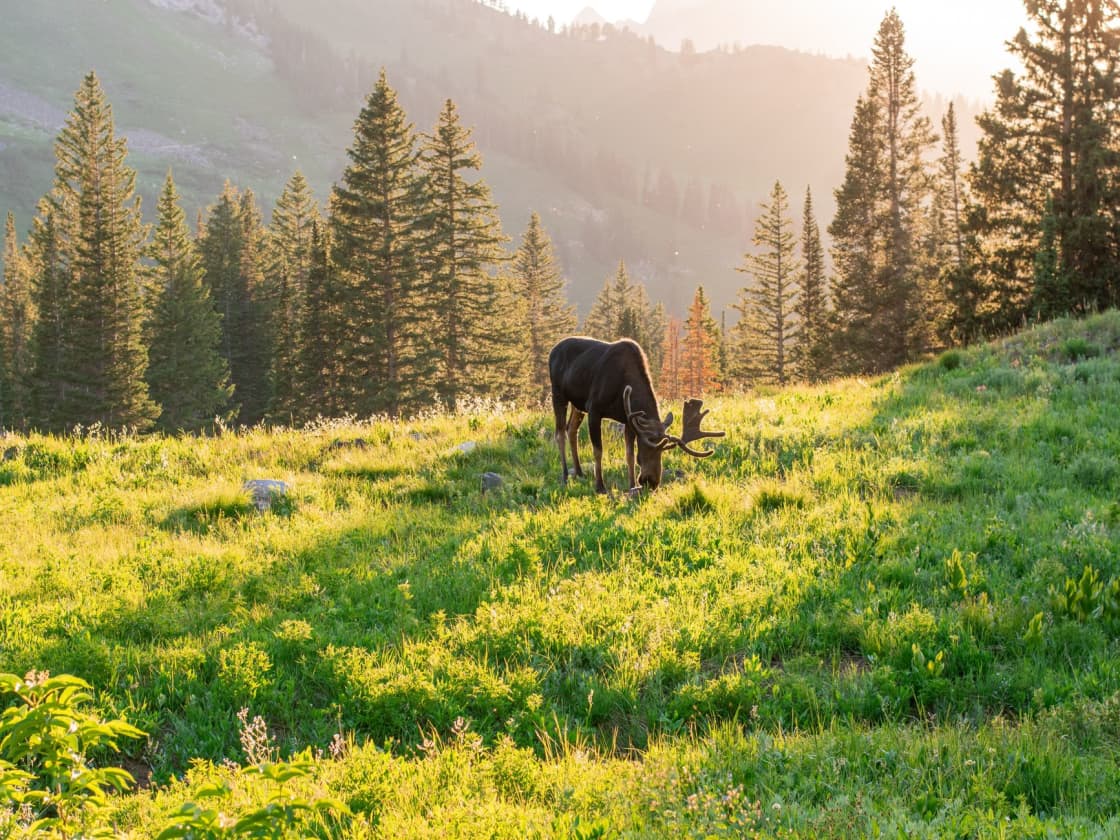
Moose are the largest members of the deer family. The Division of Wildlife Resources says adult moose in Utah weigh between six hundred and a thousand pounds, and bulls can stand six feet tall at the shoulder. The state is home to an estimated two and a half to three thousand of them, living mostly in forested areas along the Wasatch Front and in northern and northeastern Utah; the DWR notes that moose are not found in the Moab area and are rare in southeastern Utah. Moose are not predators, and that is exactly why people underestimate them. They are defensive, easily stressed, and far quicker than their size suggests.
When to Look
Time of day. Dawn and dusk are best for all three animals. They feed in the open in the cool of the morning and evening and bed down in shade through the heat of the day, so a midday drive in summer usually turns up nothing.
Winter. Snow pushes deer and elk down from the high country to winter range on lower slopes, which is when valley residents see them most. It is also the hardest season for the animals, which are living off stored fat, so winter is the season when disturbing them costs them the most. Watch from a distance, and do not chase animals for a better photograph.
Spring. Late spring and early summer bring newborn fawns and calves. The DWR warns that moose cows are especially defensive when they have calves, and a cow with a calf is an animal to give a very wide berth.
Fall. The rut changes behavior. The DWR says bull moose become more territorial during the fall breeding season, and bull elk are more active and more visible, bugling at dawn and dusk. Give bulls extra room in September and October.
Where to Look Around the Valley
Wildlife does not keep a schedule, and we are not going to promise a sighting at any particular turnout. But some places give you much better odds than others.
The east benches. In winter, the foothills along the east side of the valley, from the neighborhoods below the mountains to the bench trails above them, are the most reliable place to see mule deer, often at first light. Please enjoy them from the car or the sidewalk rather than approaching.
Provo Canyon and the Provo River corridor. Our Provo hiking guide notes that moose are occasionally spotted in Provo Canyon, and the river corridor up through Deer Creek and Jordanelle is rich habitat. Jordanelle's Rock Cliff area, on the Provo River, is known for wildlife along the river corridor. Our guides to Provo Canyon and to Deer Creek and Jordanelle cover the canyon's stops and the park.
The high meadows. Moose favor willow-lined streams and wet meadows at elevation, and elk graze open meadows at the edges of forest. The Alpine Loop's high country and the canyons branching off the valley have plenty of both, and a quiet evening at a meadow's edge is the classic way to find them. Our Alpine Loop guide covers the drive and its seasonal closure.
The Uinta Mountains. For moose in particular, the Uintas are the best bet within a day's drive. The Mirror Lake Highway climbs from Kamas into the northeastern Utah high country, one of the regions where the DWR says most of the state's moose live, with lakes, willows and meadows at every turn. Our Mirror Lake Highway guide covers the route, the fee and the season.
Hardware Ranch, for elk in winter. The one place that all but guarantees a close look at elk is the DWR's Hardware Ranch Wildlife Management Area in Blacksmith Fork Canyon in Cache County, well over two hours north of Provo. In winter, the DWR offers horse-drawn sleigh and wagon rides on the management area on the days its Wildlife Education Center is open, which the agency describes as a unique chance to see elk up close in their natural habitat. In its most recent season, the center opened on winter weekends from December into mid-February, with other exhibits on select autumn weekends. Check the DWR's Hardware Ranch page for the current schedule before you make the drive.
The Moose Rules
The Division of Wildlife Resources publishes the same advice every year, and it is worth memorizing.
Give moose plenty of space and watch their behavior. There is no safe distance that fits every situation, so err on the side of far.
Never approach or feed a moose.
Keep dogs leashed and under control. The DWR says moose see dogs as predators and may charge, kick or stomp to defend themselves, and it is against Utah law to allow dogs to chase or harass protected hoofed wildlife such as moose. Dogs are one of the most common causes of moose conflicts.
Know the warning signs. A moose that lowers its head, raises the hair on its neck, licks its snout or pins its ears back is telling you to leave. Create more distance immediately.
If you meet one, stay calm and do not run. Talk so the moose knows you are there, and back away slowly in the direction you came.
If it charges, get behind something solid, such as a tree, a vehicle or a building.
If it knocks you down, curl into a ball, protect your head and lie still until the moose leaves.
If you see a moose in town, report it. The DWR asks people to report moose within city limits or in heavily populated lower-elevation areas, so that biologists can relocate them, and it warns against trying to herd a moose out of a yard or off a road. Its biologists relocate several urban moose each year, and a moose left in a neighborhood can injure someone or be hurt by fences and traffic.
The agency also notes that there are several reports each year of moose injuring people or dogs on Utah trails and in mountain recreation areas. One of its longtime wildlife coordinators has said that of all the animals he has dealt with, including bears, rattlesnakes and cougars, the moose was the only one that ever turned and came back at him.
Deer and Elk: Quieter, Still Wild
Deer and elk are less likely than moose to charge, but they are large wild animals, and the same basic courtesy applies. Stay well back, especially from does with fawns and from bulls during the rut. Never try to touch or pet a deer, however tame it seems in a neighborhood, and keep children close. A frightened deer can strike with its hooves, and a bull elk in the rut is not an animal to argue with.
Leave fawns and calves alone. A young animal alone in the grass has almost always been left there deliberately by its mother, who stays away to avoid drawing predators. Watch from a distance and go on your way; handling it or moving it does far more harm than good. If you believe an animal is injured, contact the Division of Wildlife Resources rather than intervening yourself.
Why You Should Never Feed Them
Feeding deer, elk and moose feels kind, especially in a hard winter. It is one of the worst things you can do for them.
The DWR's guidance is blunt. Outside certain cities that have enacted no-feeding ordinances, it is not illegal to feed wildlife, but the agency strongly discourages it, citing public safety, the spread of chronic wasting disease among deer, elk and moose, and the harm that unfamiliar foods do to animals whose digestive systems are adapted to a sparse winter diet. Concentrating animals at a feeding spot spreads disease, draws them into traffic and neighborhoods, and teaches them to lose their fear of people.
Some cities restrict it. Certain Utah cities have enacted no-feeding ordinances, and the rules differ from city to city, so check your own city code before you put anything out.
Baiting is a separate matter. State law makes it illegal to bait big game to hunt it, and the DWR treats violations seriously.
On the Road: Avoiding a Collision
For most residents, the likeliest close encounter with a deer, elk or moose is through a windshield. Collisions with deer and elk cluster in autumn and winter, as our guide to day trips from Provo notes, and most happen in darkness or in the low light of dawn and dusk.
Slow down on canyon and rural roads after dark, especially where you see wildlife-crossing signs, and scan the shoulders as well as the road.
Where there is one deer, there are usually more. If one crosses in front of you, expect others to follow.
Watch for eyeshine, the reflection of your headlights in an animal's eyes, and use high beams when there is no oncoming traffic.
Brake firmly and stay in your lane. Swerving hard to avoid an animal can put you into oncoming traffic or off the road, which is often worse than the collision itself.
Moose are the special danger. A moose is so tall that a car can strike its legs and bring the body down onto the windshield and roof, and its dark coat does little to reflect headlights. Treat any moose near a road as a serious hazard and slow right down.
Photographing Wildlife Responsibly
Use a long lens and your car. A vehicle makes an excellent blind, and animals are often calmer around a stopped car than around a person on foot. Pull fully off the road, and never stop in a travel lane.
Let the animal decide the distance. If it stops feeding, stares at you or moves away, you are too close. Back off.
Do not call, whistle, bait or chase an animal for a better shot.
Keep drones away from wildlife. They stress animals and are restricted in many parks and protected areas.
Borrow binoculars before you buy them. Provo City Library lends binoculars through its Library of Things, and our guide to free passes and equipment on a library card explains how to borrow them.
Watching With Children
Children remember their first moose or elk for years, and a little preparation makes the moment safer and better. Talk before you go about staying quiet, staying close and staying back. Give each child a job, such as spotting from the back seat or keeping a tally in a notebook. Bring binoculars so the animal can be close in the eyepiece rather than close in fact. And if you want a guaranteed experience for small children in winter, Hardware Ranch's sleigh rides are made for exactly that.
The Short Version
Look at dawn and dusk. Mule deer are common on the east benches in winter; elk move to lower ground in winter and can be seen up close at the DWR's Hardware Ranch sleigh rides in Cache County; moose live in the canyons and are occasionally seen in Provo Canyon and along the Provo River, with the Uintas the best bet for seeing one. Give every animal plenty of room, keep dogs leashed, learn the moose warning signs and what to do if one charges, and report a moose in town rather than herding it. Do not feed deer, elk or moose, which the DWR strongly discourages and Provo's code restricts. And slow down on canyon roads after dark, because the likeliest place to meet any of them is in your headlights.
Related Guides
- Provo Canyon: The Complete Guide
- The Alpine Loop Scenic Drive
- Mirror Lake Highway and the Uintas From Provo
- Deer Creek and Jordanelle
- The Best Hikes in Provo
- Birdwatching at Utah Lake and the Provo River Delta
- Day Trips From Provo
- Free Passes on a Library Card in Utah Valley
Frequently Asked Questions
Where can I see moose near Provo?
What should I do if I meet a moose on a trail?
How can I tell if a moose is about to charge?
Is it legal to feed deer in Utah Valley?
Where can I see elk in winter?
When is the best time of day to see wildlife?
Should I keep my dog on a leash in moose country?
What should I do if I see a moose in town?
Sources
The facts in this guide were checked against these sources. Hours, fees and rules change, so confirm anything time-sensitive with the source before you go. How we make Provo.com.
- How to avoid conflicts with moose in Utah this summer, Utah Division of Wildlife Resources. Checked October 12, 2026.
- Visit us: Hardware Wildlife Management Area, Utah Division of Wildlife Resources. Checked October 12, 2026.
- Supplemental winter feeding of deer, Utah Division of Wildlife Resources. Checked October 12, 2026.