
Utah Valley has an unusual problem for a place with seven temples: if you are not a member of the Church, or you are a member without a current recommend, you have almost no way to see inside any of them. The buildings shape the skyline of every city in the county and most residents have never been past the foyer.
Open houses are the exception, and they are brief. For a few weeks before a new or newly renovated temple is dedicated, the doors open to anyone. Then they close, and for that building they do not open again for decades.
This guide covers how that cycle works, where Utah Valley currently sits in it, and what is coming — as opposed to what people assume is coming.
The Short Answer
There is no open house running in Utah Valley right now. The most recent one, for the Lindon Utah Temple, ran in spring and the temple was dedicated in May, which closed out the current cycle for the county.
Seven temples are dedicated in Utah County: Provo Utah Rock Canyon, Mount Timpanogos, Payson, Provo City Center, Saratoga Springs, Orem and Lindon.
Two more are announced but not built: Lehi and Spanish Fork. Announced means a site and a design process, not a schedule. Expect years.
The one to watch is the Provo Utah Rock Canyon Temple, which has been closed for reconstruction since February 2024. Rebuilt and renovated temples are rededicated, and a public open house normally precedes rededication. That is the most likely next chance to walk through a temple interior in this valley.
How the Cycle Works
The sequence is consistent enough to plan around, and understanding it prevents a lot of false anticipation.
Announcement. Temples are announced by the President of the Church, almost always at general conference in early April or early October. An announcement names a city, not a site, a design or a date.
Site selection and design. Months to years. The site gets announced separately, which is its own local news event and frequently the point at which a community first learns exactly where the building will go.
Groundbreaking and site dedication. A ceremony presided over by a Church leader, marking the start of construction.
Construction. Typically several years for a temple of ordinary size.
Media day and invited tours. A few days before the public open house, media professionals tour first, followed by invited guests. This is when the first interior photographs are released, and it is worth watching for if you cannot attend in person.
The public open house. Usually around a month, closed on Sundays, and closed on any Saturday that collides with general conference. Anyone may attend, of any faith or none.
Dedication. A dedicatory session, broadcast to congregations across the temple district. After dedication, interior access is limited to members with a current recommend.
The Lindon temple is a clean worked example of the whole arc: announced in October 2020, ground broken in April 2022, media day and invited tours in early March 2026, a public open house from mid-March to early April 2026 — skipping Sundays and the general conference Saturday — and dedication on 3 May 2026. Just over five and a half years, announcement to dedication.
The Seven, and Where They Came From
The order tells you something about how fast this valley has grown.
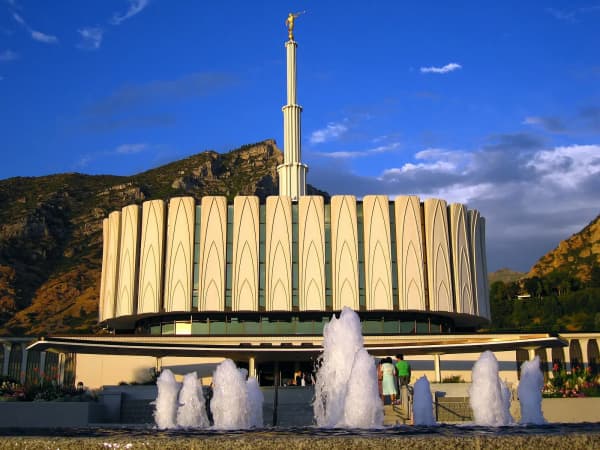
Provo Utah Rock Canyon Temple (1972). For decades simply the Provo Utah Temple. It closed on February 24, 2024 for reconstruction and was renamed the Provo Utah Rock Canyon Temple at that point, which is why it is the pivot of the next section.
Mount Timpanogos Utah Temple (1996). In American Fork, serving the north end of the county.
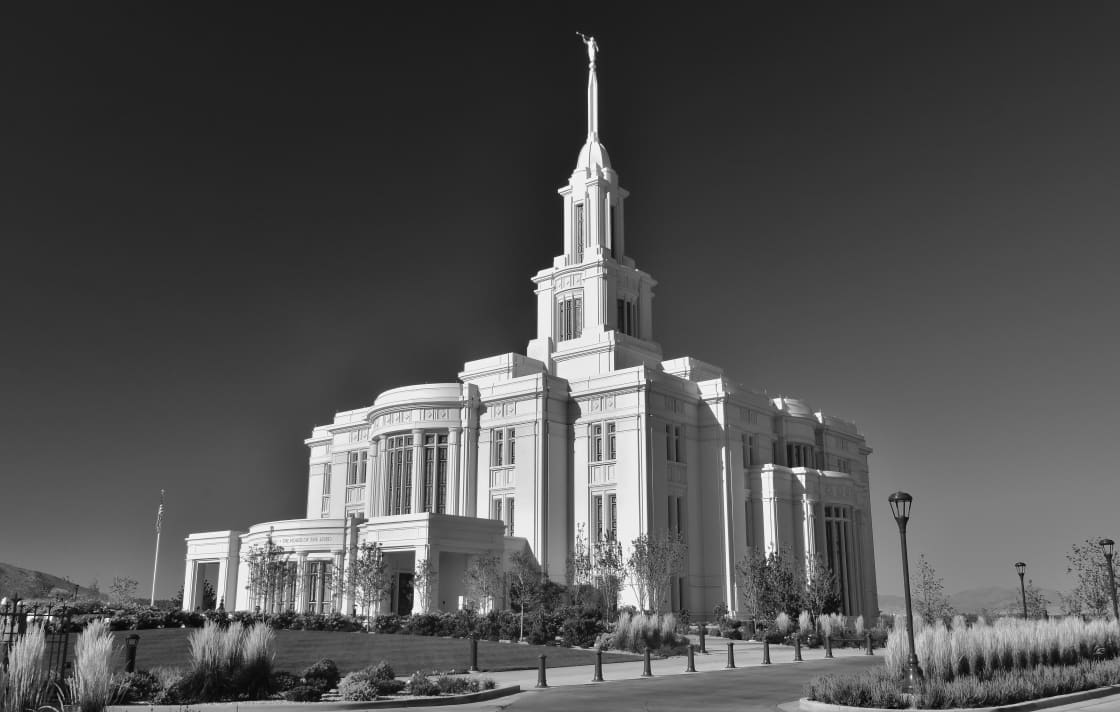
Payson Utah Temple (2015). The south county.
Provo City Center Temple (2016). Built inside the shell of the Provo Tabernacle after a fire gutted it, which makes it one of the most architecturally unusual temples anywhere and the one visitors most often ask about.
Saratoga Springs Utah Temple (2023). The west side, following the explosive growth around Utah Lake's western shore.
Orem Utah Temple (2024).
Lindon Utah Temple (2026). The seventh in Utah County.
Three of those seven arrived within about three years of each other. That is not a coincidence — it tracks the county's population growth and the practical limit of how many people one temple district can serve.
What Is Actually Coming
Here is where careful language matters, because the gap between "announced" and "scheduled" is where most misinformation lives.
Lehi and Spanish Fork: announced, undated
Two additional Utah County temples have been announced: one for Lehi (April 7, 2024) and one for Spanish Fork (April 6, 2025).
Announced is the earliest stage. It means the Church has stated an intention to build in that city. It does not mean a site has been finalized, a design released, ground broken or any date set. Using Lindon's arc as a yardstick — five and a half years from announcement to dedication — these are years away, and anyone quoting you a date for either has invented it.
What to watch for, in order: a site announcement, then a rendering, then a groundbreaking. Each is its own piece of news and each one moves the estimate.
The Rock Canyon renovation: the one most people overlook
This is the useful item in this guide.
The Provo Utah Rock Canyon Temple is closed for reconstruction. When a temple is rebuilt or undergoes substantial renovation, it is rededicated when it reopens — and a public open house normally precedes rededication, exactly as it would for a new building.
That means the valley's next realistic opportunity to walk through a temple interior is probably not Lehi or Spanish Fork. It is the reopening of a building that has been part of Provo's skyline since 1972, in a form substantially changed from the one generations of local residents remember. For anyone who has wanted to see inside a temple and missed Lindon, this is the one to keep an eye on.
No dates have been announced. When they are, they will come from the Church rather than from speculation, and they will be announced months ahead.
The announcement cadence
The most practical scheduling fact in this whole article: new temples are announced at general conference, in early April and early October. If you want to know whether another Utah County city is getting one, those two weekends a year are when you find out. Everything in between is rumor.
Going to an Open House
When the next one comes, a few things make the difference between a good visit and a frustrating one.
Reservations. Open houses generally run on free timed reservations, released a few weeks before the first tour date. There is no charge at any point. The constraint in Utah Valley is not money, it is capacity: the local population is large, interested, and fast on a booking page. The day reservations open matters more than the day the open house starts.
Go on a weekday, early. Saturdays are the busiest by a wide margin. Weekday mornings are the calmest.
Build in time for the site, not just the building. There is usually a queue, a short presentation or film before the tour, and the tour itself. Budget well over the length of the walk-through.
Expect traffic. This is not a small thing. A monthlong open house in a small Utah Valley city puts tens of thousands of extra vehicle trips onto local streets, and cities issue traffic advisories for exactly that reason. Follow the posted parking arrangements, which frequently involve a shuttle from a remote lot rather than parking at the temple itself.
Dress is ordinary. Sunday-ish clothing is typical but there is no enforced code for an open house. Comfortable shoes matter more, because of standing in line.
Take the children if you want to. Open houses are family events and strollers are common, though the tour route is quiet and slow-moving.
Photography is normally not permitted inside, which is why the media-day photographs released a few days earlier are worth looking up if you want images.
Nobody will ask about your beliefs. Guides are volunteers, questions are welcome, and there is no pressure element to the tour. Visitors of other faiths and of none are a large share of attendance and the event is designed for them.
What You Are Looking At
A little context makes an open house tour considerably more interesting.
Temples are not chapels. Ordinary Sunday worship happens in meetinghouses, which are everywhere and open to anyone. Temples are used for specific ordinances and are comparatively few. Conflating the two is the most common misunderstanding visitors bring.
The rooms have functions. A baptistry, instruction or ordinance rooms, sealing rooms, a celestial room. A guide will explain each as you pass through, and the explanation is the substance of the tour.
Local design is deliberate. Recent temples incorporate motifs drawn from their specific communities. The Lindon temple, for instance, uses the linden flower and linden tree — the city's namesake — along with harvest baskets referencing the area's agricultural history. Looking for those references turns a walk-through into something more like reading a building.
Craft is local too. Utah Valley has a genuine industry supplying temple construction, including studios in the area producing the stained glass installed in temples worldwide. The art you see on a tour was frequently made within a few miles of it.
If You Missed It
Dedicated temples close their interiors, but the grounds do not close.
The grounds are open to the public at every temple in the valley, and they are among the best-maintained public landscaping in Utah County. Walking them costs nothing and asks nothing.
Christmas lights at several Utah Valley temples are a standing December tradition and a popular free outing.
Visitor centers exist at some temples and remain open to anyone, with exhibits and staff happy to answer questions.
Exteriors are worth seeing on their own terms. The Provo City Center Temple in particular — a temple built inside the surviving shell of a burned nineteenth-century tabernacle — is an architectural story visible entirely from the outside.
Our guide to finding your ward and meetinghouse in Utah Valley covers the meetinghouse side, which is where anyone curious about ordinary Sunday worship should go, and it requires no reservation at all.
Why This County Has So Many
Seven temples in one county is a density almost nowhere else matches, and the reason is arithmetic rather than sentiment.
A temple serves a district — a defined set of congregations assigned to it. As the population inside a district grows, the building runs out of capacity: sessions fill, appointments stretch out, and the drive from the edge of the district gets long. The response is to build another temple and split the district.
Utah County has been among the fastest-growing places in the country for a sustained stretch, and the growth has been concentrated in exactly the places that later got temples — the western shore of the lake, the northern corridor toward the point of the mountain, and the southern end of the valley. Each new building relieved a district that had outgrown its temple.
That also explains the geography. The temples are not clustered downtown; they are spread across the valley floor so that no congregation is very far from one. Looking at where they sit is a reasonable proxy for where the county's population moved over the past half century.
The practical consequence for residents is that temple construction is a recurring feature of local life here rather than a rare event. Traffic plans, road improvements, zoning hearings and open-house crowds are things valley cities have learned to handle, and a new temple announcement is treated locally as an infrastructure story as much as a religious one.
What an Open House Does to a Small City
If you live near a site, the open house is the part that affects you most, whether or not you attend.
A monthlong public tour draws visitors from across the region, and in a city of modest size that is a significant load. Expect sustained traffic on the surrounding streets, shuttle operations from remote lots, temporary signage and a noticeable increase in activity on residential blocks near the site. Cities publish advisories precisely because the volume surprises people.
For nearby businesses it tends to be a good month. For nearby residents it is a mixed one, and the usual advice is to learn the shuttle routes early and plan errands around the busiest windows rather than fighting them.
The load ends abruptly. Once the temple is dedicated, the building settles into a much quieter pattern of regular use, and the traffic returns to something closer to normal.
Misconceptions Worth Clearing Up
A handful of misunderstandings come up constantly, and they are easy to correct.
**"You have to be a member to go." ** The opposite is true of an open house. It is the one period when the building is open to everyone, and a large share of attendance is people of other faiths and of none.
**"It costs money." ** It does not. Reservations are free and there is no collection, no donation request and no sales element.
**"They will try to convert me." ** Guides answer questions and explain what rooms are for. There is no pressure component built into the tour. If you want to leave without giving anyone your contact details, you can.
**"A temple is where they hold church." ** No. Weekly worship happens in meetinghouses, which are numerous and open to anyone on a Sunday without arrangement. Temples are used for specific ordinances and are comparatively few.
**"Once it's dedicated the grounds close." ** The interior closes. The grounds remain open to the public and are among the better-kept public landscapes in the valley.
**"Photos are fine." ** Interior photography is normally not permitted during a tour. Exterior photography is unrestricted, and official interior images are released around media day for anyone who wants them.
If You Are Visiting From Out of State
Utah Valley gets a steady stream of visitors who want to understand the religious landscape they are driving through, and an open house is the single best opportunity that exists — if the timing happens to work.
When it does not, the fallbacks are decent. Temple grounds are open and walkable. Visitor centers at some sites are open to anyone and staffed by people happy to explain things at whatever depth you want. Meetinghouses hold ordinary services that any visitor may attend without notice or invitation.
And the Provo City Center Temple is worth seeing from the outside regardless of whether you ever get in, because its exterior is a preserved nineteenth-century tabernacle shell. Our guide to the Provo Tabernacle fire and the temple it became tells that story, which is unusual enough to interest people with no religious interest at all.
For the wider picture of which buildings you can visit and what the etiquette is, our temple visitor guide for Utah Valley is the companion to this one.
How to Keep Track
The Church's own newsroom publishes open house and dedication dates, and it is the authoritative source. Everything else is downstream of it.
General conference weekends in early April and early October are when announcements happen.
Local news picks up site announcements and groundbreakings, which are the intermediate milestones between an announcement and a date.
Be skeptical of dates circulating socially. Temple dates spread fast and mutate faster in this valley, and "I heard the Lehi one breaks ground next spring" is the kind of claim that is almost never sourced. Check it against the newsroom before you plan around it.
The Short Version
Utah County has seven dedicated temples and no open house currently running — Lindon's ran in spring and it was dedicated in May, closing out the cycle. Two more temples are announced, at Lehi and Spanish Fork, both at the earliest stage, with no sites, designs or dates, and on Lindon's five-and-a-half-year precedent they are years out.
The realistic next chance to see inside a temple in this valley is the Provo Utah Rock Canyon Temple, closed for reconstruction and due a rededication — which normally means a public open house first. No dates yet.
When one is announced, act on the reservation date rather than the opening date, go on a weekday morning, plan for a shuttle rather than parking, and remember that open houses are open to everyone, which in a county this saturated with temples is a rare thing.
Related Guides
- Visiting Provo's Temples: Grounds, Schedules and Closures — the practical visiting side, grounds access and closures
- Finding Your Ward and Meetinghouse in Utah Valley
- LDS Singles in Utah Valley: The Three Tiers
- Things to Do in Provo on a Sunday
- The Provo Tabernacle Fire and the Temple It Became
- Temple Visitor Guide for Utah Valley
- October 2026 General Conference: The Saturday Morning Session, Talk by Talk
- October 2026 General Conference: The Sunday Afternoon Session, Talk by Talk
- Salt Lake Temple Open House 2027: Dates, Free Tickets and Planning the Trip From Utah Valley
- Temple Square Visitors' Center: What to See, Hours, Free Tours and Parking
Frequently Asked Questions
What is a temple open house?
How many temples are there in Utah County?
Is there an open house happening right now in Utah Valley?
Do renovated temples get open houses too?
Do I need tickets or a reservation?
Can anyone attend, including people of other faiths?
How long between the announcement of a temple and its open house?
When are new temples announced?
Sources
The facts in this guide were checked against these sources. Hours, fees and rules change, so confirm anything time-sensitive with the source before you go. How we make Provo.com.
- Lindon Utah Temple, The Church of Jesus Christ of Latter-day Saints. Checked October 12, 2026.
- President Eyring Dedicates the Lindon Utah Temple, Church Newsroom. Checked October 12, 2026.
- The Provo Temple Will Reopen as the Provo Utah Rock Canyon Temple, Church Newsroom. Checked October 12, 2026.
- Provo Utah Rock Canyon Temple, The Church of Jesus Christ of Latter-day Saints. Checked October 12, 2026.
- Mount Timpanogos Utah Temple, The Church of Jesus Christ of Latter-day Saints. Checked October 12, 2026.
- Payson Utah Temple, The Church of Jesus Christ of Latter-day Saints. Checked October 12, 2026.
- Provo City Center Temple, The Church of Jesus Christ of Latter-day Saints. Checked October 12, 2026.
- Saratoga Springs Utah Temple, The Church of Jesus Christ of Latter-day Saints. Checked October 12, 2026.
- Orem Utah Temple, The Church of Jesus Christ of Latter-day Saints. Checked October 12, 2026.
- Lehi Utah Temple, The Church of Jesus Christ of Latter-day Saints. Checked October 12, 2026.
- Spanish Fork Utah Temple, The Church of Jesus Christ of Latter-day Saints. Checked October 12, 2026.