
Provo is one of a small number of cities anywhere with two temples, and for eight years it had two with almost the same name. That is no longer quite true — one of them has been demolished and is being rebuilt under a different name — which means the practical question "can I go and see the Provo temple" now has a more complicated answer than it did.
This guide answers it plainly: what is there at each of the two sites today, who can visit what, how the grounds work, where to park, and how closures function. It is the practical companion to our broader guide to visiting Utah Valley's temples, which covers the etiquette and the county's other temples, and to the Rock Canyon rebuild explained, which covers why the 1972 building came down.
One thing this page deliberately does not do: publish session schedules or closure dates. Those are set per temple, change regularly, and are published by the church on its own temple pages. Any schedule copied into an article is wrong within a season, so this guide tells you how the system works and points you at the live source instead.
The short version
- Provo City Center Temple, downtown. Operating. Grounds open to everyone, interior for members with a current recommend. This is the one to visit.
- The Rock Canyon site, on the east bench. A construction site. The 1972 temple closed February 24, 2024 and was demolished; the replacement is under construction and will open with a public open house first.
- If somebody tells you to go see "the Provo Temple," ask which one they mean, and when they last visited. A great deal of advice about the east-bench building is now describing something that is not there.
The Provo City Center Temple
What it is, and why the building looks like that
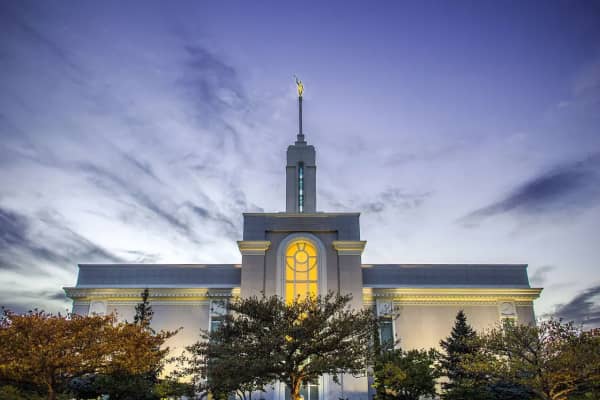
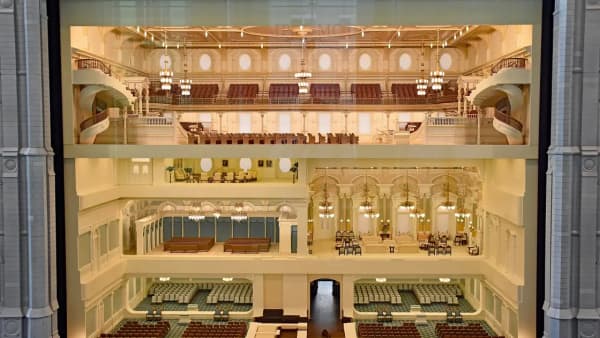
The City Center Temple is a rebuilt temple inside the surviving shell of the Provo Tabernacle, a nineteenth-century meetinghouse that burned in 2010. The exterior walls survived the fire; the interior did not. Rather than demolish the shell, the church rebuilt behind and beneath it, excavating a new basement level and constructing a temple within the historic exterior.
That history is the reason the building reads as a nineteenth-century civic structure rather than a twentieth-century temple, and it is the reason it sits on a downtown block rather than on a hill. Our guide to the Provo Tabernacle fire and what followed covers the fire and the decision in full.
Who can go where
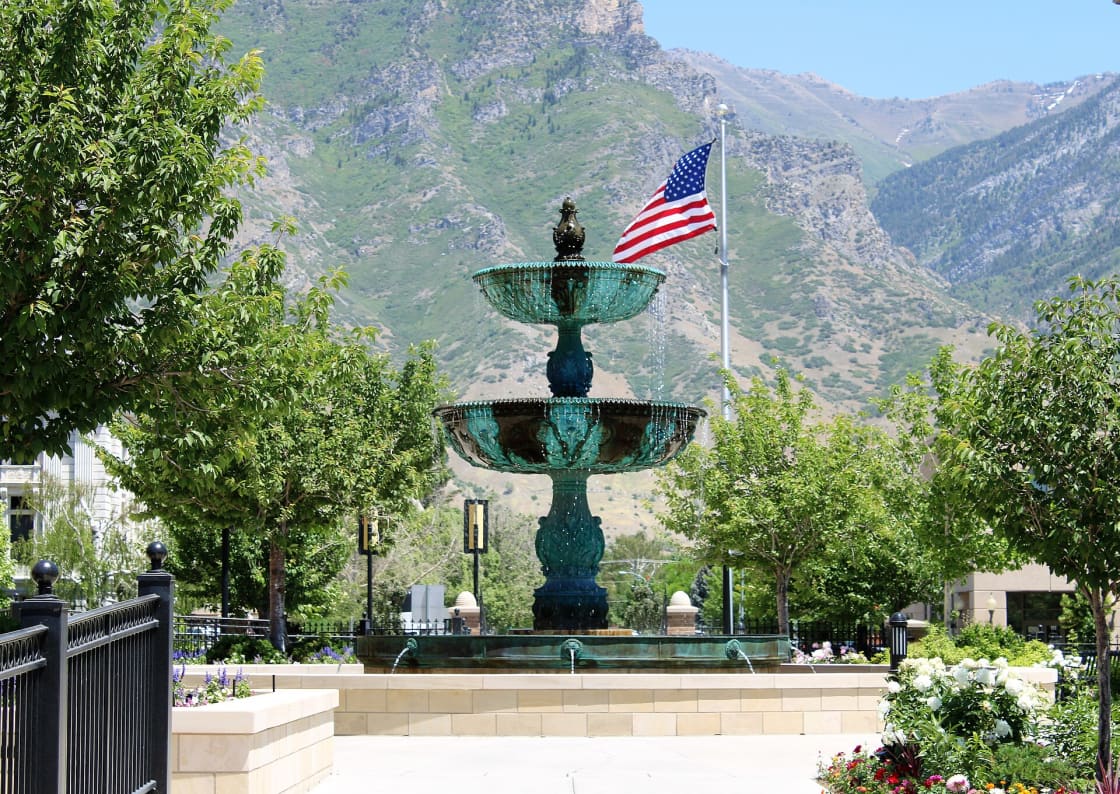
The grounds are open to everyone. This is worth saying clearly, because people assume otherwise. The landscaped block is public space in practice — you can walk it, sit on it, photograph it and bring children onto it without being a member of anything, and nobody will ask you what you believe.
The interior is not open to the public. A dedicated temple is open to members of the church holding a current recommend. This is not a crowd-control measure or a fee; it is how temples work, and it applies equally to a member without a current recommend.
The single exception is an open house, which runs for several weeks before a temple is dedicated and is open to anyone. The City Center Temple's open house was in 2016 and is over. The next opportunity of that kind in Provo will be at the Rock Canyon temple.
The grounds, practically
It is a downtown site, and that changes the visit in ways a suburban temple does not.
- It is walkable from the rest of downtown. Center Street, the library at Academy Square and the restaurants are all within a short walk, which makes the grounds an easy addition to a downtown afternoon rather than a separate trip.
- The block is small. Unlike a temple on acreage, you can walk the whole perimeter in a few minutes. Plan a stop, not an afternoon.
- It is busiest around weddings. Saturday mornings in particular. This is worth knowing whether you want to see that or avoid it.
- The lighting is good at dusk, which is why it appears in so many local photographers' portfolios.
Parking
There is parking associated with the temple block, and the rest of downtown Provo's street and lot parking surrounds it. On an ordinary weekday this is a non-issue. On a Saturday with a wedding, a downtown event or a Center Street festival it is tighter than people expect, because you are competing with downtown rather than with other temple visitors. Couples planning a sealing here will find the closest garages and the 2027 closure weeks in getting sealed at the Provo City Center Temple.
Read the current signage rather than relying on what you remember. Downtown Provo parking rules and enforcement have changed more than once, and our guide to downtown Provo parking covers how the different zones work.
The Rock Canyon site
What is there now
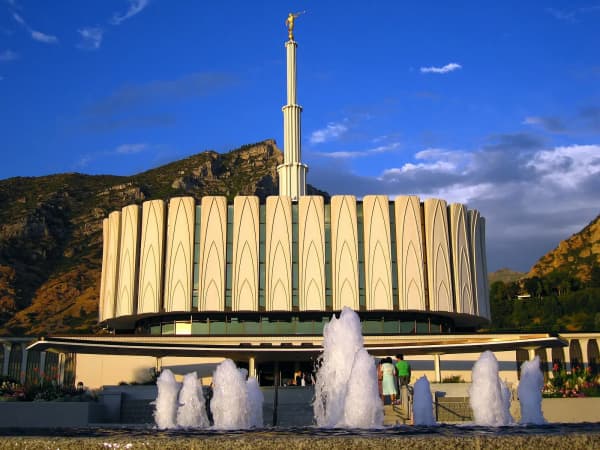
Not a temple. The Provo Utah Temple, dedicated in 1972 and one of the most architecturally distinctive buildings the church has built, closed on February 24, 2024 and was demolished. A replacement is under construction on the same site and will be known as the Provo Utah Rock Canyon Temple, taking its name from the canyon behind it rather than from the city.
This matters for visitors in a simple way: there is nothing to visit there at the moment. It is an active construction site, not a set of open grounds, and turning up expecting the landscaped lawns people remember produces a wasted trip.
What the timeline looks like
As with other new temples, a public open house will come before the dedication. Check the church's temple pages for the current schedule.
Treat that as provisional and do not plan around it. The church announces open house and dedication dates only when completion is close, and construction timelines for buildings of this kind move routinely. If you want to attend the open house — and if you are not a member, it will be your only chance to see inside — the thing to do is watch for the announcement rather than work backward from an estimate.
Why the rename fixes a real problem
For eight years Provo had the Provo Utah Temple on the east bench and the Provo City Center Temple downtown, on opposite sides of town, and the two names were close enough that people booked the wrong one, drove to the wrong one, and gave each other directions to the wrong one constantly. Naming the rebuilt temple for Rock Canyon ends that. It is a small thing that will quietly save a great many wrong turns.
How temple closures work
Closures are the part visitors misunderstand most, because they assume a temple operates like a church building with a Sunday schedule. It does not. Every Utah Valley temple's closure weeks for late 2026 and 2027 are in our weekly temple habit guide.
There is a regular weekly closed day. Temples are not open every day, and the closed day is not the same as the day a meetinghouse is busiest.
There are scheduled maintenance closures. Temples close periodically for cleaning and maintenance, typically for a defined period, and these are published in advance.
There are holiday closures, which follow their own pattern and are not identical to ordinary business holidays.
And there are renovation closures, which are a different order of thing entirely — months or years, with the building fully out of service. The 1972 Provo temple's closure was the most extreme version: a closure that ended in demolition.
Where to check. The church publishes schedules and closure notices on its own temple pages, per temple. That is the only source worth using. A schedule in a blog post, in a forum answer, or in an article like this one is a snapshot of a moment, and temple schedules do not hold still.
If you are visiting and you are not a member
The most common question we get is some version of am I allowed to be here, and the answer is yes.
Nobody will approach you. There is no greeter, no tour, no desk and no interpretive center. Temple grounds are not run as a visitor attraction, which is precisely why they are pleasant to walk.
There is no dress code on the grounds. People arriving for ordinances are dressed formally, which creates an impression that visitors must be. They do not.
Photography on the grounds is normal. Inside is not permitted, but the exterior and grounds are photographed constantly, including professionally.
The one real courtesy is to remember what the building is for. People arriving are frequently there for a wedding, a family occasion or something personally significant, and a photo session on the lawn yields to a wedding party coming out of the doors. That is the whole of the etiquette.
Our guide to visiting a church in Provo covers the equivalent questions for ordinary meetinghouses, which are a different thing and are open on Sundays to anyone who walks in.
Getting there without a car
The City Center Temple is one of the easier destinations in Utah Valley to reach without driving, which is unusual for a temple and is entirely a function of the downtown location.
By bus. UVX runs the spine between Provo and Orem and serves downtown Provo, which puts the temple block within a short walk of a stop. Our UVX guide covers the route, the frequency and how fares work. For a student without a car this is the simplest way to see the building.
On foot from downtown. If you are already on Center Street you are a few minutes away. This is the main practical difference between the two Provo temple sites: one is embedded in a walkable downtown, the other sits on the bench where a car is effectively required.
The Rock Canyon site is a different proposition. It is up on the east bench, on residential streets, and it is a drive. When the new temple opens, that will be the case for it too — worth knowing in advance if you are planning around an open house, because open houses draw crowds and bench parking is residential.
The weekly rhythm, and when to go
Temple grounds have a pattern, and matching your visit to it decides what kind of visit you get.
Saturday mornings are the busiest and the most interesting. Weddings cluster there, which means the block is full of families in formal dress, photographers working the lawns, and cars coming and going. If you want to see the building as a living place rather than an object, this is when. If you want quiet, this is exactly when not to.
Weekday mornings are the quietest. The grounds are close to empty and you can walk the whole perimeter without meeting anyone.
Evenings are the best light. The exterior is lit after dark, and the stone of the old tabernacle shell reads far better in low, warm light than in flat midday sun. In winter, when dusk arrives mid-afternoon, that window is easy to catch.
Sundays are not the answer. People assume Sunday is the day for anything church-related in Utah. Temples run on their own schedule and a meetinghouse is the Sunday building, not a temple. The grounds remain walkable, but the assumption that Sunday is when things happen here is backwards.
December, and the thing people come downtown for
Downtown Provo does a genuine Christmas season, and the temple block sits in the middle of it. The combination of the lit exterior, the surrounding downtown lights and the short walk between them makes a December evening the single most popular time of year to see the building, and the most photographed.
If you are planning that visit, our guide to Christmas in Provo covers what else is running downtown in the same window, which is the difference between a ten-minute stop and an evening out.
What the rebuild means for the east bench
For residents rather than visitors, the Rock Canyon site has been a construction project in a residential area for years, and it will be a temple with the traffic a temple brings afterwards.
Two things are worth setting expectations about. An open house is a large event — they run for weeks and draw tens of thousands of people, with shuttle and parking arrangements set up specifically for them. When the announcement comes, the parking plan will come with it, and following it matters more on a bench street than it would on an arterial.
And after dedication the pattern settles down to what the old temple generated for fifty years: steady, predictable, heaviest on Saturdays. The neighborhood has lived next to a temple before and will again; the unusual period is the one we are in now.
Making a visit worth the trip
The City Center Temple is a ten-minute stop on its own. Two ways to make it a better outing:
Pair it with downtown. The temple block, the Provo City Library at Academy Square and Center Street are all within a short walk of each other, and together they are the most architecturally interesting few blocks in the county.
Go at dusk in winter. The building is lit, the shell's stonework reads better in low light than in midday sun, and downtown is quiet. It is the version of the visit most people who live here would recommend.
The wrong turns people make
Five mistakes that account for most of the confused arrivals, collected because they are all avoidable with one sentence of warning.
Driving to the east bench expecting a temple. The most common by a distance, and the reason this guide exists. People who last visited before February 2024, or who are working from an older map or an older article, arrive at a construction site.
Confusing the two names when booking or giving directions. "Provo Temple" and "Provo City Center Temple" were two different buildings on opposite sides of town. Until the Rock Canyon name is in common use, say downtown or the bench rather than trusting the official names to disambiguate.
Turning up on the weekly closed day. Temples are not open every day and the closed day is published. This only affects members attending, but it is the most common wasted trip among people who have business there.
Assuming a visitor center. Some temples elsewhere have one. Neither Provo site does. There is no desk to check in at, no tour to join and nobody to ask, which is fine once you know it and disorienting if you are expecting otherwise.
Planning travel around an estimated opening date. Worth repeating because the cost of getting it wrong is high: the Rock Canyon completion estimate is an estimate, and open house dates are announced close to the event. Wait for the announcement.
A note on accessibility
The City Center Temple grounds are a level downtown block with paved walkways, which makes them among the more straightforwardly accessible temple grounds in the county — a wheelchair or a stroller manages the perimeter without difficulty, and there is no significant grade.
Downtown parking is the variable rather than the grounds. Accessible spaces exist but are shared with the rest of downtown, and on a busy Saturday the nearest available space may be a block or two out. Arriving outside peak times is the practical answer.
For the building interior, accessibility provisions exist and are best confirmed directly with the temple, since arrangements vary by building and by occasion.
Related Guides
- Visiting Utah Valley's Temples: A Guide for Everyone — etiquette, the county's other temples, and what happens inside in general terms
- The New Provo Temple, Explained: The Rock Canyon Rebuild — why the 1972 building came down, and what replaces it
- The Provo Tabernacle Fire and the Temple That Followed — the 2010 fire and the decision to rebuild inside the shell
- Temple Open Houses and Dedications in Utah Valley — how the cycle works and what is coming
- Visiting a Church in Provo — meetinghouses, which are a different thing entirely
Frequently Asked Questions
Can anyone visit the Provo City Center Temple?
Where is the old Provo Temple, and can I still see it?
Why are there two temples in Provo with such similar names?
Is there parking at the Provo City Center Temple?
When will the Provo Utah Rock Canyon Temple open?
Do temples close, and how would I know?
Can I take photographs on temple grounds?
What should I know before visiting temple grounds if I am not a member?
Sources
The facts in this guide were checked against these sources. Hours, fees and rules change, so confirm anything time-sensitive with the source before you go. How we make Provo.com.
- Provo City Center Temple, The Church of Jesus Christ of Latter-day Saints. Checked October 12, 2026.
- The Provo Temple Will Reopen as the Provo Utah Rock Canyon Temple, Newsroom of The Church of Jesus Christ of Latter-day Saints. Checked October 12, 2026.
- Provo Utah Rock Canyon (temple almanac), Church News (thechurchnews.com). Checked October 12, 2026.
- Provo Tabernacle, Provo City Library. Checked October 12, 2026.