
Utah Valley has a shave ice habit that outsiders find slightly baffling. There are shacks in gravel lots, walk-up windows attached to nothing, seasonal trailers that appear in May and vanish in September, and permanent shops with fifty syrups on the wall. On a hot Friday evening in July the lines are long enough to be a social event.
What almost nobody who lives here knows is that this valley did not just adopt the format. It exported it — twice.
Two national chains, both born in Provo
Tropical Sno opened its first location in Provo, Utah in the spring of 1984. Its parent company says it then set out to help others start their own Tropical Sno locations, and it has been cited in business literature as a working example of microfranchising — the model of selling very small, very low-cost franchise units to individual operators rather than building corporate stores.
That is the mechanism that produced the shack. A microfranchise is affordable enough that a family, or a college student, or someone wanting a seasonal second income, can buy one and run it out of a trailer for a summer. Multiply that by four decades and you get a valley whose default summer business is a snow shack.
Hokulia is the second. The company's own account says it began serving in 2008 with its first shave ice shack in Provo, founded by Clint and Stefani Severson after trips to Hawaii. It later partnered with Farr's Ice Cream — a long-established Utah ice cream company — and grew to dozens of locations across multiple states, moving from seasonal shacks toward year-round in-line stores.
Two nationally franchised shave ice brands, from the same small valley, twenty-four years apart. Neither one leads with it locally, and no local guide has said so.
For context, the largest national name in the category, Bahama Buck's, started in Lubbock, Texas in 1990 — six years after Tropical Sno.
Why a dry, hot, high valley took to this
It is worth asking why a landlocked county at 4,500 feet became a shave ice capital, because the answer is not simply that summers are hot. Plenty of hot places did not do this.
Three conditions stacked.
The climate suits it. Utah Valley summers are hot and very dry, and a dry heat makes a cold, wet, low-commitment treat unusually appealing — you finish it before it defeats you, which is not true of an ice cream cone at ninety-five degrees in the sun.
The social structure rewards a cheap group outing. This is a valley of large families, student wards, youth groups and late-evening socializing, in a market where alcohol is not the default social lubricant. A cold sweet thing you can buy for a crowd, eat standing in a parking lot and finish in fifteen minutes fits that shape almost perfectly. It is the same structural niche that made soda shops a Utah phenomenon.
The microfranchise model lowered the barrier to entry to almost nothing. Tropical Sno's model, from 1984 onward, made it possible for an individual with modest capital to own a summer business. In a county with an enormous seasonal student workforce and a strong culture of small-scale entrepreneurship, that is a match, and it is why so many shacks here are run by people in their twenties.
Put those together and the format did not need to be imported and adapted. It was invented here twice and exported outward, which is the part of the story that keeps getting left out.
The actual difference between shave ice and a snow cone
This is a real distinction, not marketing, and once you know it you cannot unsee it.
A snow cone is made from ice that has been crushed or ground into hard granules. Syrup poured over granules does not stick to them; it runs down between them and collects in the bottom of the cup. That is why a bad snow cone is intensely flavored for four bites and then becomes plain ice sitting on a puddle of syrup.
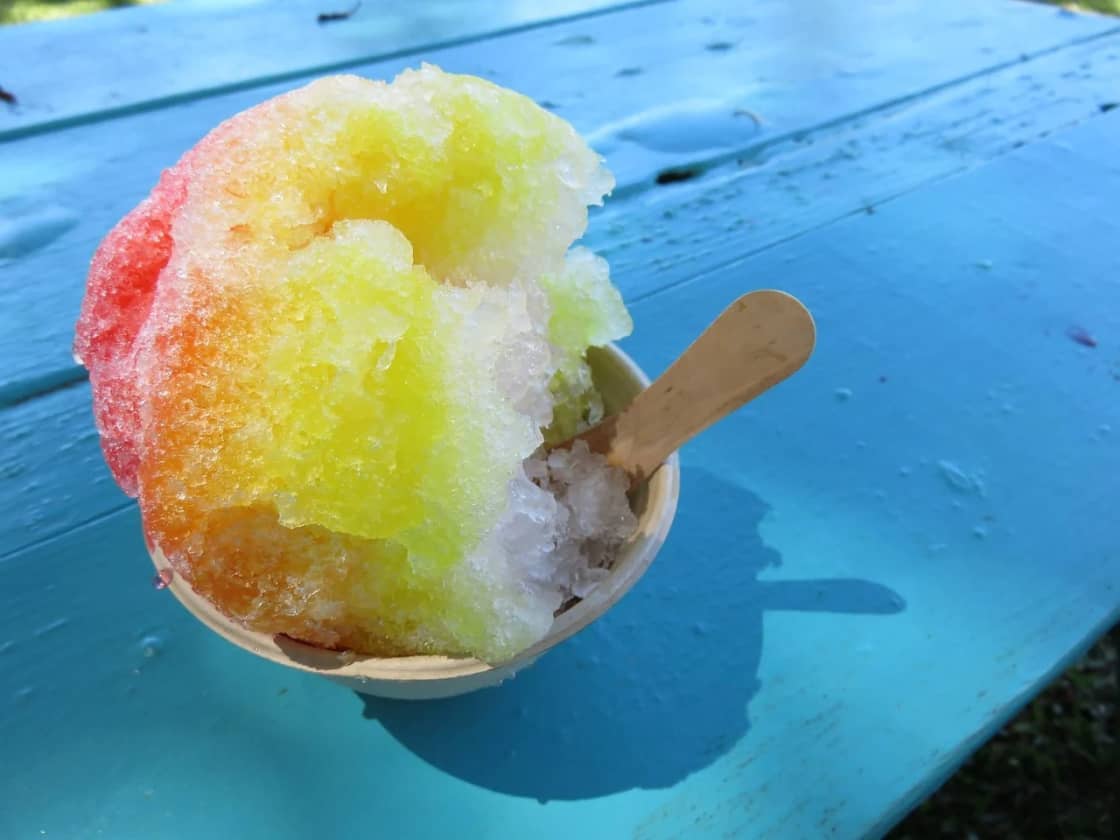
Shave ice is planed off a solid block in thin continuous sheets, producing something closer to fresh powder snow. The texture is fine enough that syrup is absorbed into it rather than draining through, so the flavor is distributed evenly and the last bite tastes like the first. The mouthfeel is closer to soft-serve than to ice.
In Hawaii the product is called shave ice, not shaved ice — the local usage drops the "d," which is why the more careful Utah shops spell it that way on the sign.
A practical caveat: Utah shops use all these words loosely, and a place calling itself a snow shack may be shaving properly while a place saying "shave ice" may not be. Judge the cup, not the sign. If the ice looks granular and the syrup is pooling, you have a snow cone regardless of what the menu says.
Where to go
Bahama Buck's — Provo. 2265 N University Pkwy. The deepest menu in the valley and by a distance the latest hours — open until eleven most nights and later on Friday and Saturday, which makes it the default after-everything-else stop. Sits close enough to campus to be a student institution. Closed Sunday.
Hokulia lists several Utah Valley locations, including 1555 Freedom Blvd in Provo, Riverwoods at 4801 N University Ave (behind the AMC theater), 450 W 1600 N and 396 State Street in Orem, plus Pleasant Grove, Highland, Cedar Hills, Saratoga Springs and Eagle Mountain. Check its locations page before driving, since shacks close for the season at different times. The house style is a scoop of Farr's ice cream buried at the bottom and a snow cap on top.
Wailoaloa Shave Ice, Acai & Summer Treats — Springville. 25 N Main Street. An independent with an unusually strong local review record, run by a young couple, and worth the drive south if you are anywhere near Springville. The menu runs past shave ice into acai bowls and shaved ice cream, which is a different product again — a Korean-style bingsu approach where the block being shaved is dairy rather than water.
Utah Snow — Orem. 495 N State Street. Small, seasonal, and differentiated: the owner grew up in Hawaii, orders flavors from there, and uses equipment chosen to produce the fine shaving that defines the style. Limited hours, longest on Friday and Saturday.
Hawaiian Ice operates out of Orem as a catering and events business rather than a walk-up — mobile shacks for weddings, ward parties, graduations and corporate events, with a strong reputation locally for the reliability side of catering rather than just the product.
Fluffy and Sweet, inside the Asian market at 266 N State Street in Orem, is adjacent rather than identical — bubble waffles, boba and shaved-milk desserts — and worth knowing about if the bingsu style is what you want.
Nobody opens on Sunday
Every location above lists Sunday as closed. The independents, the franchises, the catering operation — all of them.
This is unremarkable if you grew up here and disorienting if you did not, and it has a knock-on effect on the rest of the week. Because Sunday is unavailable, Friday and Saturday evenings absorb the demand, and those are the hours when a twenty-minute wait is normal at the busier locations.
The counter-move is simple. A weekday afternoon — say four or five o'clock on a Tuesday in July — is a completely different experience at the same shop. Same product, no line, and the staff have time to build it properly, which affects the result.
Why the shacks are seasonal, and why that is partly regulatory
The obvious answer is demand. The less obvious answer is that Utah County's environmental health program treats shaved ice operations as their own regulatory category, with guidelines distinct from a general food establishment — something our food permits and inspections guide covers from the operator's side, including why the category exists at all.
The relevant consequence for a customer is structural. A seasonal shack carries a much lower regulatory and capital burden than a year-round kitchen: less equipment, a narrower menu, simpler plumbing requirements, and a permit scoped to what it does. That is precisely what makes the format viable for a small operator, and it is why the valley fills with trailers in May and empties in September.
It also explains the drift you can observe over the last decade. As brands matured, they moved from seasonal shacks toward permanent in-line stores with expanded menus — because a shack cannot generate winter revenue, and a store that also sells ice cream, smoothies and hot drinks can.
What the syrup is made of, and why it varies
The gap between a good shave ice and a mediocre one is usually not the ice. It is the syrup, and syrup quality varies more than any other input in the category.
The cheap end is high-fructose corn syrup, water, citric acid and artificial flavor. It is intensely sweet, thin, and tastes broadly the same across flavors once you get past the first note — which is why so many people remember shave ice as "just sugar."
The better end uses cane sugar and, in the Hawaiian-style shops, syrups sourced from Hawaii rather than mixed from a national foodservice catalog. Some shops advertise this explicitly; Hokulia has historically marketed pure cane sugar and imported flavors, and Utah Snow's proposition is essentially that the owner orders from home. A few operators here make syrups in house or use real fruit purees for a subset of flavors, which is immediately obvious in anything citrus or berry.
Two things follow for a customer. A shop that will tell you what its syrup is, is usually a shop worth trusting — the ones using the cheap stuff do not volunteer it. And sugar-free options exist at several shops but are generally the weakest products on the menu, because the sweetener carries the body of the syrup as well as the sweetness. If someone in the group needs one, set expectations accordingly.
There is a texture consequence too. A thicker cane syrup clings to fine shaved ice; a thin syrup runs through it regardless of how well the ice was shaved. So a shop with a good machine and bad syrup still produces a puddle, which is why judging the machine alone is not enough.
Making it at home, honestly
Every summer somebody in this valley buys a home shave ice machine, and the results are usually disappointing for a reason worth understanding.
The domestic machines mostly crush rather than plane. Producing genuine shave ice requires a rotating blade set against a solid frozen block with the blade depth adjusted to shave microns rather than chips, and the machines that do it properly are commercial, heavy and expensive. That is not a snobbish observation; it is the entire product difference.
If you are doing it at home anyway, two adjustments help more than the machine choice. Freeze your block slowly and use it slightly tempered — ice straight out of a deep freeze at its coldest shatters into granules rather than shaving cleanly, so letting a block sit out for a few minutes before shaving improves the texture. And make your syrup thicker than seems right, because a thin syrup will sink through anything you produce at home.
For a party, the honest answer is usually to hire one of the local catering operators rather than to fight the equipment. It is cheaper than the machine and the result is not close.
How to order well
Ask for less syrup than you think. The commonest complaint about shave ice anywhere is that it is cloying. A shop that shaves properly needs less syrup, not more, because the ice holds what it is given.
Two or three flavors is the sweet spot. Four starts tasting like all of them at once. Tiger's blood — usually strawberry, watermelon and coconut — is the standard house blend across the category and a reasonable baseline for judging a shop.
Snow cap is the add-on to try first. Sweetened condensed milk over the top rounds off the acidity of fruit syrups and is close to standard at Hawaiian-style shops.
Ice cream in the bottom is the Utah signature and is good, but it changes the product into a dessert rather than a refreshment. Decide which one you want before you order.
Ask about add-on pricing up front. Toppings are frequently charged individually here, and reviewers comment on it constantly. Some shops build add-ons into a higher base price instead, which for a family of four can work out substantially cheaper. Compare loaded prices, not base prices.
Take the extra bowl if it is offered. Several local shops hand you a second bowl underneath to catch overflow, and the ones that do are telling you something about how much they pile on.
Catering, which is a real local industry
Shave ice catering is a well-established business in this valley for a reason that becomes obvious at any July reception: it is one of the cheaper frozen-dessert options, it scales to very large groups, and unlike ice cream it survives an outdoor table in ninety-degree heat.
Operators here serve wedding receptions, ward parties, graduations, school functions and corporate events, with some handling groups in the thousands. If you are planning a summer event, book early — June through August is simultaneously peak wedding season and peak demand, and the good operators fill up.
Our wedding budget guide puts dessert catering in context against the rest of a reception, and the wedding vendors section covers the broader supplier picture.
The seasonal calendar
April and May — shacks reopen, hours are erratic, and social media is more reliable than a posted schedule.
June through August — full season, long evening lines Friday and Saturday, catering booked solid.
September — the shacks close, usually quietly and often around Labor Day, while the permanent stores continue.
October through March — brick-and-mortar only, reduced menus in some cases, and a pleasant time to visit if you do not mind eating shave ice in a coat.
Confirm hours before driving in the shoulder months. A seasonal operator's posted hours are the least reliable data on the internet in late April and late September.
The short version
Shave ice is planed off a block and holds its syrup; a snow cone is crushed and does not. Tropical Sno was founded in Provo in 1984 and Hokulia's first shack opened in Provo in 2008, which makes this valley a genuine origin point for the category rather than just a market for it. Bahama Buck's on University Parkway runs the latest hours, Wailoaloa in Springville is the standout independent, and Utah Snow in Orem is the most deliberately Hawaiian. Everything is closed on Sunday, which pushes the crowds into Friday and Saturday evening and leaves weekday afternoons wide open. Ask for less syrup, try the snow cap, and compare shops on the loaded price.
Shaved ice does not deliver, and here is why
This is the one category on this site where the honest answer is: do not. Shaved ice is ice and syrup assembled seconds before it is handed over; ten minutes in a car turns a cup of it into a cup of flavored water, and no packaging changes that. The texture is the product. Most snow shacks are not on the platforms at all, which is less an oversight than a correct read of their own product. They are seasonal walk-up and drive-up windows, frequently cash-friendly, staffed by teenagers, and built around the assumption that you eat it standing there. Treat the list on this page as a map of places to drive to. That is what a snow shack is for, and on a July evening the drive is part of it.
Related Guides
- Best ice cream in Provo and Orem
- Soda shops in Provo
- Best desserts and bakeries in Provo and Orem
- Food permits and inspections in Utah County
- Summer activities in Provo
- Best food trucks in Provo
Frequently Asked Questions
What is the difference between shave ice and a snow cone?
Which shave ice chains started in Utah County?
Where should I go in Provo or Orem?
Why are so many of these places seasonal?
Are any of them open on Sunday?
What does 'snow cap' or 'ice cream in the bottom' mean?
Is shave ice expensive here?
Can you get shave ice catering for an event?
Sources
The facts in this guide were checked against these sources. Hours, fees and rules change, so confirm anything time-sensitive with the source before you go. How we make Provo.com.
- Our Story - Tropical Sno, Tropical Sno / Pioneer Family Brands. Checked October 12, 2026.
- Our Story - Hokulia Shave Ice, Hokulia Shave Ice. Checked October 12, 2026.
- Locations - Hokulia Shave Ice, Hokulia Shave Ice. Checked October 12, 2026.
- About Us | Bahama Buck's, Bahama Buck's. Checked October 12, 2026.