
Most states pick a bird, a flower and a tree and stop. Utah kept going. Somewhere in the list of official state symbols, between the crustacean and the demonym, sits a line that stops out-of-state readers cold: Utah has an official state cooking pot.
It is the Dutch oven. That is not a tourism-board slogan or a bit of local color that got repeated until people believed it. It is in the code, in the same section as the elk and the sego lily, and it is one of the more revealing things the state has ever put in statute — because you do not name an official cooking vessel unless the cooking itself is load-bearing for how a place understands itself.
This guide covers what the statute says, why this state and not another, how the pot works well enough that you could cook in one this weekend, and where in Utah Valley to learn it from people who take it seriously enough to compete.
The Short Answer
Utah Code section 63G-1-601 — the state symbols section — states that Utah's state cooking pot is the dutch oven. We verified it against the legislature's own published text rather than a secondary source, and it is worth noting that the subsection number has moved over the years as the legislature added symbols. In older versions it is subsection (6); in the current text it is (7). Cite the section, not the subsection, if you want the citation to survive.
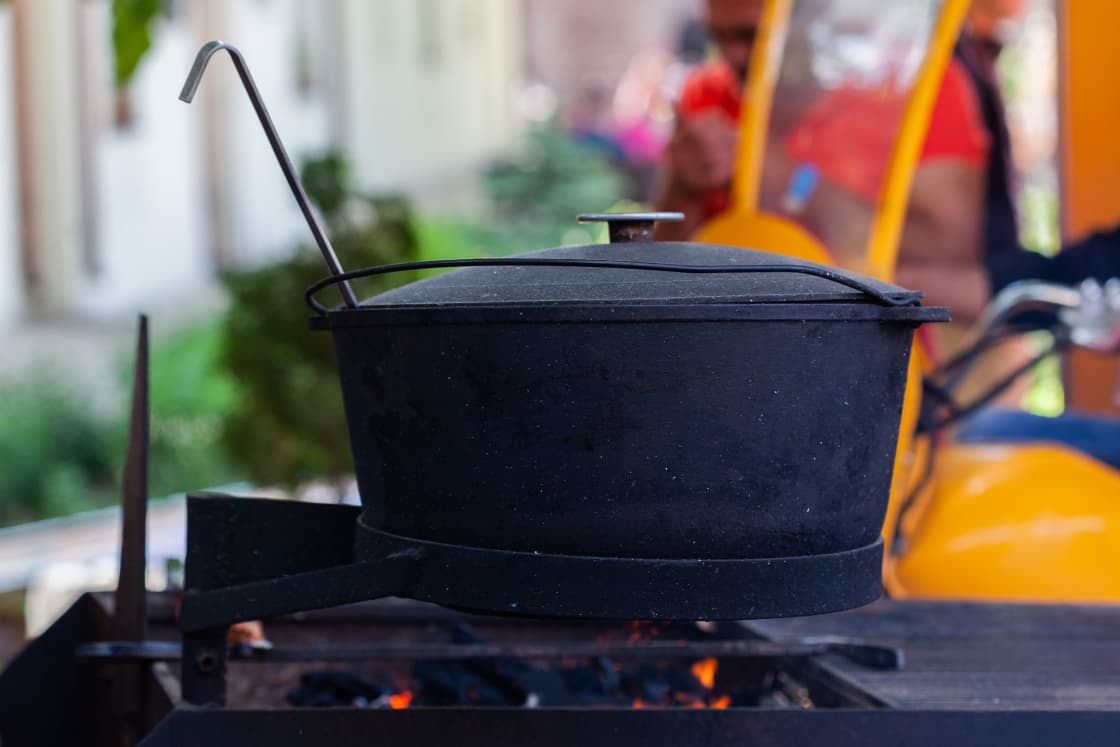
A camp Dutch oven is a lidded cast-iron pot with three legs and a flat, rimmed lid, designed to sit over coals with more coals banked on top. That top-and-bottom arrangement is the whole trick: it turns a pot into an oven.
To learn it, go to a cook-off and talk to people. The competitive Dutch-oven world in Utah is unusually generous with technique, and Utah Valley city celebrations put cook-offs on where standing and watching is free.
What the Statute Says, and What It Does Not
The state symbols section is a long list, and reading it is a small education in what Utah has decided to be official about. The animal is the elk. The bird is the sea gull. The emblem is the beehive. The fish is the Bonneville cutthroat trout. The flower is the sego lily. The dinosaur is the Utahraptor. The crustacean is the brine shrimp. The folk dance is the square dance. The demonym is "Utahn," which is an unusual thing to legislate.
And the cooking pot is the Dutch oven.
What the statute does not do is define the pot, specify a style, or confer any legal effect. It is a designation, and designations in this section are declarations of identity rather than regulation. Nothing about the line requires anyone to own one or restricts what may be called one.
That is worth saying plainly because the symbol occasionally gets cited as though it carried weight it does not. What it carries is signal. A legislature that names a cooking pot is telling you something about the constituency that asked for it.
Why Utah
The honest answer has three strands, and the tradition is older and more durable than the statute that ratified it.
The pioneer strand. Utah's founding story is an overland migration, and the cast-iron pot that could bake bread in a camp with no oven was standard equipment for exactly that kind of travel. The Dutch oven is not uniquely Utahn — it traveled every American frontier — but Utah is unusual in having built a continuous public heritage culture around its own migration, with reenactments, trek programs and pioneer-day celebrations that keep the equipment in circulation rather than in museums. A pot that would be a historical artifact elsewhere is, here, something people still cook dinner in on purpose.
The Scouting and youth-camp strand. For most of a century, an enormous share of Utah boys learned outdoor cooking through Scouting, and Dutch-oven cooking was core curriculum. That produced generations of adults who can do it without thinking, and — crucially — who own the equipment. The institutional arrangements have changed considerably in recent years, but the skills and the pots stayed in the households.
The group-meal strand. This is the one outsiders miss and it may be the most important. Utah households are large, congregations organize meals constantly, extended families gather at scale, and "how do we feed forty people outdoors" is a routine problem here rather than a catering emergency. A Dutch oven is an exceptionally good answer to that problem: several pots running in parallel over a coal bed will feed a crowd with no kitchen, no power and no rented equipment. The pot persists because it solves a problem this culture has.
The statute came after all of that. It did not invent a tradition; it noticed one.
How the Pot Actually Works
If the only cast iron you own is a skillet, the camp Dutch oven is a different instrument and the differences are functional rather than cosmetic.
The legs. Three short legs hold the pot above the coal bed so air circulates and the bottom does not scorch. This is why a camp oven does not sit flat on a stovetop and why using one indoors is awkward.
The lid. Flat, with a raised rim. That rim is a wall that keeps coals from sliding off. A domed lid — the kind on a kitchen Dutch oven — cannot hold coals, which is why the two styles are not interchangeable despite sharing a name.
The bail handle. The wire loop lets you lift a heavy pot with a hook without putting your hands near the coals. A lid lifter, the hooked tool you will see in every serious kit, does the same job for the lid, and lets you lift it level so ash does not slide into the food.
Top and bottom heat. This is the entire concept. Coals underneath give you bottom heat; coals on the lid give you top heat. Vary the ratio and you change what the pot does. Mostly-bottom is a stew or a braise. Mostly-top browns a cobbler or a bread crust. Balanced is a general-purpose oven.
Stacking. Because the lid is flat, ovens stack. Three pots in a tower share one coal bed and cook three dishes at once, and that is how a small crew cooks for a crowd.
The Coal Math
The single thing that separates people who cook in a Dutch oven from people who guess at one is counting coals.
The widely used starting rule: take the oven's diameter in inches, then use that number plus three coals on the lid and that number minus three underneath. A twelve-inch oven gets fifteen on top and nine below. That gives you roughly a moderate baking temperature, in the range where most recipes written for a home oven will behave.
From there you adjust by what you are cooking. More on the bottom for simmering, stewing, frying, anything where you want the pot to act like a pan. More on top for baking, roasting and anything that should brown on its surface. A cobbler wants the heat above it; a chili does not.
Three Utah-specific corrections matter.
Altitude. Most of the state cooks well above sea level, and Utah Valley sits high enough that water boils below the temperature recipes assume. Baked goods rise faster and dry out sooner. Expect to shorten times and add liquid rather than to follow a sea-level recipe literally.
Wind. Wind strips heat off the pot and burns your coals down fast. A windbreak is worth more than extra briquettes. Canyon sites in particular move air all evening.
Cold. Coals fade quicker in cold weather and the pot loses heat to the ground. Plan on refreshing the bed for anything running long, and start a second batch of coals before you need them rather than after.
And rotate. A quarter turn of the pot, and a quarter turn of the lid in the opposite direction, every fifteen minutes or so evens out hot spots from an uneven coal bed. It is the most reliably useful habit in the discipline and the one beginners skip.
Where to Learn, in and Around Utah Valley
The good news is that this is one of the least gatekept hobbies you will encounter.
The society and its cook-offs
The International Dutch Oven Society is the organizing body, it is headquartered in this state, and it runs the competitive structure — sanctioned cook-offs feeding into championship events that have been held at venues around Utah over the years, from expo centers on the Wasatch Front to historical farms in Cache Valley. It also runs conventions with free demonstrations, classes and vendors, historically at fairgrounds north of here, alongside informal gatherings that members call a DOG — a Dutch Oven Gathering, which is essentially a potluck where everyone brings a pot.
Venues, dates and the shape of the calendar have moved repeatedly over the years, so check the society directly rather than relying on any published list, this one included.
One competitor, quoted in a local paper, called this state a mecca for Dutch-oven cooking, and the claim is hard to argue with given where the championship events keep landing.
The Utah Valley connection
The valley has its own history in this. A world champion from Saratoga Springs got into the sport after watching a cook-off at a park in American Fork during Steel Days, discovered she needed a society membership before she could enter, joined, and went on to win at the highest level. That is a fairly exact map of the on-ramp: watch a local cook-off, talk to competitors, join, compete.
Steel Days in American Fork and Salem Days in Salem both have cook-off traditions, and the Salem event is closely enough identified with Dutch ovens that it is part of how the celebration is described. Our guides to Steel Days in American Fork and Salem Days cover the wider programs.
The competitive culture is the opposite of guarded. Competitors describe it explicitly as unlike barbecue, where technique is protected — here people teach novices on the spot and hand over recipes. If you turn up at a cook-off with genuine questions you will not be short of answers.
Classes
Community education programs in the valley periodically run camp-cooking and outdoor-cooking courses, and university continuing-education catalogs on the Wasatch Front have carried camp-cooking classes that include Dutch-oven technique. Offerings rotate by term, so check the current catalog rather than assuming. Our guide to community education in Utah Valley covers where those catalogs live. Other cooking classes are listed in cooking classes in Utah Valley.
Outdoor retailers and scouting groups also run periodic demonstrations, particularly in spring as camping season opens.
Buying Your First Pot
Size. A twelve-inch oven is the standard first purchase and the size most recipes are written for. It feeds roughly six to ten depending on the dish. A ten-inch is better for two to four and for a first attempt at something small. Fourteen-inch and up are crowd equipment and heavy enough to be a genuine two-person lift when full.
Deep or shallow. Standard depth is the general answer. Deep ovens are for large quantities of liquid — stews, chili, beans. Shallow suits baking.
Legs, always, if you intend to cook over coals. A flat-bottomed pot sold as a Dutch oven is a kitchen pot.
New or used. Cast iron is close to immortal and secondhand is a good option. Utah's thrift stores, estate sales and yard sales turn up Dutch ovens regularly precisely because so many households have one. Rust is cosmetic and fixable. A crack, a warped lid or a wobble on a flat surface are not, and those are the things to check before handing over money. Our guide to yard-sale season in Utah Valley covers the circuit.
The accessories that matter, in order: a lid lifter, heavy leather gloves, long tongs for moving coals, and a trivet or lid stand so the hot lid has somewhere to go. A chimney starter for the coals is close behind.
Care, Which Is Simpler Than the Internet Suggests
Season it, use it, dry it, oil it. That is most of the discipline.
Washing. Hot water and a brush or a chain-mail scrubber. Avoid harsh detergent and long soaking. A little mild soap will not destroy a well-seasoned pot, despite what you will be told with great confidence.
Drying. Immediately and completely, with heat if possible. Water left standing in cast iron is the only real enemy.
Oiling. A very thin film of oil over the whole pot, inside and out, while it is still warm. Thin is the operative word — a heavy coat goes sticky and gummy rather than curing.
Storage. Lid slightly ajar, with a folded paper towel between pot and lid to hold the gap and absorb moisture. A pot stored sealed and damp is how people ruin them.
Rust. Not a catastrophe. Scour it back, re-season, keep cooking. Cast iron is one of the few tools that forgives neglect.
Fire Restrictions, Which Bind This Hobby
A practical constraint worth building into any plan.
Charcoal briquettes are generally treated as an open fire under Utah's fire restriction framework, which means that in a dry summer a Dutch-oven meal can be prohibited on land where you had assumed it would be fine. Restrictions tighten and loosen through the season, they differ between federal, state and county land, and in bad years they reach developed campgrounds and picnic areas rather than only dispersed sites.
Check the current restrictions for the specific ground you will be on, on the day. Our guides to camping near Provo and dispersed camping near Provo cover where the land-management boundaries fall, which is what determines whose restrictions apply.
The workaround in a restricted year is a propane-fired Dutch-oven table, which some competitors use anyway for consistency. It is not the same experience, and it is often still legal when coals are not.
The Short Version
Utah's state cooking pot is the Dutch oven, by statute, in the state symbols section of the code alongside the elk and the sego lily. The designation carries no legal effect and plenty of signal: it ratified a tradition built out of pioneer heritage, decades of Scouting, and a culture in which feeding forty people outdoors is an ordinary Saturday problem.
The pot itself is simple once you see it as an oven rather than a pot: legs to lift it off the coals, a flat rimmed lid to hold coals on top, and a coal count — diameter plus three above, diameter minus three below — that gets you to a usable baking temperature. Adjust for Utah's altitude, wind and cold, and rotate pot and lid against each other every quarter hour.
To learn it, go and watch. The competitive scene in this state is headquartered here, it runs free classes, and by the testimony of its own members it hands out its secrets rather than guarding them. A cook-off at a summer city celebration in Utah Valley costs nothing to attend and is the single best on-ramp available.
Related Guides
- Salem Days and the Dutch-Oven Cook-off
- Steel Days in American Fork
- Camping Near Provo
- Dispersed Camping Near Provo
- Community Education in Utah Valley
Frequently Asked Questions
Is the Dutch oven really Utah's state cooking pot?
What is the difference between a camp Dutch oven and a kitchen one?
How many coals do I need?
Where can I learn Dutch-oven cooking in Utah?
Do I need to be in a club to compete?
Why does everyone in Utah seem to own one?
How do I season and care for cast iron?
Can I use one during a fire restriction?
Sources
The facts in this guide were checked against these sources. Hours, fees and rules change, so confirm anything time-sensitive with the source before you go. How we make Provo.com.
- Utah Code 63G-1-601 State symbols, Utah Legislature. Checked October 12, 2026.